Showing posts with label Glenda Farrell. Show all posts

Monday, October 7, 2019

Aline Pumps Gas

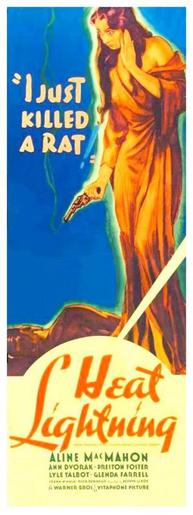
Sisters Myra (Ann Dvorak) and Olga (Aline MacMahon) run a gas station/diner/motel deep in the desert of the American Southwest. Isolated from the rest of the world (except for the customers who are always heading somewhere else), Olga is protective of her younger sister.  She forbids her from socializing with men, especially Steve Laird (Theodore Newton), much to Myrna's fury. Olga's life is disrupted by the arrival of George (Preston Foster), a man who was once Olga's lover. Our film this week is Heat Lightning (1934).

Aline MacMahon is always remarkable, and this film is no exception. When we meet Olga, her face is closed. She interacts with strangers on a business level only. She is not unfriendly, but distant and cautious. With the arrival of George (who Olga - and only Olga - calls Jerry), Ms. MacMahon changes her whole demeanor. The suspicion begins to slowly melt into affection, and finally into the hope for a resumption of their earlier relationship. Some of this is accomplished with costuming, as Olga literally lets down her lush hair (George had commented on the beauty of her thick, long hair), but most accomplished with Ms. MacMahon's eyes and posture. This was the first picture in which she received star billing, and she makes the most of it.

Ann Dvorak's part is relatively small, but the last scenes in which she appears are very strong and truly heartbreaking. Myra's early rebellion and the results that revolt make it appear that the sisters will end up very much alike. The emptiness in Ms. Dvorak's face tell us the future of Myra far better than words could.
We're not used to seeing Lyle Talbot (Jeff) play a weakling, but he does here. By the end, he develops a small amount of backbone, but primarily he is under the thumb of the domineering - and nasty - George. We previously discussed his impressive film career when we viewed A Lost Lady, but this was a new side to a decidedly versatile, and underrated, actor.

Frank McHugh (Frank) is also playing a somewhat different part from his usual sidekick roles. He's a chauffeur to Mrs. Feathers Tifton (Glenda Farrell) and Mrs. Tinkle Ashton-Ashley (Ruth Donnelly), two new divorcees, on their way home (with LOTS of expensive jewelry) from Reno. Surprisingly, Mr. McHugh is also the current object of both their affections! Mr. McHugh is amusing and effective with relatively little screen time. But seeing him as an object of lust does take some getting used to.

As is often the case, Glenda Farrell doesn't get enough to do, though her interplay with Ruth Donnelly is especially fun. They are a good combination; in the end, Ms. Donnelly gets the better lines and the stronger part. 
The script is intriguing, in that the backstory is supplied in tiny spoonfuls - you get just enough to understand Olga, and no more. It's script writing by insinuation, and is effective. You keep watching the movie to find out more, as you are given just a tad more information about Olga's life in the city. While several of the characters seem extraneous  - the girls who arrive with "Popsy" (Harry C. Bradley), for example - it's evident by the end of the story that each of these visitors is telling us more about Olga and her decision to live in the desert. 

As you can see, it's an amazing group of character actors - Jane Darwell also appears in the opening scene as Gladys, wife to henpecked husband Herbert (Edgar Kennedy), a couple motoring through the desert with a really unreliable jalopy. It's another humorous interlude, but fascinating as well - Olga is a skilled mechanic, better than most men - even in the precode era, it's not usual to see a woman who is skilled at a trade. 
The story was based on the play, Heat Lightning which was on Broadway for a month in 1933. and starred Jean Dixon as Olga. In 1941, there was remake (of course, drastically altered. The remake was, after all, well within the code) as Highway West (1941) (AFI catalog).  Reviewer Mordaunt Hall of the New York Times was not enthusiastic about the film in his review, but did like Ms. MacMahon, saying "she gives a believable performance the rĂ´le is not well suited to her". We disagree; there is not a part written which Ms. MacMahon cannot in some way make suit herself.

Released in March of 1934 (just 4 months before the Code began to be strongly enforced), the picture has not been widely circulated since then, as it was on the Legion of Decency's Banned List (TCM article). We think that it's a shame it - and its star - are not better known, and really recommend a viewing. Here's a trailer to get you started:

Monday, July 8, 2019

Dolores Dances

Magazine editor Larry MacArthur (Pat O'Brien) is in way over his head. He's somehow become engaged to golddigger Clara (Glenda Farrell), he's frequently drunk, and he is making up theatre reviews because he's too drunk to remember what he saw (if he even sobered up enough to the show). His associate editor and friend, Harold Brandon (Edward Everett Horton) decides the only recourse is to pack Larry up while he's drunk, and take him on a month's vacation to Agua Caliente, Mexico. While  In Caliente (1935), Larry become smitten with Rita Gomez (Dolores Del Rio), a dancer of whom Larry (while intoxicated) gave a blistering review in the magazine.

The AFI Silver Theatre recently hosted the Library of Congress Film Preservation Showcase. In Caliente featured a newly restored 35mm print of this film. The print was gloriously beautiful, and looked as it must have done in 1935 upon release. With numbers by Busby Berkeley, this rarely seen film was a lot of fun to watch.

The plot is really a hook on which to hang some musical performances, like this number by the Dancing De Marcos (Sally and Tony, who actually didn't marry until 1944), and a performance by Ms. Del Rio. The film introduced the song "The Lady in Red", as well as featured a previously released song "She's a Latin from Manhattan". There's even a brief comic bit from Judy Canova.
Ms. Del Rio is good as the love interest. It's hard to understand why she would fall for Larry - he's drunk much of the time and he's also insulted her in print by calling her "a bag of bones."  But, the story must prevail, and love him she does. After her strong work in the silent era, Ms. Del Rio was finding it hard to get good parts (even when she got the lead a few years earlier in Flying Down to Rio, she was eclipsed by that dynamic dancing duo, Astaire and Rogers); she returned to Mexico in the 1940s (TCM article). 

Glenda Farrell  has a bit more to work with as Clara, even though it is a relatively small part.  Since it's evident that Clara wants a settlement, and Larry's drunken escapades will help her get her money, Ms. Farrell can play broadly; as always, Ms. Farrell is entertaining.
Edward Everett Horton made a career playing dolts. Harold is actually a lot smarter than many of the characters Mr. Horton gets to play. He's smart enough to get his friend away from New York in an attempt to quell his great thirst, but his protective instincts don't seem to work well for himself. He ends up in agua caliente himself because of his desire to help his friend. 

Leo Carrillo as Jose Gomez, Rita's uncle and manager is entertaining as the con man who uses his position to cheat anyone who will play cards (or anything else) with him. He's got a lot more screen time than Ms. Farrell, but like her, he plays the part broadly to good comic effect. 
Originally titled just Caliente (AFI Catalog), the film at one point was supposed to feature Rita Cansino (Rita Hayworth) in one of the numbers; she was eliminated from the final cut.

This is not a film that is in any way deep, but it was a lot of fun. We'll leave you with a trailer from the film.

Monday, December 18, 2017

Robert is Eager

Johnny Eager (1941) (Robert Taylor), having served his time in prison, has been released on parole. He's working as a cabbie, and regularly visits his parole officer, Mr. Verne (Henry O'Neil), who firmly believes Johnny is on the straight and narrow. But Johnny has no intention of going straight, and uses his cousin Peg Fowler (Connie Gilchrist) and her daughter Matilda (Robin Raymond) as cover against discovery that's he's trying to open a dog track.  The venture is being held up, however, by D.A. John Benson Farrell (Edward Arnold). Johnny sees a way out when he meets Lisbeth Bard (Lana Turner), Farrell's much loved stepdaughter; her growing love for Johnny presents an opportunity to get the D.A. off Johnny's conniving back.

Johnny Eager is an engaging and entertaining film, primarily because of Robert Taylor's excellent portrayal.  He plays Johnny as a man on a journey to humanity.  At the beginning, Johnny is an actor, convincing one side that he is an upright citizen, and convincing the other that he is a heartless villain. The reality is somewhere in the middle, though Johnny himself considers he is the villain. Yet, early on, when he sends Garnet (Patricia Dane) away because he is not interested in her any longer, there is a kindness in his manner. Sure, he's setting her up for a fall, but he is genuinely trying to make it as painless as possible. He believes (and makes the audience believe) that he will return to Garnet once his fling with Lisabeth is over.  Taylor's genuineness makes him persuasive.
Van Heflin as Jeff Hartnett, Johnny's alcoholic best friend, won an Oscar for this portrayal. A decent actor, we still were not convinced that the performance was worthy of an Oscar. Still, in looking at the competition, which included William Bendix in Wake Island, Walter Huston in Yankee Doodle Dandy,  Frank Morgan in Tortilla Flat, and Henry Travers in Mrs. Miniver, we didn't strongly feel that there was a worthier performance among the nominees (though it was a mystery as to why Claude Rains wasn't nominated for Now, Voyager). Regardless, Mr. Heflin does a good job with a character who is hard to make engaging. Jeff is a weakling, and while his affection for Johnny is obvious, his willingness to tolerate Johnny's actions when he clearly believes them wrong, makes Jeff a character who is more despicable than the sociopathic Johnny. Mr. Heflin would later call this his favorite role (AFI catalog).
The film depends very much on the chemistry between Mr. Taylor and Ms. Turner (or TnT as they were called in the ad below). It certainly is there, but the idea of Ms. Turner's Lisabeth as a student social worker is a bit of a stretch.  According to this TCM article, the romance between the two stars was real (though Ms. Turner denied an actual affair). Mr. Taylor allegedly told his wife, Barbara Stanwyck that he was in love with Ms. Turner, but Ms. Turner broke up the relationship before an actual divorce took place.

We especially enjoyed a brief appearance by Glenda Farrell as Johnny's ex-girlfriend Mae Blythe. Now happily married, Mae comes to Johnny to request that Johnny use his influence to get her husband, a beat cop, a better assignment. We know what Mae does not, that it was Johnny who had her husband shipped to the boonies. Ms. Farrell takes the small role, and makes it quite memorable.
The New York Times review was positive; the Lux Radio Theatre would reprise the film in 1946, with Mr. Taylor and Mr. Heflin repeating their films, and Susan Peters subbing for Lana Turner.  We'll leave you with a scene featuring TnT together.

Tuesday, August 8, 2017

Barbara's Secret Marriage

Ruth Vincent (Barbara Stanwyck) and State Attorney General Robert Sheldon (Warren William) elope. When the ceremony ends, they look for a phone - he to call his office; she to contact her father, Governor W. H. Vincent (Arthur Byron) with their good news.  But Robert's call results in a roadblock to their happiness; Ruth's father has been accused of taking a bribe, and the only way for Robert to investigate the charges is for Ruth to remain The Secret Bride (1934).

Audiences at the time of release would have known from the trailer the serious nature of the film, though the title really makes one believe this is a romantic comedy. Based on an unproduced play, Concealment, by Leonard Ide, this was not really a movie anyone wanted to make (except producer Hal Wallis) - William Dieterle later said "the script was bad..." (TCM article).  Both director Dieterle and Ms. Stanwyck were under contract to Warner Brothers, however and neither could afford to be suspended  - Ms. Stanwyck was supporting herself, her son, and her then husband Frank Fay, and the Fays were having financial issues with the Internal Revenue Service [A Life of Barbara Stanwyck: True Steel 1907-1940 by Victoria Wilson]. So, rather than go on suspension, Ms. Stanwyck apparently grit her teeth and took on a role that was certainly beneath her talents.

The role of Ruth is really not one of Ms. Stanwyck's best - the part is under-written and she has little to do except be morose about her hidden marriage. She's only given one really good scene - Ruth goes to confront her father with evidence that his personal typewriter was used to write a letter demanding bribe money. Ruth, who has a close and loving relationship with her father, is distraught and feels betrayed by her suspicions about her father's actions. His denial of the charges, and her reactions to his protestations of innocence are strong and convincing. It's interesting that Dan Callahan in his biography, Barbara Stanwyck: The Miracle Woman, felt exactly the opposite. We, however, thought that Ms. Stanwyck played the scene perfectly. Stanwyck plays her as young and inexperienced, making the scene strong and appropriate for what little we know about Ruth.
Also wasted is Glenda Farrell as Robert's secretary, Hazel Normandie. She SHOULD have a pivotal role - she's romantically involved with one of the villains (she doesn't know he is a villain), and she is accused of a murder. But by the end of the film, she's all but disappeared from view. She doesn't even really figure into her own murder trial. A shame really, because Ms. Farrell is able to deliver a clever line like no one else.
Grant Mitchell's Willis Martin, the pawn in the scheme, should be a more interesting character, but that role too is poorly outlined. As a result, Martin, with his constant weeping and quivering, is merely annoying. You really want to shake him and tell him to get a grip on himself. It's a shame because, again, Grant Mitchell is a strong character actor who is given no opportunity to grow his characterization. (To see him in better form, try The Man Who Came to Dinner (1942).
The only actor who really gets to do anything in the piece is Warren William, and he runs with it. He does appear a trifle old for Ruth, but he's clearly well established in his political career, so the age difference is consistent with character. Mr. William started his acting career on Broadway (as Warren W. Krech  - he was born Warren William Krech) in 1920. The advent of sound brought hime to Hollywood and a contract with Warner Brothers. With his impressive speaking voice, he was likely a godsend to the studio, and was a leading actor in many pre-code films, including Three on a Match (1932)  and Gold Diggers of 1933 (1933). He also was cast in several series - Perry Mason and the Lone Wolf among them. Besides film work, he also did some radio, specifically a series entitled Strange Wills.  He died in 1948, at the age of 53; his wife of 25 years died a few months later.

There is a very nicely done scene which features 1930s criminal forensic science - an analysis of the typewriter used to type a bribery note. Of course, it helps if one knows what a typewriter is! 
The costuming by Orry-Kelly is stunning, especially a fur-trimmed dress that Ms. Stanwyck gets to wear (you can see it in the trailer). She also gets several really stunning hats. But Ms. Stanwyck deserves more than nice clothing - a script would help. We'll leave you with the trailer to the film:

Tuesday, April 12, 2016

Dr. Kay

 As I've mentioned before in this blog, I have a personal fondness for films about women doctors, so I was very pleased that the film my group selected for this week is Mary Stevens, M.D. (1933).  Kay Francis is Mary StevensWe meet her as she and her best friend, Don Andrews (Lyle Talbot) conclude their internships and open an office together, with Mary's devoted friend - and nurse Glenda (Glenda Farrell) in tow.  It's rough going at first - Mary, as a woman, finds it hard to recruit patients.  But, just as things start to improve, Don decides that he'll be better off married to Lois Rising (Thelma Todd), the daughter of a powerful politician.  And, while Mary now has a thriving practice, she loves Don and he is now, seemingly, out of reach.

The pre-code elements in this film are fairly simple: Don and Mary have an adulterous relationship,  and Mary has a baby out of wedlock.  There's even a brief hint at abortion (Mary refuses to "do something" about her pregnancy, since she'd recently advised a patient to "go through with the thing" and now she is "going to live up to [her] own advice!"  My fellow blogger at Pre-code.com also provides a nice overview of the film (though be warned - there are spoilers).  But Mary's integrity as a physician and as a human being are never in question.  She is a good, dedicated doctor, who just happens to fall in love with a very wrong man.
We loved Kay Francis as Mary Stevens.  Sure, she's got nicer clothing than any struggling physician should have.  Regardless, she presents a picture of a woman who is competent and who KNOWS she is competent.  Despite her love for Don, she won't brook medical sloppiness, and when she realizes that his drinking is destroying his ability as a doctor, she breaks all ties with him.

Lyle Talbot also does a good job in portraying someone with real ethical issues.  Talbot has the ability to switch from likeable to reprehensible with very little effort, a real asset with Don.  And he needs to do it in such a way that the audience will root for him when Mary and he meet years later.  We talked about Mr. Talbot at length in our review of A Lost Lady.  He is equally good here, but in a very different part.
Poor Glenda Farrell gets very little to do here, except be supportive to Kay.  She is seldom out of her nurse's uniform, and doesn't even have a last name.  But she makes the most with what she is given, making Nurse Glenda memorable. With 116 film and television credits, Glenda Farrell's career extended from an uncredited role in 1928 to 1970.  She excelled at comedy, and could do zany and/or dumb characters with her eyes closed.  Frequently paired with Joan Blondell (they would do 9 films together), Ms. Farrell really broke out when she first appeared as intrepid reporter Torchy Blane in Smart Blonde (1937).  She would play the part 6 more times   Lola Lane played Torchy once in 1938's Torchy Blane in Panama when Warner Brothers decided they wanted a new Torchy - it didn't work out, and Ms. Farrell appeared again in the role.  Jane Wyman would conclude the film series with Torchy Blane...Playing with Dynamite (1939) when Ms. Farrell left Warners to head back to New York and Broadway.  Between 1929 and 1970, Ms. Farrell appeared in 12 Broadway plays, including Forty Carats (her part went to Binnie Barnes in the film version), as well as appearances in many television shows.  While appearing in the Broadway play Separate Rooms (1941), Ms. Farrell met Dr. Henry Ross (he was treating her sprained ankle at the time).  They married, and were together until her death of lung cancer in 1971.

Another actress with a minuscule part is Thelma Todd, who only has a few scenes as Don Andrews' wife Lois.  We see her briefly prior to their marriage, then again when Lois' father forbids her from divorcing him.  Todd had started her career in silent films, but talkies gave her the opportunity to show off her comedic talents, often teamed with ZaSu Pitts in a series of short films about two hapless women (patterned after Laurel and Hardy) named Thelma and ZaSu (surprise!).  But Todd is perhaps known because of her mysterious death at age 29; she was found in her car, dead, in what the coroner called a suicide from carbon monoxide poisoning.  The truth behind her death has been debated for decades.  Did she die at her own hand, or was she the victim of a murder? In 2012, William Donati published The Life and Death of Thelma Todd, which revisited the investigation.
Two major incidents happen towards the end of the film that bear some mention.  Dr. Stevens is called in to treat a child with infantile paralysis.  She needs a serum.  Really?  Infantile paralysis - or polio - was not treatable in the 1930s, and the only "serum" currently available are the polio vaccines, discovered by Jonas Salk and by Albert Sabin in the 1950s.   The other incident revolves around Mary's depression at the end of the film.  As Don tries to bring her back to herself, it is her career that he uses as a motivator, not their pending marriage.  That, combined with a final scene that is described in this TCM article are, for me, the most interesting aspects of this film on the role of women in medicine.

This New York Times review points out the excellent work of Una O'Connor in her small part as the mother of two sick children.  All in all, it's a positive review, and we agree and highly recommend it.  We leave you with a trailer.

Next week, we'll look at another Kay Francis film in which she portrays a doctor.

Monday, November 30, 2015

Bette Loves a Druggist

This week, we returned to the pre-code period, and early to an Bette Davis effort (back when she was blonde) with The Big Shakedown (1934).  Bette plays Norma Nelson, a clerk in the neighborhood pharmacy run by her fiancĂ©, chemist Jimmy Morrell (Charles Farrell).  Jimmy is an easygoing sort, who runs his store more as a local gathering place than as a business.  He's not able to afford for he and Norma to marry, and he is being threatened by a large pharmacy chain that wants to buy him out for peanuts.  Enter Dutch Barnes (Richardo Cortez), a bootlegger who is finding it hard to pedal his wares now that Prohibition is over.  Dutch has a brainstorm - hire Jimmy to pirate PearlyDent toothpaste; Dutch will then sell the identical, but more cheaply made product for less money.  Norma is furious when Jimmy agrees to the scheme, but Jimmy doesn't see the problems (he's making it, after all. He's not SELLING it). Things get complicated, however, when Dutch decides to branch out, first into cosmetics, but then into pharmaceuticals.  And by then, Jimmy can't get out.
 
The strength of Bette Davis' personality is a real plus in this film.  Charles Farrell's Jimmy is so lackluster that Davis dominant personality gives the film the power that it needs.  In this TCM article, the reviewer laments that Davis as the good girl is wasted, but we think not.  Without the character's innate integrity and willingness to stand up for what is right, the picture would flounder.  You believe that Davis is able to disregard Jimmy AND the mobsters.

One of the wiser choices of the writers is to begin with a fairly inane crime (counterfeiting toothpaste), provide it with some humor (a group of fairly dumb gangsters - including Allen Jenkins - taste testing the product), but then build up to the true crimes: blackmarket drugs, murder, and the destruction of a company.  
Besides Davis, we're treated to two of our favorites - Glenda Farrell as Lilly Duran, Dutch's mistress, and Ricardo Cortez.  Farrell here gets to play both the ditsy blonde and the wronged woman.  Where at first you think that Lily is rather stupid, you quickly discover she's quite smart and observant.  She's also the wrong person to cross, to her misfortune.
Cortez provides a villain who is smart, disarmingly charming, and deadly.  He's seductive, a human cobra sucking in anyone who peers too deeply into his eyes.   Dutch knows how to gauge people's weaknesses, but ultimately his reach exceeds his grasp.  Our group has a fondness for Cortez, an actor who, unfortunately, is not well remembered today.  Born Jacob Krantz in New York City, he started in silents, with studio executives billing him as a Latin lover (to get in on the Rudolph Valentino craze).  While that worked before pictures spoke, sound was a give-away that Cortez, with his Lower East Side accent, was not a Latino.  So, while his roles changed, his popularity did not.  He played more character parts; often the villain, though sometimes a good guy (see Ten Cents a Dance; he's quite good!) He even played Perry Mason at one point (The Case of the Black Cat, 1936).  He appeared in over 100 films, and directed 7.  By the mid 1940s, he was finding parts hard to get, so he "retired" and became a successful stockbroker (though he did appear in two films in the 1950s, and even was in an episode of Bonanza!  Cortez died in 1977 at the age of 76. 

That this is a pre-code film is apparent, even though it came out as the Code was going into closer effect.  A murderer is left unpunished, and our lead character (while he does have to pay a price for his deeds) really doesn't suffer all that much in the long-run.  Fellow blogger at Pre-code.com disliked the film; New York Times, however, rather liked it. While this is not great literature (and drug counterfeiting plot notwithstanding, it surely is NOT The Third Man), we think it is worth a look.  The trailer below will give you a taste. 

Wednesday, July 15, 2015

Does Jean Love Cary or Ronald?

The members of our group have all seen Talk of the Town (1942) before, but it has been some time since we visited this fantastic movie, and decided it was time to reacquaint ourselves with this splendid cast of characters.  The film opens with the trial of Leopold Dilg (Cary Grant).  Dilg, an ardent activist, is accused of setting file to the Lochester Mills, and in the process, killing the night watchman Clyde Bracken (Tom Tyler).  The town is ripe for a lynching; in desperation, Leopold escapes from his cell, injuring his ankle in the process.  He arrives at the country home of Nora Shelley (Jean Arthur), a childhood friend.  Nora is in the midst of cleaning the house, which she is renting for the summer.  Though she is not eager to assist Leopold, his injured ankle and the town's angry attitude convince her to give him shelter, at least until she can contact his lawyer, Sam Yates (Edgar Buchanan).  However, a complication arises - Professor Michael Lightcap (Ronald Colman), a noted Harvard jurist, arrives a day early.  Nora has to scramble to not only keep Leopold hidden and but also keep herself in the house, to hide him from the reclusive professor.  And if that isn't a big enough problem, the following day, Professor Lightcap finds out he is being proposed for the Supreme Court, so any kind of scandal will endanger his appointment - and a murderer living in his house is not the kind of publicity he needs.

In his book Five Came Back: A Story of Hollywood and the Second World War, Mark Harris discusses the previews of the film.  It's widely known that Columbia decided to use audience previews to help them decide on the film's ending.  Two conclusions were shot: one with Cary Grant leaving with Jean Arthur; the other with Arthur selecting Ronald Colman.  That the film ends, thanks to audience reviews, with Grant is the result of those polls.  But what isn't as widely known is WHY the audience selected Grant.  According to Harris, the war-time audience (the film was released on August 20, 1942)  felt that Arthur should marry the man of draft age because "later on, the mature men will have [the women] all to themselves." (p. 167)  The idea that Nora would marry Leopold, see him off to war - and death - and ultimately end up with Michael (who is over 40 and therefore ineligible to serve)  is somewhat disturbing.  We wondered, had the survey been done a few years earlier, who would have won?  As much as our group adores Cary Grant, the consensus here was for the more stable, more mature, and more intelligent Michael Lightcap.  Leopold Dilg is just too much of a loose cannon (an unusual role for Mr. Grant) to appeal to our simpler tastes.  This TCM article goes into more detail on the tension between Colman and Grant, neither of whom was used to playing second fiddle to another actor, and on Colman's reluctance to appear in a Columbia film, due to his intense dislike of Harry Cohn (Stevens promised Colman that Cohn would never be on the set - and kept his word).
Director George Stevens was well-respected for romantic comedies, like The More the Merrier (for which he received his first Academy Award nomination as best picture) and Woman of the Year, as well as for dramatic romances like Alice Adams and Penny Serenade.  However, upon his return from World War II, where he was one of the first people into Dachau as the Allied forces entered Germany (his footage was used during the Nuremberg Trials), Stevens remade his career, never venturing into comedy again.  Instead, he chose films that, to his mind would "tell the truth and not pat us on the back" (Harris, p. 418).  The Diary of Anne Frank, Shane, Giant (Oscar-winning Director of 1956, and A Place in the Sun (Oscar-winning Director of 1951) are among his magnificent post-war efforts.   Steven would continue directing until 1970.  He died in 1975, aged 70.
There are some wonderful character actors in the film.  Edgar Buchanan, who had already worked with Grant and Stevens on Penny Serenade, appears as Sam Cade, Dilg's lawyer and an old school chum of Lightcap's. Glenda Farrell has a small part as Regina Bush, the rather crude and gabby girlfriend  of the "deceased" Clyde, and Lloyd Bridges has a brief appearance as Donald Forrester, Lochester's newspaper editor and reporter.  But the performance that stands out (and even rates a mention in this New York Times review) is that of Rex Ingram as Lightcap's valet, Tilney.  Though playing a servant, Tilney is a quiet, distinguished man.  More than just a valet, he serves as Lightcap's confidant and occasional adviser, for Tilney, unlike Lightcap, has seen something at the world.  He has even been married, albeit unsuccessfully.  Ingram had a relatively long career, beginning his film work in 1918's Tarzan of the Apes, and concluding with an appearance on The Bill Cosby Show in 1969.  A graduate of Northwestern University's medical school, he left for Hollywood, then for Broadway, where he appeared in 13 plays from 1934 to 1962.  He died in 1969, aged 73.

All in all, this is a film we highly recommend, and perhaps is close to being an essential.  We'll leave you with this video, to whet your appetite -  the first meeting between Professor Lightcap and Miss Shelley.

Friday, May 22, 2015

Barbara Has Breakfast


Our film this week in a romance from 1937.  Breakfast for Two features Herbert Marshall as Jonathan Blair, a ne'er-do-well playboy who has spent his adult life drinking, carousing, and ignoring the family business, the Blair Steamship Company of New York (except of course, for the income that it brings him).  On one of his drunken jaunts, he meets Valentine Ransome (Barbara Stanwyck).  Valentine is from a wealthy family, and is on a visit to NYC from Texas.  It doesn't take her long to decide that Jonathan is the man for her.  But Valentine is not willing to take him on as is, so she decides to rehabilitate him: force him to take responsibility for the steamship line (and its many employees) and, in the bargain, break up his affair with Carol Wallace (Glenda Farrell), a gold-digging actress who only serves to aid and abet his bad behavior.  With the cooperation of Jonathan's valet, Butch (Eric Blore), Valentine begins her campaign to turn a boy into a man.

Stanwyck is delightful as Valentine.  She's tough and smart; much smarter, in fact, than Jonathan deserves.  We spent a good portion of the movie wondering just WHAT Valentine sees in Jonathan.  Part of the problem for that reaction rests on Herbert Marshall.  Put in contrast to the dynamic Stanwyck, Marshall is comes off as rather passive.  Forces revolve around him and he weakly responds.  He and Stanwyck really have no chemistry together; he is already a rather bland actor (which works beautifully in films such as The Little Foxes and The Enchanted Cottage), but here, he just is a nonentity.  

Though this was a film role Ms. Stanwyck was enthusiastic about getting (she found the light comedy a relief after the intensity of Stella Dallas), after this, she began turning down parts from RKO.  During her suspensions, she got work on the radio, including several roles on the Lux Radio Theatre (These Three, Dark Victory, and Morning Glory are a few examples).

Herbert Marshall had an interesting and lengthy career.  He began in film during the silent era (his first film was in 1927 - Mumsie) , but already had an extensive stage resume, appearing in his first play in 1911 (Lady Ursula).  He served in the army during World War I (in a regiment that also included Basil Rathbone, Ronald Colman, Cedric Hardwick, and Claude Rains).  Shot by a sniper in the knee, his leg was eventually amputated just below the hip.  He determined to return to acting -  his limp was barely noticeable, in spite of being in some pain, both from phantom limb syndrome and from the pressure of the prosthetic itself.  Interestingly, his second silent film (now in Hollywood) was in The Letter, as the murdered lover Geoffrey Hammond.  He segued to the role of the husband, Robert, in the Bette Davis remake.  Mr. Marshall continued acting in films and on television until the year before his death.  He died, age 75, in 1966 of heart failure.

We were also amused by Donald Meek as the Justice of the peace who cannot pronounce the name Jonathan (it comes out as Joe-Nathan).  Each time Jonathan corrects him, he waggles his finger and proceeds to mis-pronounce the name yet again.  But the funniest one in the movie is, without doubt, Eric Blore.  His Butch is loyal to his boss, but sick and tired of Jonathan's laissez-faire attitude towards life.  Blore plays Butch as almost fatherly towards this man he sees as "his charge".  And while Jonathan's infantile behavior might once have been amusing, Butch now sees it is time for him to grow up and assume some responsibility.

Totally wasted is Glenda Farrell.  She's merely a blonde bimbo who has little to do but shriek and look vexed.  She has little dialogue, and isn't given even the merest chance to show what she can do.  Too bad.  She could have been a better foil for Stanwyck.
The film's sets are gorgeous and ornate, reflective of the Jonathan's opulent lifestyle.  Originally titled A Love Like That, it was filmed in sequence.  See this TCM article for more background information.

The window washer scene, which is a particularly funny routine, was based on a vaudeville routine that the director (Alfred Santell) saw years earlier in the The Gus Edwards Kids Act,  Edwards was a vaudeville staple, but was also a composer, and was inducted into the Songwriters Hall of Fame

We leave you with a delightful scene between Marshall and Farrell. We'll be back soon with more Stanwyck.

Friday, November 28, 2014

Ms. Blondell's Sorta Engaged

We were in the mood for a comedy this week, so we selected Kansas City Princess (1934), starring Joan Blondell as Rosie Sturges and Glenda Farrell as her best friend, Marie Callahan.  Though technically this film was released after the Code was being enforced, it has a lot of the earmarks of a pre-code film.  For one thing, our two heroines are clearly on the make for rich husbands, at whatever cost, and they are usually up to hijinks that hint at  the risque.  The movie was filmed in the pre-code era, and originally set for a July release (making it on the borderline of Code enforcement), but Joan Blondell was pregnant (with son Norman S. Powell - the biological child of her first husband, George Barnes, but adopted son of second husband Dick Powell), so the studio opted to wait to release the film until October, after her child's birth.  This TCM article gives a quick overview of the film's history.

The plot is fairly simple.  Rosie is seeing petty gangster Dynamite Carson (Robert Armstrong), much to the disgust of Marie, who thinks Rosie can get a more wealthy husband.  Dynamite presents Rosie with an engagement ring, but Rosie isn't quite sure (thanks to Marie) that she WANTS to be married to Dynamite.  So, she goes out on a date with Jimmy the Dude (Gordon Westcott), who appears to be wealthy, but, it turns out, is an even more petty thief than Dynamite.  Jimmy proceeds to steal Rosie's engagement ring, which forces Rosie and Marie to skip town, rather than tell Dynamite how the ring was stolen.  The girls disguise themselves as Outdoor Girls of America (shades of The Major and the Minor!) to board the train, then manage to get two men to pay their boat fare to Paris, after they get "stranded" on the ship.  However, Dynamite is in hot pursuit, having discovered his ring in Jimmy's possession.

In one of the three films in which they appeared together, Glenda Farrell and Joan Blondell make a fun team.  Their chemistry is good, and both can talk at the speed of light - Farrell especially is adept at the rapid dialogue, as noted in the article above.  We were amused at the change in mores from the 1930s - our leads are manicurists, and have opted for that occupation because they are more likely to meet wealthy men (something that we are not as used to in the 21st century.  The nail salon has become the haven for women, and not even wealthy women).  We've noticed this before, primarily in Hands Across the Table, but it is still an interesting cultural phenomena.

Robert Armstrong's Dynamite is not the brightest bulb in the pack.  It never occurs to him that Jimmy stole the ring from Rosie (and he lets Jimmy keep it!).  He blithely assumes Rosie is engaged to him (he never really ASKS her to marry him - he just presents her with a ring, which he shoves on her finger).  The biggest flaw in the character is that he just isn't really all that scary; he's more stupid and obsessed and tenacious.  One rather think that the much smarter Rosie could deflect his interest without a great deal of effort, if she wanted to.
Before we go, a few words on two of the supporting players.  We have Hugh Herbert as Junior Ashcraft, a benign, albeit wealthy idiot who serves as a means to get Marie a wealthy husband.  At least Herbert wasn't clapping his hands all the time (as you can tell, I'm not a fan).  The other is Osgood Perkins as detective Marcel Duryea.  We had never seen Mr. Perkins before, so it was interesting to finally see the father of actor Anthony Perkins.  He's good here, though a bit slimy (but he is supposed to be offputting).  Perhaps we will get to see him again, though he had a very short film career - appearing in only 21 films before he died of a heart attack at age 37. 

We leave you with a scene from the film.  Gotta love the Pre-codes!
 

Thursday, June 5, 2014

George's Wives

The silence on our end was occasioned by a number of activities involving your humble scribe - one of which was her recent marriage.  Now that we are back to our normal routine, we begin with a 1936 film.  Snowed Under stars George Brent as playwright Alan Tanner, Genevieve Tobin as his first ex-wife Alice Merrit, and Glenda Farrell as SECOND ex-wife Daisy Lowell, all trapped in the mountains after a snowstorm.

Alan Tanner is a successful playwright, however his latest play is proving to be a difficult nut to crack - he can't seem to get the third act written.  He's retreated to a mountain cabin to write.  His publisher is not convinced that Alan can complete the play, so he asks ex-wife Alice to go up and visit Alan, and possibly help him with the writing.  She arrives to find Alan under siege from his would-be next wife (Patricia Ellis as Pat Quinn), Daisy, Sheriff Orlando Rowe (Frank McHugh), and Daisy's lawyer McBride (John Eldredge) - the latter two enlisted by Daisy to collect back alimony.  Thus, a quiet weekend devolves into a loud, frantic mess.

Quite frankly, this is a fairly stupid film.  Sure, it's a farce, with lots of running around and slamming doors and yelling.  While you want it to be a film version of the famous play Noises Off, what you get instead is a not-very-witty hodgepodge of romance and mayhem.

There are so many good actors here, you would think they could pull something out of their hat to rescue this mess, but they can't.  George Brent is given very little character to work with.  Mostly, he is passive, with his various women throwing things at him. Genevieve Tobin has a little more to work with, and as a result is more enjoyable.  But when  you get to such usually fantastic actors as Frank McHugh and Glenda Farrell, one throws up one's hands in frustration.  McHugh is downright annoying as Orlando, and Farrell is WAY too  over-the-top as Daisy.  You can't wait for the scenes with them to be over.  It's rather hard to understand why Alan married Daisy (just as it is equally hard to understand his attraction to Pat).  While both are attractive in their own way, they are equally hard on the nerves - a quality that is already visible in Pat.  And Daisy's crudeness is clearly not of recent vintage.

Both Ellis and Tobin retired shortly after the release of Snowed Under - Tobin to marry William Keighley; Ellis to wed a Kansas City businessman.  Both women had over 40 films credits when they left the industry, but neither had been able to rise to leading lady status.  This TCM article provides some history for the film, as well as some information on the critical reception.

We end with a trailer which will give you a quick overview of the film.  Next time, we turn back to the Pre-code era for a Nancy Carroll film.

Wednesday, April 23, 2014

Joan B.'s on the Switchboard

I've Got Your Number (1934) is a film about the telephone: repairing them, using them, working with them.  It opens with a fascinating examination of the importance of the telephone in the 1930s - surely dated, but so enlightening.  In an age where we carry our phones with us, to see the phone being demonstrated as a new technology for both good and ill is a revelation.  As a native New Yorker, I also enjoyed the references to the old exchanges that, back in the day, told you the location of the phone (Nowadays, we carry our numbers with us, no matter where we live!)  

The story is a simple one.  Hotel switchboard operator Marie Lawson (Joan Blondell) inadvertently provides information to gangster Nicky (Gordon Westcott) that results in a financial loss for a guest.  Marie is forced to resign when telephone repair man Terry Reilly (Pat O'Brien) determines the security breech was human rather than machine.  Terry assists Marie in finding a new job.  Only problem is, Nicky is planning to use Marie's new position in a financial office to steal some some securities.  

The film is a tad silly, but it is amusing.  Terry and partner Johnny (Allen Jenkins) make telephone repair look like the most fun job in the world.  And while we have some really great actors, the script doesn't give them a whole lot of time to flesh out their characters.  Terry does a complete about-face when he meets Marie - going from rouĂ© to devoted suitor in about ten seconds,though O'Brien does a really good job at making the switch believable.  And Blondell's  Marie come across as very naive.  How can she not know that Nicky is a snake, especially after the incident at her first job?  She's awfully trusting of a man she doesn't seem to like all that much, yet she is obviously, from her banter with O'Brien, very careful of her appearance with men.
Wonderful supporting actors abound:  We've already mentioned Allen Jenkins, who is, as always, a hoot.  We also have Glenda Farrell as Bonnie, aka Madame Frances, a would-be psychic, who's not very good at it and Louise Beavers as her assistant.  And the always wonderful Eugene Pallette as Terry's often frustrated boss, Joe Flood gives a fantastic performance as a man who wants to throttle the devil-may-care Terry, but, when the chips are down, is the first one to come to his defense.  

We were not very familiar with Gordon Wescott.  He made 34 films between 1931 and 1935, but died at the age of 32 from injuries sustained while playing polo. Another interesting bit of trivia - the last scene shows Blondell in bed.  Well, she really WAS confined to her bed - she had just had emergency surgery, and the studio did the scene in Blondell's own bedroom!  The book, Joan Blondell: A Life Between Takes states that the emergency was actually the result of a botched abortion.

Released in January of 1934, this film just makes it into the pre-code era, and, as a result, it is quite risque - there is much double entendre.  And the scene in which Terry lounges on a couch with Bonnie really needs no explanations.

Orry-Kelly does the film's costumes, and Joan Blondell has some wonderful dresses that no switchboard operator could afford.   The dress with a fur collar is especially attractive. 

Before we go, here is a trailer from the film: