The sudden death of American war hero and businessman Robert Forrest throws the country into a tailspin. Steven O'Malley (Spencer Tracy), a journalist who recently returned from war-torn Europe, is one of Forrest's many admirers, and has decided to write a book about the great man. He seeks the assistance of Forrest's wife, Christine (Katharine Hepburn); she initially tries to keep her distance, then consents to assist in the biography. Steven, however, finds her reticence concerning as she attempts to be the Keeper of the Flame (1942).
As we enter the world of Keeper of the Flame, it seems we are being introduced to a mystery - who killed Robert Forrest? In a sense we are in the middle of a mystery, but it isn’t the one we think it is. The tension of the story is enhanced by the excellent performances throughout the film, ably led by the two leads. The chemistry between Tracy and Hepburn is apparent in the film, and is a contributor to the power of the movie
Over the objections of screenwriter Donald Ogden Stewart, Ms. Hepburn insisted on changes to the script that strengthened the romance between Christine and Steven (TCM article). This sometimes gives the film a feeling of Rebecca-ish gloom, with the imposing Forrest estate as the stand-in for Manderley. It also gives more opportunity for Tracy and Hepburn to interact, which, frankly, is one of the main pleasures of the film. One looks forward to seeing them spar.
Audrey Christie is excellent as Steven's friend and fellow reporter, Jane Harding. The part is relatively small but memorable. This was Ms. Christie's first film, and her casting was recommended by Katharine Hepburn (AFI Catalog). Ms. Christie had been appearing on Broadway since 1933, and Ms. Hepburn and Ms. Christie would appear together in the 1942 production of Without Love (which Ms. Hepburn brought to the screen in 1945). Audrey Christie would continue on Broadway, film and television until 1982. She's probably most remembered today for her performance as Mrs. Loomis (Natalie Wood's mother) in Splendor in the Grass (1961). Married once, with one son, Ms. Christie died in 1989 (three years after her husband) of emphysema.
We were not as impressed with Richard Whorf, Robert Forrest's personal secretary Clive Kerndon. Mr. Whorf plays the character as a fanatic, yet the information that we learn about him is that he is a tool of more powerful men. That his fanaticism is telegraphed the minute we meet Kerndon is unfortunate; a gradual building of suspicion towards the character might have been more effective. As an aside, the same year he appeared in this film, he was also in Yankee Doodle Dandy as Sam Harris.
There are so many good performances in the film, it's hard to go into detail in this small space. But, mention should be made of Howard da Silva as Jason Rickards, Forrest's surly gatekeeper and fellow war veteran. Though we get no details about his life, we quickly realize that he is perhaps the person who knew Forrest the best.
Margaret Wycherly has a small part as Forrest's insane mother. Stephen McNally (here listed as Horace) is fellow reporter Freddie Ridges, who has eyes for Jane Harding. Forrest Tucker plays Christine cousin Geoffrey Midford, who might be involved in Forrest's death. Darryl Hickman is guilt-ridden Jeb Rickards, who holds himself responsible for Forrest's death. And we can't forget to mention Donald Meek as innkeeper Mr. Arbuthnot and Percy Kilbride as cabbie Orion Peabody.
The production design is a very powerful element in the film. As we mentioned before, the house is almost oppressive in its elegance. The windowless stone fort that Forrest used as an office signals the sinister nature of his activities. The portrait of Forrest dominates the house, yet upon his death, no photos are included in the newspapers. Our only image is a stylized painting of the great man.
Keeper of the Flame received an enthusiastic review by Bosley Crowther in New York Times, calling it "a courageous and timely drama which touches frankly upon a phase of American life that is most serious and pertinent today." It opened at Radio City Music Hall, and was held over for several weeks, but ultimately it was not a top grosser for MGM (Variety), and is considered the least effective of the Tracy/Hepburn film. Perhaps the darkness was too much for people.
In the final analysis, this is a good film that is discussing a still (sadly) timely issue. It may be a bit preachy at times, but tells its story well. Here's a trailer:
Welcome to our celebration of National Classic Movie Day for May 16, 2021. As part of a blogathon hosted by the Classic Film and TV Cafe, we're going to discuss six films - one from each decade beginning in 1920. We hope you've seen these films. If not, perhaps you'll consider giving them a viewing. All are worth your time.
We'll start our discussion right at the beginning of our first decade with Way Down East (1920). Lillian Gish stars as Anna, an unwed mother who is thrown out of her home after becoming pregnant. Following the death of her infant, she finds work as a servant girl and falls in love with David Bartlett (Richard Barthelmess), the son of her employer. But gossip reaches the Bartlett farm about her past, causing her to flee out into the storm. What follows is a spectacular scene in which Ms. Gish gets trapped on an ice floe, while Mr. Barthelmess attempts to save her. The scene was actually filmed in the midst of a blizzard and Ms. Gish suffered hand pain for the rest of her life (TCM article). You can see that scene below. In the meantime, you get to see some fine acting and an engaging script. It's a powerful film, primarily because of Ms. Gish's abilities. If you've never seen her in a silent film, this may be the one with which to start.
We'll go to the end of the 1930's for our next film. The Christmas rush over, Polly Parrish (Ginger Rogers) uses her lunch hour to begin job hunting; by Christmas Eve, she'll be unemployed again. She sees a woman abandoning a baby on the steps of an orphanage, and rushes over to make sure the baby doesn't fall - and is mistaken by the orphanage personnel for the mother. Bachelor Mother (1939) changes Polly's world as she becomes tthe mother of a strange child, and is wooed by the scion of the department store for which she works. Ginger Rogers is delightful as the reluctant unwed mother.
The beauty of this remarkable film is the way in which all around her treat Polly after discovering she has a child. David Merlin (David Niven) wants to give her a permanent job; Polly's landlady, Mrs. Weiss (Ferike Boros) volunteers to take on baby-sitting duty, and David's father John Merlin (Charles Coburn) decides the baby is his grandchild. The film circumvents the code by showing sympathy to a mother on her own, by making that mother an adoptive one. It's a remarkable and genuinely sweet film, and definitely worth viewing. The trailer will give you a good idea of this lovely movie:
The 1940s was an especially difficult decade to nail down just one film, so I opted to go to the directing master Alfred Hitchcock, and discuss Notorious (1946), which for me is one of his often ignored masterpieces. Alicia Huberman (Ingrid Bergman), the daughter of a convicted German spy, is recruited by T. R. Devlin (Cary Grant) to spy on another suspected spy, Alexander Sebastian (Claude Rains). Part of the beauty of this film is that Alicia is no innocent - she's been running with a fast crowd since her father's conviction, and knows exactly what comes with her mission, consenting to wed Sebastian to get the needed information.
The combination of Grant and Bergman is intoxicating. Their's is not so much a love story as a lust story that grows despite the reluctance of the leading man. Mr. Grant makes Devlin a dark and angry man, who finds himself loving a woman he thinks is unworthy of him, only to find that she is a far better person than he. Claude Rains turns the tables on the viewer by making the audience actually sympathize with him, despite the fact that he is a Nazi spy and murderer. It's a world turned upside down, and the viewer is given a wild ride to a tense ending. The trailer will give you a look at this absorbing tale.
The role of women had changed as the 1940s ended, and the 1950s began. Women who had left the home to work were now been forced back into the home. In response, Emily Dunning Barringer, a physician in New York, wrote an autobiography about her years as an ambulance surgeon in 1902 (she was the first woman to hold this position). The film that was made of her book is The Girl in White (1952). It's possibly the only biography of a female physician, and gives a clear picture of the kinds of abuse that women who were entering the field had to face.
June Allyson brings both innocence and strength to the young woman who is bucking the system. Arthur Kennedy is good as her suitor, who originally wants her to give up her career and become the supportive wife and mother. Without going into detail, the ending of the film is an eye-opener, and not the traditional Hollywood fare. If you've never seen this before, I strongly recommend it. This trailer will serve as an introduction.
I had to think long and hard in selecting a representative film of the 1960s. In keeping with my theme of strong women, I selected The Lion in Winter (1968). Katharine Hepburn is dynamic as the power-seeking Eleanor of Aquitaine; she won her third Oscar (tying with Barbra Streisand - the only time thus far the Actress category has resulted in a tie).
The interplay between Ms. Hepburn and Peter O'Toole is dynamic. Sure, the dialog is not period but they film crackles with superb lines. My favorite has got to be Ms. Hepburn musing on her marriage annulment from Louis VII of France: "Good, good Louis. If I'd managed sons for him instead of all those
little girls, I'd still be stuck with being Queen of France and we
should not have known each other. Such my angels is the role of sex in
history." You can see that scene in this discussion of Ms. Hepburn's career by Anthony Hopkins
Peter O'Toole had a discussion about Ms. Hepburn with Robert Osborne which is available here. He had approval rights for the film, and he wanted Ms. Hepburn. While there was a remake of the story in 2003, with Patrick Stewart and Glenn Close - both marvelous actors and favorites of mine - nothing can top the electricity between all the actors in the 1968 film.
If you've not seen it - please get hold of a copy. I hope this trailer will serve as an encouragement.
As the 1960s gave rise to more violent films, I admit to not seeing many of the "greats" of the 1970s, so making a selection took some thought. I decided on The Way We Were (1973). Again, a strong woman attempts to take on the world - or at least her part of it.
Katie Morosky (Barbra Streisand) is a college radical who falls in love - initially over her better judgement - with jock Hubbell Gardiner (Robert Redford). When they meet again during World War II, their love for each other flames and they decide to marry. But Hubbell's career takes them to Hollywood, where Katie's radical past becomes a threat to their future.
If there is one thing I regret about this film, it is the fact that a decision was made to cut a scene that explained the real reason for Hubbell and Katie's eventual divorce. You can see that scene and a few others in this excerpt from a documentary about the film. In my humble opinion, the inclusion of the one scene would have made an already great picture perfect.
I had my own personal connection to the movie - they filmed the scenes outside Katie's apartment a few blocks from where I lived in New York, and I got there just in time to see the trucks leave. Sigh. But it was exciting to see the finished scenes in the film. You can actually see that location in this trailer from the film.
In conclusion, Happy National Classic Movie Day. Please be sure to visit the other blogs that are posting for the day, and find out about some additional great films.
Doris Attinger (Judy Holliday) shoots her philandering husband, Warren (Tom Ewell) after she finds him in the arms of Beryl Caighn (Jean Hagen). The case intrigues attorney Amanda Bonner (Katharine Hepburn), who sees it as a means of striking a blow for women's rights. But there is a complication - her husband Adam (Spencer Tracy) is the assistant DA assigned to prosecute the case. Our film this time is Adam's Rib (1949).
Katharine Hepburn and Spencer Tracy are delightful as a happily married couple on opposite sides of the political fence (she's a Democrat; he's a Republican) and opposing each other in a media circus of a trial. Amanda is convinced that if the defendant were a man, she would not be on trial for shooting her cheating spouse. Adam says the gender shouldn't matter - it's the letter of the law that counts, and someone who shoots another deserves jail time, no matter the reason for it.
The dialog between the couple fairly crackles - it's smart, sexy, and amusing. Written by Garson Kanin and Ruth Gordon (who were friends of Tracy and Hepburn), the screenplay was written with the acting duo in mind. The story was inspired by the divorce of Raymond Massey and Adrianne Allen, who hired a married couple as their representation. The Massey/Allen divorce resulted in two divorces, when lawyers William and Dorothy Whitney also divorced, each to marry their client (TCM's The Big Idea).
While this was not Judy Holliday's first film, it was a major breakthrough for her. She's wonderful as the remarkably dim Doris - the audience feels sorry for her, at the same time shakes their collective heads at her naivety. Ms. Holliday was appearing on Broadway in her first starring role - that of Billie Dawn in Born Yesterday. In fact, she filmed Adam's Rib during the day, and rushed back to the Henry Miller Theatre to appear in the play each evening. Ms. Holliday badly wanted to appear in the film version of Born Yesterday, but Columbia's Harry Cohn had no interest in her. So, Katharine Hepburn devised various means to bring Ms. Holliday into a position that Mr. Cohn could not say no (TCM The Essentials), even going so far as to plant stories that Ms. Holliday was stealing the movie (TCM's Behind the Camera) from Tracy and Hepburn.
Jean Hagen is also spectacular as the Other Woman. This was her first film, and she's a riot in her small scene with Katharine Hepburn. Beryl Caighn is reminiscent of Ms. Hagen's most famous role - Lena Lamont in Singin' in the Rain, but we should never forget that Ms. Hagen was a versatile actress who really never rose to the level of success that she should have.
If there is one weak link in the film, it's Tom Ewell as the cheating husband. It's hard to imagine what either Doris or Beryl could see in this uncouth lout. A cheater, an abusive husband - he's despicable, and Mr. Ewell doesn't attempt to make him in any way attractive. We're not particularly fans of Mr. Ewell - it seemed to us there should be something about him that would seem appealing to two women. We didn't see it.
David Wayne (Kip Lurie) has the pleasure of singing a "Farewell, Amanda" which Cole Porter wrote for the film. He's really funny as a fey composer who is the bane of Adam's existence. He's flirtatious, rude, and downright obnoxious - a man with some talent who thinks he can dominate every event. We wondered why the Bonner's would have it at their party (to play the piano), when Kip spends most of his time insulting the guests and Adam. It was Katharine Hepburn who convinced Mr. Porter to write the song, but he would only do it if they changed the name of the character from Madeleine (AFI catalog). At which point, they decided to also change the name of the male character from Ned to Adam.
Several other actors have small parts, and their presence in the film is most welcome. Marvin Kaplan as the Court Stenographer will be remembered more for his voice than his face - he was Choo-Choo in the animated series Top Cat. Madge Blake, who played a plethora of older women (including Aunt Harriet on the Batman television series) appears briefly as Adam's mother. And Hope Emerson (Olympia La Pere) gets to play a strong woman who has one of the funnier bits in the film.
The film has been criticized for undercutting Katharine Hepburn's bit for women's rights at the end (Framing Female Lawyers: Women on Trial in Film by Cynthia Lucia), but we felt that the movie did justice to the points of view of both attorneys. Amanda is right - women are treated unequally by the law, but Adam is right that men should be held to the same standards.
Two other titles preceded this one - Love is Legal and Man and Wife (Spencer Tracy: A Biography by James Curtis). The second title was changed, as the PCA found it suggestive. What they didn't seem to notice was that in the first scene in Adam's and Amanda's bedroom, while it has two large beds, clearly only one of them was used that night - the second bed is neatly made, and the other pillow in Adam's bed is has a head dent in it!
The New York Times review by Bosley Crowther was quite positive, calling it a "bang-up frolic". Other reviews were equally complimentary (TCM Critics Corner).
In 1973, there was a very brief TV series based on the film with Ken Howard and Blythe Danner. The film has also been included in Jeremy Arnold's first book of The Essentials: 52 Must-See Movies and Why they Matter. This is definitely a film that should be on your must-see list - here's a trailer:
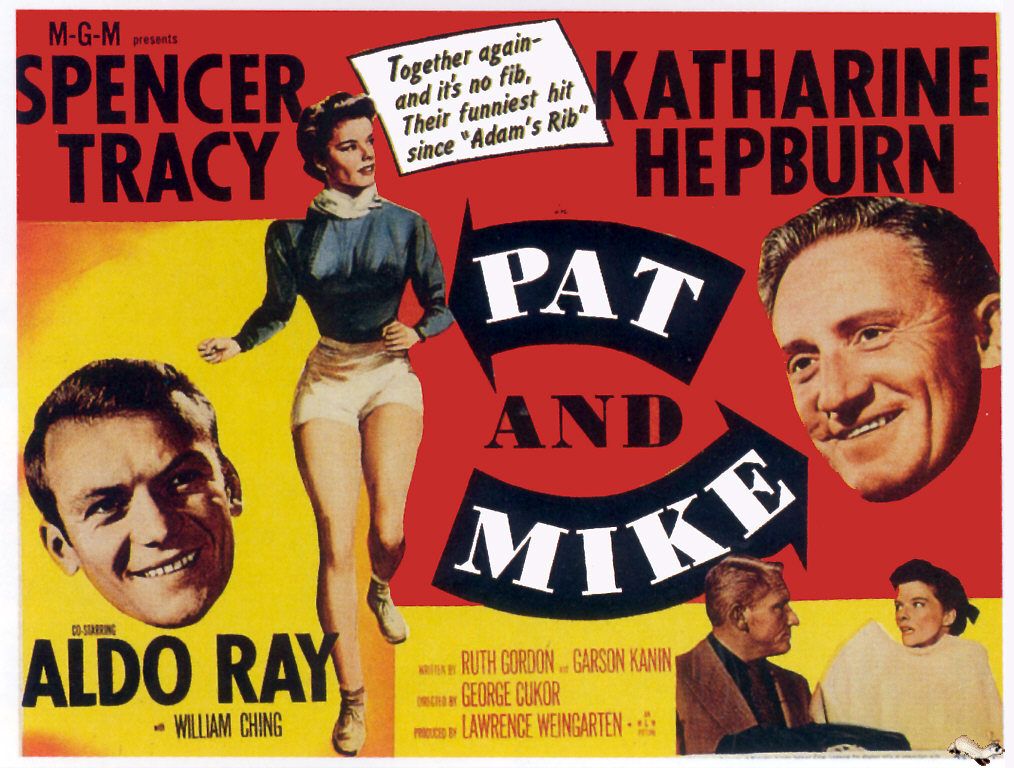
Women's athletic coach at Pacific Tech, Pat Pemberton (Katharine Hepburn) has a problem. A gifted athlete, she freezes when she is around her fiance, Collier Weld (William Ching). She resigns her job when her presence at the college endangers funding from an irate donor (she wasn't respectful enough to his wife when they lost a golf game), and competes in a golf pro-am. There, she attracts the attention of Mike Conovan (Spencer Tracy), a sports promoter. He encourages her to go pro, with him as her manager. Our film this week is Pat and Mike (1952). In their seventh (of nine) film appearances together (TCM article), Spencer Tracy and Katharine Hepburn are at the top of their game in this engaging and humorous film. When the two of them are together on screen, the fireworks are palpable. Their verbal sparring is part of what makes this film a classic. The film was written specifically for Tracy and Hepburn by their friends, Ruth Gordon and Garson Kanin (they'd previously penned Adam's Rib for the couple), with George Cukor in the director's chair. The authors were particularly interested in highlighting Ms. Hepburn's athletic prowess with their screenplay, and Ms. Hepburn did all the sports scenes herself (Sports Cinema 100 Movies: The Best of Hollywood's Athletic Heroes, Losers, Myths and Misfits by Randy Williams). Besides being excellent at golf and tennis, Ms. Hepburn swam on a regular basis, including dips in the ocean near her Fenwick, Connecticut home, even in winter (Women's World).
If there is one problematic aspect to the film, it's why someone as smart, sassy, and gifted as Pat would be involved with a dolt like Collier. William Ching is not all that attractive, and he is a bit of a stiff as an actor, so he brings nothing to the role that explains their relationship. On paper, Collier is a vile bully; he's verbally abusive and downright disgusting. He walks in late to his fiance's tennis match, making tons of distracting noise, openly laughing at her. He'd likely be thrown out of a real tennis match. We'd have like to have seen that happen. It was an absolute joy to see Pat throw her luggage out the window of the train and abandon her obnoxious fiance.
In the capable hands of Spencer Tracy, Mike starts as a conniver and learns the benefits of honest sports from his scrupulous charge. In their first scene together, Mike admires Mrs. Pemberton - "nicely packed, that kid. Not much meat on her, but what's there is cherce," he says. In the original script, the line was to read that Pat was "pretty well stacked." The film's producer Lawrence Weingarten objected - Ms. Hepburn, he said, was not "stacked." So the line was rewritten to "choice." It was Mr. Tracy who put the New York spin of "cherce" into the performances (Spencer Tracy: A Biography by James Curtis).
Chuck Connors (Police Captain) was a minor league baseball player - he'd been in the major leagues for 67 games (1 with the Brooklyn Dodgers; 66 with the Chicago Cubs), and was now working for the Los Angeles Angels (the Cubs minor league affiliate) - when he was approached by casting director (Memories and Dreams, 2018). Realizing his days as a player were coming to a close, he tried his hand at acting - this was his first role, and he is just fine as the bemused policeman. Mr. Connors would continue in films (like Move Over, Darling (1963) and Old Yeller (1957). But it was television that made his career - his five years as Lucas McCain on The Rifleman would bring the actor fame and a career that continued until his death of pneumonia and lung cancer (he was a three-pack a day smoker until the mid-1970s) in 1992.
Aldo Ray (Davie Hucko) had already done a few minor parts in films; the same year that Pat and Mike was released, he starred with Judy Holliday in The Marrying Kind. In his hands, Davie is child-like and trusting. His resentment of Pat blossoms into affection when she begins to look out for his career. He's a versatile actor, who doesn't always get noticed. If you've never seen him, Nightfall (1957), we strongly recommend you add it to your viewing list. Two other performances are worthy of note. Jim Backus (Charles Barry) has two small scenes as a tennis pro who encourages Pat to enter the golf pro-am. Charles Buchinski (Hank Tasling) is a riot as a gangster who gets a pummeling from our lady athlete (she's boxed, by the way). Mr. Buchinski would later gain fame as Charles Bronson.
The New York Timesreview by Bosley Crowther was very positive, and in his introduction to the film, Ben Mankiewicz called it one of Tracy & Hepburn's "best." It did well at the box office, bringing in nearly $2.7 million. Ruth Gordon and Garson Kanin received an Oscar nomination for Original Screenplay (AFI Catalog) - they lost to The Lavender Hill Mob.
We agree wholeheartedly that this is a film well worth viewing - it's not often you get to see a film about a female athlete that makes you want to pick up a tennis racket (or golf club) - and suggest this one for a day when you need a good laugh. We'll leave you with this trailer:
The Reverend Samuel Sayer (Robert Morley) and his sister Rose (Katharine Hepburn) work as missionaries in Kungdu in German East Africa. When "jack of all trades, master of none" Charlie Allnut, skipper of The African Queen (1951) arrives with their mail, they discover that Britain is at war with Germany. Blithely believing that no war in Europe can affect them, they are stunned when German soldiers appear, kidnapping their parishioners, and burning down the village, church and all. The Reverend protests their treatment, and is struck on the head by a rifle butt; he becomes disoriented, and dies within a few day. When Charlie returns, he agrees to take Rose to safety. Only she has another idea - journey down the un-navigable river to Lake Tanganyika, and attack the German steamer Louisa. We had the opportunity to see this wonderful film on a big screen as part of the ArcLight Presents series. A restoration of the technicolor film provided a glowing film, rich with the colors of Africa - for indeed The African Queen was filmed in Africa (for more on how the filming dealt with this on-location work, I suggest Katharine Hepburn's humorous account in The Making of the African Queen: Or How I Went to Africa With Bogart, Bacall and Huston and Almost Lost My Mind). But more than that, The African Queen is a pas de deux between Katharine Hepburn and Humphrey Bogart.
Though other actors appear in the film, notably Theodore Bikel as the First Officer on the Louisa and Robert Morley as Rose's pedantic brother, the bulk of the film centers on Rose and Charlie. There relationship starts as one of bare tolerance. Charlie finds the Sayers to be snobs, and Rose is revolted by Charlie's unkempt appearance and rumbling stomach. When circumstances force them together, Charlie is horrified at Rose's plan to attack the Germans (who wouldn't be!), and is convinced that a little bit of stress (like minor rapids) will convince this meek woman that her goals are impossible. But Hepburn's Rose is indomitable. "I never dreamed that any mere physical experience could be so stimulating," she marvels.
Katharine
Hepburn credited the success of her performance to director John Huston.
She first had a problem getting a handle on Rose. When she spoke to
Huston about it, he suggested that she pattern Rose after Eleanor
Roosevelt (TCM article).
One of my favorite lines in the film is delivered by Ms. Hepburn with
pure Mrs. Roosevelt attitude - "Nature, Mr. Allnut, is what we are put
in this world to rise above."
Hepburn was deservedly nominated for an Oscar for her performance (she lost to Vivien Leigh in A Streetcar Named Desire). John Huston and James Agee were also nominated for the screenplay (based on the C.S. Forester novel), and Huston was nominated for directing. Ms. Hepburn relates in her book that she found everything "divine" (that is, until members of the cast and crew started getting sick), much to Mr. Bogart's annoyance. But the big winner of the night was Humphrey Bogart, finally winning his only Oscar (to great applause from the attendees that evening). Leaving toddler Stephen Bogart behind, Lauren Bacall ventured to Africa with her husband, who was allegedly miserable the whole time. (Bogart: In Search of My Father by Stephen Bogart and Gary Provost) However, he found some respite by teasing Ms. Hepburn - she (and her partner, Spencer Tracy) became fast friends with the Bogarts, and were among the last people to visit Mr. Bogart when he was dying of cancer. Mr. Bogart is amazing in the part - then again, he always is. He is able to grow the character and make it believable. The change in Charlie Allnut, from polite disregard of Rose, to abhorrence, to regard, to love, is so swift that, in the hands of a lesser actor, it would not be credible. With Bogart in charge, you buy it wholeheartedly.
Bogart would reprise his role for the Lux Radio Theatre in December 1952, with Greer Garson stepping in for Ms. Hepburn (AFI catalog). The film was added to the National Film Registry in 1994. It's also on multiple of the AFI lists: It was named #65 on AFI's 100 Years, 100 Movies, 10 Anniversary List (and #17 on the original list), #14 on 100 Years, 100 Passions and #48 on 100 Years, 100 Cheers. This is another film that you should run to see. Even on you television screen, it's an amazing film. We'll leave you with a trailer.
Trailer:
It's been two years since Tracy Samantha Lord Haven (Katharine Hepburn) divorced her husband, C.K. Dexter Haven (Cary Grant) and Tracy is about to remarry. Her fiance is George Kittredge (John Howard), an up-and-comer who is completely different from the wealthy Dexter. Tracy, however, is not happy. She seethes with resentment towards Dexter, and towards her father, Seth Lord (John Halliday), who has been cavorting with a dancer in New York City. So, when Dexter shows up the day before her wedding with two reporters from the scandal sheet "Spy Magazine" in tow, Tracy is ready to give Macaulay Connor (James Stewart) and Elizabeth Imbrie (Ruth Hussey) the ride of their lives. TCM Presents for February was the delightful The Philadelphia Story (1940). Katharine Hepburn is perfection as the intolerant Tracy, a woman of strict principle who finds herself torn among 3 men on the eve of her wedding. She never misses a step as Tracy discovers the true meaning of love as her inhibitions fall away. Katharine Hepburn came to Hollywood to star in A Bill of Divorcement (1932) with John Barrymore. Two years later, she won her first (of four) Oscars for Morning Glory. But, by 1938, with her films not doing well, she bought out her contract, and departed from Hollywood (after she was included in a list of actors termed Box Office Poison), Ms. Hepburn returned to New York, where she appeared in the Broadway production of The Philadelphia Story, a play which had been written by Philip Barry with her in mind. The play was a huge hit (it ran for 417 performances in New York, then opened on National Tour). All the major studios wanted it, but there was a catch. With the help of her friend Howard Hughes, Ms. Hepburn had purchased the rights to the play. No film would be made without her in the lead, and without her approval of her leading men. MGM bit the bullet, and bought the film, hired Philip Barry to write the screenplay, and (with Ms. Hepburn's approval) hired Cary Grant to play Dexter (even with his high salary demands and insistence on top billing!) This Philadelphia Magazinearticle has more behind-the-scenes information on the production. For more on Ms. Hepburn's fascinating life and career, check out her autobiography Me, and the authorized biography that was published just after her death, Kate Remembered by A Scott Berg.
James Stewart is equally good as the angry young man who disrupts Tracy's life, a part that Ms. Hepburn intended for Spencer Tracy (they had not yet met). Mr. Stewart brings both a swagger and sass to Macauley Connor. He begins by resenting Tracy and all she represents, but ends deeply infatuated with her. Mr. Stewart would win his only Best Actor Oscar for his work in this film. His scenes with all three of his co-stars crackle with energy. Cary Grant, however, was NOT nominated for his role as Dexter. Why will always be a mystery to me. He is wonderful (as always) in a part that Ms. Hepburn intended for Clark Gable. She asked Mr. Grant to appear when Gable was unavailable, and he agreed - provided he got top billing and a salary of $137,000 (which was given to British War Relief) (TCM article). As with their three prior parings (Sylvia Scarlet (1935), Holiday (1938), and Bringing Up Baby(1938)), their interplay is dynamic. There is an ease in their conversations that make them all the more real. Mr. Grant is equally adept at sparring with Mr. Stewart. And his scenes with Virginia Weidler (as Tracy's younger sister Dinah Lord) are a pleasure to watch.
The other nominated actor in the film is the always excellent Ruth Hussey (best supporting actress). If you have never encountered Ms. Hussey, treat yourself with this film or with The Uninvited (1944). There is a world-weariness to Liz, but it has not eliminated her hope for a future with Mike. Ms. Hussey began her career in Providence, RI as a radio commentator. She eventually moved to New York where she modeled, and found jobs with theatrical touring companies. That got her an MGM contract, where she appeared films such as The Women (1939), Another Thin Man (1939), and H.M. Pulham, Esq (1941). She also appeared on Broadway in State of the Union (in the role Katharine Hepburn would play on film), and Goodbye, My Fancy (Joan Crawford's movie outing). Ms. Hussey appeared on radio and television as well until her retirement in 1973. She was married for 60 years to talent agent Bob Longenecker until his death in 2002; the couple had three children. She died in 2005, following an appendectomy, at the age of 93.
Donald Ogden Stewart won an Oscar for adapted screenplay, and director George Cukor was nominated. The film is listed as #44 in the100 Years, 100 Movies, 10th Anniversary Edition (interestingly, the rating went up from the original list, where it appeared at #51). It's also #44 on the 100 Years, 100 Passions list. In 1995, it was added to the National Film Registry. The Lux Radio Theatre adapted the film twice: in July, 1942, with the original cast, and in June, 1943 with Robert Taylor, Robert Young, and Loretta Young. (AFI catalog). It would be remade as the musical High Society in 1956, starring Gracy Kelly, Bing Crosby, Frank Sinatra, and Celeste Holm, with glorious music by Cole Porter. The New York Timesreview was glowing when the film opened at Radio City Music Hall, and quite honestly, what's not to love. We'll leave you with the trailer to this outstanding film:
December marked the fiftieth anniversary of the release of Guess Who's Coming to Dinner (1967), and the film was part of the 2017 TCM Presents series. Very much a tale of the 1960s (but still relevant today), the film introduces us to Joanna "Joey" Drayton (Katharine Houghton), a 23 year old woman raised by liberal parents. Joey has returned from her vacation prematurely to her San Francisco home, accompanied by Dr. John Wade Prentice (Sidney Poitier), a highly-regarded physician, who happens to be African-American. The two met in Hawaii and fell in love. As John is about to leave for a three month work assignment with the World Health Organization in Geneva, the pair have arrived to tell Joey's parents, Christina (Katharine Hepburn) and Matt Drayton (Spencer Tracy) of their plans to marry in two weeks in Geneva. What Joey doesn't know is that John feels it is crucial to their future as a couple that Matt and Christina bless the marriage. If they will not, he will remove himself from Joey's life. As pointed out by TCM host Tiffany Vasquez in her introduction, the film was a bit dated even upon release. John's father (Roy Glenn) states that "in several states" John and Joanna would be breaking the law - however the U.S. Supreme Court had just recently handed down a decision regarding interracial marriage in Loving v. Virginia (brought to the screen in 2016's Loving). Regardless of that momentous decision, Mr. Prentiss was correct about the difficulties that the couple would face - and still (unfortunately) face today. So, while some of the film is a tad old-fashioned, it still can speak to us in the 21st Century. (This Los Angeles Times article on 50th Anniversary of the film is an interesting examination of the film in the our times).
Spencer Tracy was ill when he filmed Guess Who's Coming to Dinner. In fact, both Katharine Hepburn and director Stanley Kramer placed their salaries for the film into escrow in the event Mr. Tracy was not able to complete shooting. Mr. Kramer arranged that Mr. Tracy would only film in the morning, while his energy levels were up to the task (TCM Article). Spencer Tracy died only 10 days after his work was completed. Regardless, his performance gives no hint that he was unwell; he is wonderful as a father facing his own liberal principles against the future happiness of his daughter. Mr. Tracy was posthumously nominated for his 10th Best Actor Oscar. (He lost to Rod Steiger in In the Heat of the Night).
Another nominated performance was that of Beah Richards, as John's mother (Ms. Richards also lost, to Estelle Parsons in Bonnie and Clyde). Her performance is just wonderful; her love for her son, as well as her fear that her husband will destroy the relationship between himself and his son is evident in every scene. She was a lovely scene with Spencer Tracy that leads to the films penultimate speech from Mr. Tracy. She started working in New York theatre, first off-Broadway (in 1955), then on Broadway (she was nominated for a Tony Award for her performance in The Amen Corner). She only made 15 films, most of them playing someone's mother. But it was in television that she made her mark, winning two Emmy awards, and appearing in shows such as I Spy (playing Alexander Scott's mother), ER (as Peter Benton's mother), and Beauty and the Beast (as Narcissa). Ms. Richards died of emphysema in 2000 at the age of 80.
Katharine Hepburn suggested that her niece, Katharine Houghton read for the role of Joanna (the studio had Samantha Eggar in mind (AFI catalog)). She's quite good in a part that really is somewhat minor - Joey is the catalyst for the action of the film. She is in the middle of the dialogue between her parents and John, not really part of the conversation. If I have one complaint about the film, it is that Joey is written as almost passive. We know she has some of her mother's fire (her comment about her mother's employee Hilary shows that), but all Joanna can say of herself is that she will be important because her husband is important. I suspect it was not the picture that we were supposed to have of Joanna, but it is very much a sign of the times that Joanna is not all that important. She's not even going to get a say in the decision regarding her future.
Besides the nominations for Mr. Tracy and Ms. Richards, there were other Oscar nominations: Actor in a Supporting Role (Cecil Kellaway), Art Direction, Film Editing, Music (Scoring of Music—adaptation or treatment), Directing, and Best Picture. It won awards for Katharine Hepburn as
Best Actress, and for William Rose's Writing (Story and
Screenplay—written directly for the screen). This was Ms. Hepburn's second Oscar win - the next year, she would win again for her role in The Lion in Winter and would share the honor with Barbra Streisand, who ALSO won for Funny Girl. The film has also been featured in three AFI lists: It stands as #35 in 100 Years, 100 Cheers, #58 in 100 Years, 100 Passions, and #99 100 Year, 100 Movies, 1998 edition. I'll close with one of my favorite scenes in the Christina's conversation with the very nosy Hilary (Virginia Christine):
 The sudden death of American war hero and businessman Robert Forrest throws the country into a tailspin. Steven O'Malley (Spencer Tracy), a journalist who recently returned from war-torn Europe, is one of Forrest's many admirers, and has decided to write a book about the great man. He seeks the assistance of Forrest's wife, Christine (Katharine Hepburn); she initially tries to keep her distance, then consents to assist in the biography. Steven, however, finds her reticence concerning as she attempts to be the Keeper of the Flame (1942).