Cole Porter (Cary Grant), a law student at Yale opts to discard a career as a jurist to take up songwriting in Night and Day (1946) a very loose interpretation of Mr. Porter's life and career.
Since the release of DeLovely (2004), Night and Day has had to bear the brunt of its claim to being a biography of Cole Porter. Quite frankly, it's not. It's a way of incorporating a vast array of Mr. Porter's glorious music into a film, and tell a story at the same time. Let's go over a few of the facts, and then we can talk about the film as a story, not a biography.
Cole Porter did attend Yale, and one of his classmates was Monty Woolley (Mr. Woolley, who plays himself, was NOT a professor at Yale). The sinking of the Lusitania had nothing to do with the failure of See America First, as the ship sunk in May 1915, and the musical opened in March 1916. Mr. Porter was not wounded in combat during World War I; he is listed as serving in the French Foreign Legion during the war (Broadway, The American Musical). He also spent time in Paris partying and met his future wife in Paris. Linda Lee Thomas was well aware of Mr. Porter's sexuality when they married - she had come from an abusive first marriage. Linda Lee Porter never officially left Cole - in fact, it was she that worked with the doctors to keep them from amputating his leg following his horseback riding accident. She continued as his health advocate until her death in 1954 (Cole Porter obituary). Following her death, doctors convinced him to allow the amputation, and he lived as a recluse for the rest of his life (as Linda feared). Mr. Porter was as openly gay as the era would allow (The New Yorker). Regardless, he and Linda loved one another and were inseparable - les Colporteurs (Smithsonian Magazine).
As you can see from the photo, The Porters looked nothing like their on-screen imitators. Linda wanted Alexis Smith to play her, and when she expressed her desires to Warner Brothers executives, Cole jokingly said that Cary Grant should play him (Cary Grant: In Name Only by Gary Morecambe & Martin Sterling). Mr. Grant and Ms. Smith are wonderful together, and Ms. Smith was thrilled to be working with him. Though he could be very definite in his opinions - for example, Mr. Grant demanded that his suit be cut so that only an eighth of an inch of cuff should show, Ms. Smith commented on his "care and attention" to the character (TCM article). This was Mr. Grant's first technicolor film.
Warner Brothers incorporated their best character people into the film. Eve Arden finally gets a chance to sing as French performer Gabrielle, who introduces Porter's song "I'm Unlucky at Gambling." Jane Wyman (Gracie Harris) also gets a chance to show her vocal talents. Dorothy Malone (Nancy) has some brief scenes with Donald Woods (Dr. Ward Blackburn) as her husband and Cole's friend and physician. Alan Hale (Leon Dowling) turns up as a theatrical producer who doesn't see the beauty of Cole's compositions. And Henry Stephenson (Omer Porter) is sympathetic as Cole's grandfather.
Monty Woolley gets to play himself, and get off some bon mots while he is at it. He pops in and out of the film, as Woolley wanders in and out of the Porters' lives (and back and forth from New York to Hollywood). There is some amusing banter as he goes off to film The Man Who Came to Dinner - he'd starred in the Broadway play (he almost didn't get the movie role - Warner Brother considered Fredric March, Charles Laughton, Robert Benchley, John Barrymore, and Charles Coburn).
Mary Martin, who got her start in Cole Porter's Leave it to Me, reprises her hit song from the musical, "My Heart Belongs to Daddy" (though this song, along with several of the others, are cleaned up versions of Mr. Porter's sometimes rather racy lyrics). Ginny Simms (Carole Hill), the woman who works with Porter in a music store in the film, is very loosely based on Ethel Merman. Ms Merman had appeared in earlier plays, but her first starring role was as Reno Sweeney in Mr. Porter's Anything Goes (AFI catalog).
The New York Timesreview by Thomas M. Prior (T.M.P.) was positive, though even Mr. Prior pointed out that it wasn't really a biography. When the film DeLovely was released in 2004, The Times again wrote about Night and Day as part of a discussion of the biographical aspects of the two movies.
If you are not a stickler for facts, and would like to see some fine acting, pleasant singing, and spectacular songs, this film is worth a viewing or two. We'll leave you with the trailer:
Author Kenneth Bixby (George Brent) is on a book tour with his secretary (and almost fiance) Ann Rogers (Ann Sheridan). Upon his arrival in Cleveland for a book signing, he receives flowers and a mysterious note from "Miriam," the fictional character in his latest book. The sender of the flowers turns out to be Ken's college girlfriend, Julie Wilson (Osa Massen), who's still fixated on him even though she is married to Harvey Wilson (Charles Ruggles). Our film this week is Honeymoon for Three (1941) With a script based on a relatively successful Broadway play, and an excellent cast, you would think Honeymoon for Three would be a good film. Unfortunately, you would be wrong. The script slides deeper and deeper into silliness, and after awhile, the audience just doesn't care any longer (and starts to look at their collective watches). It doesn't help that George Brent is miscast as the lothario Kenneth Bixby. Mr. Brent is just to stable to be convincing as a ne'er-do-well. And why on earth he would respond to a flibbertigibbet like Julie Wilson is beyond comprehension, especially when he has an attractive, intelligent woman like Ann Rogers sitting next to him.
We don't get to see enough of Ann Sheridan. Initially, there is a pleasant rapport between her and Mr. Brent (who would become her husband shortly after the filming ended. The marriage only lasted for a year). (TCM article) Ann is a calm breath of air next to the overblown Julie, and we DO get too much of Osa Massen. She's a delusional whirligig, with a mania that is just too much to take in. The viewer needs to understand why Bixby would even tolerate her, and the audience just can't. Jane Wyman, as Julie's almost sister-in-law, Elizabeth Clochessy is also wasted. Ms. Wyman was still playing small roles in 1941 - her real breakthrough as Orry Baxter (for which she was nominated for the Best Actress Oscar) in The Yearling wouldn't come for another five years. All she allowed to do in this film is dither, and look adoringly at her fiance Arthur Westlake (William T. Orr), who really isn't worth all that much adoration. Lee Patrick is equally ill-served as Mrs. Pettijohn, an idiotic woman with a penchance for naming her children after authors (Booth Tarkington Pettijohn???). The character provides a somewhat deus-ex-machina ending to the proceedings, but Ms. Patrick deserves better.
We did like Charles Ruggles who is the only part of the comedy to underplay his role. You feel sorry for Harvey - his wife is insane, and his brother is a bore - and Mr. Ruggles makes you rather like Harvey. Who can blame him for wanting to get Julie off his hands? Charles (or Charlie) Ruggles started his career on Broadway (in the 1914 production of Help Wanted), and was working in silent films by the following year. He easily made the transition to sound, often in those early years playing the romantic lead. As time progressed, he moved to character parts, including Egbert Flout in Ruggles of Red Gap (1935), Major Applegate in Bringing Up Baby (1938), and Grandfather Charles McKendrick in The Parent Trap (1961). A generation grew up with his voice - he was Aesop in the various Rocky and Bullwinkle shows. He worked frequently in both radio and television, while continuing to appear in films and on Broadway. He married his second wife (his first marriage only lasted two years) in 1942; they remained together until his death from cancer, age 70, in 1970.
Originally slated to have starred Olivia de Havilland and Fred MacMurray (AFI Catalog), the film was based on the play Goodbye Again, which opened on Broadway in 1932, starring Osgood Perkins (Anthony Perkins father) as Kenneth - and with a very young
James Stewart as The Chauffeur (in his second Broadway role). In 1933, it was made into a film, with
Warren William and Joan Blondell. In 1943, and 1956 (with Donald Cook, Patricia Barry, and Tom
Poston), the play was again produced on Broadway.
While critic Bosley Crowther is never a fan of Mr. Brent (his loss, quite frankly), we have to agree with him in his New York Timesreview Mr. Brent is just all wrong for this one. Then again, no one would have had a great deal of success with this tangled web of a script. Here's a trailer from the film.
Lawrence Rip Smith (James Stewart) is forced to close down his small survey business. Rip is a pollster, and though good at his job, he is unable to compete with the larger firms. He dreams of discovering a way of polling that is accurate, but fast and inexpensive; believes he has found it when his friend Hoopendecker (Kent Smith) sends him the results of a survey that he took in the small town of Grandview - a poll in which the results exactly match the results of a nationwide, weeks long interview process performed by one of his large competitors. Rip believes he has found his dream, a Magic Town (1947), that is a microcosm of American society, where in, in a few days, he and his colleagues Ike Sloan (Ned Sparks) and Mr. Twiddle (Donald Meek) can take a poll that would exactly mirror the opinions of the nation. The problem - keeping it a secret both from his competitors and from the town itself. This is a very peculiar film. It wants to be Mr. Smith Goes to Washington or Meet John Doe, but has a postwar anxiety that undercuts those ambitions. Rip Smith, as portrayed by James Stewart, is an ambitious young man who spent his years in the military mocking the small town life, but who in reality longs for the peaceful existence outside of the bustling city. Mr. Stewart does an excellent job in displaying the conflicts within Rip. He is, however at war with a script that isn't quite sure where it wants to go. The role was written with Mr. Stewart in mind, and it is obvious that he is comfortable both with the character, and his co-star, Jane Wyman.
The chemistry between Ms. Wyman (Mary Peterman) and James Stewart is excellent. Much of this is thanks to Mr. Stewart's subtle display of his growing affection for Mary. But frankly, Mr. Stewart's part is more fleshed out that that of Mary. Ms.Wyman takes what is given to her and is able to make Mary a more realistic character albeit one who doesn't know her town as well as she thinks she does. Jane Wyman was not the first choice for Mary. Director William Wellman first wanted Janet Blair; he later considered Arleen Whalen and Loretta Young (AFI Catalog). After years of playing light comedy, Ms. Wyman had finally started getting challenging parts. In 1945, she was Ray Milland's fiance in The Lost Weekend, and in 1946 she portrayed Orry Baxter in The Yearling, for which she was nominated for her first Oscar. The year after this film, she would appear in Johnny Belinda, and finally win an Oscar for her amazing performance (she would receive two more nominations after this, for The Blue Veil (1951) and Magnificent Obsession (1954)).
When the film was shown to a preview audience, it was three hours long; the final running time as the film exists today is 103 minutes. It's hard to imagine what was covered in three hours that is not dealt with in 103 minutes. The film falls apart when hoards of people begin to stream into the town because of the publicity that is garnered by its ability to predict poll results. The question is why? What would make that meager event beckon to so many people? What makes the film even more reminiscent of Meet John Doe is the presence of Regis Toomey and Ann Doran playing the Weavers, pretty much the same parts they played in Meet John Doe (though with different names). While the Weavers are conciliatory (just as they were in Meet John Doe), the other town folks are not all sweetness and cream; they reflect the darkness of a new post-war mentality.
Donald Meek appears briefly in the film as a statistician who works with Rip, then the character just disappears from the film, with Ned Sparks informing us the character left on an earlier train. Mr. Meek died suddenly during filming, and rather than eliminate or recast the part, director Wellman cobbled up a means for him to be gone from the action (TCM article). This New York Timesreview by Bosley Crowther was not very complimentary towards the film; it ended up losing $350,000, bankrupting Robert Riskin Productions. It did have a bit of an afterlife, however. In December 1947, James Stewart and Jane Wyman reprized their film roles for a Lux Radio Theatre production. Mr. Stewart (and his best friend, Henry Fonda), were cat lovers and frequently took in strays (James Stewart: Behind the Scenes of a Wonderful Lifeby Lawrence J. Quirk and Hank and Jim: The Fifty-Year Friendship of Henry Fonda and James Stewart by Scott Eyman), so it seems fitting to that the film has a cat. While we can't really recommend this one, here's a clip in which James Stewart interacts with Jane Wyman - and a kitten.
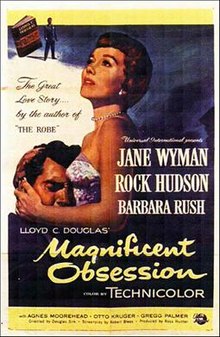
Robert Merrick (Rock Hudson) is afraid of nothing, and is constantly putting himself in jeopardy. When he finally manages to crack up his speedboat, his life is saved with the personal respirator of Dr. Wayne Phillips. But while Bob's life is being saved, Dr. Phillips suffers a heart attack, and there is no way to resuscitate him. Widow Helen (Jane Wyman) and daughter Joyce (Barbara Rush) are left to deal with the aftermath, with Helen forced to fend off the unwelcome attentions of the ever-on-the-prowl Bob. Our film for this week is Magnificent Obsession (1954). If you don't like melodrama, you won't like this film. But, we do enjoy a good weeper and this is an excellent one. In his first major role, Rock Hudson is outstanding as the callow youth who needs a good kick to make him grow up (TCM article). Early in the film, we are told that Bob attended medical school, only to drop out and assume the life of a dilettante in the wake of his father's sudden death. We get no more information than that, but the way Mr. Hudson plays the scene speaks volumes about Bob's bitterness; a bitterness that resulted in his decision to devote his life to pleasure - something it seems his father never got to do. It is important that Mr. Hudson slowly grow his character, and he does so. With subtle allusions to the passing of time by director Douglas Sirk, we watch as Bob Merrick changes from a heel into an admirable human being.
Equally, Jane Wyman is terrific as a woman who loses her husband, only to find her entire life upended by the actions of one irresponsible human being. Like Mr. Hudson, Ms. Wyman's character has to change, but the changes are more subtle. We need to understand why she is attracted to Bob Merrill (sure, she doesn't know who he is at first, but she is recently widowed, and was very much in love with her husband. Any new man should be a hard sell.). More importantly, we need to see her sacrifices as well thought out and not self-pitying. Ms. Wyman does that convincingly. Ms. Wyman was nominated for an Oscar for the part (losing to Grace Kelly in The Country Girl). Agnes Moorehead (Nancy Ashford) is one of the great character actresses of her generation, and she gives a fine performance. Especially notable is her early scene with Rock Hudson, in which she lets him know that he is acting like a complete moron, but does it with professionalism. Ms. Moorehead started her career in radio; her later involvement with Orson Welles Mercury Players led to her casting as Charles Foster Kane's mother in Citizen Kane (1940). She would go on to play nearly every kind of character - Humphrey Bogart's nemesis in Dark Passage (1947), Jane Wyman's rough-hewn Aunt Aggie in Johnny Belinda, Edward G. Robinson's loving wife in Our Vines Have Tender Grapes (1945), and the abused Madame Fosco in The Woman in White (1948). She did Broadway and regional theatre, but it was on television where she would finally make an indelible mark. A generation of viewers can't forget her memorable performance as a farm woman threatened by minature "Invaders" in The Twilight Zone. And then there is Endora on Bewitched. Take a look at
her performance in the fourth episode of the series, "Mother, Meets What's His Name"
When she asks Darrin (the ultimate idiot) "Why do you object to my daughter being herself?" you want to cheer. Her delivery is spot on (and you really want to shake Samantha for submitting to Darrin's domestic tyranny). Ms. Moorehead continued acting until her death of cancer in 1974 at the age of 73.
Also in the cast (and happily still with us) are Barbara Rush (who plays Joyce Phillips). Ms. Rush is 91. She was working until 2007, and since seems to have retired. Judy Nugent, who plays Helen's young friend, Judy, continued acting on film and television until 1978. Around the time she retired, she, husband Buck Taylor, and their three sons moved to Montana. They were divorced in 1983. In an interview for Western Clippings, Ms. Nugent stated this film was her favorite role. Jane Wyman was not the first choice for Helen - Olivia de Havilland, Eleanor Parker, and Joan Crawford were considered for the part. Jeff Chandler was in the running for the role of Bob Merrick, and Charles Bickford was considered for the role of Edgar Randolph (the role would go to Otto Kruger). (AFI catalog)
The film is a remake of a 1935 film with Robert Taylor and Irene Dunne (which was aired on Lux Radio Theatre in April of 1937, starring the film's leads). The New York Times did an excellentDVD review of 1935 and 1954 versions when Criterion released them as a set. The film was such a success that the cast we reunited in All That Heaven Allows the following year. This is a film that becomes richer with each viewing, and we encourage you to give it a try. We'll leave you with a trailer:
To celebrate National Classic Movie Day on May 16th, I'm going to break with our usual post, and contribute to the Classic Comfort Movie Blogathon, in which we'll discuss films that are sources of comfort when days are bleak. I'll be discussing Pollyanna (1960), starring Hayley Mills as the title character. After the death of her missionary parents, Pollyanna Whittier is taken in by her Aunt Polly Harrington (Jane Wyman). Aunt Polly takes her position as the leading citizen of the town of Harrington seriously, much to the disgust of Mayor Karle Warren (Donald Crisp). The Mayor feels that Polly's domination of the town's affairs demean his role as a voted official, and eliminates citizen involvement in the workings of the town. Aunt Polly also has very decided opinions on her late sister's marriage to a man who she saw as beneath the Harrington family, and about the rearing of children. But she is not prepared for is Pollyanna, a little girl secure in her parents' love and accustomed to making lemonade out of lemons. Pollyanna brings with her a determination to be happy and to teach everyone around her "the glad game".
Over the years, the name Pollyanna has become an insult. Merriam Webster defines the word as "a person characterized by irrepressible optimism and a tendency to find good in everything". Pollyanna has not had an easy life - her mother died when she was young, and she's recently lost her father. As missionaries, they were dirt poor, and couldn't even get their little daughter a doll. So, her father invented the glad game as a way to help his child appreciate what she had rather than bemoan what she lacked. Like all of us, Pollyanna gets angry, sad, and frustrated, but she tries to look for the good in people, for then (according to the medallion she has from her father), you will surely find it. Hayley
Mills is perfect as Pollyanna; then again, I'm rather biased when it
comes to Ms. Mills - I think everything she does is great. I recently
had the opportunity to see her in an Off-Broadway play, and was thrilled
(Party Face). She
brings a sincerity to the character of Pollyanna. She's not perfect. She becomes
furious at Mrs. Snow (Agnes Moorehead) whose obsession with death
frustrates the child. She scolds Jimmy Bean (Kevin Corcoran) for his
tree-climbing, but finally climbs trees herself. She loves her Aunt
Polly, but lies about her maid Nancy's (Nancy Olson) relationship with
George Dodds (James Drury).
Several scenes have always stood out for me and cheer me when I'm down. After Pollyanna's encounter with Mr. Pendergast (Adolphe Menjou), she develops a fascination with the crystals that ornament his lamps - the rainbows they throw when held in the sunlight enchant her. So, in spite of his protestations, she begins hanging them from his window, to fill the house with rainbows - until finally he too is engrossed in the project. Another is her visit to the Reverend Paul Ford (Karl Malden), who has a fire and brimstone approach to religion (primarily at the urging of Aunt Polly). Though forbidden to talk about her father by Aunt Polly, Reverend Ford is intrigued by Reverend Whittier's beliefs, resulting in Rev. Ford's conversion to a more loving approach to God. And of course, there is the relationship between Pollyanna and Aunt
Polly - a woman who has rejected love (in for the form of Dr. Edmund Chilton, well played by Richard Egan), and is astonished by the
instant love that Pollyanna lavishes on her. When Pollyanna runs to kiss
her good night, Ms. Wyman's amazement sums up Aunt Polly in an instant.
It's a marvelous moment.
Pollyanna's ability to try and see the glass as half-full is truly satisfying. She doesn't always succeed, but if she did, then she really would be the blissfully unaware creature of which she is frequently accused. But she's not. She's a wonderful, warm little girl who wants love (and a doll) and who has the magical ability to put a smile on your face. Don't believe me? Ask Tillie Lagerlof (Reta Shaw) or Angelica (Mary Grace Canfield). They will back me up! I'll leave you with one of my favorite scenes: Pollyanna discovers a rainbow:
All That Heaven Allows (1955) introduces us to Cary Scott (Jane Wyman), a widow with two grown children, Kay (Gloria Talbott) and Ned (William Reynolds). Cary essentially lives alone now - both children are away at school - and Cary is finding herself at loose ends. Unlike her best friend, Sara Warren (Agnes Moorehead), Cary is not a "club woman" and her days seem endless. So, when Sara has to renege on a luncheon date, Cary invites her gardener, Ron Kirby (Rock Hudson) in for a cup of coffee. Cary becomes fascinated with Ron's life goals - a life within nature, growing trees. Ron's invitation to visit his nursery leads to a relationship between the two, one that is ridiculed by Cary's supposed friends (represented by the vindictive Mona Plash (played with relish by Jacqueline de Wit)) and rejected by her appalled children. Let's just get it out of the way - All That Heaven Allows is a melodrama - but WHAT a melodrama! With excellent performances from the two leads, reunited after their successful teaming in Magnificent Obsession (1954) along with Agnes Moorehead and most of the production cast (AFI catalog), and with support from the likes of Virginia Grey (Alida Anderson), and Hayden Rorke (Dr. Dan Hennessy), the film goes beyond its melodramatic roots to something much grander. But what really elevates the film is the cinematography by Russell Metty and costume design by Rose Brandi. The film glows with color and texture - you can see every leaf on the trees and the colors are sumptuous. It is very much like watching an exquisite painting, but one with a story and acting that keeps you involved with the characters. The script is tight, providing just enough information about the characters to keep you involved, but avoids having backstory that overwhelms the movie.
Douglas Sirk, the film's director, is the architect. Sirk built on a novel by Edna and Harry Lee (see this TCM article for more on Sirk and the film's creation); it's a wonder that this film got past the censors, since it is really about sexuality. Oh, sure, there is only a hint that Cary and Ron are intimate, but the attitude of the Peyton Place-ish town and of the Scott children is all about the fact that Cary, an "older woman." She's actually only just 40 - we are told she married at 17, and her son is about 22 (Criterion Collection discussion of the film and Jane Wyman) and Ron is about 30.
The film makes it clear that Cary is both attractive and interested in being sexually active. All of the reactions from family and supposed friends revolve around that point. Ned, for example, is offended by Cary's attractive evening gown (you can see it below) but is fine with the idea that she marry Harvey (Conrad Nagel), who has is interested only in a companionable marriage (translation - no sex). Kay is horrified at the thought of her mother marrying someone young and attractive, until she herself marries Freddie North (David Janssen), at which point she understand her mother's desires and acknowledges that her mother should follow her heart (and libido). The townspeople wink at Howard Hoffer's (Donald Curtis) womanizing, but start rumors that Cary and Ron were having an affair while Cary's husband was still living. It's a misogynistic, small-minded mess of an environment.
The middle-aged, upper middle-class, Anglo-Saxon Protestant gathering given by Sara (who really is the only person open to Cary's relationship with Ron) is juxtaposed against the party given by Mick (Charles Drake) and Alida Anderson. A mix of people of different ages and socioeconomic status, the Anderson party is the only place where Cary and Ron are totally welcomed and completely comfortable together. These are the people who abjure riches, and live with nature. Mick and Alida were from the social strata of the town, but Thoreau's Walden has become Mick's bible, and he now lives apart from society and the economic pressures of that life. It is a life that ultimately attracts Cary to Ron and the Andersons.
The chemistry between Rock Hudson and Jane Wyman, which was so apparent in Magnificent Obsession continues in this film. Though we are told there is an age gap (Ms. Wyman was actually about 8 years older than Mr. Hudson), it's really not all that noticeable - their relationship is so solid that they seem made for each other. It's a shame they never made any other films together. Virginia Grey also stood out as Alida; we found her quite engaging as the woman who gives up the rat race for her husband. Ms. Grey had a lengthy career - she started as a child in silent films (she played Little Eva in the 1927 Uncle Tom's Cabin). As an adult, she was a supporting player (as in this film) in A movies, and the lead in many B pictures. In the 1940s, after Carole Lombard's death, she began dating Clark Gable, but his sudden marriage to Lady Sylvia Ashley ended their relationship. After Robert Taylor's separation from Barbara Stanwyck, she also dated Mr. Taylor for a time (you can see a 1952 letter which he wrote to her here. Ms. Grey would later relate that Ms. Stanwyck despised her because of the relationship). Ms. Grey never married (it's been surmised she never got over Clark Gable); she would work in films and television until 1976. She died in 2004 at the age of 87. A note of interest - Gloria Talbott was not the first choice for the role of Kay. Producer Ross Hunter initially wanted to cast Jane Wyman's daughter, Maureen Reagan in the role, but finally decided she was too young (she was about 13 at the time).
The New York Timesreview was rather ho-hum (though reviewer Bosley Crowther really liked Jane Wyman). For a more recent observation, take a look at this brief analysis (including many scenes from the film) by Richard Brody that appeared in The New Yorker. Another tribute came by way of the filmmaker Todd Haynes in Far From Heaven (2002), which he modeled, both in plot and cinematic style, after All That Heaven Allows. We'll leave you with the trailer from the film, and a recommendation that you give it a viewing.
When a rainstorm floods out a train trestle and strands her in the boom town New City, Texas, Lucy Gallant (1955) (played by Jane Wyman) realizes she can make her fortune by selling the nouveau riche clothing from New York and Paris. With the help of local banker Charlie Madden (William Demarest), the owner of the local brothel Lady "Mac" MacBeth Claire Treveor), and rancher Casey Cole (Charlton Heston), Lucy opens a store. But the success of the store creates a barrier between her and Casey - he wants a stay-at-home wife, and Lucy loves working. I try to not give away the ending of films as a rule, but as our major issue with Lucy Gallant was the ending, I'll have to do a bit of a spoiler. We had thoroughly enjoyed it up until the last scene, but the standard 1950s woman as "handmaiden to her man" routine was irritating. The character of Lucy Gallant is so attractive - she's smart, clever, imaginative, kind, and loyal - it's hard to see her giving up her dream because some man doesn't want his wife working. We found ourselves coming up with a five years later scenario in which Lucy was back running her beloved store. Based on a novella, The Life of Lucy Gallant by Margaret Cousins, this is an interesting portrait of the women in New City. The characters of Lucy, Molly Basserman (Thelma Ritter) and Mac are carefully drawn. All are strong characters, well able to take care of themselves (and often having to do so). The script is not so careful of the the men. Casey begins as gentleman-ly and rather attractive, but deteriorates into a petulant, chauvinistic caricature. Gus Basserman (Wallace Ford) may have found oil, but he remains a crude drunk, Jim Wardman (Tom Helmore) is your typical northern carpetbagger, and Charlie Madden is a weakling. In fact, the only reliable male here is Summertime (Joel Fluellen), who remains loyal to Lucy through every crisis, but as an African-American is relegated, per the mores of the time, to being the doorman at Gallant's.
Jeanine Basinger, in her book A Women's View: How Hollywood Spoke to Women 1930-1960
posits that the film equates Lucy's life in the
department store as a prison, where freedom is marriage and children. But I would suggest there is another subtext in the film, much more hidden, and possibly more critical of the role Lucy assumes at the film's conclusion. The biggest advocate for Lucy's marriage to Casey is Molly Basserman. At the beginning of the film, Molly runs a boarding house while her husband wildcats for oil. Later in the film, we see Gus Basserman drinking and whoring. Finally, Lucy discovers that Gus has purchased a very expensive fur coat for another woman, and it appears that Molly is blissfully unaware of her husband's infidelity. With this the only symbol of a "happy" marriage in the film, just WHAT is Lucy getting herself into?
In theirreview of the film, theNew York Times comments that Charlton Heston is "not believable" as Casey. We tend to agree. He plays the role as though pouting for the whole film. While at first, Casey seems like a gallant gentleman, after awhile he is merely annoying. He seems to have no regard for Lucy's happiness, and he is unable to compromise on anything. We expected that the character would grow, but he did not. Heston was allegedly dissatisfied with his performance - his mind was elsewhere. When Lucy Gallant wrapped, Heston flew off for his next role - in The Ten Commandments! The film is very much about fashion, and there are some lovely outfits (though most have a 1950s vibe, even though much of the action takes place before the second World War). We also get treated to a Vista Vision fashion show, emceed by the one and only Edith Head (who designed the dresses for the film). The film demonstrates that the growth of Gallant's mirrors the growth of the town of New City, and the dominance of the female clientele in the town. We see other stores begin to appear near Gallant's, including a high-end jewelry story. The women in the town dress better, and there is a decidedly more cosmopolitan air to New City by the conclusion of the film.
According to the AFI catalog, Joan Crawford was at first interested in the part of Lucy. The Hollywood Reporter had also announced that Jody McCrea (son of Joel and Frances Dee) and Julie Dorsey (daughter of Jimmy) were to have made their film debuts in Lucy Gallant; neither however made it to the final version of the film. We'll leave you with an early scene, in which Lucy meets some of the local ladies of New City:
As promised, this week we viewed the1953 So Big, with Jane Wyman as Selina Peake DeJong. It's fun and interesting to view these films back-to-back. This version is considerably longer than the 1932 film. A lot of information that we lacked in the earlier film in filled in here. For example, the love between Selina and Pervus (Sterling Hayden) is very clearly delineated in this version. Certainly, Pervus is not an educated man; as with the first film, their love grows as she teaches him enough arithmetic to survive in the Haymarket. But this Pervus is a loving man, who calls his wife "Little Lina" and brings her wildflowers, because their land will not support a flower garden. But Jane Wyman's Selina is not as self-reliant as Barbara Stanwyck's Selina. This Selina is not able to vend her produce in the Haymarket, and the growth of her farm is largely due to the intervention of August Hempel (Jaques Aubuchon), the father of her old friend Julie (Elizabeth Fraser). There is a narrative voice (not any of the characters; assumedly, it is the voice of the author) who makes it clear that August was the prime mover in Selina's success. However, a quick review of the book plot reveals that the the 1932 version of the film is actually closer to the book in this regard. Selina makes a success of the farm on her own, not because of old friends.
Another change here is Selina's father, who is remarkably cleaned up. In the book (and in the Stanwyck film), Mr. Peake is a gambler, and the victim of a murder. Here, he is a stockbroker, and dies of a heart attack, as he unsuccessfully attempts to preserve his fortune for his daughter. We do gain a lovely piece of dialogue, however, that was lost in the last film and preserves for us the theme of Ferber's novel. Mr. Peake tells his daughter that: "there are only two kinds of people in the world that really count. One
kind's wheat and the other kind's emeralds." The wheat are the people
who feed us; the emeralds are those that create the beauty in the world. Of course, Selina becomes wheat, while the life she desires for Dirk is that of emeralds. (In the prior film, this line was given to Roelf, towards the end of the film). In this version, we never see Mr. Peake, only his portrait, which becomes integral to the development in the story.
There are some other interesting changes from the earlier movie. Young Roelf Poole, played by here Richard Beymer, is a musician (rather than a painter), which allows Selina to be his tutor both in reading and in music (the film opens with Selina playing the piano). Dirk in this version is considerably older in this when his father dies, which makes his contributions to their work in the Haymarket much more convincing. And finally, there is the introduction of Selina's friend, Julie and her daughter Paula (played by Martha Hyer) Julie is portrayed as a good woman who, unlike her daughter, is not a snob; she cares for Selina despite the fact that Selina is now poor. Paula, on the other hand, values only money, and becomes the temptress who lures Dirk away from the "emerald" life his mother desires for him. The film contains some lovely performances - Jane Wyman is excellent as Selina, and Steve Forrest (who died this past May) is quite good as the grown Dirk. It was a pleasant surprise to see Tommy Rettig as the young Dirk DeJong. Nancy Olsen, however, as Dallas O'Mara was unimpressive, especially since we had just seen Bette Davis conquer the character in the previous version. The pluck and humor of Dallas was lost here; Olsen seems to spout platitudes, making it hard to see why Dirk is so taken with her. The performance that really stands out, however, was that of Sterling Hayden. He imbues Pervus with humanity. His good looks, combined with his strength and his gentleness finally revealed what attracts Selina. He is a gentle man, a man of the land, and a man whose love for his wife, his son, and his farm run deep.
In conclusion, we thought the 1953 version contained the better script (though we were a tad annoyed that the character of Selina was weakened by the interventions of August Hempel.) And while Jane Wyman was exceptional, the performances of Barbara Stanwyck and Bette Davis really sold us on the 1932 film. Here is the trailer from the Jane Wyman film, to introduce you to the major characters:
There is something to be said for delightful little pieces of froth,
which is exactly what this week's movie is. We're talking about My Love Came Back
(1940), wherein Ms. de Havilland plays Amelia Cornell, a music student
who is having quite a hard time financially. Her family is having
problems back home, so Amelia is forced to take on teaching assignments
in order to continue her training at the prestigious Brissac Academy of Music. Only problem is, her meager scholarship forbids her to teach. Enter Julius Malette (Charles Winninger), a wealthy man (he manufactures
musical equipment) who is captivated by her, and begins to anonymously
send her another "scholarship", and not so anonymously take her to
concerts, theater, and even the circus. However, things get complicated
when he sends his Vice-President, Tony
Baldwin (Jeffrey Lynn), to break a date for him. Baldwin is delighted
with her, but also suspects that Amelia and Malette are MUCH more than
friends. Things get even MORE complicated when her friends Joy
O'Keefe and Dusty Rhodes (Jane Wyman and Eddie Albert) cash another of
Malette's check, further intensifying Baldwin's belief that Amelia is
seeing Malette for money.
We really
enjoyed this movie. Olivia is just lovely in in. Her Amelia is sweet
and unassuming. And the filming of her violin sequences is quite well
done. You will believe she is playing the violin. We also have some
great supporting performances here.
Spring
Byington as Mrs. Malette is delightful. She knows quite well that her
husband is not just working late, but it is also clear that she trusts
him. She seems to understand that he needs to be a little "naughty" and
she is able to give him the freedom he needs to work out his mid-life
crisis. We loved her interaction with Amelia; her ability to gently put
the girl at ease just makes you like Mrs. Malette all the more. We also enjoyed Paul
Malette (as played by William Orr). Originally convinced that Amelia
is a disreputable person, he meets her and falls immediately in love.
And though he thinks badly of his father for his "relationship" with
Amelia, he bravely tries to protect both him and Amelia when he believes
his mother is about to find out "the truth".
Finally,
there is the teaming of Jane Wyman and Eddie Albert. You really want
to kill them when the steal Amelia's check, but it is hard to not like
them. And it is good to see Jane Wyman in almost anything. She is
always a bright light in any film. We found a rather unusual trailer (with George Reeves in it - he is NOT in the picture!):
Next time, we'll be venturing back to more serious Olivia territory. We hope to see you then.
This week, we watched Princess O'Rourke, a 1943 film
with Ms. De Havilland as the Princess Maria, a refugee from Europe
living quietly - much too quietly - in the United States. When she
passes out (the result of too many sleeping pills) after her flight to
San Francisco is grounded, she ends up hte in home of the pilot, Eddie
O'Rourke (played by Robert Cummings). Maria quickly becomes enchanted
by Eddie, his neighbors Dave (Jack Carson) and Jean (Jane Wyman). Eddie
and Dave are about to be inducted into the army, so there is a certain
urgency as Eddie discovers he is in love with Mary (the name Maria has
adopted). When he proposes, she is forced to reveal to him her royal
status, and he begins to discover the role he will be assuming as the
husband of a princess.
A couple of weeks ago, we complained a bit
about Jack Carson, but he is perfect in this movie. The scene where he
describes his wife's grief at his imminent departure to the armed forces
is truly heartbreaking. Equally affecting are his scenes with Jane
Wyman. Their loving banter is true and ultimately moving as we see them
trying to cope with an impossible situation. Another surprising
performance is that of Robert Cummings. Again, we are not really fans,
but he is wonderful in this. As the rules of being a consort are
explained to him, his reactions are perfect. We stay on his side
BECAUSE of the way Cummings subtly demonstrates the frustration of
Eddie. As always, Olivia is a treat. Warm, sweet, and funny. Her
Maria is a joy, and you will adore her.
On of the images that
recurs in the film is that of the caged bird; Maria is very much that
bird, which is finally released after she falls in love with Eddie. My
friend remembered that the caged bird was also the symbol of France
under the aegis of Nazi occupation. She also recalled an emblem (done
by Cartier)of the freed bird,
symbolizing the French liberation. Though the war is still underway
during the filming and release of the film, we wondered if that image of
the caged France influences the screenwriters as well.
Finally,
we loved the script. So often, writers go for the cheap release. But
these do not. Eddie ONLY rejects his role as consort when he discovers
that he will have to renounce his U.S. citizenship. Every other
"indignity" (being subservient to his wife in public, not being allowed
to serve in the armed services) he is willing to agree on. But even
today, we found the insistence that he lose his very identity as an
American to be just that one step too far.
If you've never seen
this movie, run right out and see it. In fact, set up a reminder on
TCM.com - it is being run in August. This one is a treat! Here's a scene where the Princess is on a plane:
Next time - join us for another visit with the dashing Mr. Flynn, as he rejoins our Olivia for Four's a Crowd.