May 16th is National Classic Movie Day and to celebrate, I'm participating in this year's blogathon, Five Favorite Films from the Fifties. Be sure to follow the link to see the work of other bloggers, and find discussions of films you might never have thought to view. As I've mentioned before, my favorite films change from day to day, so I've opted to pick five films I truly love in five different genres - comedy, musical, film noir, suspense, and western. My caveat is, if you asked me tomorrow, you might get a totally different list. I'm also going to avoid discussions of films we've previously covered (I'll link you over to a few noteworthy ones within my chosen categories). Regardless, all of these films are remarkable and definitely worth seeing. If there are some with which you are not familiar, get hold of a copy asap. You won't be sorry.
Tony Hunter (Fred Astaire) has all but retired when his friends, writers Lester (Oscar Levant) and Lily Marton (Nanette Fabray) try to entice him back to work with their latest play. They plan to get Jeffrey Cordova (Jack Buchanan) to direct it. Cordova, however, has grandiose ideas, including the addition of ballerina Gabrielle Gerard (Cyd Charisse) to the cast. With misgivings ("I am not Nijinsky. I am not Marlon Brando. I am Mrs. Hunter's little boy, Tony, song and dance man."), Tony agrees, but conflicts arise as rehearsals begin. When it comes to musicals of the 1950s, Singin' in the Rain (1952) and An American in Paris (1951) (justifiably) come immediately to mind. But The Band Wagon (1953) is a film that should always be included in the list of great 1950s musicals. With Cyd Charisse and Fred Astaire performing one of the greatest dance numbers in movie history, plenty of comedy, and a love story, it's a film not to be missed. In 1931, Fred and Adele Astaire (along with Frank Morgan and Helen Broderick) starred in the Broadway play, The Band Wagon. It was a musical revue; this film has nothing to do with it, though I Love Louisa and Dancing in the Dark were both performed in the play. The film has a script by Betty Comden and Adolph Green, who loosely based the story on Mr. Astaire. He'd tried retirement for a few years, but was coaxed back to star in the very successful Easter Parade (1948); his most recent film, however (The Belle of New York) that had not done well (for more on Fred Astaire and The Band Wagon see this article in The Paris Review). The Martons were based on Comden and Green (though the real-life writing duo were not married), and Cordova was based on José Ferrer, who between 1946 and 1948 produced, directed, and/or starred in 8 Broadway plays - and did 10 more in the next three years! (TCM articles). Jack Buchanan was not the first choice for Gregory Cordova - Clifton Webb was approached initially; Edward G. Robinson and Vincent Price were also considered (AFI catalog). And while Vera-Ellen was at one pointed listed for the role of Gabrielle, one wonders if the failure of The Belle of New York led to her not being used. The film was well received upon release; the New York Timesreview by Bosley Crowther was enthusiastic. It was nominated for three Academy Awards for Best Story and Screenplay, Best Costume Design (Color) and Best Scoring of a Musical Picture. With all the wonderful musical numbers, the one for me that stands out is "Dancing in the Dark," perhaps Mr. Astaire's most romantic number since he and Ginger Rogers graced the screen. We'll close this section with a video of that delightful dance.
Dr. Benjamin McKenna (James Stewart) is on vacation in Morocco with his wife Josephine Conway (Doris Day), a well-known singer who retired to take care of their son Hank (Christopher Olsen). They are befriended by Louis Bernard (Daniel Gélin), a Frenchman who asks way too many questions for Jo's tastes. Bernard is murdered and whispers to Ben that a statesman is targeted for murder. But the would-be murderers have their own plan - snatch young Hank to be sure that Jo and Ben don't contact the police. The Man Who Knew Too Much (1956) is a remake of Hitchcock's 1934 film of the same name. The plots are similar, but this version has a lot more nuance. Hitchcock told François Truffaut that "the first version is the work of a talented amateur and the second was made by a professional" (Hitchcock by François Truffaut) James Stewart had already appeared in Hitchcock's Rear Window (1954) and Rope (1948); they would work together one more time in Vertigo (1958). Mr. Stewart was attached to the project from the beginning; Doris Day was also Mr. Hitchcock's first choice for Jo, especially since he wanted part of the conclusion to replicate the search for Richard the Lionheart by his troubadour Blondel. (TCM article). Her song, "Que Sera, Sera," won the Academy Award for best song, became her theme song, and was used in two more of her films (AFI Catalog). An excellent dramatic actress, she portrays a strong woman who ultimately refuses to be cowed by the danger threatening her child. Ms. Day's recent passing has already contributed many caveats to her exceptional skills as an actress and singer. This film is further proof that she was a talented dramatic actress. To my mind, The Man Who Knew Too Much is one of Hitchcock's great films that is often overlooked in discussions of his work. Perhaps because it was not seen for so many years - it was one of the five films that Hitchcock owned and refused to release (including Vertigo, Rear Window, Rope, and The Trouble with Harry) (Mental Floss article). The highly regarded Vertigo and Rear Window got much praise and viewing when the films finally came back to their audience in the 1980s. This one has just not received as much attention. If you are ready to watch the master of suspense spin his web, watch The Man Who Knew Too Much; here's a clip of the trailer, with a bit of Ms. Day doing her famous song.
Pregnant and dumped by her no-good boyfriend Stephen Morley (Lyle Bettger), Helen Ferguson (Barbara Stanwyck) boards a train with only her meager belongings - Morley gave her the ticket to get her out of town. She is befriended by newlyweds Patrice (Phyllis Thaxter) and Hugh Harkness (Richard Denning), who are on route to introduce Patrice - who is also pregnant - to Hugh's family. Patrice lets Helen try on her wedding band while they are in the ladies room; at that moment, there is a train crash. Helen awakens to discover both her new friends are dead, and Hugh's family thinks that she is Patrice. With her baby to think about, and No Man of Her Own (1950), Helen is faced with a massive decision - accept help from the Harkness family, or leave before they realize her deception. No Man of Her Own is on my list of favorite film noirs, as well as favorite Barbara Stanwyck films. As a woman abandoned by the man she loved, Stanwyck is remarkable (as always). Her ethical dilemma is obvious - the love she has for her unborn child, versus the need to lie to people as kind as Mr. & Mrs. Harkness (Jane Cowl & Henry O'Neill). There is the further complication of her growing affection for Hugh's brother Bill (John Lund). If it is a touch melodramatic, who cares? When you get a performer like Ms. Stanwyck telling the story, you want to watch. One of the things that really intrigues me is that Helen is clearly an unwed mother, yet there are no recriminations from anyone. Patrice is obviously aware that Helen has never had a wedding ring, and generously lets Helen slip on Patrice's ring. Originally, Helen was to have been a prostitute (AFI catalog), but in my opinion, Helen as a rejected lover makes for a more interesting story line. When the DVD was released in 2016, the New York Times provided some interesting commentary about the film (Bosley Crowther disliked it when it was released in 1950). The film was based on a Cornell Woolrich story (I Married a Dead Man), it has been remade several times, with versions in Japan (Shisha to no Kekkon (1960)), in France (J'ai épousé une ombre (1983)), in India (Kati Patang (1970), and in America (Mrs. Winterbourne (1996). This is top-notch Stanwyck - and not one that comes up all the time, so watch for it! This trailer will give you an idea of what to expect.
The beauty of The Quiet Man (1952) is that it is so much more than a comedy. It tells the story of Sean Thornton (John Wayne), who left his home in Ireland as a young boy to emigrate to America with his mother. He grew up with his mother's stories of his former home, their wee cottage, White-a-Morn and the roses that grew outside the house. Sean's life in America was a hardscrabble one, and as that life has become untenable, he retreats to Innisfree, and buys White-a-Morn. As he tries to settle into a country he doesn't know, he finds that his unwillingness to fight brings heartache to him, and to the woman he loves, Mary Kate Danaher (Maureen O'Hara). The Quiet Man was based on a short story by Maurice Walsh; John Ford acquired the rights in 1937 and yearned to make it into a film (AFI Catalog). Republic Studios finally agreed to make it IF Ford, O'Hara, and Wayne would make a Western (read moneymaker - Republic considered Ford's little film a vanity project that would lose money), so the trio first did Rio Grande. Filmed in Ireland, with various members of the cast's and crews' families working on the film, Ford was also under express orders to bring in a film no longer than 2 hours. But, his final cut ran 2:09 - he showed it to his execs, and stopped the projector at exactly the 120 minute mark. They agreed to the longer time (TCM articles).
For me, the film is important for its portrayal of a strong woman who is trying to maintain her independence in a society that limits a woman's choices. Mary Kate, in hounding Sean to get her dowry, is not asking for money - she's asking for her independence. With his American upbringing, all Sean can see is that what's his is hers. Mary Kate wants "her [own] things about her," for they are what make the house and the marriage all her own. I could go on for hours about this film. As a child, I would watch it every St. Patrick's Day (and growl when they cut crucial scenes out. Thank heavens for TCM and uncut films!). I've been in Ireland twice, and both times visited Cong, the little village in County Mayo where The Quiet Man was filmed. The Quiet Man is a song of joy about Ireland, and a tale of strength under pressure.
There are some truly remarkable westerns in the 1950s - Shane, The Searchers (1956), Johnny Guitar(1956), among others. But one film that should be in this list is the excellent Westward the Women (1951). The story of a group of 140 women who are recruited by rancher Roy E. Whitman (John McIntyre) as brides for his hands, the film portrays with as much truth as possible the dangers and hardships that faced the pioneers who went west. Leading the caravan is Buck Wyatt (Robert Taylor), a hard-nosed scout with little faith in the venture. The women are a tough bunch. There is our star, Fifi Danon (Denise Darcel), a saloon girl who wants a new start. The widowed Mrs. Maroni (Renata Vanni) wants a new father for her son Tony (Guido Marfuti). Patience Hawley (Hope Emerson) has lost her husband and son to the sea, and also wants a chance with a new husband. Robert Taylor is letter perfect as the man who decries Mr. Whitman's plan as foolhardy, but grows to respect the women in his charge. Early in the film, he speaks to the assembled group. He asks if any can shoot a gun - he's stunned when Maggie O'Malley (Lenore Lonergan) shoots the eyes out of a picture. His regard grows as he sees the women take on more and more responsibility as they struggle towards California.
Regardless of his star billing, this is a film about the women. Hope Emerson especially paints a portrait of a woman trying to begin a new life. She brooks no nonsense from her colleagues or from the men who lead the trail. She's brave and forthright, and you adore her from her first "hokum-smokum". Rose Myers (Beverly Dennis), a young woman pregnant with an illegitimate child is also an interesting character - accepted and loved by the group, with no condemnation of her past indiscretion. As this TCM article notes Westward the Women goes deeper into creating a female vision of the westward progression. These are the Pioneer Women (the film's working title) who would tame the western frontier. Frank Capra had planned to direct, with Gary Cooper as Buck, but eventually sold the project to William Wellman (AFI catalog), which I believe added a layer of realism that benefited the story enormously. Bosley Crowther in his New York Timesreview has certainly missed the point of the film; I suggest you take a look at
A Woman's View: How Hollywood Spoke to Women, 1930-1960 by Jeanine Basinger for further discussion on this very timely picture. In the meantime, take a look at the trailer:
And thus, our Five from the Fifties - there are many more excellent options (I didn't include a film I love, The Girl in White (1954). That's for another day). Just head over to Five Favorite Films from the Fifties and see the other wonderful films that were selected. In the meantime, Happy National Classic Film Day!
As a happy start to the month of April, TCM Presents on Fathom Events featured North by Northwest (1959), an Alfred Hitchcock adventure starring Cary Grant and Eva Marie Saint. This presented an excellent opportunity to see this fascinating film on a big screen Roger O. Thornhill (the O stands for nothing, except to make Roger's initials "ROT") is a successful and rather cavalier Madison Avenue executive. Twice married and divorced, Roger has a jaundiced view of the world. There is in advertising, he says "no such thing as a lie. There's only expedient exaggeration." But it is a precept he adheres to in life, as he lies constantly to his mother and his latest girlfriend. Out for a business drink at the Plaza Hotel, he signals a bellboy to assist him in sending a telegram to his mother. But when he follows the bellboy to the counter, he is accosted by two men Valerian (Adam Williams) and Licht (Robert Ellenstein), who had requested that the hotel (and that bellboy) page George Kaplan. Assuming that Roger is answering that page (and is therefore Kaplan), they escort him from the hotel at gunpoint, and bring him to a home on Glen Cove, Long Island, where he is briefly questioned by a Mr. Townsend (James Mason). When Roger cannot answer their questions, they force-feed him bourbon, and toss him into a car, with the intention of sending him over a cliff. Roger escapes, but the consequences of his attempts to prove what really happened lead him into a series of dangerous adventures.
Even after repeated viewings, North by Northwest is an exhilarating movie. Of course, my repeated viewings were on television screens, and you have not seen the film (shot in VistaVision) until you've seen it on a big screen - the cropduster sequence alone is worth the price of admission! Cary Grant is perfect as a jaundiced, flippant man who is catapulted into a world of violence and misdirection. But the world in which Roger finds himself is, in many ways, not much different than the world he lives in - one in which there is only "expedient exaggeration". For what is George Kaplan but an expedient exaggeration? Interestingly, Cary Grant was not initially considered for the role of Roger. Having just concluded Vertigo, Hitchcock considered continuing his relationship with James Stewart by casting him in the part. Though Stewart dearly wanted the role, Hitchcock ultimately decided that Grant was a better fit, and delayed his shooting start until Stewart was committed to Bell, Book, and Candle (1958) (See these TCM articles for more information). It's been reported that Grant was a bit reluctant to play the role, because he felt he was too old for the part (he wasn't!)
One story about Hitchcock's direction of Cary Grant is
amusing. An individual on the set one day (when the crew was
shooting in the Plaza Hotel), noticed that Cary Grant just began filming
his scene with no direction from Hitchcock. He approached the
director, and asked: "'You haven’t even said 'Good morning' to Cary. How
does he know what to
do?' Hitch answered casually, 'Oh, he’s been walking across this lobby
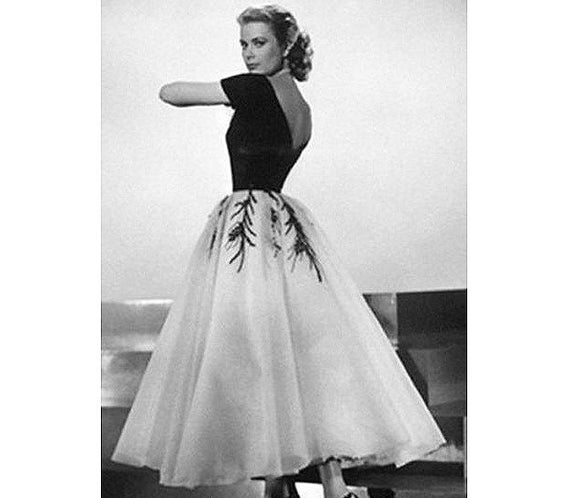
for years. I don’t need to tell him how.'" (Alfred Hitchcock Geek blog). Mr. Grant, of course, had retained an apartment at the hotel for many years. There were also issues with casting Eva Marie Saint as Eve Kendall. Though Ms. Saint had already won an Oscar for On the Waterfront (1954), MGM wanted Cyd Charisse in the role, and Cary Grant was angling to have Sophia Loren cast in the part (he was deeply in love with her at that point). But Ms. Saint brings that cool Hitchcock blonde with the inner raging fires to the part. She said in a interview for Vanity Fair that the intensity of the train kissing scene caused a photographer to fall off his ladder, so engaged was he in action! She also gets to wear my second favorite dress in all of moviedom (see it above. My first, for the record, is Grace Kelly's black and white outfit in Rear Window. Both created by the imaginative Edith Head).
The film features several interesting villains - James Mason is quite good as Phillip VanDamm. But the performance that really stands out is that of Martin Landau as Leonard, VanDamm's "right hand." Landau, with eyes that never seem to close, and a serpentine way of walking is both disturbing and fascinating. This AFI catalog entry notes that the Production Code Administration (PCA) was concerned at Leonard's seeming effeminate. With lines like "Call it my woman's intuition, if you will" and VanDamm's response that "I think you're jealous. No, I mean it. I'm very touched, very," Hitchcock plays up an interesting relationship between the two (and ignores the PCA). The disappearance of the character Licht (as portrayed by Robert Ellenstein) became much clearer when the film is viewed on a big screen. Licht is one of the men who kidnaps Roger (he's on Mr. Grant's right in the lobby card at the top. He's also notable for his odd way of holding a cigarette). We see him several times; then he disappears. Why? Well, he was on the cropduster flight that attacked Roger! The newspaper announces that two people were killed in the crash (not as easy to see on a TV screen), and someone was firing a gun BACK at Roger (as the plane passed him, so the sniper was leaning from the plane window and firing back at him.). Ergo, Licht was the sniper, and one of the two people killed when the plane collides with the oil tank truck.
Two other performances are really too wonderful to ignore. The first is Jessie Royce Landis as Roger's mother, Clara Thornhill. A bit dotty ("You gentlemen aren't really trying to kill my son, are you?") and mercenary (she takes $50 from her son to con a room key from a hotel clerk), she is also delightful and droll. Famously, it's been said that Ms. Landis was YOUNGER than her onscreen son, however she had claimed herself younger than she actually was (she was in reality 8 years older than Mr. Grant). Regardless, they make a delightful combination. Leo G. Carroll (The Professor) had already appeared in five Hitchcock movies, including Rebecca (1940) and Suspicion (1941); the latter was Cary Grant's first film with Hitchcock. Born in England in 1886, Mr. Carroll started his career on the London stage, eventually moving to New York, where he appeared in 35 Broadway plays, including the title role in The Late George Apley (1944), a screen part that would go to Ronald Colman and Detective Rough in Angel Street (1941), which would be reworked for Joseph Cotten in Gaslight (1944). Seemingly always cast as an old man (his film career didn't really start until he was nearly 50), Mr. Carroll played a wide variety of supporting roles from Phelps Finnegan in Sadie McKee (1934) to Count Bertil Jacobsson in The Prize (1963). For two years, he dealt with two chatty spirits on TV's Topper (1953-1955), but he became known to a new audience as the enigmatic Alexander Waverly in The Man From U.N.C.L.E. (1964-1968). Mr. Carroll was married to Edith Nancy de Silva from 1926 until his death at the age of 85 in 1972.
When North by Northwest opened at Radio City Music Hall in New York City (and other venues nationwide), it garnered praise, as in this New York Timesreview, which commented that it was "the year's most scenic, intriguing and merriest chase,"or a review in Variety which said that "the Alfred Hitchcock mixture - suspense, intrigue, comedy, humor. . . Seldom has . . .been served up so delectably." In 1995, it was added to the Library of Congress' National Film Registry. And the American Film Institute put it in 4th position in their 100 Years, 100 Thrills listing.
If you've not yet seen this film, please do yourself a favor and get hold of a copy. In the meantime, I'll leave you with the sexually charged dinner conversation between Cary Grant and Eva Marie Saint.
TCM Fathom Event recently aired the magnificent Rear Window (1954), and we were quite delighted to be able to attend. Starring James Stewart as
L. B. "Jeff" Jeffries and Grace Kelly
as Lisa Carol Fremont, directed by Alfred Hitchcock, and with a supporting cast to die for, this is unarguably a Hitchcock masterpiece. For those unfamiliar with the plot, here's a brief rundown of the premise. Jeff Jeffries, a highly regarded international photographer has been laid up for 5 weeks in a cast up to his hip, having broken his leg trying to get a photo of a race car in action (he got the picture). During a hot New York summer (it's the 1950s - there's no in-home air-conditioning), with one week of immobility left (stuck in a walk-up apartment he's not left since his injury), Jeff is bored, so he stares out his window, peering into the lives of his neighbors. He's got nicknames for all of them, and he imagines their life stories from his "rear window" view. Then, one hot night, as he dozes in his wheelchair, he thinks he sees a murder. Some years ago, I attended a class on Hitchcock's film. The class was taught by Donald Spoto, author of many books about Hollywood, but most especially, the author of The Art of Alfred Hitchcock. One of the points he made was that, as Jeff looks into the windows of his neighbors, what he sees are alternate versions of his own life and that of Lisa, the woman he loves (but is determined NOT to marry). He sees a pair of newlyweds, a satisfied older couple doting on a beloved dog, a couple who bicker constantly (with Raymond Burr as the husband, Lars Thorwald), a lonely middle-aged woman (Judith Evelyn
as "Miss Lonely Hearts"), a young woman surrounded by suitors, and a composer (played by Ross Bagdasarian), who can't seem to get his work noticed. Which life will Jeff get? We'll never know (hopefully not the Raymond Burr thread!), but Lisa has own ideas, and is a pretty determined lady!
I don't think there is a movie on earth that has Thelma Ritter (Stella) in it that is bad. Her very presence moves the film up a notch, in my humble opinion. Ritter's part was not in the original short story by Cornell Woolrich (neither was Grace Kelly's), and according to one of the TCM articles you'll find here, Ritter's part was enlarged after the initial script was completed to provide some humor and humanity to the part of Jeff. The film needed, according to writer John Michael Hayes, some comedy to get the audience immediately engaged with the character. He knew that Hitchcock had cast Ritter, and there is no better mouthpiece for the human condition than the phenomenal Thelma Ritter. And then there is the other lady in Jeff's life, the ever-glorious Grace Kelly. A woman of jaw-dropping beauty, Hitchcock, perhaps more than any other director, was able to make her a woman of parts - beautiful, fashionable, smart, daring, passionate. Her Lisa is unexpected - Jeff leads us to expect she is only a fashionplate - interested in clothing and nothing else. And while her entrance - twirling around the room in a dress that I would give my eye-teeth for - seems to support that, it isn't long before we realize that Jeff is an idiot - as Stella told him - Lisa is a jewel beyond price.
Seeing Rear Window in a theatre is a treat beyond compare. While it is good on a television, it's even more magnificent when you can see the framing the way Hitchcock meant it to be seen. Filmed in wide-screen and Technicolor, the movie still manages to convey the claustrophobic atmosphere that has become Jeff's life, as he goes from a boundless world, to a confined, one-room apartment. It is a film you can see again and again, and each time see something new and exciting. Grace Kelly's marvelous wardrobe was designed by Edith Head. Every one of her dresses is glorious, but I'm going to leave you with a clip that contains my personal favorite dress. Meet Lisa Carole Freemont!:
"Last night I dreamt I went to Manderley again..." is perhaps one of the most famous opening lines of a novel. Last night, I too went to Manderley again, submerging myself in the wonder that is Rebecca (1940), Alfred Hitchcock's first American film, and his only film to win a Best Picture Oscar. Aired as part of TCM's Summer Under the Stars tribute to Joan Fontaine, Rebecca is a remarkable film. Starring Joan Fontaine as the nameless second Mrs. deWinter, Laurence Olivier as her husband - and the widower of the unseen, but always felt, Rebecca - Maxim, and Judith Anderson as the always creepy Mrs. Danvers, it faithfully represents the Daphne du Maurier novel, yet creates compelling cinema AND manages to placate the Production Code.
The story of Rebecca open in Monte Carlo. Our heroine is wandering the cliff-side, when she sees a man gazing over the edge of the precipice. Alarmed, she cries out. He reacts violently, telling her loudly to mind her own business. That evening, as she sits in the lobby of the hotel with her employer, the crude Edyth van Hopper (played by the always wonderful Florence Bates), who should appear but That Man - Maxim de Winter, the wealthy owner of Manderley, and a lion of the social set. Mrs. van Hopper tries to ingratiate herself to him, to no avail (though she is oblivious to Maxim's disregard of her). Maxim is much more intrigued by her paid companion, and when Mrs. van Hopper is relegated to her room by a cold, the girl and Maxim begin to keep company. She, of course, is immediately smitten by him. He treats her as a child, needing constant care and correction. But, when Mrs. Van Hopper decides to drag the girl back to America, Maxim proposes marriage. Following a happy honeymoon, the couple returns to Manderley, and the second Mrs. De Winter finds that her life is a constant stream of insecurity and fear.
Joan Fontaine is really perfect as the second Mrs. De Winter. Her mannerisms, which can sometimes be annoying, work beautifully here; they highlight her naivety and anxiety. Laurence Olivier provides the perfect balance of superciliousness and affection as Maxim. One is never quite sure of his love for his second wife, nor his feelings for Rebecca. Which is as it should be - Rebecca needs to hover over the proceedings, as her minion, the magnificent Mrs. Danvers attempts to destroy Maxim's marriage, as well as his new wife. Ms. Anderson was rightfully nominated for an Oscar for her performance (losing to Jane Darwell in The Grapes of Wrath). Watch her as she shows the second wife Rebecca's room and belongings. Her obsession with, and passion for, Rebecca oozes from her. She is frightening and fascinating. Also notable is George Sanders as Rebecca's "cousin" Jack Favell. Sanders revels in his "hail fellow well met" persona, as he tries to figure out the best way to wring some money out of Maxim, and intimidate the second Mrs. De Winter. Just seeing his character, you get a clearer picture of who Rebecca really was (and don't like her much, as a result). TCM has a wealth of information about this film. One place to start is this article which discusses the uneasy relationship between director Hitchcock and David Selznick. Where Hitchcock had intended to use the novel of Rebecca as merely a jumping-off point, Selznick required an exact retelling of the novel. Though one change did have to be made - Rebecca's death in the book is somewhat different than the circumstances described in the movie. The Production Code would not have allowed the film to end as it did with the original story line. So great was Hitchcock's antipathy for Selznick, that he used him as the model for Raymond Burr's character in Rear Window! A trailer from the film is below. If you've never seen Rebecca, do yourself a favor and put it at the top of your list.
 May 16th is National Classic Movie Day and to celebrate, I'm participating in this year's blogathon, Five Favorite Films from the Fifties. Be sure to follow the link to see the work of other bloggers, and find discussions of films you might never have thought to view.
 In 1931, Fred and Adele Astaire (along with Frank Morgan and Helen Broderick) starred in the Broadway play, The Band Wagon. It was a musical revue; this film has nothing to do with it, though I Love Louisa and Dancing in the Dark were both performed in the play. The film has a script by Betty Comden and Adolph Green, who loosely based the story on Mr. Astaire. He'd tried retirement for a few years, but was coaxed back to star in the very successful Easter Parade (1948); his most recent film, however (The Belle of New York) that had not done well (for more on Fred Astaire and The Band Wagon see this article in The Paris Review). The Martons were based on Comden and Green (though the real-life writing duo were not married), and Cordova was based on José Ferrer, who between 1946 and 1948 produced, directed, and/or starred in 8 Broadway plays - and did 10 more in the next three years! (TCM articles).
  Dr. Benjamin McKenna (James Stewart) is on vacation in Morocco with his wife Josephine Conway (Doris Day), a well-known singer who retired to take care of their son Hank (Christopher Olsen). They are befriended by Louis Bernard (Daniel Gélin), a Frenchman who asks way too many questions for Jo's tastes. Bernard is murdered and whispers to Ben that a statesman is targeted for murder. But the would-be murderers have their own plan - snatch young Hank to be sure that Jo and Ben don't contact the police.

 One of the things that really intrigues me is that Helen is clearly an unwed mother, yet there are no recriminations from anyone. Patrice is obviously aware that Helen has never had a wedding ring, and generously lets Helen slip on Patrice's ring. Originally, Helen was to have been a prostitute (AFI catalog), but in my opinion, Helen as a rejected lover makes for a more interesting story line.