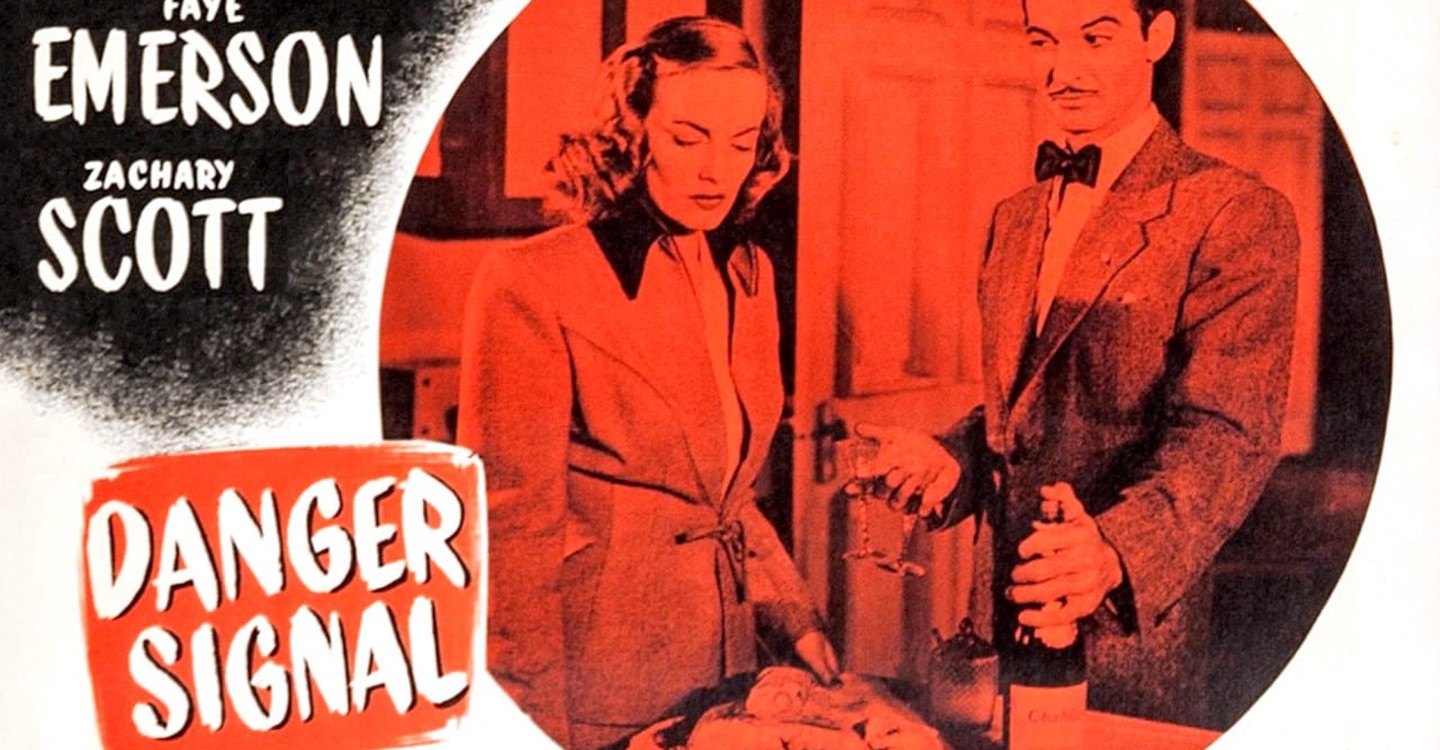
Ronnie Marsh (Zachary Scott) is a fast talking, fascinating man, who manages to convince Hilda Fenchurch (Faye Emerson) to rent him a room in the home she shares with her mother (Mary Servoss). Ronnie recently beat a hasty retreat from another town, where he was almost found with the dead body of Alice Turner. Ronnie rapidly decides that Hilda and her home offer a nice way for him to live comfortably, and he successfully woos her. But he changes his mind about his target when Hilda's younger sister Anne (Mona Freeman) returns home - Anne, you see has a substantial inheritance. Watch for the Danger Signal (1945)! With Zachary Scott (who interestingly is not given top billing) in this film, you are in for a wild ride. He's perfect as an amoral seducer who is also probably a murderer. He has just the right amount of appeal that you understand why Hilda would fall for him, as well as the ability to make the audience cringe as you realize what an absolute heel he is. Mr. Scott has an odd smile, and he has a way of turning it from endearing to menacing at the drop of a hat. The audience keeps watching because you're never sure what he will do next. This film was released the same year as Mildred Pierce, in which Mr. Scott plays another remarkable scoundrel. Though the characters have been compared to each other (Zachary Scott: Hollywood's Sophisticated Cad by Ronald L. Davis), these really are very different roles. You never fear Monty Beragon - he's lazy and, relatively speaking, harmless. Ronnie, on the other hand is a snake - he hypnotizes his victims, and then bites.
Faye Emerson is equally appealing as Hilda. You have to like her if you are to appreciate the film - you need to worry about her, and wonder just what she is capable of doing to preserve her family. She's fascinated by Ronnie from their first meeting; her poise and obvious intelligence help to convince the audience of Ronnie's power over women. It's one thing when her mother and sister succumb to his charms. It's quite another when Hilda falls. Ms. Emerson moved to California as a small child; in 1941, she landed a Warner Brother's contract after appearing in local stage productions. She had small parts in a number of a movies, like Air Force (1943) and Destination Toyko (1943), but B movies - like Lady Gangster (1942) -were her forte. Her first marriage disintegrated primarily because of her career; in 1943, she met Elliot Roosevelt, the son of the President. They married during the filming of this movie (which was one of a number of delays caused by their relationship), but the marriage only lasted until 1950. During the marriage, she left her Warner Brothers' contract, planning to spend the time with her husband. When she decided to return to work, she went first to Broadway (appearing in The Play's the Thing (1948) - she would ultimately appear in 5 Broadway plays) and to television, where she hosted The Faye Emerson Show. She would later work with her third husband, Skitch Henderson and become a regular on game shows and talk shows (Women Pioneers in Television: Biographies of Fifteen Industry Leaders by Cary O'Dell). Ms. Emerson retired in 1963; she died in 1983 at the age of 65.
Ann Blyth was originally slated for the role of Anne, but a back injury caused her to drop out (AFI catalog). Mona Freedman does a good job in a thankless role; Anne makes a good contrast to Hilda - she's silly, feckless, and uncaring. It's hard to like or care about Anne - she has little regard for the rest of her family and seems to get pleasure out of hurting her sister. In contrast, Rosemary DeCamp is excellent and convincing as psychiatrist Dr. Jane Silla - the voice of reason and experience in the film. The character is a tip of the hat to the novel’s author, Phyllis Bottome, who was a student of psychologist Alfred Adler (Eddie Muller intro). Ms. DeCamp would later state this was her favorite film role (TCM article). Dick (Richard) Erdman, who has a small amount of screen time as Anne's would-be love interest, Bunkie, died last year at the of 93, after a career in films and television that lasted from 1944 until 2017. Bruce Bennett (Dr. Andrew Lang) is banal as Hilda's boss - a research physician working in botulism. Appearing opposite Zachary Scott again (he was Bert Pierce in Mildred Pierce), Mr. Bennett fades into the background - he's not really a dynamic personality, and placed in contrast to Mr. Scott, well, there simply is no comparison.
Thomas M. Pryor's (TMP) review in the New York Times was lukewarm, however, the film showed a profit at the box office. There's only one problem - it's the ending, which takes a very bizarre turn that can make you feel a like you have a slight case of whiplash. Regardless, you will spend the film engaged with the characters and the story. We'll leave you with the trailer:
From the stage of I’d Rather Be Right, George M. Cohan (James Cagney), famed actor and the composer/lyricist of Yankee Doodle Dandy (1942), is summoned to Washington DC to meet President Roosevelt. At the President’s request, Cohan recounts the story of his life.
This post is part of the Politics on Film Blogathon, hosted by the Classic Movie Blog Association. James Cagney gives the performance of a lifetime as Cohan. Though the role was offered to Fred Astaire (Mr. Astaire said no - he felt he was wrong to portray Cohan; he was right), and finally was given to Mr. Cagney, who was eager to play the part (TCM article). Mr. Cagney had always considered himself a hoofer - his first job in the theatre was dancing in the chorus (Library of Congress biography) - and he was eager to get away from the gangsters to which his career had been relegated. He'd also on occasion been accused of being a communist (his activities in the Screen Actors Guild were part of the issue), and playing Cohan showed him as the ultimate American patriot. Mr. Cagney was a perfectionist, and demanded long rehearsals to perfect his dancing. He was coached by Johnny Boyle, a vaudevillian who was highly regarded as an Irish-American tap dancer. At the same time, he was not averse to improvisation - when he first meets Mary Cohan (Joan Leslie), Mr. Cagney improvised most of his "business." The stair dance at the conclusion of the film was also spur of the moment. The dancing style, however was very reminiscent of Cohan's style (you can see some brief clips of Mr. Cohan dancing in this video). His dynamic dancing makes the film - when he is on screen you cannot take your eyes off him. He's no singer, but as Joan Leslie pointed out "Jim doesn't sing, because he doesn't sing worth a darn. He'd talk it, and every now and again, he'd hit a note...but he had some much energy and such a presence that it doesn't seem like he couldn't sing." (Michael Curtiz: A Life in Film by Alan K. Rode).
Joan Leslie is a strong counterpart to Mr. Cagney. She gives Mary just the right amount of naivete in the beginning, and slowing moves the character into a knowing and supportive partner. Ms. Leslie had an excellent singing voice, and could dance a bit; she follows Mr. Cagney's lead, as he improvises some of their scenes together, she responds easily. Ms. Leslie is playing a primarily fictional character. George M. Cohan was married twice - to Ethel Levey and Agnes Nolan.
When he agreed to the film biography, he stipulated that he didn't want either of his wives discussed. Warner Brothers decided to
create an amalgam of the two women and give her a different name, thus
abiding by Cohan's requirement and still having him be married - as well
as provide a motivation for the song "Mary's A Grand Old Name." Yankee Doodle Dandy is very much a Cagney family affair. James
Cagney's brother, William, served as the producer, and sister Jeanne
Cagney appears as Josie Cohan. The easy relationship between the brother and sister, combined with the talents of Rosemary DeCamp (Nellie Cohan) and Walter Huston
(Jerry Cohan) make for a strong family unit. Ms. DeCamp was actually 11 years younger than Mr. Cagney. Her autobiography comments on the difficulties she and Ms. Cagney had learning the complex dance routines (Tigers in My Lap by Rosemary DeCamp).
Walter Huston, however, had a theatre background - he'd worked in Vaudeville, and among his fourteen Broadway credits was the musical Knickerbocker Holiday. He has what is perhaps the most moving scene in the film - the death of Jerry Cohan. According to Rudy Behmer (in his commentary on the DVD), Michael Curtiz broke down sobbing as he watched Cagney perform. He ruined at least one take and can be heard in the background of the film if you listen carefully. The film also features strong performances by Richard Whorf
(Sam H. Harris) and Irene Manning
(Fay Templeton). George Tobias (Dietz) appears as a would-be theatrical impresario. And S.Z. "Cuddles" Sakall (Schwab) has one scene as the man who stages Cohan and Harris first production. Though the scene is fine, Mr. Cagney was initially upset that Mr. Sakall was mugging through the filming - he asked Mr. Curtiz to tone Sakall down. Much of his work ended up on the cutting room floor.
Obviously, a lot of the history is incorrect - the frame story in particular is not anywhere the actual story. World War II broke out while Yankee Doodle Dandy was being filmed (Ms. DeCamp related the company huddled around a radio on the set, listening to Franklin Roosevelt deliver his address to Congress). I’d Rather Be Right, however, ran from November 1937 to July 1938. And Roosevelt gave Cohan the Congressional Gold Medal (NOT, as stated in the film, the Congressional Medal of Honor - the Medal of Honor is a military award) in May of 1940. It had been awarded in June of 1936, but Cohan (a Democrat), disliked unions and though an early Roosevelt supporter was not fond of Roosevelt's pro-union stance. The photo below (from the Library of Congress), shows George M. Cohan receiving the Gold Metal from the President. Mr. Cohan died in November of 1942, a few months after the film was released (AFI Catalog).
Bosley Crowther's review in the New York Times was glowing: "as warm and delightful a musical picture as has hit the screen in years, a
corking good entertainment and as affectionate, if not as accurate, a
film biography as has ever—yes, ever—been made." A Roger Ebert review from 1998 was also complimentary. The film received three Academy Awards (for Actor - Mr. Cagney, Sound Recording, and Scoring of a Musical). It was also nominated for five awards: Picture, Supporting Actor - Walter Huston, Director, Original Screenplay, and Film Editing). In 1993, it was added to the National Film Registry. It is #18 on AFI's list of musicals, #100 on the original 100 Years, 100 Movies, and #98 on the 10th Anniversary list. If you'd like to read more about this exceptional picture, take a look at "‘A Great American Service’: George M. Cohan, the Stage, and the Nation in Yankee Doodle Dandy" by
Elizabeth Titrington Craft from
The Oxford Handbook of Musical Theatre Screen Adaptations
Edited by Dominic McHugh Oxford Handbook Online and this American Heritagearticle. If you've never seen Yankee Doodle Dandy, treat yourself and get hold of a copy. In the meantime, here is the trailer:
This post is part of the Classic Movie Blog Association Blogathon, Politics on Film. Please visit the website to read some of the other wonderful posts.
We return for a visit with an old friend - Olivia de Havilland in Hold Back the Dawn (1941). This is an absolutely wonderful film, romantic and engaging. Sure, it's a melodrama, but in the best sense of the word, with characters that grow and keep you engaged in their stories. It also continues to be a timely story - that of immigration and the desire for people to find a home in the United States.
The film is narrated by Georges Iscovescu (Charles Boyer), who is on the run and trying desperately to get some money. He sneaks into the Paramount lot, to tell his story to Hollywood director, Mr. Saxon (played by Hold Back the Dawn's actual director, Mitchell Leisen). The war in Europe is raging, and Georges has escaped Europe to Mexico, intent on settling in the U.S. However, the U.S. immigration quota for Romania (Georges' place of birth) has already been exhausted, and there is a long waiting list. Georges finds himself stuck in a seedy little bordertown hotel, with other hopeful immigrants, waiting from five to eight years for a spot to open up. The arrival of Anita Dixon Shaughnessy (Paulette Goddard), Georges former dancing partner and lover, presents another option: marry an unknowing American and get a green card as the spouse of a U.S. citizen. Once in the country, divorce the duped spouse, and go off with Anita. Georges sets his sights on Emmy Brown (Olivia de Havilland), a shy schoolteacher in Mexico for the day.
The film contains some absolutely outstanding performances. Charles Boyer is wonderful as a cad who gradually changes into a decent person (and in some sense, much against his will). As he begins to fall in love with Emmy, we can see his inner battle between his growing feelings for her and his desire to resume his wayward life. As Emmy, Olivia de Havilland is sweet and generous, but with an inner core of strength that becomes apparent towards the film's end. Her conversation with Anita, and her comment that she is "from a small town. We don't have any of those fine
hotels. We eat at the drugstore... But we leave a tip just the same" is both biting and assertive. Finally, Paulette Goddard gives us an Anita who is grasping, passionate, and self-serving, but is also an absolute riot. That our immigration officer, Mr. Hammock (played with verve by Walter Abel) is also attracted and amused.
This film features a number of memorable performances by the supporting cast. Of special note is Rosemary deCamp as Berta Kurz. Patiently waiting to get into the US, the pregnant Berta is all the more sympathetic because of her desire to make a better life for her child. Without giving too much away, her actions to make sure that her child will have a secure future will have you rooting her her. Hold Back the Dawn was released in September of 1941, just before the war in the U.S. starts, but after the war in Europe has forced thousands of refugees to flee the Nazis. Though never stated, it seems obvious that Berta and her husband are Jews, fleeing the holocaust. It's interesting that the film never discusses WHAT the characters are running away from, yet you cheer for them all the same.
Costuming for the film is done by Edith Head; here she creates a variety of costumes, with bold, elaborate clothing for Anita, and simpler, more everyday garb for Emmy. The costuming tells us a great deal about the characters, adding even more dimenions to the characterizations.
Watch for the scene where Georges is escaping
from the police. It's quite well done, but has some humorous moments.
Also, George's encounter with an American woman at the bullfight is also quite
funny. Watch their faces as her marital status becomes apparent.
Finally, the lovely scene in which Emmy names some olives that Georges
shook from a tree (you have to see the film to find out why) is gentle
and romantic.
The film is based on an autobiographic story by Ketti Frings, with a script by Billy Wilder and Charles Bracken. This TCM article
discusses some of the story and script changes, causing some annoyance
to all of the authors. Despite the changes, this is still a remarkable
script. Robert Osborne, in an introduction to the film on TCM noted that deHavilland was in the unenviable position at her home studio of Warner Brothers of having to go outside the studio to find good roles. Here, she goes to Paramount, and ends up with an Oscar nomination. It is worth noting that, at Oscar time, Olivia DeHavilland was pitted against her sister Joan Fontaine (for the film Suspicion), the first time siblings had competed for the same award. Joan, of course, won, beginning rumors of a feud between the sisters. This Hollywood Reporterarticle looks at the story behind the feud.
As we leave you, here is a brief scene of Georges romances Emmy in pursuit of a green card: