Showing posts with label Nancy Coleman. Show all posts

Monday, September 13, 2021

Errol Escapes

When their bomber crashes in Nazi Germany, a group of Allied airmen make a Desperate Journey (1942) to get out of the country with information that may help the war effort. 

Let's begin by admitting that this is very much a wartime propaganda film.  According to this movie, five Allied officers can take down the entire Nazi war machine and defeat it without breaking into much of a sweat.  Regardless, it's an interesting adventure, with snappy (albeit somewhat jingoistic) dialog and a good rapport among the lead and supporting actors.

Errol Flynn gets top billing as Flight Lt Terrence Forbes, an Australian working with the Allied command in Europe.  This is one of the few times in which Flynn gets to play someone from his native land, and he's quite good as the cocky, but competent Forbes. Errol Flynn was examined by the draft board, but physicians discovered that he had tuberculosis.  Knowing that he would be unable to work (and would not be entitled to any money during his recuperation), Mr. Flynn declined to let the studio know of his illness, nor accept any of the treatments available to him (TCM article). As a result, he lost  a tremendous amount of weight (forcing wardrobe adjustments). Frequently late for work, he was difficult to work with during the shoot.

Ronald Reagan (Flying Officer Johnny Hammond) was just off his rousing success in King's Row (1942), and gets second billing above the title with Errol Flynn.  He's good as the devil-may-care American, and got to be the hero of the piece, knocking out Major Otto Baumeister (Raymond Massey), albeit off-camera.  Errol Flynn wanted to the the one to do that particular deed, but he was told no.  Mr. Reagan was called up for military service while shooting the picture - they allowed him a week to finish up the production.  His three years of service did not help his career; he was never able to regain the momentum following King's Row. However, he eventually had other career goals.

The role of Kaethe Brahms was originally intended for Kaaren Verne, but she was replaced by Nancy Coleman (AFI Catalog). It's not a big part, but Ms. Coleman does her best to make Kaethe heroic and appealing.  If there is one fault in the film, it is the scene where the escaping flyers share a meal with Kaethe's parents. Relaxing for the first time in awhile, the men talk liberally - something no soldier would do in these circumstances.  

Raymond Massey has the most thankless part. Major Otto Baumeister is downright stupid, and his Nazi soldiers resemble nothing more than the Keystone Kops.  Massey is a good actor, but you wouldn't know it here.  He's really given nothing with which to work.

We have a number of other good actors in the film - Alan Hale as Flight Sergeant Kirk Edwards gets to do some of the comic relief. Arthur Kennedy (Flying Officer Jed Forrest) is the conscience of the group - trying to keep them on task towards getting home with the information they've obtained.  This would be Ronald Sinclair (Flight Sergeant Lloyd Hollis) last acting role (he'd been a child actor) -  he became a film editor, working with Roger Corman.
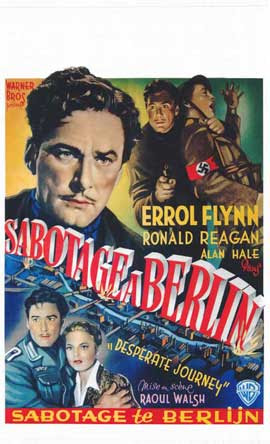
Bosley Crowther, in his The New York Times review, was unimpressed with the movie - "an invasion of Nazi Germany which would put the Commandos to shame." It was nominated for an Oscar for Special Effects (it lost to Reap the Wild Wind). While this is not the best movie ever made, it's fun, with an enjoyable cast.  We'll leave you with this trailer:


Tuesday, November 20, 2018

Barbara Needs a Lawyer

Since the death of her father when she was 9 years old, Fiona Gaylord (Barbara Stanwyck) has been the titular head of the family. As such, she has spent much of her life in court, fighting to get her father's will to probate. An alleged remarriage, the death of various lawyers, and a second will that leaves 10% of the estate to a charity have delayed action on the will and forced Fiona, Susanna (Nancy Coleman), and Evelyn (Geraldine Fitzgerald) into near penury. In the 23rd year of the court proceedings, the crux of the matter is now that Charles Barclay (George Brent), who heads the charity that would benefit from the new will, is trying to force The Gay Sisters (1942) to sell their home, something that Fiona rejects.

Based on the novel of the same name by Stephen Longstreet, the plot of The Gay Sisters owes much to Dickens. If you've ever read Bleak House, you'll find that the basic plot is the same - conflicting wills and children driven to near bankruptcy as they wait years for a resolution to their case. The novel is possibly based on actual events: the Barkley Square project is the Rockefellers vs the Vanderbilts regarding the construction of Rockefeller Center. (TCM article).
As is so often the case, Ms. Stanwyck was not the first choice for Fiona. The film was intended for Bette Davis, with sister Evelyn Gaylord Burton played by Mary Astor. Though Ms. Davis and Ms. Astor got along swimmingly on the set of The Great Lie the previous year (the two women rewrote and improvised to strengthen the script (TCM article)), Ms. Davis felt that Ms. Astor would appear to old for the role of younger sister Evelyn. (TCM notes). In the long run, Ms. Davis felt that Fiona was too hard and withdrew, with Irene Dunne, Norma Shearer, and Katharine Hepburn all considered for the part. Ms. Stanwyck is excellent in a role that can be unpleasant at times. She is able to make Fiona tough and likeable. 

Another almost casting note was Olivia de Havilland as Susanna, but Ms. de Havilland wanted a vacation, so the part went to Nancy Coleman instead (AFI catalog). Like Fiona, this is a tricky part; Ms. Coleman does a decent job of keeping Susanna from being too much of a doormat, though there are times you would like to shake her. With two such powerful sisters, she is much too unwilling to confront anyone, and it can become irksome after awhile.
In the few films in which he was listed, Gig Young had heretofore been acting under his real name - Byron Barr. The audience, however, liked his character's name, so in this film (and after) he was listed as Gig Young. He's good in the role, though one wonders at the character's attraction to Evelyn. Regardless, Mr. Young makes it clear that sexual chemistry is not enough for Gig. Mr. Young had a long and successful career. He moved into television in the 1950s, but continued acting in films, eventually winning an Oscar (after two prior nominations) for Best Supporting Actor in They Shoot Horses, Don't They? (1969). Married five times (including 7 years to Elizabeth Montgomery), he inexplicably shot to death his wife of less than one month, then killed himself. 

George Brent has a nearly impossible role to play. We find out that he's a rapist (sure, he and Fiona were legally married, but it's still rape). He's trying to steal her property for his grand real estate scheme, all because he is in love with her. Huh? Mr. Brent does a decent job; you do end up rooting for him a little - not to win the case, but to come to his senses. 
Young Larry Simms (Austin) is jdelightful as Fiona's ward (and son). The interplay between him and Ms. Stanwyck is wonderful - her stamping of her feet to make him follow orders, and his growing trust of her make Fiona a more likeable person. Mr. Simms (who died in 2009) left films in 1954 -  he really didn't much care for acting - to join the Navy. He would later have a career that took him around the world as an aeronautical engineering. He spent his acting years primarily playing Alexander "Baby Dumpling" Bumstead in the Blondie series. 

The film features a plethora of excellent character performances, including Donald Crisp and Gene Lockhart, as good lawyer Ralph Pedloch and shady lawyer Herschell Gibbon. We also have a brief appearance from Ann Revere as Ida Orner, the nurse who attended Fiona during her confinement. It's wonderful to get such excellent actors in even these minor parts.
The story was aired on the Lux Radio Theater in November 1942, with Ms. Stanwyck and Robert Young as Fiona and Charles. In November 1956 it was revived on the Lux Video Theatre, this time starring Alexis Smith and Don Taylor.

With so much going on, the plot can become a bit dense, but we found this to be an enjoyable film.  The New York Times review, however was very unfavorable; based on some of his comments, we wondered if the reviewer was watching the same movie.  We'll leave you with the trailer to the film:

Monday, June 21, 2010

Olivia Writes a Novel

This week, we were able to watch Devotion, wherein Olivia plays Charlotte Bronte, and gets to write the novel Jane Eyre. Again, Ms. De Havilland plays second lead, this time to Ida Lupino, who is playing her sister Emily. Ms. Lupino has the meatier role, as the tortured, dying Charlotte, but Ms. De Havilland ends up with more screen time (and more to do than just be tortured).  Her Charlotte harkens back to some of the earlier teen roles we've seen, such as Call it a Day and It's Love I'm After, where she gets to fall in love with a man who is already taken (and be a tad silly about it). However, this is no screwball story.  Because in the end, both sisters end up in love with the same man - Paul Henreid as the Reverend Arthur Nicholls. And he is oblivious to one of them.

As history, this film rather plays fast and loose.  Yes, Bramwell (Arthur Kennedy) was an alcoholic, and yes, Emily did die of TB.  But so did Anne Bronte (played by Nancy Coleman) and you wouldn't know it from this movie. In fact, Anne died about 6 months after Emily.  Charlotte did go to London, but after Emily's and Anne's deaths.  And Charlotte's marriage to Arthur Nicholls was no happy ending.  Her father was totally against the marriage, because he feared that marriage would kill his only surviving child (of the 6 born to him). He was right. Charlotte became pregnant; she and the baby died, probably the result of hyperemesis gravidarum, or excessive morning sickness resulting in malnutrition.  Another point, the sisters were all very small and probably slender - at an exhibit of their books and item at the Morgan Library in New York City, I saw one of Emily's gloves. It was TINY. I have VERY small hands - the glove would not have fit me. None of these ladies is in the least bit tiny or frail-looking!! A couple of items that they did get right though, were rather fun. The sisters three books (Jane Eyre, Wuthering Heights and Agnes Grey) did come out together (in fact Wuthering Heights and Agnes Grey were published in the same three volume set). The other little piece that we enjoyed was that, when Charlotte visits Arthur Nicholls to give him a copy of her novel, she is holding three books. Indeed, Jane Eyre was published (as many novels were at the time - to accommodate lending libraries) in a three-volume set!

Like many historical films that play a little to fast and loose, this can be a problematic movie, but the acting is wonderful. We have some lovely character pieces here, especially Sydney Greenstreet as William Makepeace Thackeray, who manages to portray Thackeray as an adorable egoist!  Also fun to watch is Odette Myrtil as Mme Heger, who reminded us very much of Peggy Wood as the patient wife of the artist in Call it a Day.

We hope to see you again next week.  In the meantime, here's a trailer from the film: