Showing posts with label screwball comedy. Show all posts

Monday, May 20, 2019

Clark Rides the Night Bus

When Ellie Andrews (Claudette Colbert) literally jumps ship to join her new husband King Westley (Jameson Thomas) - over her father's vehement objections - hell breaks loose. Alexander Andrews (Walter Connolly) hires every detective he can find to search for Ellie, but she has other ideas. She boards the night bus to New York City to reach Westley. Unfortunately, Ellie has no idea of how to be on the lam; she is befriended by reporter Peter Warne (Clark Gable) who plans on using her story to get back in good graces with his editor. Our film is It Happened One Night (1936).

Victoria Riskin provided an introduction to this film, which was part of the Fay Wray/Robert Riskin Retrospective at the AFI Silver Theatre.  Mr. Riskin collaborated with Frank Capra on the film -  Mr. Capra read the story Night Bus by Samuel Hopkins Adams, which was published in Cosmopolitan, and approached Mr. Riskin about adapting it for the screen (Fay Wray and Robert Riskin: A Hollywood Memoir by Victoria Riskin); they pitched it to Harry Cohn at Columbia.

Myrna Loy, Miriam Hopkins, Constance Bennett and Margaret Sullavan were all approached to play Ellie. Finally, Claudette Colbert (who was not enthusiastic) consented to do the part, contingent upon a hefty salary. Similarly, Robert Montgomery was requested for the part of Peter, but Louis B. Mayer decided to send Clark Gable instead; Mayer resented Gable's increased salary demands and decided four weeks at a Poverty Row studio was fit punishment (AFI Catalog).  By the film's conclusion, no one was particularly thrilled with the result - except the audiences!
Claudette Colbert is excellent as Ellie. It's a difficult part - Ellie needs to be snooty enough to be believable as a spoiled brat, but warm enough to attract Peter's attentions from the start. Ms. Colbert had not wanted to work with Frank Capra again (there had been some animosity on the 1927 film For the Love of Mike) and she was unwilling to show her legs for the now-famous hitchhiking scene. However, when Mr. Capra brought in a model to be "the leg," Ms. Colbert said, "get her out of here, I'll do it -- that's not my leg!" and did the scene that has become synonymous with the film (TCM article). She left the film convince it was "the worst picture in the world," but by 1982, when Frank Capra received the AFI Lifetime Achievement award, she was much more enthusiastic. (You can see her speech here).
While Mr. Gable had worn a mustache in other films, the reaction to his appearance in It Happened One Night convinced him that he should keep it permanently (Clark Gable: A Biography by Warren G. Harris). He also began wearing a trenchcoat as a lucky charm. Mr. Gable gives Peter Warne just enough arrogance to stand up to Ellie, but he's also warm and gentle. There's a scene in which a woman faints on the bus - Peter's ambivalence in wanting to help her, but knowing that he hasn't very much money, makes you warm to the character. Gable also has the unique ability to play comedy without being silly. Watch him undress in a scene that could have been ridiculous - with him doing it, it's a masterpiece.
The film is replete with some very impressive character performances. Roscoe Karns is decidedly slimy as Oscar Shapeley, the lecherous traveling salesman.  Alan Hale seems friendly and innocuous as Danker, the driver who picks up our hitchhikers (but he's not). And finally, there is Walter Connolly as Ellie's beleaguered father, a man who only wants the best for his only child, but isn't always very good at letting her know that.
It Happened One Night became the first comedy to win an Oscar, and the first film to win Oscars in the five major categories: Picture, Actor, Actress, Director and Writing (Robert Osborne commentary).  It became the model for a subset of the screwball comedy genre (See: The Runaway Bride: Hollywood Romantic Comedy of the 1930's by Elizabeth Kendall). It spawned two remakes (both musicals): Eve Knew Her Apples (1945) with Ann Miller, and You Can't Run Away from It (1956) with June Allyson. It appears on multiple AFI lists: #46 on 100 Years, 100 Movies (Anniversary Edition) and #36 on the original list; #8 on 100 Years, 100 Laughs; and #38 on 100 Years, 100 Passions. In 1993, it was added to the National Film Registry.

If you've never seen this excellent film, treat yourself and find a copy. In the meantime, we'll leave you with the scene that nearly bankrupted the men's undershirt industry:

Monday, August 6, 2018

Gumshow Virginia

Private investigator Bill Reardon (Melvyn Douglas) is trying to find the thief who robbed the jewelry store owned by Francine Nacelle (Margaret Lindsay) and her husband (Pierre Watkin). While he's preoccupied with this case, his wife, Sally (Virginia Bruce) is taking on new clients by pretending she is herself an agent.  Highjinks ensue as Sally again complicates Bill's life and career in There's that Woman Again (1938)

Some years ago, we saw There's Always a Woman (1938), the precursor to this film. Frankly, we didn't enjoy the first one all that much, and we disliked this one more. The crew seems to think they are making a new Thin Man movie, but they aren't even in the universe, much less the ballpark. The script is plodding, the characters are underdeveloped, and the character of Sally is just plain silly.

With Joan Blondell in the part of Sally, you had a slight chance at humor, but Virginia Bruce, who really is quite a good actress in other films, is beyond annoying. It's not Ms. Bruce's fault really. She doesn't have any chemistry with Melvyn Douglas, and the script gives her precious little to do except get in the way of everyone. (Though hats off to her in the very last scene - the only funny one in the film!) Ms. Blondell was pregnant when shooting began (The Women of Warner Brothers: The Lives and Careers of 15 Leading Ladies by Daniel Bubbeo), and thus escaped being embroiled in this fiasco.
Though the film is only 72 minutes long, it feels as though the screenwriters needed to pad it out. And much of the padding makes no sense. The so-called comic bits go on for too long - there is a scene in a gym that has nothing to do with the plot and just goes on forever - and it's not funny. It's clear that they are not sure if they are making a comedy, a mystery, a farce, or pure screwball.

Poor Margaret Lindsay has nothing to do in this morass of a movie. She is involved in one of the better scenes - a fairly ingenious murder - but otherwise you want to tell her to run as far away from the film as she can get. Watch The House on 56th Street or B.F.'s Daughter if you want to visit with her.

According to the AFI catalog, this film was supposed to be the second in a trilogy. Thankfully, that idea was mercifully put to sleep after this debacle. Columbia Pictures Movie Series, 1926–1955: The Harry Cohn Years by Gene Blottner says it all: "the comedy is forced and unfunny. The story lets the viewer down when the murderer is revealed long before Douglas comes up with solution. No wonder the series was cancelled after this one." 

We agree. This is one to pass up.

Friday, November 22, 2013

Loretta's Haunted Apartment

A Night to Remember (1942) is one of those films that doesn't seem to know what it wants to be when it grows up. Screwball comedy? Horror? Suspense? Romance? Take your pick, because the film really doesn't do any of them very well.

The film opens on Nancy (Loretta Young) and Jeff Troy (Brian Aherne).  They have just arrived at their new Greenwich Village basement apartment, which Nancy found for them (Jeff's never been there before).  He's a hack mystery writer (he writes as Jeff Yort), and wants to work in the Village, in hopes of writing the Great American Novel. They have arrived early (without notifying their landlord), and are stunned that the apartment isn't ready for them (who arrives two days early, and expects to just move in? They haven't even paid for the apartment yet).  But the real problem is, the landlord is more frightened than annoyed that they are there.  And there is this weird housekeeper who says something keeps crawling on her feet. 

The film is extremely repetitious.  The housekeeper keeps telling the same story over and over; there is a door that is always getting stuck.  It's like the writers had a few jokes, and decided they could keep using them.  Rather than build on humor, the repetitions become inane.The one humorous bit is the introduction of Old Hickory, a turtle that was the mascot of the speakeasy that used to be in the apartment building.  Old Hickory keeps turning up (scaring everyone), and MANY people, including the police inspector investigating the murder (of course, there is a murder!), are fans of Old Hickory.


The film is based on the third in a series of nine mystery books about the exploits of
Jeff and Haila Troy, entitled The Frightened Stiff.  There was also a Screen Guild Theatre radio production of the film, with Lucille Ball playing Nancy Troy and Brian Donlevy playing Jeff on May 1, 1944.  

The supporting cast is good, albeit not well used.  Sidney Toler as Inspector Hankins (shades of Charlie Chan!) is the only smart one within a group of fairly dumb police officers,  That's probably why he is an inspector.  At one point, Jeff comments that the police are no longer allowed to used rubber hoses during an interrogation - shades of the Miranda Warning!.  You get to see the wonderful Lee Patrick  (playing apartment house resident Polly Franklin) right away, but you have to wait quite a while before Gale Sondergaard (as Mrs. DeVoe) shows up.  Both are fun to watch.  We would have liked to have seen more of them, as both Aherne and Young got a bit annoying after awhile.

As the movie opens, it has a creepy air.   We felt that the writers should have emphasized that suspense aspect more, as we think they would have had a better movie.  Not that humor and murder can't be done - Miss Pinkerton, which we saw a bit ago, was able to do it.  So did the wonderful Cat and the Canary.  But the problem with A Night to Remember is that nothing really makes sense.  Why would the landlord would rent an apartment in the building to an outsider, when he and all the tenants are so frightened that an outsider will discover their crimes.   And, the ending is very abrupt. The murderer is revealed with almost no explanation, and the film is over. 

We kinda liked the little apartment, though, with its private garden in the back.  It is supposed to be on Gay Street, which is a real Village street.  But other than that (and Old Hickory), this movie was missing that certain something that makes you want to come back for more.  It's no wonder there were no further Troy mysteries.


Monday, November 18, 2013

Liberated Loretta

The Doctor Takes a Wife (1940) is about two extremely obnoxious people, who are supposedly funny when they get together. Loretta Young plays June Cameron, author of the bestselling book "Spinsters aren't Spinach," a tome that urges women to be independent, and seek careers rather than marriage.  Ray Milland is Dr. Timothy Sterling, a medical school instructor and researcher in head pain.  They meet at an inn, when June, desperate to return to New York, intrudes herself into Tim's car, and demands (yes, demands!) that he drive her home.  During a stop, a young boy accidentally attaches a "Just Married" sign to Tim's car, and the local telegrapher is horrified to discover her hero (June) is married!  To avoid scandal, June's publisher convinces her to pretend marriage (she'll also get another book out of it - "Marriage Ain't Measles"), and then "divorce" Tim once it is published.  Tim agrees when he is given a long sought-after promotion BECAUSE he is married.

The biggest problem with this film is that neither Tim nor June is particularly likeable.  June intrudes herself into Tim's car (too cheap to get a taxi?), then refuses to reimburse him for gas or her lunch (for which he paid), then breaks a piece of his medical equipment (a head, which bears remarkable resemblance to a Chia pet) because it looks like her hatbox.  Certainly, Tim has more reason to be obnoxious (he didn't request her company or expenses), but then he proceeds to pay her debt by getting drunk on her liquor, and falling asleep in her bed.  One would think that the approximately $2 he was out was worth losing to get away from her.
We're all fond of Ray Milland, though most of us are more familiar with his dramatic work (The Uninvited, The Lost Weekend, Ministry of Fear), than with his comedies.  That being said, we're all fans of The Major and the Minor, and looked forward to seeing him again in a comedy.  The problem with The Doctor Takes a Wife is that it isn't all that funny.  It has some funny moments, but the leads end up being more of a hindrance than a benefit, and the screwball elements - like the scene where Tim runs back and forth between apartments (in an effort to keep his medical colleagues and his fiance apart) - strain credulity.  The plot is so segmented that it just doesn't hold together very well, and June's very abrupt reversal regarding Tim is hard to believe.

The characters that we would loved to have seen more of were Marilyn Thomas, played with verve by Gail Patrick and the always wonderful Edmund Gwenn, as Tim's father Dr. Lionel Sterling.  Gwenn is barely used - an absolute shame, as his character was just lovely, and he is such an excellent actor.  Patrick here is (again), the other woman.  Except, if you look at it closely, June really is the other woman - Marilyn and Tim are engaged when the whole marriage ruse is cooked up.  If Marilyn is a bit much, it is merely a device to make her more unappealing than June (and it's hard to make someone more unappealing that June).  It's Marilyn who is the wronged party; she is quite loyal to Tim, even after she believes he has married someone else while she was out of town.

Reginald Gardiner playing June's publisher (and would-be husband) is really just playing the same character he played in Christmas in Connecticut.  John is even more unlikeable than June, and is openly dishonest - it's his idea to milk the pretend marriage for yet another advise book (from a woman who knows nothing about the subject).  He's even planning for a "divorce" book once June is able to ditch Tim.


The film's opening scene is a lovely, idealized view of the contemporary bookstore.  Another fantastic set design is June's two-story New York City apartment.  Her book is obviously doing well - among other touches, the apartment has a lovely spiral staircase up to the balcony.

It's also interesting to note that the title "Spinsters aren't Spinach" was probably influenced by the book "Fashion is Spinach" by fashion designer Elizabeth Hawes, which was published in 1938.  One of our group discovered the title's multiple copies in her library (which has a fashion focus).  She suspects that the book was very popular in those days since since so many copies were available.

Another little oddity in the film was June's display of a knitted baby sweater.  Never mind her complete about face regarding marital bliss.  As someone who knits, the author is rather perplexed at how she knit that thing so quickly! 

Just to get an idea of the reception of the film in 1940, we took a look at this rather blah New York Times review.   The problem, we think is that the film is trying to be screwball, but is it really? Does one farcical scene make a screwball comedy?  It's not the worst movie ever done, but neither is it really top of the game for any of the leads.  Here's a trailer from the film, to give you a chance to decide for yourself.

Friday, June 7, 2013

Kay Edits a Book

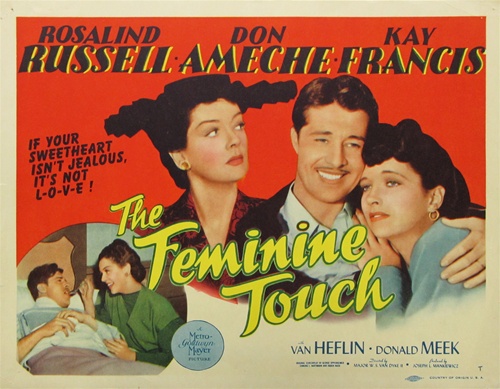
At its best, screwball comedy is a wonderful thing.  It is a manic, charming, delightful walk into the wacky world of a person who lives very much in an alternate universe.  The Feminine Touch (1941) does NOT fall into this category.  The film features Rosalind Russell as Julie Hathaway, the wife of  Prof. John Hathaway (Don Ameche), a college professor who despises jealousy as a worthless emotion, and who has decided to ditch his university job and write a book on the subject.  Enter Nellie Woods (Kay Francis), the editor for publisher Elliott Morgan (Van Heflin).  Elliott's not very involved in his business - Nellie does all the work in the publishing house, as her boss is too busy pursuing the high life and women.  Unfortunately, Nellie is also in love with Elliott, and sees this book as an opportunity to force Elliott into paying some attention to her.  Elliott, of course, is much more interested in wooing Julie.  Julie's problem is that while she is not the least bit interested in Van, she is dismayed that John doesn't care that another man is trying to seduce her.

While the film has some amusing moments, primarily it is just annoying.  We're presented with a number of characters who are just, quite frankly, stupid.  Nellie is the only one with any brains.  And Elliott, besides being an idiot, is a pest.  You spend most of the movie wanting to smack him.  It is amazing how long it takes him to realize that Julie is not  interested in anyone but her husband.  Plus, Heflin, usually such a disciplined actor, here is hugely overacting. He spends much of the movie distorting his face, to no real purpose. 
Russell and Ameche are similarly annoying.  She is overacting; he is just being smug.  Worse still, there is NO chemistry between the two of them.  Perhaps that's why this is their only film together.  Though, given that both are excellent actors when given a decent script, one would have liked to have seen them together in a more sympathetic venue.  With the writing talent (George Oppenheimer and Ogden Nash, specifically) and the producer (Joseph L. Mankiewicz) of the film also people's who work we admire, we were surprised that the script wasn't sharper. As it is, it just seems to go on forever.  Even the final scene seems gratuitous.

We did enjoy, as New Yorkers all, the scenes of New York City, specifically the depiction of the subways.  (We remember the old rattan seats and the overhead straps, which gave NYers the name "straphangers".  Actually, one of us - the short one - misses those straps!).  In spite of everything,  Kay Francis is really quite good.  As always, she gets great clothing - her hats, especially, are something to be seen.  We suspected the costumers wanted to look a bit avant garde and daring - they do succeed.  Her character, as we said, is the only one with a brain - she is running the company, and we suspect, will continue to run it.  Ms. Francis is the breath of fresh air in the middle of chaos.

We should note that, according to this article from TCM, The Feminine Touch was actually quite well received when it was released, so you may want to judge for yourself whether it is a hit or a miss.  To get you started, here is a trailer:  

Monday, March 11, 2013

Gumshoe Joan, Take Two

Bill Reardon (Melvyn Douglas) is an unsuccessful PI.  With no clients, and loads of debts, he decides to go back to his job as an investigator for the District Attorney's office.  His wife, Sally (Joan Blondell) protests, so he jokingly gifts her with his office.  Next thing you know, a client, in the form of Lola Fraser (Mary Astor) appears. She hires Sally to find out if her husband is a cheat.  Only, within hours, Walter Fraser is dead.  Who dun it?

Thus begins the screwball There's Always a Woman (1938).  Our group had rather mixed reactions to it.  Developed as a response to The Thin Man, the big reaction was that Bill and Sally are no Nick and Nora.  The jokes tended to go on and on (sometimes way too long for some tastes).  And the over-the-top humor made the movie far less enjoyable.  

On the other hand, the film had great sets and costumes.  And some scenes were really funny.  Like a bit, late in the film, when Sally is being interrogated by the police, and is not in the least phased by the rhetoric.  Blondell could be very cute at times; other times, you wanted to give her a good spanking.  Here, we can share a little bit of the slapstick action (and it might give you a clue of why Sally is such a brat):

Finally, a couple of things to look out for: a young Rita Hayworth as the Bill's secretary (she's there for about one minute),l and Mary Astor appearing in a role very reminiscent of something a few years away - The Maltese Falcon.

Next time - another pre-code.

Monday, June 27, 2011

Myrna Sues Jean?

As we wait for a few more Crawford or Lombard movie to appear on our favorite channel, we visit with a pair of truly lovely, talented ladies - Myrna Loy and Jean Harlow - in the hilarious Libeled Lady(1936).  Loy is Connie Allenbury, a wealthy young lady with lawsuit on her mind after a newspaper, run by Spencer Tracy's Warren Haggerty inadvertently libels her.  To circumvent the suit, Haggerty comes up with a plan - marry his fiance Gladys (Jean Harlow) to writer Bill Chandler (William Powell), then have Bill seduce Connie, so Gladys can sue Connie for alienation of affection!  Only problem is, both Gladys and Connie actually fall in love with Bill, who is head over heels for Connie. 

This is a very funny movie. If you have a decent script (which this does), it is rather hard to miss with this cast.  Spencer Tracy as the reluctant groom is a riot; and you are rather pleased when he gets a bit of his comeuppance.  Harlow as the doubly spurned woman is lovely.  Thankfully, she gets her man in the end (this is a comedy!). 
And can you miss with that wonderful team of Powell and Loy! They had already made the first Thin Man  together, as well as Evelyn Prentice and Manhattan Melodrama. You cannot see the credit list and not assume that they will end up together.  They are perfectly matched, and Powell does his utmost to turn Bill from cad to dream.

A screwball comedy in the best sense, this one is well worth a look. We highly recommend it.  Here's a trailer to give you a taste:

Monday, June 13, 2011

Carole Takes the Train

Some time ago, we did a Carole Lombard film festival. There were a few movies we didn't get to see because we couldn't lay hands on them, but we finally got a copy of 1934's Twentieth Century, a delightful comedy in which Carole trades tirades with John Barrymore. Would be actress Mildred Plotka (Carole Lombard) comes under the spell of producer/director Oscar Jaffe (John Barrymore).  Their professional partnership results in a name change (to Lily Garland) for Mildred, as well as fame and fortune to them both UNTIL yet another fight results in a rift that drives Oscar into near bankruptcy. His solution - woo Lily back into his latest play, featuring her as Mary Magdalene.  As they say, high-jinx ensue.

This is a very funny movie, but it is LOUD.  Neither Oscar nor Lily believe in talking - they scream, screech, yell, bellow, cry, but they NEVER just talk. Much of this movie resembles an old fashioned farce, with lots of noise, slamming doors and just generally weird characters. Some good character actors here - including Walter Connolly as the much put-upon Oliver Webb (Oscar's favorite hobby is firing poor Oliver), as well as Oscar's other aide Owen O'Malley played with gusto by Roscoe Karns,  Of course, one really does want to see Barrymore and Lombard together, as they duel endlessly.  And then, there is Oscar's oft repeated line "I close the iron door..."  Here's a little montage of the action:


Our thanks to Carole and Co. blog for mentioning our efforts here. It was just a coincidence that we had another Carole movie in the pipeline.  We hope to find a few more.  In the meantime, we also hope for some other fine performances down the road.

Monday, May 24, 2010

Olivia Gets Gas

Our movie today is 1938's Hard to Get. Olivia plays spoiled heiress Margaret Richards; out on a lark, she meets auto mechanic (and unemployed architect Bill Davis (played by Dick Powell, with only a little bit of singing).  Margaret pulls into Dick's gas station and demands he fill her auto - on credit.  No id, no money, no nothing.  Since he has already filled her car, he demands repayment - she has to clean all the rooms in his autocourt. Of course, she wants revenge. And, of course (since this is a screwball comedy), they fall in love.

The beginning of this movie very much reminded us of the (serious) 1933 Ginger Rogers/Joel McCrea movie Chance at Heaven,wherein Joel fills the tank of another fund-less/id-less heiress and finds himself  in love (only Joel doesn't make her clean up afterwards).  And Olivia's Margaret harkened back to another screwball - Marcia West from It's Love I'm After. Dick Powell only gets to sing for a tiny bit; mostly,  he gets to be thrown on his head.  And Charles Winninger (as Margaret's irracible father Ben), gets to be, well, irracible. Interestingly, we also have a brief appearance by Bonita Granville, again playing Olivia's younger sister.  Sadly, she is only on screen for about 5 minutes total (at the beginning and end of the movie), but she is always delightful.
In 2010, the idea of a young woman gallivanting around town in her roadster without a cent in her pocket or any kind of ID is rather unbelievable (we hoped she didn't want to get into a government building on her sojourn!!). Heck, when a police officer shows up, he isn't even concerned that she is without a driver's license! But, regardless of the silliness, and the fairly unbelievable plot, this is a fun movie, with a good cast. It made us laugh. We think it will delight you as well.  To get you ready, here's a trailer:
Next week, we take a break from comedy - join us for a more serious side of our heroine.

Monday, March 29, 2010

Screwball Olivia (and Bette and Leslie)

This week, we see Ms.de Havilland at her screwball best in It's Love I'm After.  She plays Marcia West, a young woman who spends her life falling in love with actors; this time, it is stage actor Basil Underwood (played by Leslie Howard), a vain ham who is engaged (off and on) to the equally vain Joyce Arden (Bette Davis), his frequent stage costar.  When Marcia's fiance Henry Grant (played by Patric Knowles) decides that the best way to get Marcia's infatuation quashed is to invite Basil for the weekend, mayhem ensures. Especially when the irritated Joyce arrives at the house party.

This is a truly funny movie, and Olivia is a riot as the avid - and rabid - pursuer of  Basil's affections.  She has some terrific scenes here.  One, when Basil decides that the best way to cool her ardor is to lock her bedroom door (with him inside) and threaten her with "a fate worse than death".  Her reaction is priceless.  Another, when Marcia decides that Basil is perhaps not all he is cracked up to be, and announced that she should have just continued her adoration of Clark Gable.  "Clark who?" poses the baffled Basil.  (Six years earlier, he and Gable had costarred in A Free Soul). 

This was the third, and final, paring of Leslie Howard and Bette Davis (they had earlier appeared together in The Petrified Forest and Of Human Bondage), and their only comedy together.  Neither really made all that many comedies.  However, there is a scene here, in which Davis, attempting to keep Howard out of her room, piles furniture in front of her door. Meanwhile, Howard climbs in the window.  The scene would be copied years later in another Davis comedy (this time with James Cagney) The Bride Came C.O.D. In either movie, it is still funny.
Our discussion of the movie ended with a rather long discussion of Leslie Howard.  His early death in World War II, his sponsorship of Humphrey Bogart, and his film career in general make him an interesting actor.  We've all seen many of his films.  This was was a real breath of fresh air, giving him the chance to do something he almost never gets to do - be funny.  We thought he sort of had that opportunity in The Scarlet Pimpernel (where the comedy serves as a mask for his real identity.), but other than that, this screwball comedy gave us a new vision of a wonderful actor.  Here's a trailer:
Next week, we'll return with a later de Havilland comedy, The Male Animal.

Monday, March 1, 2010

Screwball Carole

This week, we watched Nothing Sacred, a screwball comedy which stars Carole Lombard as Hazel Flagg, a young woman from Warsaw, a tiny New England town, who is diagnosed with radium poisoning.  When reporter Wally Cook (Frederic March) is looking for a story to get him back on top, he hits on Hazel's misfortune as a means to re-ingratiating himself with his boss.  Only problem is, Hazel has since found out that her doctor (Charles Winninger) was mistaken. She's fine.  Hazel however, wants her free trip to New York City (the gift promised by Wally), and to get out of Warsaw, so she conceals her health, and goes to town as the Martyr Who is About to Die. (My favorite line: "It's kind of startling to be brought to life twice - and each time in Warsaw!")

In some senses, it feels as though the writers wrote themselves into a corner, and couldn't get out.  They need a way to end it, so they do, but whether it exactly works, is a matter of opinion. However, this is screwball comedy, so on some levels it doesn't really matter.  Ms. Lombard is adorable as Hazel; loving the attention she is getting, but horrified because people seem to so genuinely care that she is dying. And, of course, falling in love with Wally who ALSO thinks she is about to die.  Here's a trailer:
There is also a great deal of wonderful character support here.  We were particularly tickled by a brief, uncredited appearance by Hattie McDaniel, as the wife of a man pretending to be a Middle Eastern potentate.  One word from her, and we were laughing. You can't miss that voice.  Even without the closeup that we never got, we knew it was her!  Another delightful surprise was Margaret Hamilton as a local neighbor of Hazel.  She doesn't have a huge part, doesn't even have a lot of dialog, but again, she is hysterically funny. We loved it. Interesting to note is that both actresses were 2 years from their breakthrough 1939 performances in Gone with the Wind and The Wizard of Oz.

Next week, we'll be moving on.

Monday, February 15, 2010

Carole the Compulsive Liar

This week, we watched True Confession, with Ms. Lombard, Fred MacMurray, and John Barrymore. It is surely interesting to see her reunited with not one, but two of her prior co-stars, and, at least for MacMurray, in such different parts.  Lombard's Helen is nothing short of a compulsive liar. There isn't a problem she won't try to fix with a lie. Her husband, Ken, is the total reverse - a lawyer who despises liars, and won't take on a guilty client (which makes him a very underemployed lawyer indeed).  When Helen is accused of murder, Ken's insistence that she own up to her guilt ends in another lie, and in creating a celebrity couple.  And, when John Barrymore enters the picture, hijinks ensue. 

Watch Carole lie her way out of a creditor repossessing a typewriter:


Certainly this movie easily fits into the screwball mode, and while it is no Love Before Breakfast, it isn't My Man Godfrey either.  Our group had rather mixed reactions to Ms. Lombard - one person describing her performance as "shrill". But all were agreed that it was at times quite amusing.  Though, we did want to take Ken and launch him into outer space. He is rather a self-absorbed piece of work. Insisting his wife not work, because it will look like he can't support her. And of course, he can't. His ethics won't allow him to represent a guilty client. One can feel for Helen's predicament being married to such a prig. As for Barrymore, his Charley is just weird. Not as manic as the character he played in Twentieth Century, but certainly cut from the same eccentric cloth.

Next week, we visit Carol in the land of another star. Much smaller,and with curlier hair.  Tune in then.

Monday, February 1, 2010

WHY is Love Before Breakfast?

Our Carole Lombard focus this time is 1936's Love Before Breakfast.  In the spirit of honesty, let's just start by getting it out in the open - we just DIDN'T like this movie!  Try as they might, this trio of excellent actors (Carole Lombard, Preston Foster, Cesar Romero), could not make this mess of a script into a cohesive whole. First off, the title - just WHERE did they pick this title from? It made no sense, bore no relation to the movie at all. Next, there is the relationship between Kay Colby (Carole Lombard) and Scott Miller (Preston Foster). All they do is fight. And fight to the point where it is ridiculous.  I won't go into the ending here, but just watch it. It makes no sense, and is just plain stupid. Compare it to a similar ending in My Man Godfrey, where the ending is handled brilliantly.  Though it has been a long time since I've seen it (and one of my viewing companions has not see it at all), we wondered if the screenwriters were trying to recapture the screwball silliness of Twentiety Century.  Regardless, it doesn't succeed.

Another problem with the film is that it brings in elements, and then doesn't use them.  For example, very early in the film, Scott discovers that Bill Wadsworth (Cesar Romero - here, for a change, not playing a Latin lover or Indian houseman) is seeing another woman, though he is engaged to Kay.  So, to get rid of Bill, Scott ships Bill abroad (Bill works for him), and tells Kay that he did it purposely, but NEVER tells her that Bill is not faithful to her. WHY? Scott blabs everything else. Why not that? And if he is not going to use the information, why do we need to know it? It's dropped out there like some kind of time bomb, then turns out to be a dud that never goes off.

And then there is Kay. She is stubborn beyond belief! Trapped in a small boat that is about to be swamped by a storm, she refuses to come aboard Scott's large, warm, DRY yacht. Bill (who has returned from his work abroad) is so drunk he can't stand up. The pair can't hide below decks because it is already full of water. So, all they can do is sit on the main deck, getting drenched and wait to be swept overboard. Could anyone be that antagonistic towards someone that they would die for it?  

So, not exactly one we can recommend.  I'm sure we will find The Princess Comes Across much more enjoyable!

Monday, December 21, 2009

Carole Lombard Joins Movie Night

We've decided to begin a mini-Carole Lombard festival for movie night (mini in the sense that we've done a bunch of her movies in the past, and won't repeat most of them) We started with We're Not Dressing.  This is a very silly movie.  Carole plays an heiress, pursued by two men (one of who is a very young and callow Ray Milland!!), but she instead falls in unwilling love with a hand aboard her yacht.  His claim to fame? He can sing to her pet gorilla.  He, of course, is Bing Crosby, so we get treated to a number of songs by the maestro of 1930s pop. 

We wondered if Lina Wertmuller (Swept Away) had seen this movie, because it is the same plot, only done for humor.  And we have additional humor in the form of the delicious Gracie Allen.  We talked a lot about Gracie.  As always, she is so funny - living in her own world, and bemused that others don't get it.  This movie, however, shows the earlier incarnation of George Burns, as an exasperated and annoyed onlooker to Gracie's viewpoint.  We much prefer him in the 50s, when his response to her nonsense was always "I love her, that's why". 

We were also amused by the "special effects", obvious cuts between a real gorilla and a man in a costume.  Really, they did do a decent job in the transition.  (Why we needed the dumb gorilla, we never quite figured out.  It really was silly beyond belief). 

Is this a great movie? NO. Is it funny - yes, it is.  Thanks to Gracie Allen, and some lovely work by the ever luminous Ms. Lombard, it is funny.  Certainly worth a look (and if you like to listen to Bing Crosby singing, again - worth your time.)  And here is Crosby singing to Lombard in the trailer: