An infant is abandoned at a New York City foundling hospital and the matron on duty makes a phone call to the Institute of Child Psychology. Professor Peter Vincent (Philip Merivale) and Dr. Woodring (Alan Napier) arrive to conduct a series of evaluations on the infant; she is adjudged satisfactory, and removed to the Institute for education. The Institute has a theory about education, and have taken on the infant girl, named Alpha (Margaret O'Brien) to test their theories. Alpha will be taught Chinese, music, chess, math and history, but will be removed from the rest of the world, so as to eliminate any corrupting influences. At age 6, Alpha, now fluent in Chinese, able to read complicated books, and an expert in world history, is ready to be tested by Professor Josh Pringle (Henry O'Neill). When word gets out about Prof. Pringle's arrival, reporter Mike Regan (James Craig) arrives at the Institute to do a story on the prodigy. Bemused by Alpha's concrete understanding of the world, Mike tells her the world is full of magic, a concept that has been rejected by her tutors. So the Lost Angel (1944) ventures out of the Institute to find Mike and prove the validity of magic.
This is a truly delightful film, both moving and funny, with a cast that is in top form. Margaret O'Brien is excellent as Alpha, a little girl who is, at times, more mature than her elders. She manages to make Alpha smart without being a show-off, but also to retain Alpha's innocence and child-wonder of the new world she is being revealed. (The character is somewhat reminiscent of Natalie Wood's Susan Walker in Miracle on 34th Street.) In 1945, Ms. O'Brien was presented a special juvenile Oscar, for her work that year (including this picture) (AFI catalog) The story of that Oscar did not end in 1945 - it was stolen from Ms. O'Brien's home in 1954, shortly before her mother's death, found 50 years later (for the full story, visit this blog post) and returned to the ecstatic Ms. O'Brien.
But Ms. O'Brien would be lost if it was not for the rapport that she has with both James Craig and Marsha Hunt (Katie Mallory). Ms. Hunt is particularly terrific, combining a developing motherly affection for the child with a wariness of her. The scene of their meeting at Katie's nightclub is especially funny. The image of the Alpha and Katie staring at one another in a game of visual chicken is wonderful (Katie loses the match!). They would appear in another film together that same year: Music for Millions.
Ms. Hunt, who just celebrated her 100th birthday, began her film career in 1936 with The Virginia Judge; she retired from acting in 2008, following her appearance in the short film The Grand Inquisitor (for more on her appearance in this film, listen to this Film Noir Foundation podcast on Ms. Hunt). A truly underrated performer (watch her extraordinary performance in Cry 'Havoc' (1943), her career was foreshortened when she was blacklisted. Her crime - she was a member of the Committee for the First Amendment, and protested HUAC's questioning of the Hollywood Ten. Offered the opportunity to apologize for her protest, she steadfastly refused, and channeled herself into working for world peace and the environment (Deadline Hollywood). Now retired, there are ongoing efforts to make a documentary on her life.
The film is gifted with a number of fantastic supporting actors. Keenan Wynn had already appeared in four films, only one of which credited, when he appeared as Packy Roos in our film, and he is wonderful as a gangster who doesn't read very well. His interactions with Ms. O'Brien are very funny, resulting in several sweet and amusing scenes. Alan Napier, Philip Merivale, Donald Meek (Professor Katty), and Sara Haden (Rhoda Kitterick) also handle their parts with extreme delicacy. It would be easy to make the members of the Institute into villains, something these remarkable actors avoid. Their love for Alpha is apparent from the beginning of the film - though she is their job, she is also a responsibility, and one that requires understanding and affection. There are a few more actors to watch for - Ava Gardner in an unbilled roll as a Hat Check Girl. Even though you don't get a good look at her, the voice is unmistakable. Robert Blake, as Mike's neighbor Jerry is credited, but Bobby Driscoll (as Bobby, the boy on the train) is not. This was Mr. Driscoll's film debut (TCM article).
Radio versions of the film would appear on the Lux Radio Theatre in June 1944, with Mr. Craig, Ms. Hunt, and Ms. O'Brien reprising their screen roles, and in December 1946 with Ms. O'Brien again enacted Alpha on Academy Award Theater. The story had been written specifically for Ms. O'Brien at Louis B. Mayer's orders (he wanted her to be the next Shirley Temple).
After reading Bosley Crowther's review of the picture in the New York Times , we wondered if he had seen the same movie as we did. Variety, however, did enjoy the film, as did my fellow blogger at Laura's Miscellaneous Musings. We'll leave you with the meeting of Alpha and Mike, and the suggestion that you settle down in front of the TV with this little gem. It's an evening well spent.
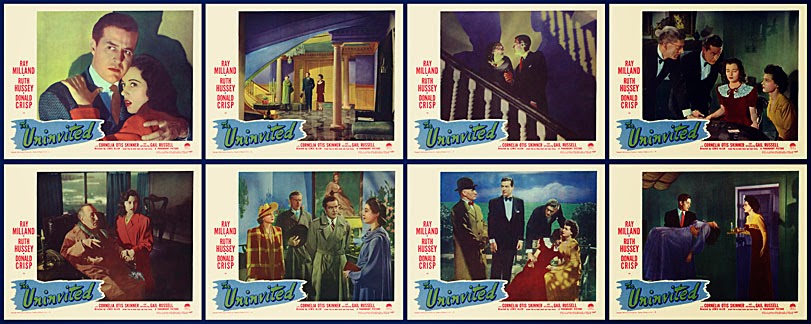
This week, we revisited one of my favorite movies, the suspenseful The Uninvited (1944). Ray Milland
stars as Roderick Fitzgerald, a music critic for a London newspaper who is vacationing on the Cornwall coast with his sister Pamela (Ruth Hussey). Rick and Pam are NOT rich. They have enough money to get by, and some small savings, but on this fateful day, they encounter a wonderful old house that apparently has not been inhabited for some time. The house reminds the siblings of their childhood home, the view and seaside location are breathtaking; the Fitzgeralds decide immediately to pool their savings and try to buy the house. To their surprise and delight, Rick and Pamela find that the owner of Windward House, Commander Beech (Donald Crisp), is eager to sell the house at a price they can afford. However, it is over the loud protests of his young granddaughter,
Stella Meredith (Gail Russell). The brother and sister take possession of their new home and Rick finds himself becoming involved with the "sleeping beauty" quality that is Stella Meredith. But before he can move in, Rick must return to London to settle affairs with his employer. When he returns, he finds Pamela's dog, Bobby, has run away, and Pamela seems tense and withdrawn. That evening, Rick's first in Windward House, all becomes clear. The sound of a woman sobbing reverberates through the house. Only no one is there. The fabulous thing about this film is that it never denies the existence of ghosts. It doesn't end by having all the fantastic occurrences explained away by natural phenomena. The house is haunted; there are ghosts, and while ghosts can be either good or evil, they remain on earth for a reason. And that goodness or evil is a reflection of their human personality, not something that came after death. It is up to the mortals to determine WHY the ghosts are in the house and try to satisfy them, so both ghost and mortal can at last have peace. This TCM article goes into more detail on the unique nature of this film.
As the article mentioned above states, by today's standards, this is NOT a scary film - no one gets killed in some particularly gory manner, nor are there long chase scenes by a masked stalker with a chainsaw. But what there is is a delightfully eerie feeling - enough to put you on edge and keep you there. Much of this is thanks to the acting, especially the remarkably talented Ray Milland and Gail Russell. Milland is able to give Rick a controlled panic - he's just invested his life savings in a house that may be uninhabitable, and the girl he loves is dangerously attracted to a house that seems to want to harm her. And so as Rick, Pamela, and Dr. Scott (Alan Napier) begin to investigate just WHAT causes spirits to stay at Windward House, and why they would want to harm Stella, Milland remains the focal point for the audience. He is our anchor to reality and our connection to the supernatural; we trust the ghosts are real because HE believes it. Which brings us to Gail Russell. Much has been written about her beauty and her sad, short life. An alcoholic, originating from her severe stage fright (and probably started while filming The Uninvited), she ended up dead at age 36 from malnutrition and liver disease. (This Los Angeles Times history outlines Ms. Russell's unfortunate life). But her history should not detract from her performance. Her Stella is delicate, but determined; innocent yet wise in many things. She is the glue that binds Rick to Windward, she is the song he composes. Who can hear "Stella by Starlight" and NOT see Gail Russell's lovely face rise as the inspiration? She gives Stella a heart that makes you want her to finally live in the house she loves, and find the man of her dreams. In some senses, she is the soul of The Uninvited.
If Stella is goodness incarnate, then Miss Holloway, as portrayed by Cornelia Otis Skinner is the human link to pure evil. The dear friend of Stella's mother, Mary Meredith, Miss Holloway hates Mary's daughter with the same passion that she adores Mary. As the TCM article above mentioned, there is a lot in common between Miss Holloway and Rebecca's Mrs. Danvers, not the least of which is both of their overtly sexual obsession with a long-dead intimate. Ms. Skinner, a noted stage actress and author, had a very limited screen career - only four films (one silent) and several appearances on television. She's wonderfully spooky here, letting the viewer glimpse the madness that is underneath her calm exterior.
There is another rarely seen actress, Dorothy Stickney
as Miss Bird, a resident at the Mary Meredith home. Though Miss Bird is supposed to be the one who is sick, she seems a lot saner than Miss Holloway! We'd seen another one of Ms. Stickney's rare film appearances - she appeared as Henry Fonda's obnoxious mother in I Met My Love Again. Ms Stickney had a very distinct voice, which led to her portraying a number of eccentrics on film and on stage. She had a long career on Broadway, from her debut in 1926 in The Squall to the mid-1970s, when she appeared in Pippin (assuming the role of Pippin's grandmother after Irene Ryan's sudden death). Of her many stage roles, two are worth mention here: in 1928, she played Mollie Malloy in The Front Page and, beginning in 1939, she appeared as Lavinia in the original production of Life with Father. She was, in fact, in that play for its entire run (til 1947), following it up with a short run, again as Lavinia, in Life with Mother. Ms. Stickney died in 1998, just shy of her 102nd birthday.
The film was given a well-deserved cinematography nomination by the Academy of Motion Picture Arts and Sciences (it lost to Laura), but interestingly, the song "Stella by Starlight" was not even nominated, nor was the film's score. The songs that were nominated include some standards like "The Trolley Song" (Meet Me in St. Louis), "Long Ago and Far Away" (Cover Girl), "I'll Walk Alone" (Follow the Boys), and (the winner) "Swingin' on a Star" (Going My Way). Regardless, "Stella by Starlight" became a popular and jazz favorite, performed by such artists as Frank Sinatra, Ella Fitzgerald, Sarah Vaughan, Ray Charles, and Miles Davis.
Though it appears that the NY Times' Bosley Crowther was not paying attention during his viewing of the film in 1944, we know you will enjoy it. We'll leave you with a trailer from this wonderful fillm.