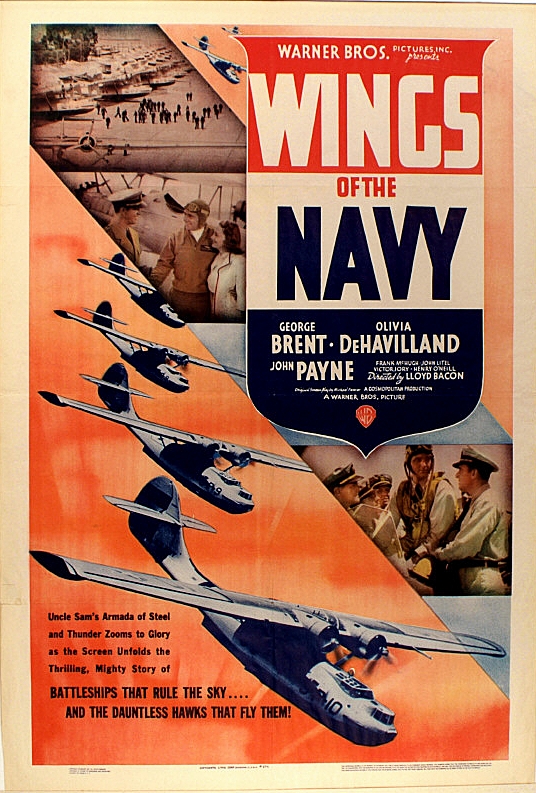
Cass Harrington (George Brent) is a Navy flyer through and through, with a family history in the service. His father was a highly regarded flyer for the Navy, and his brother Jerry (John Payne), also career Navy, wants to join Cass in the Air Corps, though Cass would rather Jerry stay in the submarine service. Cass is in love with Irene Dale (Olivia de Havilland), but once Irene meets Jerry, she wonders if she has made the wrong choice - Cass is too wrapped up in his work designing a new fighter plane to pay her much attention. When the brothers both end up at the Naval Air School in Pensacola, where Cass is an instructor, it's clear that something's got to give. Wings of the Navy (1939) tells the story of these three individuals and of the making of a Navy airman.
In the July 2016 issue of TCM's Now Playing, Robert Osborne writes that Olivia de Havilland, who had signed a contract with Warner Brothers to star in A Midsummer Night's Dream (1935), "...considered [Wings of the Navy] the absolute nadir of her career. It was as far afield from Shakespeare as one could get...." While this isn't the worst film ever made (and probably not her worst either. There is, after all The Swarm...), it's not all that good. However, in many ways (according to this TCM article), it was this film that helped Ms. de Havilland appear in her most famous role - she was so irritated that she had been forced to do Wings of the Navy, she redoubled her efforts to land the part of a lifetime - that of Melanie in Gone With the Wind.
Really, this film is an advertisement for the Navy, and a means for Warner Brothers to inform the public on the state of the armed services. It was evident that a war in Europe was in the offing, and the Brothers Warner had already shown their dislike of fascism in 1937's Black Legion. Shortly after this film was released (February of 1939), Warner Brothers would be the first studio to openly brand Nazi Germany as an enemy in Confessions of a Nazi Spy (released in May, 1939) [PBS History Detectives]. With its emphasis on the flying service, Wings of the Navy is a documentary praising the U.S. Navy Air Corps. Even the New York Times review felt that "the educational part [of the film] is so interesting that we return to the romantic
part... with a feeling almost akin to pain." The advertising for the release also (discussed on WarnerBrothers.com) displays the studio's primary interest in creating this film: "'For all the world to witness that America will not be unprepared!' [it declared] —and backed it up with bravura footage
shot at Pensacola Naval Station in Florida and North Island Naval
Station at Coronado, California."
Because this really is a documentary-type film focusing on the military, the interactions between Brent and Payne, and between Frank McHugh (as Scat Allen) are pretty good, and while we always want to see more of Ms. de Havilland, the love story is pretty pointless - just a way to have the girlfriends agree to come with their dates to see the planes.
There are several surprise appearances in the movie, not the least of which is the appearance of Frank McHugh, who brings both humor and gravitas to the role of Scat, a man who has joined the Air Corps to perfect his flying skills. He is not planning on a career in the Navy - he plans to return to his profession as a crop duster after his term is over, but Scat ends up being the voice of reason in most situations. Also appearing are John Litel as Commander Clark, and Victor Jory as Lieutenant Parsons. Jory's part is so small that if you blink, you might miss him!
Much as Ms. de Havilland disliked the film, she did not immediately escape it. According to this article from the AFI Catalog, she ended up reprising her role (with George Brent and John Payne) in the Lux Radio Theatre production of October 1940. While we agree with her, it is not all that wonderful a film, we'll leave you with a clip of Ms. de Havilland and Mr. Payne:
Though Christmas is now but a memory, theTCM presentation of Miracle on 34th Street (1947) on the big screen was a real treat for the holiday season. The story focuses on Kris Kringle (Edmund Gwenn), an elderly gentleman who takes Christmas quite seriously. When he encounters a drunken Santa Claus at the Thanksgiving Day Parade in New York City, he confronts the parade's organizer Doris Walker (Maureen O'Hara), who immediately hires him as a substitute Santa, both for the parade, and later to work in the store. Doris is rather matter of fact about Christmas; she's raised her daughter Susan (Natalie Wood) to view it as a commercial holiday - Santa Claus isn't real nor are fairy tales to be regarded as anything more than silly fictions. There is, she tells Susan, no such thing as "happily ever after," something their neighbor Fred Gailey (John Payne) finds distressing, since he is hoping for a "happily ever after" with Doris. So, when Kris announces he IS the real Santa Claus, and is labeled as mentally incompetent by Mr. Sawyer (Porter Hall), the Macy's staff psychologist, Fred decides to represent Kris in court - and prove Kris is the REAL Santa. As someone who grew up in New York City, shopping at Macy's and Gimbel's, this film has resonances that cannot be escaped. At one point, we see a shopper's book that Macy's has created to help guide customers to products they don't carry (but that other stores do - one of Kris' innovations). Most of the stores in the book, including Gimbels - have since closed. I've been to the Parade once, and watched it on television nearly every year - and the metamorphosis of the Parade from a "home town" event to an advertisement for New York City tourism is something this film makes very apparent. (I'm not complaining - I like seeing the Broadway plays show their stuff). So, regardless that this is an annual event, the film provides a time capsule view of a New York that is long gone, when the parade was a local event run by a local store, not a national pastime. (To this day, Macy's in Herald Square uses Miracle on 34th Street as a window display at Christmastime.)
This Fathom presentation of the film was made especially poignant by the death of Maureen O'Hara on October 24, 2015. The last survivor of the lead actors in the cast, her portrayal of Doris is on spot. She makes the character tough, but never heartless - her affections radiate from her lovely eyes, but she is always in charge of her home and her business. Born in Ireland as Maureen FitzSimmons in 1920, Ms. O'Hara started her career at the Abbey Theatre in Dublin. After a screen test, Charles Laughton signed her to a contract and starred her, with him, in Jamaica Inn (1939). The rest, as they say, is history. In 1941, she appeared as Angharad in director John Ford's How Green Was My Valley, the first of their 4 films together. Her most famous screen partner was certainly John Wayne - a collaboration that didn't begin until 1950 in Rio Grande. Never even nominated for an Academy Award (is that even possible), Ms O'Hara was finally given an Honorary Oscar in 2014. With her flaming red hair and a complexion that looks like pure butter, Ms. O'Hara was so staggeringly beautiful in color films she was sometimes called The Queen of Technicolor. Regardless of that beauty, she was an actor without compare.
Edmund Gwenn actually appeared as Santa in the 1946 Thanksgiving Day Parade, and other members of the cast (like Ms. O'Hara) were shot in the parade to add scenes to the film (see these TCM articles and the AFI catalog for more background on the film). Ms. O'Hara was initially reluctant to appear in the film, as she had JUST been allowed to visit her family in Ireland (she was barred from visiting her homeland because of War restrictions. Ireland was a neutral country during World War II), and was now being called back immediately to appear in " silly little movie about Santa Claus". She stated that, once she saw the script, she changed her mind - the film, by the way is still #9 in AFI's 100 Years, 100 Cheers.
There have been other attempts to trap the lightning in a bottle that is Miracle on 34th Street, with limited success. Maureen O'Hara, John Payne and Edmund Gwenn reprised their roles for the Lux Radio Theatre version on December 22, 1947. In 1955, Thomas Mitchell appeared as Kris in a live television version (also starring Teresa Wright and MacDonald Carey) for the Twentieth Century Fox Hour. Meredith Wilson (of The Music Man fame) wrote a musical version of the tale in 1963 entitled Here's Love, which ran for 334 performances and starred Laurence Naismith as Kris. On December 14, 1973, another television version ran, starring Sebastian Cabot as Kris and Jane Alexander as Doris (now named Karen!). Finally, a big screen version was again attempted in 1994, with Richard Attenborough as Kris - Macy's refused to allow their name to be used in the film! Even star John Payne tried for many years to produce a sequel to the story, based on his own screenplay, but the attempts ended when he died in 1989.
Many character actors contribute to this film - Gene Lockhart as Judge Henry X. Harper, the man who must rule on the reality of Santa Claus; William Frawley as Charles Halloran, Judge Harper's cagey political advisor; Jerome Cowan as district attorney Thomas Mara, whose own son is called to testify as to the reality of Santa Claus (how does Tommy know there really is a Santa Claus: "Because my Daddy told me so"), and Philip Tonge as Doris' colleague Mr. Shellhammer. But in many senses, the film is stolen in one brief scene by Thelma Ritter as the harried mother who can't find the fire truck her son wants in time for Christmas. This was Ms. Ritter's first role, and of course, she shines. We'll close with the scene in which Doris asks Kris to tell Susan he isn't really Santa Claus:
This year's TCM Cruise presented a number of films with Tyrone Power (which is never a hardship for me); not surprisingly, I saw them all. The third night of the cruise featuredThe Razor's Edge (1946), based on W. Somerset Maugham's novel, and introduced by Alex Trebek and Robert Osborne, both huge fans of this excellent rendition. (For those of you who liked the Bill Murray remake, sorry - I didn't care for it, and neither did the evening's hosts). The story focuses on Larry Darrell (Power), He has physically survived the First World War, but is tormented by the death of a friend, who died saving Larry's life on the eve of the armistice. Why, Larry wonders, should he live, when this man is dead, and what can he do with his life to make up for that death? Larry's fiance, Isabel Bradley (Gene Tierney) is sympathetic, and agrees that Larry should travel for a while, to try and find the answers to his questions. But when, a year later, Larry is still determined to continue his quest, Isabel balks - she is not willing to live as an itinerant, with a husband who has no ambitions to anything but the life of a nomad. So, they separate, only to be reunited years later, when both their lives - and the lives of their friends and relatives - have drastically changed.
This is a complex film, following the lives of a number of central characters over a period of nearly 15 years, all of whom are in some way related to Larry and Isabel. The characters are real - with faults and flaws. We admire Larry, but would find him impossible to live with. We sympathize with Isabel, but gasp at her machinations. It's a film of greys - there are almost no black and whites. Elliot Templeton (Clifton Webb) is a prime example of a "grey" character. Wealthy, selfish, and somewhat arrogant, Elliot is also generous and intrinsically good. Late in the film, a priest characterizes Elliot as "a good man. His defects were on the surface, but he was generous of heart ...and kindly toward his fellow creatures." That he is basically good is reflected in the fact that our narrator, Maugham (Herbert Marshall), actually likes Elliot (also calling him "kind and generous"), even though he feels that Elliot " has no friends, only acquaintances." Elliot's wealth has allowed him to live his life in Europe, hobnobbing with the wealthy and noble, and to look with aghast at his much loved sister, Louisa (Lucile Watson), who has chosen to spend her life in the Midwest. But, when his niece and nephew-in-law lose all their money in the Stock Market crash, it is Elliot who takes them in, and supports them and their children until they can get on their feet. Webb paints a picture of a man whom you like in spite of yourself; he allows us to the see the inner Elliot.
Anne Baxter won her Academy Award for playing Sophie
MacDonald, a
loving wife and mother whose life is shattered after an
automobile accident. Other actresses were considered for the part
(Susan Hayward, Betty Grable, Judy Garland, Anabel Shaw, Nancy Guild,
and Bonita Granville, according to Ms. Baxter), but it is hard to
imagine anyone else doing it. The character of Sophie floats in and out
of the
story, as she does in the lives of the other characters. Sophie's alcoholism
becomes a major focus of the film, and it is Baxter's seering portrait
of Sophie's problem that more than likely cinched the award for her.
While we sympathize with Sophie, Baxter is careful to make her
unappealing in the latter half of the film - again, she is painted in
grey tones. And her alcoholism is not something that just appears
because of the accident - early on, Sophie tells us that her husband Bob
(Frank Latimore) doesn't like her to drink because of what it does to
her. Of course, Joseph Breen tried to get the alcoholism eliminated
from the film - Darrel Zanuck refused to take it out, as essential to
the story (for more on this and other casting issues see these AFI notes.)
Gene Tierney was not the first choice for Isabel. Both Joan Fontaine and
Olivia de Haviland were considered, as was Maureen O'Hara. In her autobiography, 'Tis Herself, Ms O'Hara recalls that the deal was all but completed. There was one proviso, however: producer Darrell Zanuck told her to keep quiet about her casting. She didn't - she told her friend Linda Darnell - who was in a relationship with Zanuck at that point, unbeknownst to Ms. O'Hara- and Zanuck fired her later that day for blabbing.Regardless of the fact she was not the first choice, Ms. Tierney
shines (she was nominated for an Oscar - losing to Joan Crawford in Mildred Pierce) as Isabel, and creates a character of dimension and layers. As hideous as some of
her actions are, even narrator Maugham cannot dislike her, nor in a
sense can we do more than shake our heads at her selfishness. According
to this TCM article,
Tyrone Power (newly back from his service in World War II), developed
on crush on her. She privately let him know that, though divorced from
Oleg Cassini, she was seeing someone else - future president John
Kennedy. Though Tierney loved JFK deeply, it was not too be. Kennedy
was already looking towards his future in politics, and men married to
divorcees just didn't get to be president in the 1940s.
Gray Maturin (John Payne) is the man who has loved Isabel for years,
and who ends up married to her when Isabel is unwilling to wait for
Larry. It's interesting that his name is "Gray", because he is perhaps
the only non-gray character in the film. Gray is, in fact, the only really "good"
person we meet. He loves Isabel unquestioningly and he likes Larry, even
though Larry is the competition. It is Gray who has to interact
with Sophie on the most critical day of her life - Payne gives us a man who is caring, but unable to do more than just sympathize. Payne works hard to
make Gray a complex, but not weak character; he mostly succeeds, as we care about Gray and understand how deeply honorable he is. One other character of note is that of Miss Keith (played by Elsa Lanchester). As the private secretary of the Princess Novemali, the part is tiny - at one point, we see her in the background of the action, but finally get to meet her at the film's end. Like Gray, she is someone who is deeply good. Though Lanchester only has this one brief scene with Tyrone Power, you will remember her. Her Miss Keith is a woman of integrity in a world of mere surface. In the discussion prior to the film, Robert Osborne cited one scene in the film that he thought one of the most beautiful on film. You can see it below, as Isabel tries to seduce Larry, to keep him from going away again. A magnificent setting, and two of filmdom's most attractive people - this scene does shine. We'll be returning to more films from the festival in coming weeks (along with our regular conversations).