Showing posts with label Otto Kruger. Show all posts

Monday, July 20, 2020

Joan Visits Germany

Art critic Carol Cabot Hoffman (Joan Bennett) is taking an extended vacation with her husband of eight years, Eric Hoffman (Francis Lederer).  Eric's father, Heinrich (Otto Kruger) needs help selling the family business, and the couple and their seven year old son, Ricky (Johnny Russell) are going to Germany to mix business with pleasure. But, when they arrive, Carol begins to wonder if The Man I Married (1940) is the same person with whom she is now living.

Joan Bennett is excellent as the wife who gradually realizes that her husband is not only having an affair with his childhood friend, Freda Heinkel (Anna Sten), but is also becoming a fervent Nazi. For the 21st Century viewer, the latter is the most hateful. But like the 1940 audience, Carol is initially less concerned about Eric's political leanings. She serves as the eyes of the audience, slowly learning about the evils of the Nazi party, primarily through her friendship with American newsman Kenneth Delane (Lloyd Nolan). It's a frightening revelation for all concerned, as Carol learns of unjust imprisonments, torture, and murder.

As the husband who is seduced into the Nazi party, Francis Lederer is impressive. It would be easy to go over the top with the part, but he doesn't fall into that trap. When Eric and Carol attend a Nazi rally, his fervor becomes apparent. Mr. Lederer does it with a Nazi salute - it's an effective and terrifying moment. George Saunders was originally considered for the role, but he was involved with another film, and was unavailable. (AFI catalog)
Francis Lederer was born in Austria. After stage and silent film work in Germany, he went to London to appear in the play Volpone. Another London production (Autumn Crocus) and a transfer of the play to Broadway (he would appear in four Broadway plays during his career) brought him to America.  As he had no desire to return to Germany - Mr. Lederer was Jewish - he stayed and became a U.S. citizen in 1939. He worked in Hollywood (in both films and television) from 1934 until 1971. His third marriage lasted for nearly 60 years, until his death in 2000 at the age of 100. The home that he helped to design is a protected Los Angeles monument (and is now a wine tasting room).
A number of supporting actors add noteworthy performances to the movie.  Lloyd Nolan only gets a little screen time, but is excellent as the reporter who tries to help Carol locate a missing academic for his brother, Dr. Hugo Gerhardt (Ludwig Stossel). Mr. Nolan serves as the audience's tour guide to Nazi Germany He has little regard for the Hitler regime; by 1940, it's not likely that the audience knew his time in Germany was about to come to an end.

Otto Kruger has a small, but effective part as Eric’s elderly father. He provides the necessary moral compass to the film - a man who lives in Germany, but is not sucked in the the reactionary politics of the Third Reich.
Anna Sten does a decent job with Freda - it's never easy to play a fanatic. If there is any problem with the character, it's that she never seems to be in love with Eric. Her seduction is intended to bring him into the party. Eric is merely another convert for the party.  

Finally, the always remarkable Maria Ouspenskaya has the small role of Frau Gerhardt, the widow of the academic Carol was asked to seek out. Ms. Ouspenskaya has only one scene in the film, but with her quiet dignity, it is not a moment you are likely to forget.

The movie was based on a short story, "Swastika" by Oscar Schisgall. Producer Darryl F. Zanuck changed some names, ostensibly to make them sound less Jewish, but using "Jude" instead of "Jew" didn't hide a whole lot. (The Moguls and the Dictators:Hollywood and the Coming of World War II by David Welky). This TCM article cites it as "one of the first aggressively anti-Nazi films made in the wake of the Invasion of Poland in September 1939."
The press for the film was good as is shown in this review from Variety.  The New York Times review by Bosley Crowther was absolutely glowing: "If we are bound to have a succession of anti-Nazi propaganda pictures...let's hope that they all may be as restrained in their emotions, as frank and factual in their reports and as generally entertaining cinematically as Twentieth Century-Fox's The Man I Married,...."  

Pressure from the German government had resulted in a name change (from I Married a Nazi); the studio underplayed the plot of the film, and didn't distribute it widely. As a result, the film is not as well known as it should be.  You may not have heard of this film before, but we suggest you seek it out. It's worth your time.

Monday, August 20, 2018

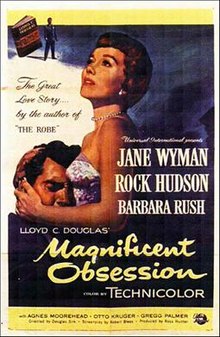
Rock is Obsessed

Robert Merrick (Rock Hudson) is afraid of nothing, and is constantly putting himself in jeopardy. When he finally manages to crack up his speedboat, his life is saved with the personal respirator of Dr. Wayne Phillips. But while Bob's life is being saved, Dr. Phillips suffers a heart attack, and there is no way to resuscitate him. Widow Helen (Jane Wyman) and daughter Joyce (Barbara Rush) are left to deal with the aftermath, with Helen forced to fend off the unwelcome attentions of the ever-on-the-prowl Bob. Our film for this week is Magnificent Obsession (1954).

If you don't like melodrama, you won't like this film. But, we do enjoy a good weeper and this is an excellent one. In his first major role, Rock Hudson is outstanding as the callow youth who needs a good kick to make him grow up (TCM article).  Early in the film, we are told that Bob attended medical school, only to drop out and assume the life of a dilettante in the wake of his father's sudden death.  We get no more information than that, but the way Mr. Hudson plays the scene speaks volumes about Bob's bitterness; a bitterness that resulted in his decision to devote his life to pleasure - something it seems his father never got to do. It is important that Mr. Hudson slowly grow his character, and he does so. With subtle allusions to the passing of time by director Douglas Sirk, we watch as Bob Merrick changes from a heel into an admirable human being.
Equally, Jane Wyman is terrific as a woman who loses her husband, only to find her entire life upended by the actions of one irresponsible human being.  Like Mr. Hudson, Ms. Wyman's character has to change, but the changes are more subtle. We need to understand why she is attracted to Bob Merrill (sure, she doesn't know who he is at first, but she is recently widowed, and was very much in love with her husband. Any new man should be a hard sell.). More importantly, we need to see her sacrifices as well thought out and not self-pitying. Ms. Wyman does that convincingly. Ms. Wyman was nominated for an Oscar for the part (losing to Grace Kelly in The Country Girl).

Agnes Moorehead (Nancy Ashford) is one of the great character actresses of her generation, and she gives a fine performance. Especially notable is her early scene with Rock Hudson, in which she lets him know that he is acting like a complete moron, but does it with professionalism.  Ms. Moorehead started her career in radio; her later involvement with Orson Welles Mercury Players led to her casting as Charles Foster Kane's mother in Citizen Kane (1940). She would go on to play nearly every kind of character - Humphrey Bogart's nemesis in Dark Passage (1947), Jane Wyman's rough-hewn Aunt Aggie in Johnny Belinda, Edward G. Robinson's loving wife in Our Vines Have Tender Grapes (1945), and the abused Madame Fosco in The Woman in White (1948). She did Broadway and regional theatre, but it was on television where she would finally make an indelible mark. A generation of viewers can't forget her memorable performance as a farm woman threatened by minature "Invaders" in The Twilight Zone. And then there is Endora on Bewitched. Take a look at her performance in the fourth episode of the series, "Mother, Meets What's His Name" When she asks Darrin (the ultimate idiot) "Why do you object to my daughter being herself?" you want to cheer. Her delivery is spot on (and you really want to shake Samantha for submitting to Darrin's domestic tyranny). Ms. Moorehead continued acting until her death of cancer in 1974 at the age of 73.
Also in the cast (and happily still with us) are Barbara Rush (who plays Joyce Phillips). Ms. Rush is 91. She was working until 2007, and since seems to have retired. Judy Nugent, who plays Helen's young friend, Judy, continued acting on film and television until 1978. Around the time she retired, she, husband Buck Taylor, and their three sons moved to Montana. They were divorced in 1983. In an interview for Western Clippings, Ms. Nugent stated this film was her favorite role.

Jane Wyman was not the first choice for Helen - Olivia de Havilland, Eleanor Parker, and Joan Crawford were considered for the part. Jeff Chandler was in the running for the role of Bob Merrick, and Charles Bickford was considered for the role of Edgar Randolph (the role would go to Otto Kruger). (AFI catalog)
The film is a remake of a 1935 film with Robert Taylor and Irene Dunne (which was aired on Lux Radio Theatre in April of 1937, starring the film's leads). The New York Times did an excellent DVD review of 1935 and 1954 versions when Criterion released them as a set.  The film was such a success that the cast we reunited in All That Heaven Allows the following year.

This is a film that becomes richer with each viewing, and we encourage you to give it a try. We'll leave you with a trailer:

Tuesday, March 7, 2017

Barbara Marries an Immigrant


It's 1909.  Mary Archer (Barbara Stanwyck) nervously awaits the return of her cousin (and possible fiance) Jeff  (Ralph Bellamy) from Germany.  But Jeff's return changes both of their lives when Mary meets his friend, Hugo Wilbrandt (Otto Kruger).  Hugo and Mary fall deeply in love, marry, and begin a family, consisting of their dachshund Cammie and their son Teddy (Ronnie Cosby).  Hugo begins a successful career as a professor in Rossmore College, and becomes an American citizen.  Their lives seemed blessed, until World War I erupts.  From that point on, Hugo and Mary are shunned as the enemy, and their happy existence becomes a series of tragedies.

Ever in My Heart (1933), a pre-code film, is almost relentlessly sad; there are parts of the film that are almost too much to bear.  Since it begins as an almost lighthearted romance, the ultimate spiral downward makes for an even more intense viewer experience. Released by Warner Brothers studio, which also gave us such socially relevant films as I Am a Fugitive from a Chain Gang (1932, which looked at the American criminal justice system) and Heroes for Sale (1933, which dealt with the problems faced by World War I veterans); this film too is attempting to highlight injustice within the United States. The film, however, came out as Germany was electing a Nazi government, and beginning their persecution of the Jewish population (Victoria Wilson's A Life of Barbara Stanwyck: Steel-True, 1907-1940).  As a result, it probably was not perhaps seen in the light which screenwriter Bertram Millhauser had intended.
Barbara Stanwyck was not fond of this picture (TCM article) or any of her films at Warner Brothers; she called them "a series of parts that were much alike - women who were suffering and poor, and living amid sloppy surroundings."  That may be true, but she is dynamic as a woman who watches her life crash in ruins about her.  We have no doubt of her sincerity when Mary refuses to leave her husband, despite their reduced circumstances.  When neighbors, who had been their friends begin to reject them because of her husband's nationality, Stanwyck gives Mary a quiet but determined dignity.

We were enchanted by Ronnie Cosby in the role of young Teddy.   He is just delighful in the role of the affectionate child whose life becomes a tragedy.  Mr. Cosby's career began with a small role in 1929's Madame X.  He worked steadily through 1939, appearing in films such as Broadway Through a Keyhole (1933), Little Men (1934), and the 1937 remake of Madame X.  His last appearance was in 1941's Birth of the Blues.  He died in 2010, at the age of 82.

Ralph Bellamy is also excellent as Jeff, Mary's first cousin and original intended.  Jeff is carefully set up as a contrast to Mary's brother, Sam (played with a certain amount of petulance and jealousy by Frank Albertson).  When Sam revolts against his brother-in-law merely because he was born in Germany, it is Jeff who tries to soothe the family. Though Jeff describes himself as passionless, is always a true friend to both Mary and to his rival, Otto.  When Mary's family ignore her, it is Jeff who ultimately convinces Grandma Archer (Laura Hope Crews) to take in the starving couple. That Jeff is also a member of the very biased family is sometimes hard to remember - he is much more like the very open-minded Mary than the rest of the Archers.  We understand why Mary at one point was considering a marriage with Jeff.

As is often the case, Ms. Stanwyck and Mr. Kruger were not the first choices for the Wilbrandts. Kay Francis and Paul Muni were originally considered (AFI Catalog).  Not surprisingly, The New York Times reviewer was not enamored of the film, calling it "meaningless to this new generation" because it was not "news any more that the war propaganda which dramatized the Germans as baby murderers and wife beaters was prejudiced."
This comment by the Times in 1933 is quite ironic, given that Ever in My Heart is much more timely today than any of us might like to admit.  Just days before we viewed the film, I heard this report from NPR story concerning US residents, most of the Muslims, who are fleeing to Canada - and to arrest - rather than staying the in U.S. This film is testimony to the fact that these are not new prejudices, and that despite this film's pleas for tolerance and understanding, history keeps repeating itself, with the imprisonment of Japanese Americans during World War II, and today with a political agenda aimed at a particular religious group.   

As we publish this article, the news of Robert Osborne's death has just been announced. It's with a heavy heart that we add our voices to those that mourn this kind, wonderful and intelligent man.  I had the privilege of meeting him at a reception several years ago; he was gracious and welcoming.  But more than this, I will miss my nightly visit with him on television, where he answered my need for more information, and provided a context and an appreciation for the films that I've always loved.  I have learned at the feet of a master; he will be greatly missed.
 
We will leave you with this trailer and with a reminder that no one in the United States should be forced to state that "they let me be a citizen, but they won't let me be an American."

Tuesday, January 10, 2017

Kay Scams the Military

Allotment Wives (1945 aka Woman in the Case) opens with an announcement that the film is based on an actual wartime problem - women who would marry soldiers solely for the purposes of collecting their allotment checks.  Colonel Pete Martin (Paul Kelly) is assigned the task of finding the women who are perpetrating this fraud.  His investigation leads him to a service canteen, organized by Mrs. Sheila Seymour (Kay Francis), a wealthy society woman, who, unbeknownst to Pete, is the head of an organization that recruits young women to gull soldiers into marriage - often taking on three or four "husbands".  She is assisted by  Whitey Colton (Otto Kruger), her friend and confidant.  Sheila, a strong woman who has a firm control on her operation,, has a weakness - her daughter Connie Seymour (Teala Loring), who Sheila has carefully stashed away in a boarding school, primarily to keep her away from "the business".  Or so Sheila thinks.  In truth, Connie is out on the town, spending her days finding men and drinking.  Sheila also has another problem - Gladys Smith (Gertrude Michael), who knew Sheila when both were in reform school, and wants payment to keep quiet about it.

Let's start by saying, this is not a great movie.  Unlike my colleague at Kay Francis on Film, this is not a film we would consider essential Kay Francis viewing.  Were it not for the fact that it was her last appearance on the silver screen, we doubt it would be remembered at all.  It's not that Ms. Francis isn't good, she is.  But she doesn't have a whole lot to work with.  Made at the Poverty Row Monograph Studios and originally titled
Allotment Wives, Inc. (AFI catalog), filmed in 10 days, and with a script that required Ms. Francis (who was also a producer) to do some major editing, the inferior production values tend to diminish the viewer experience.  The New York Times wasn't impressed either - their short review was not laudatory.

The benefit, however, at working in Poverty Row was that the censors didn't seem to care as much about what got through (see this TCM article).  There's quite a bit of risque plot - not the least of which is the idea of one woman being married to several men.  There's  the relationship between Whitey and Sheila - it seems very apparent that they are lovers.  And finally, the fact that a woman could unquestioningly lead this group of men.  Even when Sheila is compromised, there is no question that she is still in charge. 

Pete Martin, as played by Paul Kelly, really comes across as a passive character.  It's only by chance that he discovers that Sheila is the ringleader (and he knows about the marriage ring because he's told where to go.  There's no great detecting on his part).  He never even finds the secret back room in the beauty parlor (we all loved that hidden room).  Mr. Kelly is overpowered by the strong performances of Ms. Francis and Mr. Kruger.  You end up rooting for them, not for him.

Paul Kelly had a fairly lengthy career, despite the fact that it was interrupted by his death in 1956, at the age of 57, and a 25 month stint in San Quentin for manslaughter.  Kelly had an extensive career in silent films when a fight with Ray Raymond (both men were drunk) in 1927  over Kelly's affair with Raymond's wife (Dorothy Mackaye) resulted in Raymond's death from a brain hemorrhage.  (See our review of Ladies They Talk About for more on the story).  When he was released from prison, Kelly resumed his career, now appearing in talkies - often as a heavy.  He also returned to a career on Broadway (he had appeared in 13 plays before his incarceration), appearing in 9 productions from 1930 through 1950.  He was nominated for a Tony for his appearance in Command Decision  (in the role Clark Gable would assume in the film version), and appeared in the role that would earn Bing Crosby a best actor nomination for the film version of The Country Girl.  After Mackaye's death in 1940 (in an automobile accident), Kelly remarried.  He worked in film, stage, and television until his death of a heart attack.
Otto Kruger is very good in the film, and plays the character of Whitey as a gentleman, not a thug.  With a name like Whitey, one expects a low-life, but Kruger gives us a man of sophistication and class, which makes the character more appealing than perhaps he should be.  At the very least, it helps us to understand the relationship between Whitey and Sheila.

Mr. Kruger began his career on the Broadway stage; from 1915 to 1949, he appeared in 32 plays, including the part of Waldo Lydecker in Laura.  Beginning in 1915, he appeared in a few silents, but his career on film bloomed with talkies, which is not hard to understand, given his lovely speaking voice.  He primarily played heavies (as in Saboteur (1942).  But on occasion, he got to play a secondary role as a nice guy - Chained (1934), in which he is Joan Crawford's kindly - but older - husband and Cover Girl (1944) where he plays Rita Hayworth's enamored - but older - suitor.  By 1949, he had started to appear on television (he also had a fairly substantive career on radio) and would continue working between film and TV until his retirement in 1964.  Married in 1919 to Susan MacManamy (they had one daugher, Ottilie), they were together until his death at age 89 in 1974.  

So, while not a totally awful film, its not great.  And while Ms. Francis tries her best to give a performance worthy of her talent, she's really not got enough to work with.  If you want to cover her oeuvre, by all means, give it a try.  Otherwise, stick to Confession (to see her suffer) or In Name Only (if you want to see her sink her teeth into a really great villain role).  We'll have more Kay in the future, but next time, join us for a Barbara Stanwyck film.


Friday, December 13, 2013

Rita Haunts Otto


Rusty Parker (Rita Hayworth) is the lead performer in Danny McGuire's (Gene Kelly) Brooklyn night club.  She learns of a contest to model for the fashion magazineVanity from fellow dancer Maurine Martin (Leslie Brooks) and decides to enter.  Though Maurine does all she can to sabotage Rusty's chances, magazine editor John Coudair is so taken by Rusty's appearance that he hires her.  It seems Rusty is the spitting image of John's lost love, Maribelle Hicks.  It's no coincidence - Rusty is Maribelle's granddaughter. Unfortunately, not everyone is thrilled by Rusty's success.  Maurine is furious; but Danny is also angry and jealous, for his girlfriend is being courted by other men; specifically, Noel Wheaton (Lee Bowman), who is as captivated by Rusty as John was by Maribelle.  In his pursuit of her, Noel encourages Rusty to quit her job at Danny's place: he will get her show on Broadway. 

Thus begins Cover Girl (1944).  It is not really one of Gene Kelly's best musicals, which is sad to say.  One of the problems is that there are just too many musical numbers which don't advance the plot; instead, the serve as distractions away from the story of Rusty and Danny.  One example is the "Cover Girl" number, which is way too long, and Rita Hayworth isn't in enough of it.  The same with "The Show Must Go On": you have to wait too long to see Hayworth, and instead, get to look at a bunch of models trying to be as engaging as Hayward (and not succeeding).  It's not that the dancing or songs are bad, it's that they are jarring. They don't seem to fit into what is going on.

However, there are some wonderful numbers.  Kelly's impressive "Alter Ego" number, in which he dances with himself, (back before CGI).  Hayworth (not singing - Hayworth's singing was dubbed. More on that later) "Long Ago and Far Away" (a spectacular Jerome Kern/Ira Gershwin song), and finally the amusing "Poor John", which DOES advance the John-Maribelle story.  Also intriguing is the first "trio"  number with Phil Silvers (as Danny's best friend, Genius), Gene Kelly, and Rita Hayworth ("Make Way For Tomorrow").  The routine feels like a practice for Singin' in the Rain, perhaps not surprising, since it was developed by the same choreographers (Kelly and Stanley Donen). This was Donen's first film work with Kelly, so it is interesting to see the development of their unique and impressive partnership.

Though Rita Hayworth "sings" in a number of films, she is actually dubbed in every one of them.  This was a surprise to us, as we were so familiar with her in Pal Joey and in Gilda.  We, of course are curious as to WHY she was dubbed. We assume that powers-that-be deemed her inferior (as with Audrey Hepburn, Ava Gardner, and Natalie Wood - all of whom had sung in films with their own voices in other films, but in My Fair Lady, Showboat, and West Side Story, respectively, were determined to be vocally insufficient).  However, she did do SOME singing in Gilda, and sang for the troops during World War II (see this article on Gilda from TCM). Below is a YouTube video of Ms. Hayward singing "The Heat is On".  Why she wasn't allowed to sing is a mystery.


The movie draws some nice parallels between Rusty and her grandmother, but we felt that Rusty comes off as a bit more callous than Maribelle.  Rusty clearly doesn't love Noel; and while Danny is acting like a total jerk, consenting to marry Noel is cruel to Noel.  Is she going to Noel for security? Because she SHOULD be married? Or just passively letting Noel lead her by the hand? Regardless, she ends up jilting him at the altar (Maribelle tells John they are done long before their relationship gets that far).  We thought that Noel took it a lot better than he should have.

As always, Eve Arden is tremendous as assistant editor Cornelia Jackson. The scene in which Rusty walks in being "animated" is a hoot; it's instantly apparent that Rusty is no actress (and that Hayworth is fantastic at mocking bad acting).  But the scene is stolen in one look by Arden.  As always, Ms. Arden can do more with an eyebrow than most performers can do with their entire body.

To close, here is one of our favorite novelty numbers from the film, Ms. Hayworth doing "Poor John".


Monday, May 23, 2011

Joan Gets "Chained"

Chained (1934) is a delightful movie, and we heartily recommend it.  Joan Crawford plays Diane Levering, a secretary who has fallen in love with her married boss Richard Field (warmly played by Otto Kruger).  He loves her dearly, and asks his wife for a divorce.  Though they have lived apart for years, she likes the position and money his name provides and refuses to let him go.  Diane is not willing to be a mistress, so she leaves the country on a cruise, where she meets Argentina rancher Mike Bradley (Clark Gable). Of course, they fall in love.  It should be simple, but it is not. For when Diane goes back to Richard to end their relationship, she finds he is joyfully awaiting her, divorce in hand, having given up almost everything to be with the woman he loves.

And so it goes.  One of the things that makes this movie so delightful is the performances by the lead actors.  Crawford's Diane is a genuinely good woman.  She loves Richard, but has resisted breaking up his marriage (even though it is clearly a marriage in name only).  So too is Richard the ultimate gentleman.  Even as we root for Mike and Diane to get together, we have warm feelings for Richard.  One wants to find him a nice woman, who will love him as much as he deserves. Add to this strong performances by Gable (watch him in the scene where he finally meets Field. It is wonderful). Stuart Erwin joins this ensemble as Mike's best friend, Johnny Smith; you begin thinking he is a fool you will despise, but realize he is a true friend and a good person.  One other little plus - as Diane and Mike cavort in a swimming pool on the ship, they are joined by a young boy - played by Mickey Rooney.  Don't look away, you might miss him!

This isn't shown very often; too bad. It is well worth your time. Gable and Crawford do have a screen magic that is hard to beat.  And the story is just lovely.  Here's a scene from the beginning of the film, where we get to know Diana and Richard: