May 16th is National Classic Movie Day and to celebrate, I'm participating in this year's blogathon, Five Favorite Films from the Fifties. Be sure to follow the link to see the work of other bloggers, and find discussions of films you might never have thought to view. As I've mentioned before, my favorite films change from day to day, so I've opted to pick five films I truly love in five different genres - comedy, musical, film noir, suspense, and western. My caveat is, if you asked me tomorrow, you might get a totally different list. I'm also going to avoid discussions of films we've previously covered (I'll link you over to a few noteworthy ones within my chosen categories). Regardless, all of these films are remarkable and definitely worth seeing. If there are some with which you are not familiar, get hold of a copy asap. You won't be sorry.
Tony Hunter (Fred Astaire) has all but retired when his friends, writers Lester (Oscar Levant) and Lily Marton (Nanette Fabray) try to entice him back to work with their latest play. They plan to get Jeffrey Cordova (Jack Buchanan) to direct it. Cordova, however, has grandiose ideas, including the addition of ballerina Gabrielle Gerard (Cyd Charisse) to the cast. With misgivings ("I am not Nijinsky. I am not Marlon Brando. I am Mrs. Hunter's little boy, Tony, song and dance man."), Tony agrees, but conflicts arise as rehearsals begin. When it comes to musicals of the 1950s, Singin' in the Rain (1952) and An American in Paris (1951) (justifiably) come immediately to mind. But The Band Wagon (1953) is a film that should always be included in the list of great 1950s musicals. With Cyd Charisse and Fred Astaire performing one of the greatest dance numbers in movie history, plenty of comedy, and a love story, it's a film not to be missed. In 1931, Fred and Adele Astaire (along with Frank Morgan and Helen Broderick) starred in the Broadway play, The Band Wagon. It was a musical revue; this film has nothing to do with it, though I Love Louisa and Dancing in the Dark were both performed in the play. The film has a script by Betty Comden and Adolph Green, who loosely based the story on Mr. Astaire. He'd tried retirement for a few years, but was coaxed back to star in the very successful Easter Parade (1948); his most recent film, however (The Belle of New York) that had not done well (for more on Fred Astaire and The Band Wagon see this article in The Paris Review). The Martons were based on Comden and Green (though the real-life writing duo were not married), and Cordova was based on José Ferrer, who between 1946 and 1948 produced, directed, and/or starred in 8 Broadway plays - and did 10 more in the next three years! (TCM articles). Jack Buchanan was not the first choice for Gregory Cordova - Clifton Webb was approached initially; Edward G. Robinson and Vincent Price were also considered (AFI catalog). And while Vera-Ellen was at one pointed listed for the role of Gabrielle, one wonders if the failure of The Belle of New York led to her not being used. The film was well received upon release; the New York Timesreview by Bosley Crowther was enthusiastic. It was nominated for three Academy Awards for Best Story and Screenplay, Best Costume Design (Color) and Best Scoring of a Musical Picture. With all the wonderful musical numbers, the one for me that stands out is "Dancing in the Dark," perhaps Mr. Astaire's most romantic number since he and Ginger Rogers graced the screen. We'll close this section with a video of that delightful dance.
Dr. Benjamin McKenna (James Stewart) is on vacation in Morocco with his wife Josephine Conway (Doris Day), a well-known singer who retired to take care of their son Hank (Christopher Olsen). They are befriended by Louis Bernard (Daniel Gélin), a Frenchman who asks way too many questions for Jo's tastes. Bernard is murdered and whispers to Ben that a statesman is targeted for murder. But the would-be murderers have their own plan - snatch young Hank to be sure that Jo and Ben don't contact the police. The Man Who Knew Too Much (1956) is a remake of Hitchcock's 1934 film of the same name. The plots are similar, but this version has a lot more nuance. Hitchcock told François Truffaut that "the first version is the work of a talented amateur and the second was made by a professional" (Hitchcock by François Truffaut) James Stewart had already appeared in Hitchcock's Rear Window (1954) and Rope (1948); they would work together one more time in Vertigo (1958). Mr. Stewart was attached to the project from the beginning; Doris Day was also Mr. Hitchcock's first choice for Jo, especially since he wanted part of the conclusion to replicate the search for Richard the Lionheart by his troubadour Blondel. (TCM article). Her song, "Que Sera, Sera," won the Academy Award for best song, became her theme song, and was used in two more of her films (AFI Catalog). An excellent dramatic actress, she portrays a strong woman who ultimately refuses to be cowed by the danger threatening her child. Ms. Day's recent passing has already contributed many caveats to her exceptional skills as an actress and singer. This film is further proof that she was a talented dramatic actress. To my mind, The Man Who Knew Too Much is one of Hitchcock's great films that is often overlooked in discussions of his work. Perhaps because it was not seen for so many years - it was one of the five films that Hitchcock owned and refused to release (including Vertigo, Rear Window, Rope, and The Trouble with Harry) (Mental Floss article). The highly regarded Vertigo and Rear Window got much praise and viewing when the films finally came back to their audience in the 1980s. This one has just not received as much attention. If you are ready to watch the master of suspense spin his web, watch The Man Who Knew Too Much; here's a clip of the trailer, with a bit of Ms. Day doing her famous song.
Pregnant and dumped by her no-good boyfriend Stephen Morley (Lyle Bettger), Helen Ferguson (Barbara Stanwyck) boards a train with only her meager belongings - Morley gave her the ticket to get her out of town. She is befriended by newlyweds Patrice (Phyllis Thaxter) and Hugh Harkness (Richard Denning), who are on route to introduce Patrice - who is also pregnant - to Hugh's family. Patrice lets Helen try on her wedding band while they are in the ladies room; at that moment, there is a train crash. Helen awakens to discover both her new friends are dead, and Hugh's family thinks that she is Patrice. With her baby to think about, and No Man of Her Own (1950), Helen is faced with a massive decision - accept help from the Harkness family, or leave before they realize her deception. No Man of Her Own is on my list of favorite film noirs, as well as favorite Barbara Stanwyck films. As a woman abandoned by the man she loved, Stanwyck is remarkable (as always). Her ethical dilemma is obvious - the love she has for her unborn child, versus the need to lie to people as kind as Mr. & Mrs. Harkness (Jane Cowl & Henry O'Neill). There is the further complication of her growing affection for Hugh's brother Bill (John Lund). If it is a touch melodramatic, who cares? When you get a performer like Ms. Stanwyck telling the story, you want to watch. One of the things that really intrigues me is that Helen is clearly an unwed mother, yet there are no recriminations from anyone. Patrice is obviously aware that Helen has never had a wedding ring, and generously lets Helen slip on Patrice's ring. Originally, Helen was to have been a prostitute (AFI catalog), but in my opinion, Helen as a rejected lover makes for a more interesting story line. When the DVD was released in 2016, the New York Times provided some interesting commentary about the film (Bosley Crowther disliked it when it was released in 1950). The film was based on a Cornell Woolrich story (I Married a Dead Man), it has been remade several times, with versions in Japan (Shisha to no Kekkon (1960)), in France (J'ai épousé une ombre (1983)), in India (Kati Patang (1970), and in America (Mrs. Winterbourne (1996). This is top-notch Stanwyck - and not one that comes up all the time, so watch for it! This trailer will give you an idea of what to expect.
The beauty of The Quiet Man (1952) is that it is so much more than a comedy. It tells the story of Sean Thornton (John Wayne), who left his home in Ireland as a young boy to emigrate to America with his mother. He grew up with his mother's stories of his former home, their wee cottage, White-a-Morn and the roses that grew outside the house. Sean's life in America was a hardscrabble one, and as that life has become untenable, he retreats to Innisfree, and buys White-a-Morn. As he tries to settle into a country he doesn't know, he finds that his unwillingness to fight brings heartache to him, and to the woman he loves, Mary Kate Danaher (Maureen O'Hara). The Quiet Man was based on a short story by Maurice Walsh; John Ford acquired the rights in 1937 and yearned to make it into a film (AFI Catalog). Republic Studios finally agreed to make it IF Ford, O'Hara, and Wayne would make a Western (read moneymaker - Republic considered Ford's little film a vanity project that would lose money), so the trio first did Rio Grande. Filmed in Ireland, with various members of the cast's and crews' families working on the film, Ford was also under express orders to bring in a film no longer than 2 hours. But, his final cut ran 2:09 - he showed it to his execs, and stopped the projector at exactly the 120 minute mark. They agreed to the longer time (TCM articles).
For me, the film is important for its portrayal of a strong woman who is trying to maintain her independence in a society that limits a woman's choices. Mary Kate, in hounding Sean to get her dowry, is not asking for money - she's asking for her independence. With his American upbringing, all Sean can see is that what's his is hers. Mary Kate wants "her [own] things about her," for they are what make the house and the marriage all her own. I could go on for hours about this film. As a child, I would watch it every St. Patrick's Day (and growl when they cut crucial scenes out. Thank heavens for TCM and uncut films!). I've been in Ireland twice, and both times visited Cong, the little village in County Mayo where The Quiet Man was filmed. The Quiet Man is a song of joy about Ireland, and a tale of strength under pressure.
There are some truly remarkable westerns in the 1950s - Shane, The Searchers (1956), Johnny Guitar(1956), among others. But one film that should be in this list is the excellent Westward the Women (1951). The story of a group of 140 women who are recruited by rancher Roy E. Whitman (John McIntyre) as brides for his hands, the film portrays with as much truth as possible the dangers and hardships that faced the pioneers who went west. Leading the caravan is Buck Wyatt (Robert Taylor), a hard-nosed scout with little faith in the venture. The women are a tough bunch. There is our star, Fifi Danon (Denise Darcel), a saloon girl who wants a new start. The widowed Mrs. Maroni (Renata Vanni) wants a new father for her son Tony (Guido Marfuti). Patience Hawley (Hope Emerson) has lost her husband and son to the sea, and also wants a chance with a new husband. Robert Taylor is letter perfect as the man who decries Mr. Whitman's plan as foolhardy, but grows to respect the women in his charge. Early in the film, he speaks to the assembled group. He asks if any can shoot a gun - he's stunned when Maggie O'Malley (Lenore Lonergan) shoots the eyes out of a picture. His regard grows as he sees the women take on more and more responsibility as they struggle towards California.
Regardless of his star billing, this is a film about the women. Hope Emerson especially paints a portrait of a woman trying to begin a new life. She brooks no nonsense from her colleagues or from the men who lead the trail. She's brave and forthright, and you adore her from her first "hokum-smokum". Rose Myers (Beverly Dennis), a young woman pregnant with an illegitimate child is also an interesting character - accepted and loved by the group, with no condemnation of her past indiscretion. As this TCM article notes Westward the Women goes deeper into creating a female vision of the westward progression. These are the Pioneer Women (the film's working title) who would tame the western frontier. Frank Capra had planned to direct, with Gary Cooper as Buck, but eventually sold the project to William Wellman (AFI catalog), which I believe added a layer of realism that benefited the story enormously. Bosley Crowther in his New York Timesreview has certainly missed the point of the film; I suggest you take a look at
A Woman's View: How Hollywood Spoke to Women, 1930-1960 by Jeanine Basinger for further discussion on this very timely picture. In the meantime, take a look at the trailer:
And thus, our Five from the Fifties - there are many more excellent options (I didn't include a film I love, The Girl in White (1954). That's for another day). Just head over to Five Favorite Films from the Fifties and see the other wonderful films that were selected. In the meantime, Happy National Classic Film Day!
Lawrence Rip Smith (James Stewart) is forced to close down his small survey business. Rip is a pollster, and though good at his job, he is unable to compete with the larger firms. He dreams of discovering a way of polling that is accurate, but fast and inexpensive; believes he has found it when his friend Hoopendecker (Kent Smith) sends him the results of a survey that he took in the small town of Grandview - a poll in which the results exactly match the results of a nationwide, weeks long interview process performed by one of his large competitors. Rip believes he has found his dream, a Magic Town (1947), that is a microcosm of American society, where in, in a few days, he and his colleagues Ike Sloan (Ned Sparks) and Mr. Twiddle (Donald Meek) can take a poll that would exactly mirror the opinions of the nation. The problem - keeping it a secret both from his competitors and from the town itself. This is a very peculiar film. It wants to be Mr. Smith Goes to Washington or Meet John Doe, but has a postwar anxiety that undercuts those ambitions. Rip Smith, as portrayed by James Stewart, is an ambitious young man who spent his years in the military mocking the small town life, but who in reality longs for the peaceful existence outside of the bustling city. Mr. Stewart does an excellent job in displaying the conflicts within Rip. He is, however at war with a script that isn't quite sure where it wants to go. The role was written with Mr. Stewart in mind, and it is obvious that he is comfortable both with the character, and his co-star, Jane Wyman.
The chemistry between Ms. Wyman (Mary Peterman) and James Stewart is excellent. Much of this is thanks to Mr. Stewart's subtle display of his growing affection for Mary. But frankly, Mr. Stewart's part is more fleshed out that that of Mary. Ms.Wyman takes what is given to her and is able to make Mary a more realistic character albeit one who doesn't know her town as well as she thinks she does. Jane Wyman was not the first choice for Mary. Director William Wellman first wanted Janet Blair; he later considered Arleen Whalen and Loretta Young (AFI Catalog). After years of playing light comedy, Ms. Wyman had finally started getting challenging parts. In 1945, she was Ray Milland's fiance in The Lost Weekend, and in 1946 she portrayed Orry Baxter in The Yearling, for which she was nominated for her first Oscar. The year after this film, she would appear in Johnny Belinda, and finally win an Oscar for her amazing performance (she would receive two more nominations after this, for The Blue Veil (1951) and Magnificent Obsession (1954)).
When the film was shown to a preview audience, it was three hours long; the final running time as the film exists today is 103 minutes. It's hard to imagine what was covered in three hours that is not dealt with in 103 minutes. The film falls apart when hoards of people begin to stream into the town because of the publicity that is garnered by its ability to predict poll results. The question is why? What would make that meager event beckon to so many people? What makes the film even more reminiscent of Meet John Doe is the presence of Regis Toomey and Ann Doran playing the Weavers, pretty much the same parts they played in Meet John Doe (though with different names). While the Weavers are conciliatory (just as they were in Meet John Doe), the other town folks are not all sweetness and cream; they reflect the darkness of a new post-war mentality.
Donald Meek appears briefly in the film as a statistician who works with Rip, then the character just disappears from the film, with Ned Sparks informing us the character left on an earlier train. Mr. Meek died suddenly during filming, and rather than eliminate or recast the part, director Wellman cobbled up a means for him to be gone from the action (TCM article). This New York Timesreview by Bosley Crowther was not very complimentary towards the film; it ended up losing $350,000, bankrupting Robert Riskin Productions. It did have a bit of an afterlife, however. In December 1947, James Stewart and Jane Wyman reprized their film roles for a Lux Radio Theatre production. Mr. Stewart (and his best friend, Henry Fonda), were cat lovers and frequently took in strays (James Stewart: Behind the Scenes of a Wonderful Lifeby Lawrence J. Quirk and Hank and Jim: The Fifty-Year Friendship of Henry Fonda and James Stewart by Scott Eyman), so it seems fitting to that the film has a cat. While we can't really recommend this one, here's a clip in which James Stewart interacts with Jane Wyman - and a kitten.
Richard Heldar (Ronald Colman) returns from the Sudan with a scar from a head injury he received saving the life of his best friend Torp Torpenhow (Walter Huston) and images from his life in the military. Dick is a painter, and gains success back home translating those images into highly successful paintings. Torp, however, is disappointed that Dick's views idealize the war; Dick pragmatically points out that idealism sells. But then Dick gets an idea for a painting of a woman - a Melancholy, which he knows will be his masterpiece. Using a local street girl, Bessie Broke (Ida Lupino), as model, Dick works steadily on his canvas. But Dick is under time constraints - due to his injury, he is going blind, and only has a few months to work. The Light That Failed (1939) is our film this week. This film is the third based on an 1891 novel by Rudyard Kipling. The first two, silent films from 1916 and 1923, ended differently than our film. Kipling's novel originally had a very dark ending. But, under pressure, Kipling gave it a happy one. It was this ending that was used by the silent films. Director William Wellman, however, was not going to go for the whitewashed version. He used the original story, with its grim, hopeless conclusion. Bear in mind that Wellman wanted to give his pre-code film Wild Boys of the Road a bleak ending, and was prevented from doing so by the studio. We wondered if perhaps the studio should have intervened again.
Mr. Colman, who is willing to make Richard a nasty individual when called to do so, was not Mr. Wellman's first choice - he wanted Gary Cooper for the role (AFI Catalog), following their work together in Beau Geste. Mr. Colman and Mr. Wellman did NOT get along. According to this TCM article, Mr. Colman wanted Vivien Leigh (who was in the midst of filming Gone with the Wind) for the role of Bessie. Wellman refused - he had auditioned Ms. Lupino and wanted her in the part. This resulted in some on-set verbal sparring (Ida Lupino: A Biography by William Donati) and Mr. Colman finishing the scene without incident. Despite the fact that she was unwanted by Mr. Colman, Ida Lupino nearly steals the movie in her breakout role as Bessie. Bessie is a complex and interesting character, and Ms. Lupino makes the most of it. In her able hands, Bessie is both sympathetic and unlikable at the same time. Born in England to performers, Ms. Lupino began working in British films in 1931. After several years in Hollywood in which producers did not know what to do with her, Ms. Lupino became "the poor man's Bette Davis" (her description; LA Times) picking up serious parts Ms. Davis had rejected. Her work in our film resulted in her casting in They Drive By Night (1940), as the mentally unbalanced Lana Carlsen. In 1949, she directed her first film Not Wanted, when Elmer Clifton became ill and was unable to finish the project. She would continue acting and directing, in both film and television until 1978. Ms. Lupino married and divorced three times (to Louis Hayward, Collier Young, and Howard Duff. Her only child was the result of her marriage to Mr. Duff). One of my favorite imaginary images are the reported meetings of the Directors Guild of America; the meeting opened with the words "Gentlemen, and Miss Lupino" (San Francisco Chronicle). Ms. Lupino may not have been the first female director, but she surely paved the way for women directors today.
Muriel Angelus doesn't really impress as Maisie. Where we dearly want Maisie to be an independent career woman, she comes across as a petulant brat. She invites Dick to see her work. When he provides honest criticism - which she had asked of him - she pouts, all the while pointing out that when men have previously praised her work, they had different intentions in mind. Maisie claims to love Dick, but she seems inherently selfish. You begin to wonder what exactly Dick sees in her. Walter Huston, who is always a pleasure to see in any film, makes Torp a layered character. It is he who finds Bessie, and while we're pretty sure he has ulterior motives in bringing her to his lodging, he ends up feeding her and letting her get some sleep. He is a support to Dick, as well as his sternest critic.
Attitudes towards disability have changed since Kipling's time, making this a difficult movie to watch. But with good performances, and an interesting discussion of art it is a worthwhile film. Just be prepared that you may not like the ending.
We decided to return to the pre-code era this week, visiting Edward G. Robinson earlier in his career in the 1932 film The Hatchet Man (also called The Honourable Mr. Wong in the United Kingdom). Featuring an impressive cast of Caucasian actors all playing Asians, the film is quite politically incorrect, but has an ending that will knock your socks off. Wong Low Get (Robinson) is the titular Hatchet Man for the Lem Sing Tong in San Francisco (a Chinese brotherhood that by modern standards would be the local mobsters). The title of Hatchet Man is, as the opening crawl informs us, an honorable one that is handed down from father to son. Following the death of the Tong's leader, the new chief, Nog Hong Fah (Dudley Digges) orders Wong to murder his best friend, Sun Yat Ming (J. Carroll Naish), who was complicit in the death of the leader. Sun realizes that his death is imminent, and so makes out his will, leaving his fortune and the care of his 6 year old daughter, Sun Toya San (who will grow up to be Loretta Young), to the care of Wong. His will also expresses his desire that Toya will wed Wong when she is of age. The men talk, Sun forgives his friend for the deed he must commit, and Wong throws his hatchet. We see a doll fall from the hand of the young Toya, its head hanging by a thread. And then the story jumps forward 12 year.
We've already mentioned that this is a movie about the Chinese in
America in which not ONE Chinese (or Asian) person appears. As
politically incorrect as this is in the 21st Century, this was standard
practice in Hollywood in the 1930s and 1940s. As this TCM article
points out, it was crucial to have a star name to tout, and those
stars, of course, were Caucasian. But, if you had a Caucasian done up
to look Asian, next to a person of genuine Asian ancestry, the make-up
on your white actor looked outlandish. So, the decision was to hire an
all-white cast, and everyone's make-up was the same. Only here, it
really isn't, as Edward G. Robinson is barely made up, compared to
Loretta Young or Leslie Fenton (Harry En Hai). As a result, Robinson
maintains the facial expression that is crucial to his characterization
while the other actors look as though they are wearing Halloween masks.
The other problem with the movie, from a modern perspective, is the relationship between Wong and Toya. Wong raises her as a daughter, then marries her. It is a trifle disturbing to think about, especially when you throw into the mix that Wong murdered her father. But, Robinson's skill as an actor helps to mitigate the audience discomfort. He is loving and gentle - he is even surprised when Toya consents to their marriage. It's because of Robinson that the viewer can't help but feel sympathy for Wong.
The wonderful character actor J. Carrol Naish has a VERY small part,
but as with most things Naish does, you don't forget him. Naish had a
long career, from 1925 until 1971. He made the transition to television
fairly seamlessly, and probably appeared as a member of every ethnic group on the planet.
He was nominated for two Academy Awards (for Sahara in 1943 and A Medal for Benny in 1945, for which he was awarded the Golden Globe award). Naish married his wife Gladys in 1929; they had one child and were together until his death of emphysema in 1973. In his last role, he starred as Dr. Frankenstein in the low-budget Dracula vs. Frankenstein (which also featured Lon Chaney, Jr.).
Back in 2013, when we discussed She Had to Say Yes, we talked about Loretta Young and her relationship with Clark Gable. A new article on Loretta Young was recently released, and in light of our prior conversation, we thought it important to alert you to this new information. Ms. Young's son, Chris Lewis, spoke to an interviewer about conversations he and his wife Linda had with Ms. Young. After watching an episode of Larry King Live in 1998 (a show Ms. Young watched regularly), she asked Linda what "date rape" was. Linda explained, and Ms. Young stated “That’s what happened between me and Clark.” Ms. Young asked her son and daughter-in-law to keep the secret - she didn't want daughter Judy to think that her conception was totally without love. But, with Judy's death (of lymphoma) in 2011, Chris and Linda felt it was time to confess his mother's secret, and though neither party from that night is there to confirm or deny, it is an important story to tell. We hope you will read the article above. Directed by William Wellman, the movie is fascinating to watch primarily because of the ending (which we will avoid telling you). It's interesting that, in a contemporary New York Timesreview critic Mordaunt Hall had no compunction about blowing the ending. I know my fellow blogger at Pre-code.com was not impressed with the film, and while The Hatchet Man is far from perfect, we think it is worth viewing, if for nothing more than to see the ending. We will just say that words have power, and curses aimed in the right direction can achieve as much as a weapon. We leave you with an early scene from the film - the introduction of Wong Low Get:
Based on Gypsy Rose Lee's mystery novel, The G-String Murders, Lady of Burlesque (1943) stars Barbara Stanwyck as Dixie Daisy (aka Deborah Hoople), star of the Old Opera House's burlesque show. When the police raid a performance, and Dixie tries to escape, she is nearly strangled by someone. Only the arrival of a stagehand saves her. Several days later, another of the performers is found strangled to death, her g-string tied around her neck; it becomes apparent that someone has found a very deadly method of closing down the Old Opera House. Without giving too much away, the location of the action - an opera house - and the presence of a watchman, who not only used to be an opera singer in the house, but is also somewhat crazy, brings to mind The Phantom of the Opera. This is not to say that Lady of Burlesque is great literature - it's not. But it is fun; once you realize that the plot has very little to do with burlesque, and is a murder mystery, the sooner you will enjoy it. As this New York Times review says, perhaps the movie should have just been called "Murder in the Old Opera House". But that probably wasn't titillating enough.
The film, of course, had it's problems. The studio originally planned to have Gypsy Rose Lee play herself (in the book, Dixie is, in fact, Ms. Lee), and use the title of her novel. Not surprisingly, the Production Code Administration objected to the title of the book, and to the strip-tease aspect of the burlesque house. So, we never actually see Dixie strip - we see her throw a muff and reactions from the audience! This TCM Article and the accompanying notes page will give you more information on the films troubles with the PCA. Though released in 1943, the film has absolutely nothing to do with World War II. A text crawl at the beginning of the film is the only thing to remind us that there is a war going on: "Along the Great White Way, Before the lights went out..." We know from that opening and by the fact that burlesque was almost completely gone by early 1940s, that this film is set in the not-too-distant past. It is pretty clear that the Old Opera House is one of the last of the burlesque houses open. By 1942, Mayor LaGuardia of New York City had pretty much shut down all of the burlesque houses. Those that were left struggled to survive, as did the performers. As we see in this film, the performers seem to have no where else to go - which makes the idea that someone is trying to close down the Old Opera House even more important to the story line.
Stanwyck does her own singing, and, as is mentioned in the New York Times review (above) the film highlights her dancing talents. After all, Stanwyck started her career in New York City, dancing at the Ziegfeld Follies, and branching out to do Broadway plays and musicals (like Keep Kool in 1924 and Tattle Tales in 1933). She even appeared in Broadway play entitled Burlesque (1927), in which she played Bonny, the show's leading lady. Lady of Burlesque must have felt very familiar to this talented woman. She's lots of fun in the role - brash and daring, and very self-sufficient. Her verbal tennis with Biff Brannigan really makes the movie. Michael O'Shea (Biff Brannigan) had an interesting career. This was his first of 21 film appearances. He also appeared in a number of television shows. His second marriage, to Virginia Mayo, lasted for 26 years, until his death at age 67 from a heart attack. When film work dried up, he began another career, working as a plainclothes operative for the CIA. Iris Adrian (Gee Gee) is another actress with extensive credits - 160 credits to her name, mostly playing ditzes. She began her career with a couple of silent shorts, and continued acting until the 1980s - at the end of her career working in television and in Disney films. She died at age 82, as the result of injuries suffered in the 1994 Northridge earthquake.
So, take a look at this cute little film, and relish Ms. Stanwyck as she tries to save her theatre. In the meantime, we'll leave Barbara playing it on the G-String:
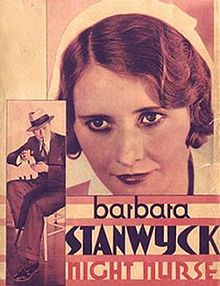
Several years ago, our group began our quest for pre-code films. We viewed the wonderful Barbara Stanwyck in Night Nurse (1931) at that time. Recently, I re-watched the film with a newer member of the group, and here share some of our thoughts. Stanwyck plays Lora Hart, a young woman who passionately wants to be a nurse. We meet Lora as she applies for a position in a hospital nursing school. However, Lora does not have a high school diploma - her mother's illness forced her to withdraw from school shortly before graduation - and the nursing matron will not accept her. As she leaves the hospital, she literally runs into Dr. Bell (Charles Winninger) who, it turns out, is the hospital administrator. Bell is quite taken with the attractive young woman, and decides to support her application. Lora becomes friendly with her roommate, Nurse Maloney (Joan Blondell), and Mortie (Ben Lyon), a bootlegger whom she assists (after he is shot). After graduation, she finds herself in a conundrum - her nursing oath demands that she obey the orders of the doctor in charge, but Lora quickly realizes that Doctor Ranger is in cahoots with Nick, the Chauffeur (Clark Gable) to murder two little children for their trust fund.
There is a lot of rowdy goings-on in this film. We have our heroine in a state of undress several times (and Ms. Maloney joins her in one of these slip-teases once). We have a bootlegger, who is not above asking his friends to take someone for a ride (we won't tell you who). We have a dipsomaniac mother, a doctor who may be on drugs, and a murderous chauffeur. And we possibly have an off-screen rape (see the TCM article for more on that). Want to see more, here is a clip of Stanwyck in one of the slip scenes:
We also have some outstanding performances. Joan Blondell as the gum-chewing Maloney is a hoot. She's not really interested in nursing - it's just the only job that will pay you to go to school! However, you like Maloney, who is quite good at her job, and a true friend. It's Maloney who first recognizes that the children are being mistreated, and her concern is real.
Clark Gable is very menacing as Nick - this was a breakthrough role for him, and it is understandable. Director William Wellman uses this up-and-coming star to good effect. In the TCM article we previously referenced, there is a discussion of Stanwyck and Blondell's reaction to this new man on the block. It's quite humorous. Finally, there is Stanwyck herself - her Lora truly wants to be a nurse. Watch the scene where the nurses take the Nightingale oath, and watch Stanwyck's eyes. Her idealism radiates (as opposed to Maloney, who keeps cracking her gum!). Also, watch her when she meets Dr. Bell, and later when she discusses him with Maloney. How DID she explain her predicament to him? Lastly, there are her interactions with the children - her tenderness is moving.
Join us next time for another film - the first of two versions of the same story.
Wild Boys of the Road! We laughed about the title for
weeks. We were sure it would be quite silly We were WRONG. This is a
fascinating movie. It focuses on three children - two boys and a girl,
about age 15 - who set off on the road because the depression has made
them a burden to their families. The boys, Eddie (Frankie Darrow) and
Tommy (Edwin Phillips) are friends; Tommy's family is already feeling
the poverty of the era, when Eddie's father loses his job. Eddie tries
to help by selling his car, but it is not enough, so the two boys
determine to leave home in order to find work. Of course, they can't.
They meet other children in the same predicament and are chased from
place to place, as their numbers grow and town citizenry become
disenchanted with this gang of impoverished children.
The unique thing about Wild Boys of the Road is that none of the children are mean-spirited or cruel. When Sally (Dorothy Coonan, who would become Wellman's wife) is raped, it is by an adult - her companions rush to her defense. When Eddie loses a leg in an accident, all the children work to support him. Here's that scene:
The beauty of this film is the fact that director Wellman
makes sure that the children are seen in a positive light. Their
existence is almost communal, with all the children staying together, all
contributing to the support of the group. Though they seem to lose
track of their original goal, to support their impoverished families, we
later discover they still hold that goal close to their heart. It is
just that the crushing poverty in which they find themselves make
survival become the priority. The performances, especially Frankie
Darrow, are a joy.
We watched a few minutes of the commentary
(and I look forward to watching the rest of it at a later date); what we
heard was fascinating. The ending is a positive one, but we learned
that Welllman had wanted a far more downbeat ending. We agreed with the
commentator who said that we preferred the positive ending. Had the
film ended differently, I think it would have been unbearable. [And -
an aside - look at the picture on the desk of NYC judge. He will become
famous as a TV actor in later life. The answer is in the commentary].
Don't let the title turn you off. Do watch this. We think you will agree with us, that Wild Boys of the Road is a forgotten gem.
Heroes for Sale is nearly unrelenting in the intensity
of pain that the character of Tom Holmes (Richard Barthelmess) goes
through. A soldier in the first World War, who is severelywounded in an
enemy action, he ends up addicted to morphine when his German doctor can
only relieve his pain rather than remove the shrapnel in his body. He
returns to America to find that his fellow soldier George (Grant
Mitchell) has been given awards for bravery for leading the action in
which Tom was injured, while George hid in a foxhole, paralyzed with
fear. George attempts to help his friend, as much out of fear of being
revealed as anything else, until Tom's addiction becomes known, at which
point Tom is fired from his bank job and put into a rehabilitation
center.
Cured of his drug problem, Tom starts over, marries
(Loretta Young as Ruth), becomes successful, only to have everything
taken away from him yet again. He loses his job, his wife, his son and
finally ends up one of the depression homeless, primarily because he
refuses to live upon the pain of his fellow man.
William Wellman
never lets up in this story. Just when you think Tom will make it,
something else happens to him. Richard Barthelmess is wonderful as Tom.
We felt for him at every moment. He had had a remarkable career in
silents, which continued into the 1930's, finally petering out
(unfortunately) in the 1940's. We had previously seen him in Only Angels Have Wings, and looked forward to seeing him in a lead role; he was not a disappointment.
Unlike the previously discussed Midnight Mary, Loretta Young plays an innocent girl in Heroes for Sale, someone who loves her husband and son
with her whole heart. Young is quite good in what is really a small part.
Besides Barthelmess, though, the other actor of real interest is Aline MacMahon as Mary Dennis. Of particular note is a
scene during which she realizes that Tom has feelings for Ruth. Watch her face -
Aline MacMahon will break your heart.
Ms. MacMahon began her career in 1931, and continued working until 1975. She had started on Broadway, appearing in The Madras House in 1921 - she would continue to work on the New York stage until 1975. She spent her film career in supporting roles, like Trixie Lorraine in Gold Diggers of 1933 and Mrs. Murray in The Search. Married once (from 1928 until her husband's death in 1975), she retired in after completing For the Use of the Hall. She died in 1991, aged 92.
Here's a scene with the always wonderful Aline MacMahon and Richard Barthelmess:
Next week, we conclude this particular precode set with Wild Boys of the Road.
The discussion for today will focus on Midnight Mary. We
were all fascinated to see Loretta Young play a prostitute/gun moll. One
is NOT used to her playing anything but the sweet innocent. However,
she was excellent in this, a tribute to her abilities as an actress.
Though Midnight Mary IS a traditional woman's picture, it is
also a condemnation of the Great Depression, and the conditions that
women faced as a result. Mary Martin ends up in reform school, primarily
because she is an orphan and has no one to defend her (when it is her
friend who is stealing). When she returns to the community, she is
unable to find work, and ultimately turns to prostitution just to pay
for food. We noticed that there are real similarities to the situation
facing Myra in Waterloo Bridge (we were discussing the the 1931
version - because it fit our "precode" focus, but this certainly
applies to the the 1940 version as well).
Quite a bit of our
discussion was about Ricardo Cortez, this time playing Leo, the mobster
(who is a really awful human being). He is, of course, so very different
in this than his role in Torch Singer. We found an
interesting comparison to Franchot Tone's Tom, who is our hero in the
film. Though he marries another woman after Mary rejects him, we felt
that Tone made the character a lot stronger than we would have
expected. We also liked Mary's relationship with him. Her desire to
protect him from her past was lovely; we also felt that he was well
aware of her past, and that it made no difference to him.
Here's a scene, featuring Loretta Young and Ricardo Cortez:
Next posting will be about another very interesting William Wellman film: Heroes for Sale.
 May 16th is National Classic Movie Day and to celebrate, I'm participating in this year's blogathon, Five Favorite Films from the Fifties. Be sure to follow the link to see the work of other bloggers, and find discussions of films you might never have thought to view.
 In 1931, Fred and Adele Astaire (along with Frank Morgan and Helen Broderick) starred in the Broadway play, The Band Wagon. It was a musical revue; this film has nothing to do with it, though I Love Louisa and Dancing in the Dark were both performed in the play. The film has a script by Betty Comden and Adolph Green, who loosely based the story on Mr. Astaire. He'd tried retirement for a few years, but was coaxed back to star in the very successful Easter Parade (1948); his most recent film, however (The Belle of New York) that had not done well (for more on Fred Astaire and The Band Wagon see this article in The Paris Review). The Martons were based on Comden and Green (though the real-life writing duo were not married), and Cordova was based on José Ferrer, who between 1946 and 1948 produced, directed, and/or starred in 8 Broadway plays - and did 10 more in the next three years! (TCM articles).
  Dr. Benjamin McKenna (James Stewart) is on vacation in Morocco with his wife Josephine Conway (Doris Day), a well-known singer who retired to take care of their son Hank (Christopher Olsen). They are befriended by Louis Bernard (Daniel Gélin), a Frenchman who asks way too many questions for Jo's tastes. Bernard is murdered and whispers to Ben that a statesman is targeted for murder. But the would-be murderers have their own plan - snatch young Hank to be sure that Jo and Ben don't contact the police.

 One of the things that really intrigues me is that Helen is clearly an unwed mother, yet there are no recriminations from anyone. Patrice is obviously aware that Helen has never had a wedding ring, and generously lets Helen slip on Patrice's ring. Originally, Helen was to have been a prostitute (AFI catalog), but in my opinion, Helen as a rejected lover makes for a more interesting story line.