Multi-millionaire John P. Merrick (Charles Coburn) is furious. Though he studiously keeps himself out of the limelight, a recent labor protest by the employees of a department store he owns have brought his name front and center. Determined to fire all of the people involved in the protest, he hires private detective Thomas Higgins (Robert Emmett Keane) to infiltrate the store and find the protesters. Mr. Higgins is unable to start immediately (his wife is about to have a baby), so Merrick fires him and uses the store credentials Higgins has acquired to become an employee in the store's shoe department. It's not long before he discovers that he really likes the store employees and despises the management. Our film this week is The Devil and Miss Jones (1941). The tone of this sweet and funny film is set at the opening credits, when we are introduced to the "devilish" Mr. Coburn and the angelic Ms. Arthur. While Ms. Arthur gets above-the-title billing, this film really belongs to Mr. Coburn, as it should. J.P. Merrick could be a bully and a bore, but not in Mr. Coburn's capable hands. He treads a fine line in being lovable, but still keeping you in suspense as to what he will do in the end. Though, as he becomes increasingly furious at the store managers and supervisors, you really want to give him a hug.
Charles Coburn came to the screen late in life - he was 60. He'd spent his career working in a touring company with his wife, Ivah Wills (they had 6 children). When Ivah died of congestive heart failure in 1937, Mr. Coburn moved his family to Los Angeles to try his hand at film acting. Between 1938 and his death in 1961, he appeared in more than 90 films and television shows. He received a Best Supporting Actor Oscar in 1944 for his work in The More the Merrier, and was nominated two other times - for his work in this film, and for The Green Years (1946). He was active in the Motion Picture Alliance for the Preservation of American Ideals (Hollywood Traitors: Blacklisted Screenwriters - Agents of Stalin, Allies of Hitler by Allan H. Ryskind), a group supporting the McCarthy hearings. Following a second marriage (he was 81 at the time), and the birth of a seventh child, he died of a heart attack at the age of 84. His papers are housed at the University of Georgia, Hargrett Rare Book and Manuscript Library.
Jean Arthur is delightful as Mary Jones. Though her romantic interest is Robert Cummings (Joe O'Brien), it is Mr. Coburn with whom she has the most scenes and the best chemistry. She would work with Mr. Coburn twice more: The More the Merrier (1943) and in The Impatient Years (1944) (TCM Article). The part of Mary Jones was specifically designed for Ms. Arthur - this film's producer was her husband Frank Ross. He had set up an independent production company and was eager to find a property that fit her talents better than the scripts she was being offered. Though Mr. Coburn's part is much stronger, Ms. Arthur refused rewrites that would have given her character more screen time. (Jean Arthur: A Biofilmography by Jerry Vermilyeand). She was fond enough of the part that she planned to do a remake of it in 1966, to be titled The Devil and Mr. Jones, with Ms. Arthur as the Devil; sadly, it didn't materialize.
Robert Cummings is good in a relatively small part. An early scene in the film has Joe cavorting with Mary on the beach at Coney Island. It's quite delightful to watch, and there is a naturalness to the performances. Mr. Cummings was not the first choice for the role - Jeffrey Lynn was originally considered. (AFI Catalog) Also in a small but important part is Spring Byington (Elizabeth Ellis). A gentle woman who just wants to find someone to love, she fixes her sights on Merrick when she thinks that he is indigent. One feels that Merrick has avoided any kind of entanglements because of his money. Ms. Byington makes Elizabeth into someone who cares nothing for money. She wants to find a man she can make happy, and Merrick is the right fit.
There are so many excellent character actors in the film it is hard to focus on just one or two. Edmund Gwenn is marvelous as the repugnant Hooper, one of the bosses who drive Merrick to distraction. S.Z. Sakall appears as George, Merrick's very tolerant butler, and is his usual warm self. William Demarest shows up in the small part of a detective, Regis Toomey is a police officer in Coney Island, and Florence Bates plays a professional shopper - all contribute greatly to the film.
The film, which opened in April at Radio City Music Hall, received an enthusiastic review from New York Times critic Bosley Crowther "Out of the sheerest gossamer the most captivating webs are sometimes spun". Unfortunately, it did not do well at the box offer (Author Jerry Vermilye speculates that the "unsubtle pro-union stance" was a factor"). In January 1942, there was a Lux Radio Theatre production which starred Lana Turner and Lionel Barrymore. The film was nominated for two Oscars: Norman Krasna for his original screenplay and Charles Coburn as Best Supporting Actor.
This is a movie that is not to be missed, especially if you are a Jean Arthur fan. We'll leave you with a clip, in which Charles Coburn meets Ms. Arthur:
Former British army Captain Hugh "Bulldog" Drummond (Ronald Colman) is finding civilian life to be a bore, so he puts an advertisement in the Times as a lark - advertising his services in exchange for some adventure. Though most of the replies are nonsensical, one - from Phyllis Benton (Joan Bennett) is not. She is in extreme danger and needs his help. Intrigued, Drummond heads out to meet her - where he finds the adventure he seeks. So begins Bulldog Drummond (1929), a very early sound film, and the first talkie featuring Ronald Colman. Films from the beginning of the talking film era can be both a blessing and a curse to the modern audience. It's fascinating to watch the birth of a new technology, but the birth pangs - the unease with the technology, the problems with its limitation, the insecurities of the performers as they try to adapt to a new style of acting - are equally frustrating in an age where CGI makes special effects hyper-realistic. But these early films often provide a surprise and in this one, the surprise is Ronald Colman, in his first sound film.
According to this TCM article, "by late 1928, producer Sam Goldwyn was searching for a suitable property
for Ronald Colman to transition from silent films to talkies." The natural choice seemed to be a romance, but Goldwyn decided instead on a mystery film, and was he ever correct!.
Colman is so natural, and so comfortable with sound that he immediately takes command of the film. While the rest of the actors (especially Lawrence Grant as one of our villains, Dr. Lakington - he all but twirls his mustache!) appear to have some problems making the transition, Colman is never ill at ease. One wonders what it was like for the viewers, familiar with Colman in silents, first hearing that glorious voice. Certainly, Goldwyn must have suspected he had a goldmine on his hands! Colman gives Drummond a joie de vivre that permeates the film, and keeps you wanting to watch it. The character of Bulldog Drummond was not unfamiliar to the screen.
While this was the first talking film about his exploits, there had
previously been two silent films - Bulldog Drummond (1922, a US production with Carlyle Blackwell in the title role) and The Third Round (from
the UK in 1925, with Jack Buchanan as Drummond). Nor would this
rendition be the last. Ronald Colman would return as Drummond in 1934's
Bulldog Drummond Strikes Back, but in the meantime, two other films would be released with Kenneth MacKenna (Temple Tower, US, 1930) and Ralph Richardson (The Return of Bulldog Drummond,
UK, 1934). In all, there was a total of 23 films featuring the character of Bulldog
Drummond released between 1922 and 1969. Among the actors who
appeared as the character were Ray Milland, Tom Conway, John Howard, and
Walter Pidgeon. The character also was featured on television and
radio adaptations. (TheAFI Catalog also discusses the history of the film series).
The series of films is based on the popular
novels of H. C. McNeile (aka "Sapper"), who wrote 10 novels between 1920
and 1937. Sapper was inspired by Sherlock Holmes, Richard Hannay, and
The Scarlet Pimpernel in his creation of the character of the gentleman
adventurer. After McNeile's death, the series continued with 7 novels
written by Gerard Fairlie (from 1939-1954). More novels followed in
1967 and 1969, both authored by Henry Raymond. Later iterations using
the character included short stories and graphic novels. Our two female leads - Joan Bennett as Phyllis and Lilyan Tashman as
Erma display different levels of comfort with sound. Bennett, at age
19, and also appearing in her first talkie, seems strained, though she
gives Phyllis a spunky-ness that is appealing - watching her rescue
Drummond was a real treat! Her unease with the new medium would, of
course, quickly pass - she would ultimately appear in 98 film and
television appearances. She began her career as a blonde - it wasn't
until her character in Trade Winds (1938) needed a disguise that
she went to brunette tresses. The look was so attractive, and opened up
such a range of roles (like that greedy Kitty March in Scarlet Street) that she retained the dark locks til the end of her career.
Lilyan Tashman, on the other hand, seems more relaxed with sound. An interesting actress, the bulk of her career was in silent films. She was transitioning nicely, when she was diagnosed with cancer. She died in the hospital, following surgery. She was 37 years old. Bulldog Drummond was extremely well received, as evidenced by these reviews from the New York Times and Variety. The film also received two Oscar nominations: for Art Director James Cameron Menzies and Ronald Colman as best actor (he lost to George Arliss in Disraeli. Technically, both Arliss and Colman were nominated for two appearances that year. Colman was also cited for Condemned). We were lucky enough to see an introduction by author James Curtis. He credits Menzies and his use of
storyboards for the fluidity of the film, as well as the use of sound effects which give the film
movement and sound simultaneously, something films of this period generally lack. We wholeheartedly recommend this film, especially if you are a Colman fan - he is a delight! Next week, we'll look at another Drummond film, with one of our favorite actresses, Dorothy MacKaill.
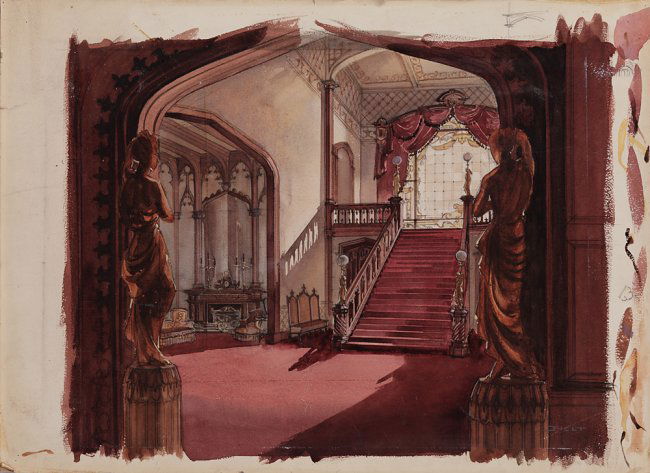
Though I've already posted on Gone with the Wind several times, I'm again going to discuss it, this time in relation to a interesting program held at AFI Silver (in partnership with Smithsonian Associates), which was part of a series entitled William Cameron Menzies: Inventing Production Design. James Curtis, the author of William Cameron Menzies: The Shape of Films to Come, spoke about Menzies contributions to filmmaking in general, and specifically about his impact on the film that would become Gone with the Wind. Using examples from Menzies' surviving art work (a sketchbook was miraculously saved from the attic of his home before the building was razed), Mr. Curtis discussed the contribution of Menzies' amazing eye in creating the look and feel of the film. Gone with the Wind was always going to be a Technicolor film; this gave Menzies the opportunity to use color in the telling of the story. Mr. Curtis pointed out the pastel hues of the early scenes - think of Scarlett entertaining her beaus on the steps of Tara, compared to the deep reds and oranges of the escape from Atlanta. The sketches tell the story of Menzies vision of the film.
Today, we see the term "production designer" on all films, but Menzies was the first person to have that title; in fact, it was created to describe his unique contribution to filmmaking. He won the first awarded Oscar in Art Design for his work in The Dove and Tempest (both in 1929) and was given a special Oscar for Production Design in 1939 for Gone with the Wind. Of course, there WAS no Production Design award at that point - the Oscar in that category was only renamed (from Art Direction) in 2012. In 2016, the Art Director's Guild instituted an award named after William Cameron Menzies. The first awardee was Robert Osborne, "for his work in championing classic motion pictures." Menzies would eventually go on to try his hand at film direction - Things to Come (1936) and Invaders from Mars (1953) are the two that are most highly regarded. But his credits in this area cannot surpass his credits in production design. With films like Kings Row (1942), Our Town (1940) and Made for Each Other (1939), he created a vocabulary of images.