Showing posts with label John Ford. Show all posts

Monday, January 20, 2020

Edward Sees Himself

The Whole Town's Talking (1935) about gangster "Killer" Manion (Edward G. Robinson), who just broken out of jail in search of stoolie "Slugs" Martin (Edward Brophy). With Manion's picture all over the front page of every newspaper in town, Arthur Ferguson Jones (Edward G. Robinson) is in a pickle - the mild-mannered clerk is a dead-ringer for Manion. How can the police catch Manion and not keep arresting Jones? Well, a pass issued by the Chief of Police seems like a good solution, but when that information hits the papers as well (thanks to Reporter Healy (Wallace Ford), Manion develops his own plan.

Mr. Robinson is quite impressive in the dual roles. Using him is an interesting and effective casting decision; it toys with the audience's familiarity with him in his gangster roles, by throwing another characterization into the mix.  Mr. Robinson doesn't rely on makeup or vocal changes to differentiate the characters - he uses his posture and his face. The audience always knows which character is which because of his skill in demarcating one man from the other. Clearly the star of the film - and the romantic lead - his performance also shows the skills that would make him a magnificent - and powerful - character actor as he aged. 

Following his success in Little Caesar (1931), it appeared that Edward G. Robinson was doomed to a career of gangster roles. So, when Columbia pictures wanted to borrow him for The Whole Town's Talking, he initially balked (TCM article). Under suspension and pressed for cash, Mr. Robinson eventually agreed to take the part. The film was so well received that there were rumors he would be nominated for an Oscar. However, Jack Warner used his influence to block the nomination - he didn't want a Warner star nominated for another studio's film (Little Caesar: A Biography of Edward G. Robinson by Alan L. Gansberg).
Jean Arthur is appropriately sassy as Wilhemina "Bill" Clark, the woman of Arthur’s dreams. He secretly writes poems to her, addressing them to Cymbeline; poems which she mocks (not knowing Arthur is the author). When she realizes that Arthur is a double of Manion, she becomes fascinated with the timid clerk. And while Bill finds Arthur's bachelor apartment exactly as she suspected (even to “a canary bird”), she has mellowed enough to find this endearing. We were especially amused by Bill’s discussions with the police, as she yells “Manion” to every crime about which they inquire. This film was something new for Ms. Arthur and contributed to her future in films like Mr. Smith Goes to Washington (1939) and Mr. Deeds Goes to Town (1936) (Women in the Films of John Ford by David Meuel).
It's surprising to realize that the film was directed by John Ford. One doesn't often think of him in relation to films of this type, but he had directed contemporary American stories before (John Ford: The Man and His Films by Tag Gallagher). In his autobiography, Edward G. Robinson had nothing but praise for Mr. Ford. The pair bring a gentle comedy to the film - Arthur is amusing, but never mocked.

A quick tip of the hat to the always amusing Donald Meek as Hoyt, the first person to confuse Arthur with Manion  - his efforts to claim the reward for finding Manion are really funny (it's not a surprise that he's having a problem getting the money, since he keeps turning in the wrong person). 

We do wish the police were a little less stupid - the idea of giving Arthur a note, and then letting a reporter put that in the newspaper is so tantamountly idiotic that you can only shake your head at this plot device. Regardless, this is a very small complaint in an otherwise enjoyable picture.
When it opened at Radio City Music Hall, The Whole Town's Talking received a glowing review from Andre Sennwald at the New York Times. This was the first of Mr. Robinson's films to open at Radio City and was a huge success for the studio (Little Caesar: A Biography of Edward G. Robinson by Alan L. Gansberg). 

The story was adapted from a novel by William R. Burnett, the author of Little Caesar (which would certainly help explain Mr. Robinson's initial reaction to the role). Working titles were Jail Breaker and Passport to Fame (AFI catalog).  In February 1941, Jeff Corey took on the story for the Lux Radio Theatre.

This is a fun film, and one we wholeheartedly encourage you to view.  We'll leave you with a clip from the opening of the film:

Thursday, May 16, 2019

5 From the 50s

May 16th is National Classic Movie Day and to celebrate, I'm participating in this year's blogathon, Five Favorite Films from the Fifties. Be sure to follow the link to see the work of other bloggers, and find discussions of films you might never have thought to view.

As I've mentioned before, my favorite films change from day to day, so I've opted to pick five films I truly love in five different genres - comedy, musical, film noir, suspense, and western. My caveat is, if you asked me tomorrow, you might get a totally different list. I'm also going to avoid discussions of films we've previously covered (I'll link you over to a few noteworthy ones within my chosen categories). Regardless, all of these films are remarkable and definitely worth seeing. If there are some with which you are not familiar, get hold of a copy asap. You won't be sorry.


Tony Hunter (Fred Astaire) has all but retired when his friends, writers Lester (Oscar Levant) and Lily Marton (Nanette Fabray) try to entice him back to work with their latest play. They plan to get Jeffrey Cordova (Jack Buchanan) to direct it. Cordova, however, has grandiose ideas, including the addition of ballerina Gabrielle Gerard (Cyd Charisse) to the cast. With misgivings ("I am not Nijinsky. I am not Marlon Brando. I am Mrs. Hunter's little boy, Tony, song and dance man."), Tony agrees, but conflicts arise as rehearsals begin.

When it comes to musicals of the 1950s, Singin' in the Rain (1952) and An American in Paris (1951) (justifiably) come immediately to mind. But The Band Wagon (1953) is a film that should always be included in the list of great 1950s musicals. With Cyd Charisse and Fred Astaire performing one of the greatest dance numbers in movie history, plenty of comedy, and a love story, it's a film not to be missed.

In 1931, Fred and Adele Astaire (along with Frank Morgan and Helen Broderick) starred in the Broadway play, The Band Wagon. It was a musical revue; this film has nothing to do with it, though I Love Louisa and Dancing in the Dark were both performed in the play. The film has a script by Betty Comden and Adolph Green, who loosely based the story on Mr. Astaire. He'd tried retirement for a few years, but was coaxed back to star in the very successful Easter Parade (1948); his most recent film, however (The Belle of New York) that had not done well (for more on Fred Astaire and The Band Wagon see this article in The Paris Review). The Martons were based on Comden and Green (though the real-life writing duo were not married), and Cordova was based on  José Ferrer, who between 1946 and 1948 produced, directed, and/or starred in 8 Broadway plays - and did 10 more in the next three years! (TCM articles).

Jack Buchanan was not the first choice for Gregory Cordova - Clifton Webb was approached initially; Edward G. Robinson and Vincent Price were also considered (AFI catalog).  And while Vera-Ellen was at one pointed listed for the role of Gabrielle, one wonders if the failure of The Belle of New York led to her not being used.

The film was well received upon release; the  New York Times review by Bosley Crowther was enthusiastic. It was nominated for three Academy Awards for Best Story and Screenplay, Best Costume Design (Color) and Best Scoring of a Musical Picture.  With all the wonderful musical numbers, the one for me that stands out is "Dancing in the Dark," perhaps Mr. Astaire's most romantic number since he and Ginger Rogers graced the screen.  We'll close this section with a video of that delightful dance.


Dr. Benjamin McKenna (James Stewart) is on vacation in Morocco with his wife Josephine Conway (Doris Day), a well-known singer who retired to take care of their son Hank (Christopher Olsen).  They are befriended by Louis Bernard (Daniel Gélin), a Frenchman who asks way too many questions for Jo's tastes. Bernard is murdered and whispers to Ben that a statesman is targeted for murder. But the would-be murderers have their own plan - snatch young Hank to be sure that Jo and Ben don't contact the police.

The Man Who Knew Too Much (1956) is a remake of Hitchcock's 1934 film of the same name. The plots are similar, but this version has a lot more nuance. Hitchcock told François Truffaut that "the first version is the work of a talented amateur and the second was made by a professional" (Hitchcock by François Truffaut)

James Stewart had already appeared in Hitchcock's Rear Window (1954) and Rope (1948); they would work together one more time in Vertigo (1958). Mr. Stewart was attached to the project from the beginning; Doris Day was also Mr. Hitchcock's first choice for Jo, especially since he wanted part of the conclusion to replicate the search for Richard the Lionheart by his troubadour Blondel. (TCM article). Her song, "Que Sera, Sera," won the Academy Award for best song, became her theme song, and was used in two more of her films (AFI Catalog). An excellent dramatic actress, she portrays a strong woman who ultimately refuses to be cowed by the danger threatening her child. Ms. Day's recent passing has already contributed many caveats to her exceptional skills as an actress and singer. This film is further proof that she was a talented dramatic actress.


To my mind, The Man Who Knew Too Much is one of Hitchcock's great films that is often overlooked in discussions of his work. Perhaps because it was not seen for so many years - it was one of the five films that Hitchcock owned and refused to release (including Vertigo, Rear Window, Rope, and The Trouble with Harry) (Mental Floss article). The highly regarded Vertigo and Rear Window got much praise and viewing when the films finally came back to their audience in the 1980s. This one has just not received as much attention.

If you are ready to watch the master of suspense spin his web, watch The Man Who Knew Too Much; here's a clip of the trailer, with a bit of Ms. Day doing her famous song.


Pregnant and dumped by her no-good boyfriend Stephen Morley (Lyle Bettger), Helen Ferguson (Barbara Stanwyck) boards a train with only her meager belongings - Morley gave her the ticket to get her out of town.  She is befriended by newlyweds Patrice (Phyllis Thaxter) and Hugh Harkness (Richard Denning), who are on route to introduce Patrice - who is also pregnant - to Hugh's family. Patrice lets Helen try on her wedding band while they are in the ladies room; at that moment, there is a train crash. Helen awakens to discover both her new friends are dead, and Hugh's family thinks that she is Patrice. With her baby to think about, and No Man of Her Own (1950), Helen is faced with a massive decision - accept help from the Harkness family, or leave before they realize her deception.

No Man of Her Own is on my list of favorite film noirs, as well as favorite Barbara Stanwyck films. As a woman abandoned by the man she loved, Stanwyck is remarkable (as always). Her ethical dilemma is obvious - the love she has for her unborn child, versus the need to lie to people as kind as Mr. & Mrs. Harkness (Jane Cowl & Henry O'Neill). There is the further complication of her growing affection for Hugh's brother Bill (John Lund). If it is a touch melodramatic, who cares? When you get a performer like Ms. Stanwyck telling the story, you want to watch.

One of the things that really intrigues me is that Helen is clearly an unwed mother, yet there are no recriminations from anyone. Patrice is obviously aware that Helen has never had a wedding ring, and generously lets Helen slip on Patrice's ring. Originally, Helen was to have been a prostitute (AFI catalog), but in my opinion, Helen as a rejected lover makes for a more interesting story line.

When the DVD was released in 2016, the New York Times provided some interesting commentary about the film (Bosley Crowther disliked it when it was released in 1950). The film was based on a Cornell Woolrich story (I Married a Dead Man), it has been remade several times, with versions in Japan (Shisha to no Kekkon (1960)), in France (J'ai épousé une ombre (1983)), in India (Kati Patang (1970), and in America (Mrs. Winterbourne (1996).

This is top-notch Stanwyck - and not one that comes up all the time, so watch for it! This trailer will give you an idea of what to expect.


The beauty of The Quiet Man (1952) is that it is so much more than a comedy. It tells the story of Sean Thornton (John Wayne), who left his home in Ireland as a young boy to emigrate to America with his mother. He grew up with his mother's stories of his former home, their wee cottage, White-a-Morn and the roses that grew outside the house. Sean's life in America was a hardscrabble one, and as that life has become untenable, he retreats to Innisfree, and buys White-a-Morn. As he tries to settle into a country he doesn't know, he finds that his unwillingness to fight brings heartache to him, and to the woman he loves, Mary Kate Danaher (Maureen O'Hara).

The Quiet Man was based on a short story by Maurice Walsh; John Ford acquired the rights in 1937 and yearned to make it into a film (AFI Catalog). Republic Studios finally agreed to make it IF Ford, O'Hara, and Wayne would make a Western (read moneymaker - Republic considered Ford's little film a vanity project that would lose money), so the trio first did Rio Grande. Filmed in Ireland, with various members of the cast's and crews' families working on the film, Ford was also under express orders to bring in a film no longer than 2 hours. But, his final cut ran 2:09 - he showed it to his execs, and stopped the projector at exactly the 120 minute mark. They agreed to the longer time (TCM articles).

For me, the film is important for its portrayal of a strong woman who is trying to maintain her independence in a society that limits a woman's choices. Mary Kate, in hounding Sean to get her dowry, is not asking for money - she's asking for her independence. With his American upbringing, all Sean can see is that what's his is hers. Mary Kate wants "her [own] things about her," for they are what make the house and the marriage all her own. 

I could go on for hours about this film. As a child, I would watch it every St. Patrick's Day (and growl when they cut crucial scenes out. Thank heavens for TCM and uncut films!).  I've been in Ireland twice, and both times visited Cong, the little village in County Mayo where The Quiet Man was filmed. The Quiet Man is a song of joy about Ireland, and a tale of strength under pressure.


There are some truly remarkable westerns in the 1950s - Shane, The Searchers (1956), Johnny Guitar (1956), among others.  But one film that should be in this list is the excellent Westward the Women (1951). The story of a group of 140 women who are recruited by rancher Roy E. Whitman (John McIntyre) as brides for his hands, the film portrays with as much truth as possible the dangers and hardships that faced the pioneers who went west. Leading the caravan is Buck Wyatt (Robert Taylor), a hard-nosed scout with little faith in the venture.

The women are a tough bunch. There is our star, Fifi Danon (Denise Darcel), a saloon girl who wants a new start. The widowed Mrs. Maroni (Renata Vanni) wants a new father for her son Tony (Guido Marfuti). Patience Hawley (Hope Emerson) has lost her husband and son to the sea, and also wants a chance with a new husband.
 
Robert Taylor is letter perfect as the man who decries Mr. Whitman's plan as foolhardy, but grows to respect the women in his charge.  Early in the film, he speaks to the assembled group. He asks if any can shoot a gun - he's stunned when Maggie O'Malley (Lenore Lonergan) shoots the eyes out of a picture. His regard grows as he sees the women take on more and more responsibility as they struggle towards California.


Regardless of his star billing, this is a film about the women.  Hope Emerson especially paints a portrait of a woman trying to begin a new life. She brooks no nonsense from her colleagues or from the men who lead the trail. She's brave and forthright, and you adore her from her first "hokum-smokum". Rose Myers (Beverly Dennis), a young woman pregnant with an illegitimate child is also an interesting character - accepted and loved by the group, with no condemnation of her past indiscretion. As this TCM article notes Westward the Women goes deeper into creating a female vision of the westward progression. These are the Pioneer Women (the film's working title) who would tame the western frontier.

Frank Capra had planned to direct, with Gary Cooper as Buck, but eventually sold the project to William Wellman (AFI catalog), which I believe added a layer of realism that benefited the story enormously.  Bosley Crowther in his New York Times review has certainly missed the point of the film; I suggest you take a look at A Woman's View: How Hollywood Spoke to Women, 1930-1960 by Jeanine Basinger for further discussion on this very timely picture.  In the meantime, take a look at the trailer:


And thus, our Five from the Fifties - there are many more excellent options (I didn't include a film I love, The Girl in White (1954). That's for another day). Just head over to Five Favorite Films from the Fifties and see the other wonderful films that were selected. In the meantime, Happy National Classic Film Day!

Thursday, May 12, 2016

Stuck on a Desert Island (with a DVD player)

In celebration of National Classic Movie Day, and as part of the Classic Film and TV Cafe's blogathon, I'm going to venture on choosing the five (!!) movies I want with me when I'm stuck on a desert island.  For someone with over 1,000 DVDs in her library, this is no easy task, but I'm going to give it a try with the caveat that the five I pick today may not be the same five I pick tomorrow!

I know that when forced to choose, I'm going to want to mix up the genres a bit, so I'm not watching the same kind of film over and over,.  Let's start with a musical, and my selection here is without equivocation.   Whenever Singin' in the Rain is on, I have to watch the whole thing.  I start out saying "I'll just watch this scene", and the next thing I know, the movie is over and I've re-watched it again.  I actually do that with a lot of movies, which is probably not a surprise to anyone reading this.  Regardless, Singin' in the Rain is special.  With great music, wonderful dancing (Donald O'Connor doing "Make 'em Laugh" is an especial favorite), and terrific actors (Jean Hagen as Lola Lamont - she is perfection!)  it has everything.  It also serves as an introduction to the beginning of talkies.  It's a film to which I frequently refer people, especially when they are puzzled as to why films look like they do in 1929 and 1930.  Plus, it's a film that you will finish with a smile on your face and a song in your heart.
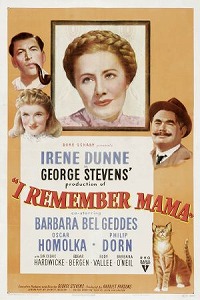
If you've never see I Remember Mama, you are missing a wonderful film.  My pick for drama has several competitors (mainly A Tree Grows in Brooklyn, Johnny Belinda and The Enchanted Cottage), but for this week, I'm going with Irene Dunne in one of her last films.  As the titular Mama, Dunne is perfect as Marta Hansen.  Sure, Mama at time seems without fault, but it's hard to care or even notice as Dunne is so unbelievingly convincing as this warm and loving wife and mother.  Narrated by the family's oldest daughter, Katrin (played beautifully by Barbara Bel Geddes), the story is a series of incidents in the life of the Hansen family over a number of years, which makes it perfect desert island viewing.  Each "story" can be watched as part of the whole progression of the film, or as an independent short story.  Especially poignant is an incident that revolves around the illness of the youngest daughter, Dagmar (June Hedin), and the inability of Mama to see her ailing child after surgery (hospital rules forbid any visitors for 24 hours post surgery.  Wow, have things changed with time!)  Dunne's heartbreak and guilt (she'd promised the child she would be there when she woke) in this segment reaches out from the screen and tears your heart.  Ultimately, it is the strength of the family and the care that the immigrant mother and father show to their children as they try to avoid "go[ing] to the bank" that you will remember.
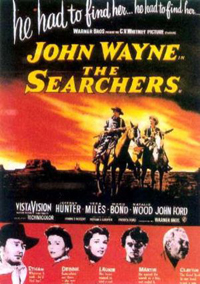
There are some really great westerns, and I have to admit that I had trouble deciding on just one.  It came down to two:  The Searchers and Westward the Women (add to the mix, a friend suggested Shane and The Big Country.  Yes, my friends make my life harder).  Ultimately, I chose The Searchers since it is again one of those movies I fall into each time I see it.  John Wayne is exceptional as Ethan Edwards, a man driven to almost insanity by his hatred of Native Americans.  When Ethan's niece, Debbie, is captured by a group of Indians who murdered the rest of her family, Ethan and Martin Pawley, a young man of mixed heritage who was raised by Debbie's parents, go on a quest to recover Debbie from her captors.  But as the years pass and Debbie goes from childhood to young adulthood, it becomes clear to Martin that he must continue on the journey, no matter the cost.  For, if he abandons it, Ethan will surely murder the young woman he now sees as a squaw.  The story is intense, with Wayne creating a character that is impossible to like, but with whom the viewer feels a bond.  Also notable are Jeffrey Hunter as Martin and Ward Bond as the Reverend Clayton, both characters that act as counterpoint to Wayne's driven loner.  Finally, there are the magnificent vistas of Monument Valley, which director John Ford uses to tell his tale.  It's a film with so many layers that, with each viewing, you'll see something new. 
There are a number of comedies, especially romantic comedies which come to mind when asked to pick a desert-island selection: Victoria, Victoria, The Major and the Minor, Roman Holiday are just the tip of the iceberg.  But I decided to select Bachelor Mother, starring Ginger Rogers as Polly Parrish, the temporary employee of Merlin and Son Department Store.  When her job is about to come to an end, Polly goes out on her lunch break to find another job.  She sees a woman abandoning a baby at a foundling home.  Fearful the baby will roll from the stoop, Polly rushes in - and is mistaken for the baby's mother by the staff.  As a result, Polly finds herself saddled with a baby, as well as a suitor, in the form of David Merlin, the "and Son" of the department store.  The film is funny and sweet, the baby is adorable, and our romantic couple have a great chemistry.  But what I love about this film are the attitudes of everyone towards this seemingly unwed mother.  Sure, we, the audience, know that Polly is a "good girl", but the other characters don't, and uniformly they treat her with kindness and compassion.  I especially love Polly's landlady Mrs Weiss (played to perfection by Ferike Boros), who, rather than condemn the girl, goes and gets her adult son's baby things and becomes Polly's go-to baby sitter!  In an era where unwed mothers didn't exist, or were punished (usually by death) at movie's end, Bachelor Mother gives us a picture of a society that embraces the mistakes of a young woman, and ends by creating a happy family, all without violating the Code.
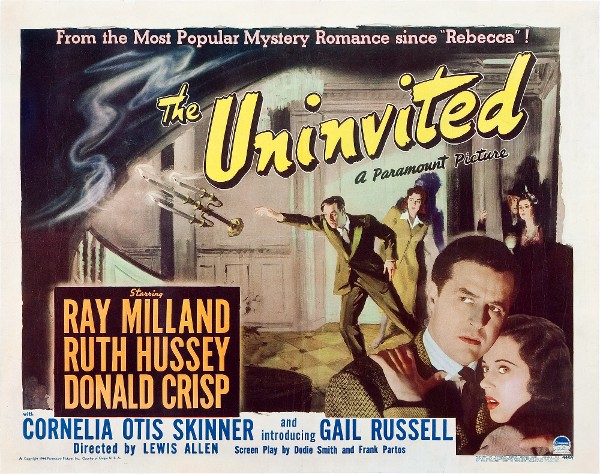
I'm not a huge horror fan, but I love suspenseful films.  The Spiral Staircase is one film that I considered for this category, but really there was no contest in the ultimate winner: The Uninvited.    It really does have everything - a phenomenal story, great cast, two ghosts, a really mysterious house, and a haunting musical score.  (In an earlier blog entry, above, you'll find a link to a You-Tube video of the magnificent theme, Stella By Starlight).  One of the problems with suspense films is that, once you know the answer, you don't always enjoy rewatching the film.  But The Uninvited still is a pleasure even when you know what is coming.  Much like Laura, it's the acting, and the relationships of the characters that keep you returning to this film.  Ray Milland is exceptional as Rick, the new owner of Windwood House, as is Ruth Hussey as his sister Pam.  But the person who steals the film from under everyone else is the ethereal Gail Russell, playing Stella Meredith, the object of Rick's love and the focus of the beings that haunt the house.  The Uninvited is a movie that will make you believe in ghosts.
As I said, this is a list that could change at a moment's notice, and you'll notice that the list lacks a few films that one might expect to see on a desert island list.  So, let's give a nod to To Kill a Mockingbird, Gone with the Wind,  The Best Years of Our Lives, The Thin Man, Casablanca, just a few in a list of "essentials" that film fans love.  These are wonderful; I own them, I would never give them up. I rewatch them regularly, but you all KNOW about these films.  With my list, I hope I may have brought up a few films that might not have made your own "essentials" queue.


Wednesday, January 20, 2016

Dr. Ronald


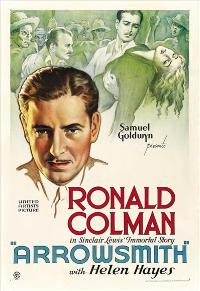
Ronald Colman plays a physician with an interest in research in  Arrowsmith (1931).  Dr. Martin Arrowsmith (Colman) knows from early in his career that he wants to do big things.  He wants, he tells his mentor Dr. Max Gottleib (A.E. Anson) to cure cancer.  But when he meets and falls in love with Leora Tozer (Helen Hayes), Arrowsmith decides to set up a clinical practice in a rural area, where he can make some money to support what he hopes will be a growing family.  But research is in his blood, and he begins to work on a finding a cure for Black Leg Disease, a bovine infection that is decimating the area.  His success leads to an offer to join the prestigious McGurk Institute in New York City, where, he hopes, he can begin to cure the ills of mankind.

Based on the novel by Sinclair Lewis, Arrowsmith is a layered film, though drastically shortened from the novel.   Helen Hayes, whose wonderful portrayal of Leora gives us a strong but insecure woman, alleged that director John Ford excised much of the script in order to shorten the production time - she claimed that as he had promised to not drink during the filming, he was in a hurry to finish the film (this TCM article outlines the story that is included in her autobiography, My Life in Three Acts.  In John Ford: Hollywood's Old Master by Ronald L. Davis, the story is elaborated on to discuss in a bit more detail the affection that resulted between Hayes and Ford.)
In spite of Ford's alleged trimming of the plot, the film still retains a lot of depth and character development.  Martin Arrowsmith is carefully played by Colman, and he makes the relationship between Martin and Leora especially poignant before and after her miscarriage.  While Martin is always genuinely caring of her, once she loses their child and is told she will not be able to conceive again, his attentions shift more towards his work.  Is Arrowsmith afraid of losing Leora, or does he have problems confronting a life without the family for which he sacrificed his early career?  Having married a nurse, it would seem obvious that Leora would become a helpmeet in his research, but, with the exception of one scene, she does not.  In fact, there are no women scientists in this film (it is the 1930s, after all), and often the female characters are given short shrift.  But, regardless, the story and Colman's portrayal document a marriage that is loving, but tenuous at best.  John Ford: The Man and His Films by Tag Gallagher looks briefly at the marriage of Martin and Leora (but be aware, there are spoilers here).

In a brief role is Myrna Loy as Joyce Lanyon.  In the novel, the character of Joyce was much more substantial, and figured heavily in the conclusion of the story.  Though filmed in the pre-code era (see this commentary by my fellow blogger at Pre-code.com), this movie is remarkably tame.  There is a hint of attraction between Joyce and Martin (is there an affair? It's not clear.  In the book, there is some kissing, but nothing more), but the film does not dwell on any possible infidelity.  Still several years away from her breakthrough role in The Thin Man, Ms Loy was still being cast as the vamp or the exotic, so it is not surprising her part is so suspicious.  But even a brief appearance by Myrna Loy is welcome, and she does not disappoint. (For more information on the MPAA and the film, see this listing from the AFI Catalog).
In an even more brief appearance is Beulah Bondi as Leora's mother.  She has all of one scene, and gets to say very little.  Too bad, as Ms. Bondi is an asset to any film in which she appears.  Born in 1889, she began her career at age 7 in her hometown of Valparaiso, Indiana (playing Little Lord Fauntleroy!)  After receiving a master's degree in oratory at Valparaiso University, she began to get roles on Broadway (she would appear in 11 Broadway productions in her lifetime) in plays such as Street Scene and Rain (a part she would reprise in the screen version starring Joan Crawford). One of the first actresses to be nominated in the category of Best Supporting Actress (for her work in The Gorgeous Hussy) by AMPAS, she never won an Oscar (she was nominated one more time for Of Human Hearts).  Interestingly, she played the same character three times, over a span of 18 years, appearing in On Borrowed Time in the 1939 film, the 1953 Broadway production, and a 1957 Hallmark Hall of Fame TV version.  With 86 film and television credits (many of them named Granny or Mom), she is probably best remembered as James Stewart's loving mother in It's a Wonderful Life (though one of my favorite Beulah Bondi moments is her dance with Ginger Rogers in Vivacious Lady!).  Her final role, in a career of 49 years, would be an Emmy Award winning performance in The Waltons.  She died in 1981, at the age of 92.  This TCM tribute to Beulah Bondi is well worth a viewing:

It is important to mention the presence of Dr. Oliver Marchand, as played by actor Clarence Brooks.  Dr. Marchand is of African descent, and is treated by Drs. Arrowsmith and Sondelius (Richard Bennett) with respect and courtesy.  Though a small part, it is a remarkable one, given the time period.  Dr. Marchand is shown a competent doctor, concerned with in the health of his patients, with an understanding of Arrowsmith's need to check his research with a clinical trial.  Marchand is willing to have his patients serve as test subjects, as it means many who would other die will survive.  That a man of color in the 1930s was shown as a knowledgeable professional is something that should be noted.

One interesting aspect of the film is the need for Dr, Arrowsmith to prove his theory on the plague vaccine with a clinical trial.   The film gives us both a population who refuse to be "guinea pigs" (even though the serum may save some of their lives), and another population who willingly participates.  But, like Dr. Ehrlich's Magic Bullet (1940), the clinical trial is shown as something that prevents patients from receiving medication that will save their lives.  In the 21st Century, we have embraced the notion of the clinical trial, but in the era of heroic medicine, the clinical trial was seen as an unnecessary delay in delivering a cure.

We'll leave you with an early scene in the film in which Arrowsmith learns the joys of primary care medicine.

Tuesday, September 8, 2015

Ava Takes a Bath

Mogambo (1953), the remake of Red Dust is unique in that the same actor plays the lead over twenty years later.  And frankly, it's hard to imagine anyone else doing it.  Victor Marswell (Gable) is a big-game hunter in Kenya.  Most of his work involves trapping animals for American zoos, though he will take on the occasional tourist or researcher.  But when  Eloise Y. (Honey Bear) Kelly (Ava Gardner) arrives, he is not prepared for the consequences.  She is there to meet the Maharajah of Bungalor, who it happens, canceled his trip without informing Honey Bear.  Since the next boat back isn't for a week, Honey Bear is stuck; a romance quickly develops between her and Vic.  But not for long, because when the boat arrives, Vic happily shoves her on it - he assumed a brief fling, she (unbeknownst to him) had other ideas.  The boat is also the bringer of business - Donald Nordley (Donald Sinden) and his wife of 7 years, Linda (Grace Kelly) alight.   Donald plans on researching gorillas in the back country.  Vic is at first reluctant - he considers gorillas far too dangerous, but changes his mind as he becomes attracted to Linda.  Further complications ensue when Honey Bear returns - her boat broke down - the tension between the two women is palpable, as each makes her bid for Victor's affections.

Mogambo does not veer extensively from the story of Red Dust.  It changes character names,  the location of the action, and the reason for the visit of the Nordleys.  It also extends the story somewhat.  Much of this is in the nature of a travelogue.  We are treated to many shots of stunning African vistas, exotic animals, all in wide-screen and Technicolor.   Much of this is done to attract an audience that is dismissing film for their television -  TV is not really available in color, so the film entices audiences with the promise of excitement and beauty.  And viewes Clark Gable without his shirt (still a rather pleasant slight).  The film was shot on location, a huge incentive for hunters Gable and director John Ford, and for Grace Kelly, who was delighted at the idea of a trip to Africa.  Allegedly, Gable and Kelly also became romantically involved while there (at least according to Donald Sinden).  This series of TCM articles is worth a read for many tidbits about the film.

Other actors were considered before the cast was finalized:  Stewart Granger (as Victor - Granger actually suggested the remake, with himself in the lead.  Sam Zimbalist, however, wanted Gable); Deborah Kerr, Greer Garson, and Gene Tierney (for the part of Linda) and Lana Turner (as Honey Bear).  And while some of our group members were not impressed with Kelly (her Linda is much harder than Astor's Barbara), there was overwhelming praise for Ava Gardner.  Her character has much more depth than that of Vantine - we learn a little about her past, and her gradual growth into acceptance is a  big plus in liking Honey Bear.  Gardner also get all the best lines.  One of my personal favorites is: "The only lions I ever want to see again are in front of the public library."  Spoken like a true New Yorker!

One thing that the character of Linda has that Barbara does not is more backstory.  Linda and Donald are childhood sweethearts (she's known him since she was five years old).  They've been married for 7 years, and she is only 27 (Barbara and Gary are newlyweds), and Linda has traipsed around the world with her husband, despite that fact that what she really wants is a set home and children.  The affair with Victor becomes all the more understandable when one has all this background information - that she's been trying to sustain the marriage for many years, has been a "good sport" about her husband's penchant for exotic travel, and that she is reaching an age where the call for a family is probably quite loud (a call that Donald doesn't hear).  Her husband's illness, and Victor's rescue of her from an animal trap make him Sir Galahad in her eyes.  Small wonder that she falls for him.

If Gable at times seems impatient, we wondered if it could have been the difficulties he was having with John Ford, who resented Gable's need for retakes (Gable - compromised by years of drinking -  now suffered occasional palsies, that would come unbidden.  He would need to reshoot scenes if they popped up onscreen).
The one problem with the remake is there seems less reason for Victor's attraction to Linda.  Certainly, Kelly is a beauty par excellence, but Gardner is no slouch in the looks department, and demonstrates a sense of humor and good fellowship that Linda sorely lacks.  Yet, Gable shows his to Kelly attraction immediately: Victor's eyes light up when he sees Linda, but there is a gentleness behind it, almost out of character for the rather gruff Victor.  Nevertheless, it does make Victor more attractive - he is not the "two-legged boa constrictor" Honey Bear describes in his relations with Linda.  And even 20+ years older, Gable is stunning - he mesmerizes on the screen, and it is perfectly understandable that Zimbalist would want him rather than Stewart Granger.  No one else could duplicate the role; Gable is too dynamic.
Stories abound concerning the difficulties of working with John Ford, and as noted above, this film was no exception.  Eventually, Gable came to terms with Ford, who had not, it seems, ever seen Gable in Red Dust.  But Gable was not the only one to suffer Ford's wrath - Donald Sinden was also a victim - the ultra-Irish Ford decided to blame the English Sinden for the troubles in Ireland!

It was Ford who insisted on Grace Kelly for the part of Linda; and, both Kelly and Gardner were nominated for Oscars for their work on the film.  The film also - at Ford's insistence, does not have a soundtrack.  He wanted, and got - animal sounds and native music to be the background to his story. 

We'll close with the scene in which we meet Honey Bear - a scene "borrowed" from the original film.  Interestingly, according to this AFI article, the Censorship Board had problems with the scene; "the PCA believed the shower scene 'involved too much exposure' and demanded that some footage be eliminated"  The ruling was protested (and, it seems MGM's Robert Vogel won).  See if you agree (the dialog is in Spanish, but a picture is worth a thousand words):