Showing posts with label Jane Russell. Show all posts

Monday, April 19, 2021

Robert Meets Jane

After several thugs beat Dan Milner (Robert Mitchum) with claims that he owes a gambling debt, Milner is offered an opportunity - go to a ritzy resort in Mexico, all expenses paid, and stay for one year. En route, he meets Lenore Brent (Jane Russell), a wealthy woman who is also going to the resort. When he arrives, he meets various characters, including hunting-mad actor Mark Cardigan (Vincent Price), FBI Agent Bill Lusk (Tim Holt), and the threatening Thompson (Charles McGraw). But what is becoming clear is that Dan is in danger.  Our film this week is His Kind of Woman (1951).

Any discussion of this film has to start with the fact that it is weird. It's classed as a film noir in many publications, but it is more than that - it's got a little marital melodrama, elements of the traditional gangster film, and a lot of comedy.  This by no means is to intimate that it is a bad film - there is pleasure in weirdness, and there certainly is in His Kind of Woman.
 
The audience is often in the same situation as Dan Milner - going on an unknown ride, with precious little information to guide us.  We know from the start that Nick Ferraro (Raymond Burr) is up to something, and that Dan's appearance is part of the factor, but we aren't sure of what, which adds to the suspenseful aspects of the film.  There is supposed to be a resemblance between Dan and Ferraro, but the camerawork also makes it seem that Mr. Mitchum is much taller than Mr. Burr (there was actually only a 1 inch difference in their heights), so we finally see the two together, the similarities are slim at best. 
Mr. Burr was the THIRD person cast in the role of Ferraro, a character loosely based on Lucky Luciano (TCM article).  Lee Van Cleef had shot his scenes when Howard Hughes informed his second director, Richard Fleischer (more on that later) that he didn't like Van Cleef.  So Fleischer re-filmed all the scenes with Robert J. Wilke, only to have Mr. Burr walk in one day to tell Fleischer that Mr. Hughes had ordered Mr. Burr to the set to again re-film the Ferraro scenes (Movies!TV). Mr. Burr is convincingly menacing as Ferraro - even in stillness, he has an air of danger around him. It's been said that, in one of the intense fight scenes, he accidentally knocked out Robert Mitchum (AFI catalog). We felt he was a real asset to the film, but three different filmings does seem a bit excess. 

Robert Mitchum was Howard Hughes only choice for the role, and he's excellent as a man way out of his depth.  In the extended ending, he is truly fearful - something you don't often see from a hero.  Also, he has an excellent rapport with his fellow actors, especially with Jane Russell (who became his long-time friend with this film) and Vincent Price (who called Mr. Mitchum "an extraordinary actor" who was "heaven to work with").  
Jane Russell brings just the right amount of street smarts to the character of Lenore, who is really Liz Brady, a former singer trying hard to find a rich husband.  She and Mr. Mitchum bounce off of one another beautifully; she's also smart and gutsy.  When the final showdown begins, she's all set to storm the gates with Mr. Price's ragtag army.  She brings a sweetness to Liz that is refreshing - yes, she's planning to marry Mr. Price for his money, but the audience never feels that she is completely mercenary. 
 
Some other supporting parts worth mentioning are Jim Backus as a professional gambler who is using his skills to railroad a newlywed into his bed - watch for the Casablanca-inspired scene with Leslye Banning (Jennie Stone), who was, in fact, Jane Russell's sister-in-law.  Ms. Banning and Mr. Russell were divorced in the 1950s; she remarried and had a total of 10 children - 3 with Mr. Russell and 7 with her second husband Keith Rogers, to whom she is still married). Marjorie Reynolds (Helen Cardigan) as Cardigan's estranged wife and Tim Holt have far too little screen time, in our estimation, but both (especially Ms. Reynolds) make the best with what they have.
I've saved the best for last - Vincent Price is amazingly funny as the actor who takes on the villains. Mr. Price looks like he is enjoying himself in the part, and it brings some much needed relief at the end of the film when the sadism level reaches it's peak.  Howard Hughes was particularly enamored with the character of Mark Cardigan, and insisted that it be substantially expanded. Watching Mr. Price spout Shakespeare (and for those who have watched the commentary by film historian and academic Vivian Sobchack, they is NOT all from Hamlet. Mark quotes Romeo and Juliet, Macbeth, A Midsummer Night's Dream, The Tempest) and throw his cape around is immensely funny. At the same time, you have to admire his bravery, as well as his intelligence - watch him figure out exactly where an attacker is hiding.

It would take more space than we have here to go into detail on the varied and sundry changes made to this film - Eddie Muller's intro and outro for the film's presentation on Noir Alley will give you a really good overview. The short version is that director John Farrow refused to make the emendations that Howard Hughes wanted - the expansion of Vincent Price's scenes, and a long ending that involved beating and torturing Mitchum's Dan Milner (it's amazing that this film got through the PCA!). So, Hughes brought in Richard Fleischer and told him he would only release The Narrow Margin IF Mr. Fleischer subbed as director for the scenes he wanted. By the time the film ended, Mr. Mitchum had been on the production for one year, having shot some of the extremely intense scenes many times with different actors.  He finally lost it one day, and destroyed much of the set when he was shooting a fairly violent episode yet again.
The New York Times review by H.H.T. (Howard Thompson) was abysmal, calling it "one of the worst Hollywood pictures in years".  It lost money upon release, primarily because Hughes spent so much money in reshooting that the budget was overly inflated.  In recent years, it has been viewed more positively, with Senses of Cinema say it is one of  "classics of narrative perversity" and TimeOut saying that in spite of its oddness it is "an unforgettable delight".

If only to see Vincent Price, we heartily recommend of viewing of this peculiar film.  We'll leave you with the trailer:


Monday, May 11, 2020

Jane is Kidnapped

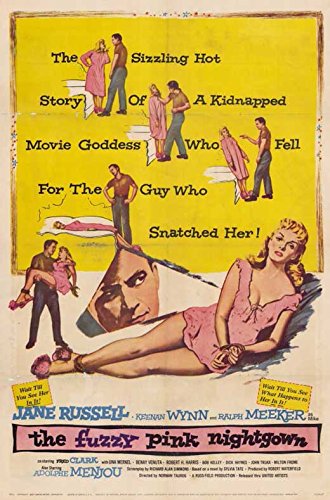
Laurel Stevens (Jane Russell) is a successful actress with a new film being released - The Kidnapped Bride. She's a tough negotiator, who is careful to protect her career and image, and who uses her power to make sure her studio also protects them. Having successfully brokered several concessions for the release of the picture, she leaves for the premiere, only to find that her driver is, in fact, a kidnapper.  Driven to a beach-side bungalow and handed The Fuzzy Pink Nightgown (1957), Laurel tries to find a way out.

It's unfortunate that this effort at filmmaking is not really successful. It has a decent premise, and a number of good actors, but nothing really gels. It's not that the movie is bad - it has some good moments and presentable performances, but in the long run, the film sinks because of a poorly designed script.

Jane Russell does her best with what she's given. Laurel is a strong woman, who sees her career as the most important thing in her life. She's smart and she is determined, so it is hard to understand why she would fall for someone like Mike Valla (Ralph Meeker). He strikes her, and he has forcibly removed her from her home.  Part of the problem is that the years have made some aspects of the film distasteful - Laurel is hit a several times; when she hits back, it's set up as being amusing. Quite honestly, there is nothing amusing about her predicament.
None of our group are particular fans of Ralph Meeker, and we didn't find that there was any chemistry between him and Ms. Russell. He's not bad, but he is much more convincing in menacing mode (like in Jeopardy) than in as the romantic lead.  Ms. Russell very much wanted Dean Martin to appear as Mike, but director Norman Taurog selected Mr. Meeker after Ray Danton was released from the film (Flashes from Filmland, January 12, 1957 by Erskine Johnson) - it was decided that Mr. Danton looked much too young to be romancing Ms. Russell.

The interactions between Laurel and Mike's best friend Dandy (Keenan Wynn) are far more engaging. There seems to be real affection between the two, and Dandy is a more likeable character than Mike. The son and grandson of actors (Ed Wynn and Frank Keenan, respectively), Mr. Wynn spent his film career as a second banana, with a body of work in some outstanding films: The Hucksters (1947), B.F.'s Daughter (1948), Annie Get Your Gun (1950), and Dr. Strangelove (1964) are just a few examples. He'd started on Broadway (he appeared in 9 plays between 1935 and 1943); worked in radio, and eventually segued into television - he took over the role of Digger Barnes in Dallas when David Wayne's other commitments forced him to leave the role. Mr. Wynn was married three times. His first marriage, to Evie Lynn Abbott ended in divorce (the next day Ms. Abbott married Mr. Wynn's best friend, Van Johnson. She would later state that she was forced to marry Mr. Johnson to protect Mr. Wynn's career (The Independent)). His third marriage to Sharley Hudson lasted from 1954 until his death of pancreatic cancer in 1986. 
There are some other good character actors in the cast, who make the most of what screen-time they have. Fred Clark  (Sgt. Ed McBride) is convincing as a police officer trying to make amends to Mike Valla for wrongly imprisoning him.  Una Merkel  (Bertha) gives a nice turn as Laurel's assistant, confidant, and best friend.  Adolphe Menjou (Arthur Martin), however, is quite over-the-top as the studio head. 

Ms. Russell and her husband Bob Waterfield purchased the novel on which the script is based for Russ-Field, their production company (AFI catalog). The novel by Sylvia Tate was based on the alleged kidnapping of actress Marie McDonald (TCM article). Though Ms. MacDonald was found battered on a desert road in California, police and her ex-husband Harry Karl (who would later marry Debbie Reynolds and ruin her financially) believed the kidnapping was faked to garner Ms. MacDonald some publicity (Pulp International).  The truth of the story was never proved or disproved.
The New York Times review was dismissive, and we have to agree with it. Even at 87 minutes the film seems long. It's not a bad film, it just is a very mixed-up one.  It seems like the writers wanted to write a romance, but then decided it should be a comedy - neither holds for very long.  You wait for hi-jinx you never get; or for a real romance that never quite materializes.  We'll leave you with this trailer: