It is the 75th Anniversary of Casablanca (1942) and to celebrate AFI Silver featured the film for several days. I've seen the film more times than I can count on television and home video; I've also seen it several times on a big screen, but when your friend tells you that she's NEVER seen the film, what can you do but go again? The opportunity to see the # 1 film on AFI's list of 100 Years, 100 Passions, not to mention #2 on the AFI 100 Years, 100 Films list with a neophyte is just too good to resist. It really is like getting to see the film AGAIN for the first time. If you are like my friend, and have never seen Casablanca, a quick plot rundown is in order (then again, if you've never seen Casablanca, stop reading this blog, and go watch the movie!) It's December 1941, and Rick Blaine (Humphrey Bogart) owns a successful cafe and (illegal) casino in Casablanca. The cafe is inhabited primarily by refugees, trying to get to America. But, on the night when black marketeer Ugarte (Peter Lorre) is arrested for the murder of German couriers (they were carrying non-revocable letters of transit), Rick's past catches up with him, in the form of his lost love, Ilsa Lund (Ingrid Bergman).
It's likely that Casablanca is one of the most written about films in movie history - I know of four, one of which was just released: We'll Always Have Casablanca: The Life, Legend, and Afterlife of Hollywood's Most Beloved Movie by Noah Isenberg (2017); The Making of Casablanca: Bogart, Bergman, and World War II by Aljean Harmetz (2002), Casablanca: Behind the Scenesby Harlen Lebo and Julius Epstein (1992); and Casablanca: Script and Legend by Howard Koch (1995). As a result, it has a much storied history. For example, the rumor (fed by a Hollywood Reporter news item) that Ronald Reagan and Ann Sheridan were to play Rick and Ilsa has been debunked by numerous sources (including Ms. Harmetz). Ms. Harmetz also clarifies the rumor that George Raft was offered the role - his name was suggested, however producer Hal Wallis wanted Humphrey Bogart. Ms. Harmetz also relates Paul Henried's (Victor Laslo) later antipathy for the part of Victor Laslo, and his disregard for Humphrey Bogart. He told the author in 1992 that "Mr. Bogie was nobody.... Before Casablanca he was nobody...he was a mediocre actor." To give him credit where credit is due, he had had a successful theatrical and film career in German before the rise of the Nazis, and had appeared on the New York stage as well.
The other actor who is impressive (besides our key three players, of course) is Conrad Veidt as Major Strasser. A star of German cinema (Veidt is perhaps best remembered from his amazing performance as the somnambulist in The Cabinet of Dr. Caligari (1920)), Veidt left Germany in 1933. His wife was a Jew, and Veidt despised the Nazis. He emigrated first to England, then to the United States, where it seems that his most memorable roles were as Nazis (such as All Through the Night (1942) and Escape (1940)). He donated large sums of money to the war effort (TCM article); Veidt also required that, if he were cast as a Nazi, that character must be a villain (Casablanca: As Time Goes By: 50th Anniversary Commemorative by Frank Miller). Unfortunately, Mr. Veidt did not get a chance to escape from the Nazi typecasting - he died of a heart attack in 1943, shortly after he finished filming Above Suspicion.
Of course, Mr. Veidt was not the only refugee appearing in the film: Madeline LeBeau (Yvonne), S. Z. Sakall (Carl), Peter Lorre, Marcel Dalio (Emil the Croupier), Helmut Dantine (Jan Brandel), and Paul Henreid were among the actors who escaped from German and the occupied nations to work in Hollywood. (AFI catalog)
In 1944, Casablanca won 3 Oscars in 1944 (Film, Michael Curtiz (Director), Adapted Screenplay (Julius and Philip Epstein and Howard Koch)) and was nominated for 6 others including Best Actor (Bogart), Supporting Actor (Rains), Score (Max Steiner), Editing, and Cinematography. It appears on several other AFI lists:AFI 100 Years, 100 Cheers at #32, AFI's top Heroes, with Rick Blaine at #4, and 100 Years, 100 Thrills at #37. But the true test of the film is watching it again and again (which I have). It's a picture which you decide you will watch JUST this one scene and end up watching the whole movie. I'll leave you this this conversation between Rick and Louis, and another wonderful Rick quote:
This week, we move to the period just before the start of World War II to discuss All Through the Night (1941), a very funny - and entertaining - film from Warner Brothers. 'Gloves' Donahue (Humphrey Bogart) is a promoter in New York City. Every day, 'Gloves' goes to his favorite restaurant for Miller's cheesecake. The restaurant is under orders to ONLY serve Miller's cheesecake. On one particular day, Papa Miller (Ludwig Stossel) has not made his usual delivery. Though Papa Miller assures 'Gloves' that all is well, later that day, - following a frantic phone call from his mother (Jane Darwell) - 'Gloves' discovers Papa Miller has been murdered. 'Gloves' - the prime suspect of the police - and his crew investigate the murder, and find not only the murderer, but a passel of Nazis who have infiltrated New York City.
This film has an amazing cast. Humphrey Bogart demonstrates his flare for comedy as 'Gloves' (whose given name is Alfred!), and is supported by actors like Frank McHugh (as newlywed Barney), William Demarest (as right-hand man Sunshine), and Jackie Gleason (as Starchy). His opposition is just as impressive. Peter Lorre as Pepi, our slimy villain was of particular interest. He is an actor who is always fascinating to watch; he is not a disappointment here. The wonderful Conrad Veidt is featured as Hall Ebbing, the ultimate Nazi; and Judith Anderson appears as Ebbing's comrade - she is just as menacing as she was in Rebecca. Add Kaaren Verne
as love interest Leda Hamilton and Phil Silvers
(as a waiter in the restaurant), and you have a powerhouse of actors. It's really it is the acting that make this film so enjoyable. It has a good script, but coming from the mouths of these folks, the dialogue shimmers.
The film was released on December 2nd, 1941 - just 5 days before the United States would enter World War II. Many of the studios tried to avoid any mention of the difficulties in Europe. Certainly, this was an economic issue (insulting the Nazi party would assure that the studio's films would not be shown in Germany). But censorship was an issue as well. The Hays office, which governed film standards under the Production Code, was very clear that films which "would arouse very bad feeling in Germany" were to be avoided (The New Yorker. "Hitler in Hollywood"). However, Warner Brothers had other ideas. As this article from the American Film Institute discusses, Warner Brothers release of Confessions of a Nazi Spy in 1939 (based on an FBI case in New York) was the first explicitly
anti-Nazi film made in America. It was produced in the face of numerous
domestic and international threats, and reversed the policy of the Hays
office.
This film follows in
that anti-Nazi vein, and features three actors who had a vested interest
in showing the dangers of the Nazi party. Conrad Veidt, whose wife was
a Jew, left Nazi Germany for the United Kingdom in 1933, relocating the U.S.
around 1940. Peter Lorre was in a similar situation. Though lauded by Nazi Minister of Propaganda Joseph Goebbel for his work in the film M,
Lorre and his wife (actress Celia Lovsky) fled to the United States in
1933. Kaaren Verne left Germany in 1938, also to get away from the
Nazis (Verne and Lorre would marry four years after this film, after
divorcing their respective spouses). Veidt, who donated huge sums of money to the British war effort, especially seemed to relish the chance to make the Nazis look bad. He is a marvelous actor, and it is a shame that his death of a heart attack in 1943 precluded his return to meatier roles.
The advertisements for the film make sure to emphasize that Bogart's 'Gloves' is a gangster. Take a look at the poster above. "The underworld's top trigger-guy..." That's 'Gloves'. Except that the film clearly tries to make him less a gangster and more a businessman. Sure, he orders all the local restaurants to only purchase cheesecake from Papa Miller (a cheesecake protection racket!), and he has a gun. But he is a nice guy who loves his mother. The script really wants to de-emphasize the shadiness of 'Gloves' line of work, so that the film can have a happy ending (the Code would not allow a real gangster to survive the ending, no matter how noble he was). But it's amusing that Warner Brothers is really trying to have their cheesecake and eat it too!
All Through the Night is obviously set in New York City. But as natives, we were very amused by the film's geography. The warehouse which 'Gloves' and crew go to investigate is on 733 E. 61st
Street, which would be in the middle of the East River. The art gallery is attached to it (around the corner, we are told), but later on we are told that the gallery is 3 blocks from 5th Avenue. Huh? If the warehouse is floating in the center of the East River, that's about 10 blocks from 5th Avenue.
This film was yet another role that Bogart got because George Raft wasn't interested. (Raft also refused to do The Maltese Falcon and High Sierra). Olivia de Havilland was at one point listed for the role of Leda. This TCM article discusses how Gleason and Silver got into the film. Though no characters were in the original script for the actors, Jack Warner told Vincent Sherman to find them parts. So he did!
We end our discussion for this week with a trailer featuring our remarkable character actors and our star:
We were able to get a copy of Above Suspicion when it
last aired on TCM, much to our delight. The advertisements which aired
on TCM made the film seem to be a much more tongue-in-cheek story than
we would have expected from a World War II vintage (1943) film, and
while there are some moments that are humorous, on the whole, this movie
very much reminded us of The Man from U.N.C.L.E. (plug for my
favorite TV show), it had those same elements of seriousness that one
expects from good spy story, combined with humor. Here, we have a pair
of innocents, newlyweds Frances and Richard Myles (Joan Crawford and
Fred MacMurray), who are recruited to locate a scientist with essential
war related information. Because they are Americans, and because they
are on their honeymoon, it is believed that they are "above suspicion".
Of course, they are not, and rather rapidly they come under the eye of
Count Sig von Aschenhausen (Basil Rathbone), a former classmates of Richard's who is deeply involved with the Gestapo.
There
are a number of nice touches in this movie. The introduction of the
character of Thornley (Bruce Lester), who also came to Germany to assist
the English, and who also was considered "above suspicion", much to his
sorrow makes a nice counterpoint to our couple. Also, it was wonderful
to see that excellent actor Conrad Veidt as Hassert
Seidel, who is working AGAINST the Nazis. Veidt escaped from the Nazis,
yet spent most of his years in Hollywood playing rather horrid Nazis.
Robert Osborne, in his introduction, reminded us that this was Veidt's
last movie - he died a short time later from a massive coronary - a
great loss to film.
This was also Joan Crawford's
final MGM film (and her only film with MacMurray). She is really
delightful in it. And the ending, in which she has to assume a disguise
in order to escape from he Nazis, is wonderful. She really is
convincing in her costume! Add to all this excellent performances by
Fred MacMurray and Basil Rathbone, and this is certainly a movie that is
worth your time. It was our belief that the film did not do especially
well in 1943 - a shame, because it is certainly a film that keeps you
interested. A truly neglected little gem. We found a trailer for you to look at:
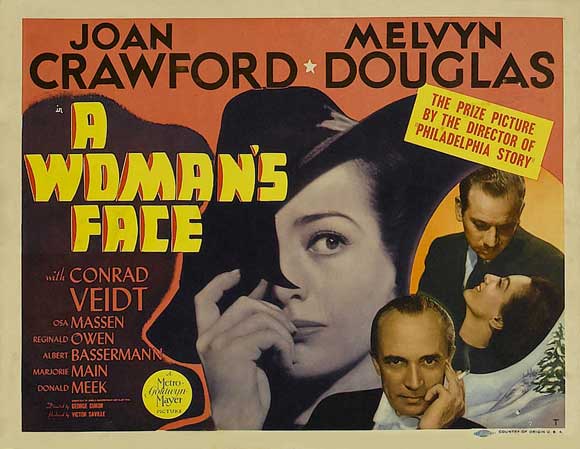
When we decided to view Joan Crawford's movies, A Woman's Face
(1941) was one of the movies I was most looking forward to seeing with
my friends. A totally underrated movie, with a beautiful, understated
performance by Ms. Crawford, I was sure everyone would love it. And they
did.
Joan plays Anna Holm, a young woman who works as a blackmailer,
and who was horribly scarred as a child. During one of her blackmail
missions, she encounters Dr. Gustav Segert
(Melvyn Douglas), a plastic surgeon with a remarkable record of
successes. Fascinated by Anna's scars, he offers to attempt a series of
surgeries that will possibly correct the damage. Anna consents; she
had recently met Torsten Barring (Conrad
Veidt), and hopes to be part of his life, scar-free. Unbeknownst to her,
Barring is far more interested in luring her into a murder plot, a murder that
would leave him the heir to millions.
Crawford
is just perfect in this role. Her acting is subtle; watch her
reactions to fire (Anna is terrified of fire), her mannerisms before
and after her surgery, and the restrained but definite reactions that
we see in her eyes as she reacts to a variety of frightening and
horrifying issues. Also magnificent is the always wonderful Conrad
Veidt. Veidt began his career in the silent cinema of his native
Germany, and generally played the hero. In the 1930s, he managed to
alienate the Nazis (he loathed Hitler and everything Hitler stood for),
and escape to England (where he became a citizen). Of course, his
career in American movies generally cast him as either a villain (as
here) or a Nazi (as in his most famous performance - Major Strasser in Casablanca).
While we know at the start that there is something a tad slimy about
Barring, we are able to watch Veidt construct a maniac before our eyes.
We watch as his insanity is more clearly and definitely revealed with
each passing scene.
Finally, we wanted to say a word about Richard Nichols as Lars-Erik. Nichols did not have a long career, but we've seen him in several films (most notably Kitty Foyle and All This and Heaven, Too).
Nichols has a rather childlike speech pattern that is hard to miss, but
he is SO much the little boy in this movie (and in everything he does),
that it is hard to remember he IS an actor. Witness Lars-Erik bouncing
around on a cable car, and then looking back to see if he will be
scolded for doing something so dangerous. So totally 5 year old boy!!
And with a sense of tension ably supplied by the astute direction of
George Cukor! We hope you will give this one a try. We think it is worth a viewing, especially if you've not seen it before. Here's a brief scene to give you a glimpse of the film: