As a happy start to the month of April, TCM Presents on Fathom Events featured North by Northwest (1959), an Alfred Hitchcock adventure starring Cary Grant and Eva Marie Saint. This presented an excellent opportunity to see this fascinating film on a big screen Roger O. Thornhill (the O stands for nothing, except to make Roger's initials "ROT") is a successful and rather cavalier Madison Avenue executive. Twice married and divorced, Roger has a jaundiced view of the world. There is in advertising, he says "no such thing as a lie. There's only expedient exaggeration." But it is a precept he adheres to in life, as he lies constantly to his mother and his latest girlfriend. Out for a business drink at the Plaza Hotel, he signals a bellboy to assist him in sending a telegram to his mother. But when he follows the bellboy to the counter, he is accosted by two men Valerian (Adam Williams) and Licht (Robert Ellenstein), who had requested that the hotel (and that bellboy) page George Kaplan. Assuming that Roger is answering that page (and is therefore Kaplan), they escort him from the hotel at gunpoint, and bring him to a home on Glen Cove, Long Island, where he is briefly questioned by a Mr. Townsend (James Mason). When Roger cannot answer their questions, they force-feed him bourbon, and toss him into a car, with the intention of sending him over a cliff. Roger escapes, but the consequences of his attempts to prove what really happened lead him into a series of dangerous adventures.
Even after repeated viewings, North by Northwest is an exhilarating movie. Of course, my repeated viewings were on television screens, and you have not seen the film (shot in VistaVision) until you've seen it on a big screen - the cropduster sequence alone is worth the price of admission! Cary Grant is perfect as a jaundiced, flippant man who is catapulted into a world of violence and misdirection. But the world in which Roger finds himself is, in many ways, not much different than the world he lives in - one in which there is only "expedient exaggeration". For what is George Kaplan but an expedient exaggeration? Interestingly, Cary Grant was not initially considered for the role of Roger. Having just concluded Vertigo, Hitchcock considered continuing his relationship with James Stewart by casting him in the part. Though Stewart dearly wanted the role, Hitchcock ultimately decided that Grant was a better fit, and delayed his shooting start until Stewart was committed to Bell, Book, and Candle (1958) (See these TCM articles for more information). It's been reported that Grant was a bit reluctant to play the role, because he felt he was too old for the part (he wasn't!)
One story about Hitchcock's direction of Cary Grant is
amusing. An individual on the set one day (when the crew was
shooting in the Plaza Hotel), noticed that Cary Grant just began filming
his scene with no direction from Hitchcock. He approached the
director, and asked: "'You haven’t even said 'Good morning' to Cary. How
does he know what to
do?' Hitch answered casually, 'Oh, he’s been walking across this lobby
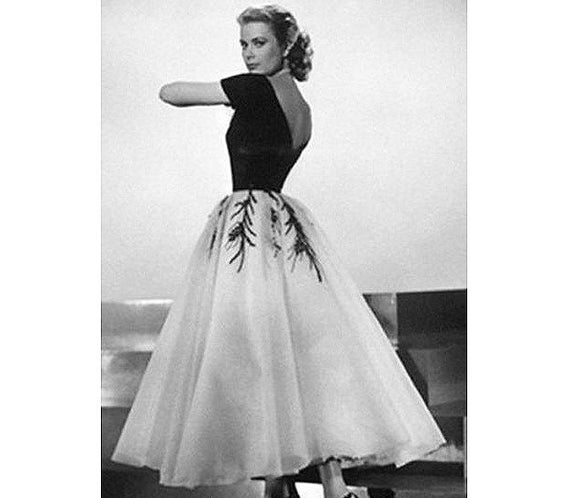
for years. I don’t need to tell him how.'" (Alfred Hitchcock Geek blog). Mr. Grant, of course, had retained an apartment at the hotel for many years. There were also issues with casting Eva Marie Saint as Eve Kendall. Though Ms. Saint had already won an Oscar for On the Waterfront (1954), MGM wanted Cyd Charisse in the role, and Cary Grant was angling to have Sophia Loren cast in the part (he was deeply in love with her at that point). But Ms. Saint brings that cool Hitchcock blonde with the inner raging fires to the part. She said in a interview for Vanity Fair that the intensity of the train kissing scene caused a photographer to fall off his ladder, so engaged was he in action! She also gets to wear my second favorite dress in all of moviedom (see it above. My first, for the record, is Grace Kelly's black and white outfit in Rear Window. Both created by the imaginative Edith Head).
The film features several interesting villains - James Mason is quite good as Phillip VanDamm. But the performance that really stands out is that of Martin Landau as Leonard, VanDamm's "right hand." Landau, with eyes that never seem to close, and a serpentine way of walking is both disturbing and fascinating. This AFI catalog entry notes that the Production Code Administration (PCA) was concerned at Leonard's seeming effeminate. With lines like "Call it my woman's intuition, if you will" and VanDamm's response that "I think you're jealous. No, I mean it. I'm very touched, very," Hitchcock plays up an interesting relationship between the two (and ignores the PCA). The disappearance of the character Licht (as portrayed by Robert Ellenstein) became much clearer when the film is viewed on a big screen. Licht is one of the men who kidnaps Roger (he's on Mr. Grant's right in the lobby card at the top. He's also notable for his odd way of holding a cigarette). We see him several times; then he disappears. Why? Well, he was on the cropduster flight that attacked Roger! The newspaper announces that two people were killed in the crash (not as easy to see on a TV screen), and someone was firing a gun BACK at Roger (as the plane passed him, so the sniper was leaning from the plane window and firing back at him.). Ergo, Licht was the sniper, and one of the two people killed when the plane collides with the oil tank truck.
Two other performances are really too wonderful to ignore. The first is Jessie Royce Landis as Roger's mother, Clara Thornhill. A bit dotty ("You gentlemen aren't really trying to kill my son, are you?") and mercenary (she takes $50 from her son to con a room key from a hotel clerk), she is also delightful and droll. Famously, it's been said that Ms. Landis was YOUNGER than her onscreen son, however she had claimed herself younger than she actually was (she was in reality 8 years older than Mr. Grant). Regardless, they make a delightful combination. Leo G. Carroll (The Professor) had already appeared in five Hitchcock movies, including Rebecca (1940) and Suspicion (1941); the latter was Cary Grant's first film with Hitchcock. Born in England in 1886, Mr. Carroll started his career on the London stage, eventually moving to New York, where he appeared in 35 Broadway plays, including the title role in The Late George Apley (1944), a screen part that would go to Ronald Colman and Detective Rough in Angel Street (1941), which would be reworked for Joseph Cotten in Gaslight (1944). Seemingly always cast as an old man (his film career didn't really start until he was nearly 50), Mr. Carroll played a wide variety of supporting roles from Phelps Finnegan in Sadie McKee (1934) to Count Bertil Jacobsson in The Prize (1963). For two years, he dealt with two chatty spirits on TV's Topper (1953-1955), but he became known to a new audience as the enigmatic Alexander Waverly in The Man From U.N.C.L.E. (1964-1968). Mr. Carroll was married to Edith Nancy de Silva from 1926 until his death at the age of 85 in 1972.
When North by Northwest opened at Radio City Music Hall in New York City (and other venues nationwide), it garnered praise, as in this New York Timesreview, which commented that it was "the year's most scenic, intriguing and merriest chase,"or a review in Variety which said that "the Alfred Hitchcock mixture - suspense, intrigue, comedy, humor. . . Seldom has . . .been served up so delectably." In 1995, it was added to the Library of Congress' National Film Registry. And the American Film Institute put it in 4th position in their 100 Years, 100 Thrills listing.
If you've not yet seen this film, please do yourself a favor and get hold of a copy. In the meantime, I'll leave you with the sexually charged dinner conversation between Cary Grant and Eva Marie Saint.
In my last post, I mentioned there would be a hiatus on the blog as one of the members was going on vacation. That member was me, and I was thrilled to spend 5 days onboard the Disney Magic on this year's Turner Classic Movies Cruise. Though I've cruised before, I'd never attended a themed event, nor have I had the opportunity to attend any of the TCM festivals. So, it was with a mix of anticipation and excitement that we arrived at the cruise. It was, I can honestly say, well beyond my wildest dreams. We had a ball, and if I have one regret, it's that I didn't have a time turner, so I could do EVERYTHING. The cruise is so chock-full of events, it's hard to pick just one in a given time period. For the most part, I attended as many of the interviews as I could squeeze in; but there was still time for films, and over the next few weeks, I'll intersperse our group watching with some comments on films that I viewed during the cruise.We'll start with our day one film - On the Waterfront (1954). Eva Marie Saint, a guest on the cruise, provided some comments, along with the always knowledgeable Robert Osborne.
Watching a film in a public venue is always a more magical experience; but it can also be a problematic one. One "viewer" of the film, we are sure, attended ONLY so he could issue a loud "BOO" when Elia Kazan's name appeared on the screen. I'm aware that Kazan notoriously "named names" during his examination by the HUAC (House UnAmerican Activities Committee), and while I deeply regret his actions, I also know I wasn't there (I wasn't even born yet), so I have no idea how I would have responded to the pressure placed on Mr. Kazan in 1952. Other people "named names" - Budd Schulberg, Sterling Hayden, and Lee J. Cobb for example; yet they are not vilified the way Kazan is (It could be said that there was no need to condemn Sterling Hayden - he condemned - and punished - himself for years because he was "a stoolie"). But Kazan has become the poster boy for those who need to find someone to blame for this shameful period in America. That someone would try to ruin this great film by "showing off" his superiority was the only down note to the screening.
One scene that was discussed during the comment section was the "Glove scene" (which I've attached below). Asked if the scene was scripted or improvised, Ms. Saint talked about the rehearsals between herself and Mr. Brando. In one of their sessions, she dropped the glove, and Mr. Brando began to play with it, much as he does here. When Mr. Kazan arrived to discuss the rehearsal process with them, they showed him this little improvised bit, and he said to include it in the filmed version.
Another scene discussed by Ms. Saint and Mr. Osborne was this, perhaps the most famous one from the film. The scene was supposed to have a back projection as the cab sped through the City, however, it couldn't be arranged, so instead, Venetian blinds were installed to shut off the back from view. Like Mr. Osborne, I've been looking for a cab with Venetian blinds my whole life (and never found one). This TCM article also discusses that scene. You can also see a clip from it below.
Before we go, a few factoids about On the Waterfront. In 1954, it won Oscars for Best Picture, Actor (Brando), Actress (Saint), Director (Kazan, who also won the Director's Guild Award), Screenplay (Schulberg), Cinematography (Boris Kaufmann), Black and White Art-Set Direction, and Editing). Karl Malden, Lee J. Cobb, AND Rod Steiger ALL received nominations for Best Supporting Actor (the award went to Edmond O'Brien for The Barefoot Contessa), and Leonard Bernstein was nominated for his score (with the award going to Dimitri Tiomkin for The High and the Mighty). The New York Times review called it "moviemaking of a rare and high order". It was #19 on the AFI's list of Greatest Films of All Time, and #3 on the "100 Years, 100 Quotes" list (for You don't understand! I coulda had class. I coulda been a contender. I could've been somebody, instead of a bum, which is what I am.") On the 25 Greatest Scores List, it placed #22, #23 on the list of the 50 Greatest Heroes, and #36 on the "Most Inspiring Films" list. In 1989, it was one of the first 25 films to be added to the National Film Registry.
If you've not seen On the Waterfront, you should, if only to see the birth of a new form of film acting. You'll also see performances that still shine, even after over 60 years.
We'll be back soon with more from the Cruise, and more from our weekly discussions.