Showing posts with label Olivia de Havilland. Show all posts

Monday, August 22, 2016

Olivia is an Italian Widow

Told that another English winter will kill him, Ambrose Ashley (John Sutton) leaves his estate in the hands of his cousin, and adopted son, Philip (Richard Burton).  Promising to return in the spring, Ambrose initially delays his return, followed by a letter announcing his marriage to the widow Rachel Sangalletti (Olivia de Havilland).  The letters stop; but finally, one arrives, written in a shaky hand, telling Phillip that Ambrose's life in in danger - and that the culprit is his wife, Rachel.  Philip rushes to Ambrose's side, to find that his cousin is dead (supposedly of a brain tumor), Mrs. Ashley has left the area, and Philip is the heir to Ambrose's vast estate. Convinced that Rachel murdered his beloved cousin, Philip returns to Cornwall, and waits to revenge himself on My Cousin Rachel (1953).

Based on a novel by Daphne du Maurier, author of Rebecca, the film has the distinction of being the third du Maurier film featuring a member of the de Havilland/Fontaine family, as Ms. de Havilland's sister Joan had already appeared in Rebecca (1940, for which she was nominated for the Best Actress Academy Award) and in Frenchman's Creek (1944).  Like the other films, My Cousin Rachel, set on the Cornish coast, has the wild English seaside feel to it.  And, like the other two films, we have a character who is ambiguous.  Is Rachel to be trusted?  Or is she, as we eventually discover about the title character in Rebecca, a manipulative woman, out only for money and position?
This was the Hollywood film introduction of Richard Burton (he had already appeared in a few films and television shows in the UK), who was only 26 at the time.  Commentary by Ben Mankiewicz, which preceded the movie noted that he was unfamiliar with film and the camera.  He wanted to play out the entire scene, though only certain shots were needed for close-ups and other angles.  Director Henry Koster spent time teaching Burton to save himself up for the big scenes, and not waste his energies on shots that required only a look or a line, a lesson that would stand Burton in good stead in his 77 film and television appearances.  Burton was nominated for best supporting actor for his performance in this film, and deservedly so (he lost to Anthony Quinn in Viva Zapata!).  He is able to turn the character of Philip on a dime, going from mature, thoughtful man, to petulant child in a heartbeat. 

Though not nominated for the Oscar that year (sad but true), Ms. de Havilland gives a masterful performance as Rachel.  She plays her as a question mark.  Is she guilty of murder?  Is she in love with Philip? Was she in love with Ambrose?  What is her relationship, really, with Guido Ranaldi (George Dolenz)?  The audience is never sure. We delight in her, we admire her, and we even like her, but we are really never sure if we can trust her. 
The AFI Catalog notes that the story was initially serialized in Ladies Home Journal, and though filmed versions of du Maurier's novels had a proven record of success, the major studios shied away from her asking price of $80,000.  George Cukor and Vivien Leigh were original considerations for director and for the part of Rachel, but Cukor disliked the script (as did du Maurier, who offered her own screen treatment) and withdrew.  But Ms. Leigh was not the only contender for the title role - the part was allegedly offered to Greta Garbo, and David Selznick wanted it for his wife Jennifer Jones. 

Director Koster's son Nicholas plays the young Philip.  Also in the cast is George Dolenz, whose son is know to many of us - future Monkee Micky Dolenz.  Audrey Dalton makes her screen debut as Philip's best friend and neighbor,  Louise Kendall, and is quite good in a small part.  Ms. Dalton would go on to appear in Titanic (1953) as Barbara Stanwyck's daughter Annette Sturges, and to a total of 59 film and television appearances. Born in Ireland, she married assistant director James H. Brown in 1953. The marriage lasted until 1977; they had four children.  In 1979, she remarried, this time to an engineer (Rod F. Simenz), at which point she seems to have retired. 

This is not the only telling of the story of My Cousin Rachel.  On 7 September 1953, Olivia de Havilland reprized her title role (with Ron Randall as Philip) in a Lux Radio Theatre presentation of the story. In 1982, the BBC produced a four-hour series starring  Christopher Guard and Geraldine Chaplin as Philip and Rachel.  A new feature film version is in post-production, with Rachel Weisz and Sam Clafin in the lead roles. It is currently listed as having a release date sometime in 2017. 

Though perhaps not a glowing one, this New York Times review is quite impressed with the film. Our group was much more so, with one of the members saying it was "the best film [she had] seen in a long time".  We strongly recommend it, and leave you with this trailer to whet your appetite.  

Monday, August 15, 2016

Olivia's Trip to Italy

Six years ago, our group reviewed Light in the Piazza (1962) when we began looking a the films of Olivia de Havilland.  As the film is one that several of us love, and a newer group member had never seen it, we decided to revisit this excellent film.  Ms. de Havilland plays Margaret Johnson, an American visiting Italy with her daughter Clara (Yvette Mimieux).  As they see the sights in Florence, they are approached by Fabrizio Naccarelli (George Hamilton), a young Florentine who is captivated by Clara.  Margaret attempts to avoid Fabrizio, but to no avail - he is not to be dissuaded.  Meg's problem? Clara suffered a traumatic brain injury when she was 12; as a result, though she is a lovely young woman of 26, she has the mental age of a pre-teen.

Based on the novel The Light in the Piazza by Elizabeth Spencer (New York, 1960), the story first appeared in The New Yorker.  Reviews in the Hollywood Reporter and Variety praised the film (see TCM article), but the New York Times review is scathing.  A shame, really, because it is a moving film, with an exceptional cast - Bosley Crowther just didn't get it.

It's interesting how several years distance from the film, and new discussants adds to one's appreciation.  In our prior discussion, we were very critical of Barry Sullivan, who played Clara's father, Noel Johnson.  Noel is a hard man to like, primarily because of his attitude towards his daughter - he is both jealous of her and embarrassed by her.  His solution: ship her off to Maryland (he's a tobacco executive in Winston-Salem, NC), where visits will be limited, and she will be "safe" in something that is not "an institution" (he describes it as a "country club, or should be for the amount we're paying").  It also means his wife will be all his, not the guardian of their daughter.  Did we like Noel any better? Of course not, but we were more appreciative of the way Mr. Sullivan played him.  He's not afraid to make him unattractive, and it works well.
Our opinion of Signor Naccarelli, as portrayed by Rossano Brazzi, didn't change all that much.  We still found him somewhat shady.  Signor Naccarelli does, however, bring a bit of humanity to Meg;  Meg is so tied up in knots over her fears for her daughter's future, that it is only the flirtatious Signor who is able to finally loosen her up a bit, with his flattery and attempt at lovemaking. But his efforts to blackmail Meg for a larger dowry are rather petty - he's not a poor man, and it is likely Noel will happily supply plenty of money to his daughter's upkeep (though, of course, Signor Naccarelli is not aware that Noel will pay pretty much anything to have Clara out of sight).

Some years ago, two of us saw the Broadway musical version (2006) Light in the Piazza at Lincoln Center.  We enjoyed it, but somehow it didn't click the way the film did.  I think perhaps that the film had more intimacy than the play.  Regardless, it was a good night of theatre, and we appreciated that they would want to tell this story again.  Here is a clip from that version.
Light in the Piazza does a good job in portraying a difficult subject, and we were especially impressed by Yvette Mimieux and George Hamilton.  Originally, Italian actor Thomas Millian was cast as Fabrizio, but Hamilton actively campaigned for the role.  Hamilton is not afraid to make Fabrizio a simple man - not stupid, but a man who wants a loving wife, a home and a family.  He sees in Clara the child bride he yearns for - a playmate of sorts, but a loving one who will revel with him in his love of home and family.  He also makes him a bit of a stalker (with his relentless ability to find Clara and Meg, no matter what part of Florence into which they venture), making Meg's distrust of him eminently understandable, but also providing the audience with a chuckle.

In the end, the film hinges on whether or not we can accept the sincerity of Ms. Mimieux's Clara.  We have to believe that Meg is right in her decision with regards to Clara's future.  Can she be a wife and mother? Can she live in the Florentine world, among adults, and not be ridiculed?  Ms. Mimieux gives us a picture of a girl who, though disabled, is going to be able to grow and adapt, as long as she has the help of those who love her.  Currently retired, Ms. Mimieux made a total of  24 films (most in the 1960s and 1970s), as well as many television appearances.  Her appearance in 1964 as Pat Holmes, the epileptic surfer in the episode "Tyger, Tyger" of Dr. Kildare was very memorable (she was nominated for a Golden Globe in the category of Best Female TV Star).  She currently works in real estate and is married to her second husband of 20 years, Howard Ruby.

We'll leave you with this trailer from the film.  Next time (there will be a bit of a gap, as I'm off to a wedding), we'll return with another Olivia de Havilland film.

Monday, July 11, 2016

Olivia and the Pilots

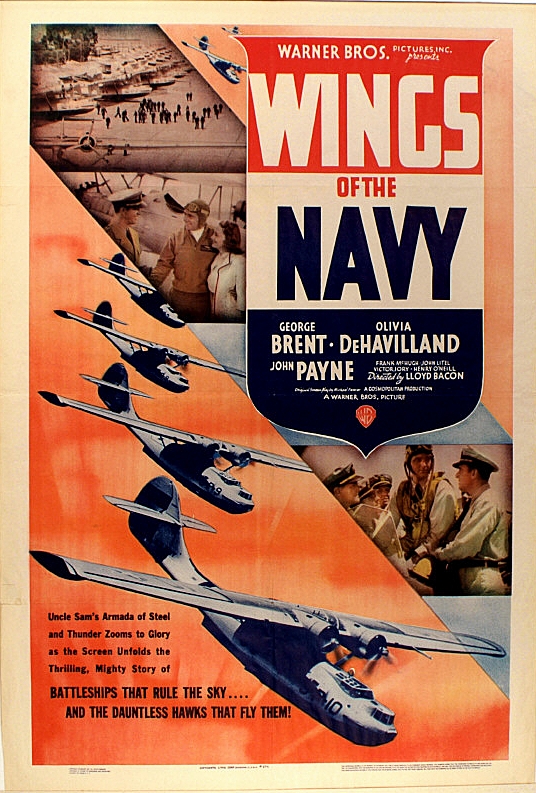
Cass Harrington (George Brent) is a Navy flyer through and through, with a family history in the service.  His father was a highly regarded flyer for the Navy, and his brother Jerry (John Payne), also career Navy, wants to join Cass in the Air Corps, though Cass would rather Jerry stay in the submarine service.  Cass is in love with Irene Dale (Olivia de Havilland), but once Irene meets Jerry, she wonders if she has made the wrong choice - Cass is too wrapped up in his work designing a new fighter plane to pay her much attention.  When the brothers both end up at the Naval Air School in Pensacola, where Cass is an instructor, it's clear that something's got to give.  Wings of the Navy (1939) tells the story of these three individuals and of the making of a Navy airman.

In the July 2016 issue of TCM's Now Playing, Robert Osborne writes that Olivia de Havilland, who had signed a contract with Warner Brothers to star in A Midsummer Night's Dream (1935), "...considered [Wings of the Navy] the absolute nadir of her career.  It was as far afield from Shakespeare as one could get...."  While this isn't the worst film ever made (and probably not her worst either.  There is, after all The Swarm...), it's not all that good.  However, in many ways (according to this TCM article), it was this film that helped Ms. de Havilland appear in her most famous role - she was so irritated that she had been forced to do Wings of the Navy, she redoubled her efforts to land the part of a lifetime - that of Melanie in Gone With the Wind
Really, this film is an advertisement for the Navy, and a means for Warner Brothers to inform the public on the state of the armed services.  It was evident that a war in Europe was in the offing, and the Brothers Warner had already shown their dislike of fascism in 1937's Black Legion.  Shortly after this film was released (February of 1939), Warner Brothers would be the first studio to openly brand Nazi Germany as an enemy in Confessions of a Nazi Spy (released in May, 1939) [PBS History Detectives].  With its emphasis on the flying service, Wings of the Navy is a documentary praising the U.S. Navy Air Corps.  Even the New York Times review felt that "the educational part [of the film] is so interesting that we return to the romantic part... with a feeling almost akin to pain."   The advertising for the release also (discussed on WarnerBrothers.com)  displays the studio's primary interest in creating this film:  "'For all the world to witness that America will not be unprepared!' [it declared] —and backed it up with bravura footage shot at Pensacola Naval Station in Florida and North Island Naval Station at Coronado, California."
 
Because this really is a documentary-type film focusing on the military, the interactions between Brent and Payne, and between Frank McHugh (as Scat Allen) are pretty good, and while we always want to see more of Ms. de Havilland, the love story is pretty pointless - just a way to have the girlfriends agree to come with their dates to see the planes.
There are several surprise appearances in the movie, not the least of which is the appearance of Frank McHugh, who brings both humor and gravitas to the role of Scat, a man who has joined the Air Corps to perfect his flying skills.  He is not planning on a career in the Navy - he plans to return to his profession as a crop duster after his term is over, but Scat ends up being the voice of reason in most situations.  Also appearing are John Litel as Commander Clark, and Victor Jory as Lieutenant Parsons.  Jory's part is so small that if you blink, you might miss him!

Much as Ms. de Havilland disliked the film, she did not immediately escape it.  According to this article from the AFI Catalog, she ended up reprising her role (with George Brent and John Payne) in the Lux Radio Theatre production of October 1940.  While we agree with her, it is not all that wonderful a film, we'll leave you with a clip of Ms. de Havilland and Mr. Payne:

Thursday, June 30, 2016

Olivia's a Farmer

The Civil War is over.  John Chandler (Alan Ladd) and his young son David (David Ladd) arrive at the small Illinois town of Aberdeen.  Once a soldier of the South, the widowed father needs help - his son is mute, the result of witnessing his mother's death in a fire.  John is trying to find a doctor - any doctor - who can help his boy regain his ability to speak.   Doctor Enos Davis (Cecil Kellaway) recommends a colleague at the Mayo Clinic, an expert in dealing with traumatic speech loss.  But before the Chandlers can head out, John is arrested after he crosses paths with the local town bully, Jeb Burleigh (Harry Dean Stanton) and his father Harry (Dean Jagger).  Thus begins The Proud Rebel (1958).

Some films don't seem to have become recognizable classics, and The Proud Rebel is one of them.  Our question is "WHY NOT??"  This is an excellent film that carefully treads a thin line between sympathy and mawkishness - a line it never crosses.  In many ways reminiscent of Shane and The Big Country, this is an outstanding film, which emphasizes the need for family.  The talent of the three leads: Olivia de Havilland (as Linnett Moore), Mr. Ladd, Sr. and Mr. Ladd, Jr.  are important reasons, though the excellent script is a prime factor.

Linnett Moore, as portrayed by Ms. de Havilland is a wonderful woman - she is strong, brave, and stubborn, but also kind, sympathetic and loving.  The film is a love story, but it concentrates on the love that blooms between Linnett and young David more than that of John and Linnett.  Certainly, there is a love story for the adults, but it comes from the desire for family and home more than one of passion.  It is a love story of deep commitment and common beliefs.  Nevertheless, it is a love that will withstand the ravages of time.
Alan Ladd plays John as a man still scarred by the death of his wife.  In Linnett he begins to find the cure for his pain, though his almost obsessive quest for a cure for his equally damaged child is a major barrier.  His obsession initially makes him emotionally unavailable; the image he carries of his wife (a photo he immediately unpacks when he moved into Linnett's ranch) seems to act as an emotional spur, reminding him of the need to find a doctor for David.

The film is full of counterpoints. There are the two family units - the caring relationship of Linnette, David and John, set in contrast to the cruelty of three Burleighs.  The Moore farm, with its simple, cozy atmosphere, can be compared to slovenly home of the Burleigh's. The photo of John and his wife that sits at his bedside will later echo a scene of  John posing with Linnett for a similar photo. 

The performance that really stands out in the film is that of David Ladd, who, at the age of 11 gives a genuine portrayal of this child in crisis.  The chemistry between him and his father is impressive, as is that between him and Ms. de Havilland.  After a notable acting career, David became a producer (like his older brother, Alan Jr).  He and Olivia de Havilland have remained friends since the movie; according to an introduction by Robert Osborne, they regularly speak on the phone. This New York Times review is especially complementary (and deservedly so) of David's work in the film.
Alan Ladd is perfect as the tormented father.  Ladd started in film, in a number of uncredited roles, in 1932, and continued being a face in the crowd and in small roles (including a role as a reporter in Citizen Kane), until his breakthrough performance in This Gun for Hire (1942).  Though he had a wonderful speaking voice (he was much more successful in radio during his early career), his height (he was either 5'6" or 5'7", depending upon the source) was a barrier to leading man roles.  His frequent co-star Veronica Lake was tiny (she was 5'1"), and his costar here, Ms. de Havilland was also not very tall (5'3"), but stories exist of Ladd being perched on a box, so he was taller than costars like Sophia Loren (5'9" Boy on a Dolphin).  But limiting discussion of Ladd's height is to ignore his talent.  In films like Shane, The Glass Key, and The Blue Dahlia he is magnificent - with his subdued demeanor and rumbling voice, he seems made for film noir and westerns.  He was married for 22 years to Sue Carol, who also acted as his agent; the marriage produced three children - David, Alan Jr, and Alana.  Ladd battled depression (his mother, herself a victim of depression, ended her own life), attempted suicide in 1962, and died of an accidental overdose (sleeping pills and alcohol.  Ladd suffered from chronic insomnia) in 1964.  Following his death, his final performance in The Carpetbaggers (he played Nevada Smith, a character later revisited by Steve McQueen) was released, to excellent box office.

Filmed in Utah, the scenery (and cinematography by Ted D. McCord) is fantastic (it should be noted that Utah looks nothing like Illinois!).  According to the AFI catalog, Adolph Menjou was to be in the film (probably in the role of  Harry Burleigh, the role ably enacted by Dean Jagger), but a torn ligament forced Menjou to withdraw from the production.  There was one star of the film who got special treatment - that was King, the border collie that portrayed David's pet, Lance.  According to this  TCM article, "King and his two canine stand-ins were deemed so important by the production team that they were given their own hotel room in one of Utah's finest motels right next to Ladd's and de Havilland's quarters." 

We'll end with the introduction of Linnett Moore. Ms. de Havilland is dynamite in the scene.  And let's take this opportunity to wish this amazing actress a happy 100th birthday (with a link to a recent write-up in Vanity Fair of her 1962 autobiography Every Frenchman Has One):

Wednesday, June 22, 2016

The O'Hara Boys Love Olivia

Ma O'Hara (Mary Gordon) lives with her three sons, Police Officer Pat  (Pat O'Brien), Fireman Mike (Frank McHugh), and Danny (James Cagney),  the black sheep of the family (and Ma's darling) who is trying to forge a career as a fight promoter (much to brother Pat's disgust).  The Irish in Us (1935) looks into the lives of the family as Pat plans for a marriage to Lucille Jackson (Olivia De Havilland) - without telling Lucille.

Sure, this is a rather silly movie, but we enjoyed it.  The interplay among the three O'Hara brothers is spot on, and, not surprising, when James Cagney is on the screen, you really can't take your eyes off of him.  Equally wonderful is the relationship between Cagney and Mary Gordon, who plays his mother.  You can sense the affection within the family group, and Ms. Gordon, especially paints a picture of a woman who is the thread that binds the family unit together.

Though the plotline is so-so, this TCM article points out that director Lloyd Bacon, well aware of the script's limitations, encouraged the actors to ad-lib during the production.  As a result, the dialogue has a bounce and energy to it.  And while boxing match at the end does seem a bit prolonged, it gives the character of Pat time to recover from the circumstances that have alienated him from his youngest brother.  O'Brien and Cagney do a wonderful job of creating a brotherly dynamic that it made us imagine Pat and Danny as children, with Danny always getting into scrapes from which big brother Pat needed to rescue him.
Normally, we love Allen Jenkins, but his Carbarn Hammerschlog is a bit over the top.  One wonders how Danny could possibly see this rather insane man as a successful boxer (but that is Danny - always looking for the underdog!).  It's one of the weaker aspects of the plot, but does serve as a means of getting Cagney into a boxing ring (the AFI Catalog states that Cagney did his own boxing in the picture). 

We're also treated to a picture of bygone era in New York City - a time when you knew all your neighbors, and it was a fact of life that everyone knew what the other person was doing.  One scene in particular - Ma O'Hara passing a bit of butter wrapped in a napkin to her neighbor via the clothes-line between their apartments, brought up memories of my childhood, when my mother would lend a bowl or some eggs to the neighbor through a narrow kitchen shaft window!
The strength of the film is that strong sense of family.  Pat's anger at Danny's haphazard lifestyle centers more on his fear that Danny will not be able to help support the family when Pat marries and moves out than on any jealousy or dislike of his brother.  And the relationship between Ma and Lucille also emphasizes the family as a unit - Ma is immediately welcoming to a potential new member of her family.  Lucille senses that she is now an O'Hara, and seems to find in Ma the mother that she has lost (Lucille has a father, but it seems he may be widowed).

We'll end this discussion with a scene from the film, as Danny and Lucille get to know one another:

Monday, November 10, 2014

Olivia Loves a Thief

TA. J. Raffles (David Niven) is a young man of society - a well-known cricket player and man about town. Though Raffles has no real income, he lives quite well.  He supports himself with his hobby - in his spare time, he is the notorious Amateur Cracksman, a thief who has been bedeviling the local police.  Thus begins the fourth remake of Raffles (1939).

The film had already been made in 1917 (as Raffles, the Amateur Cracksman, with John Barrymore), in 1925 (with House Peters) and in 1930 (with Ronald Colman).  We were lucky enough to see some commentary from Robert Osborne, and he mentioned that this version was an almost scene by scene recreation of the Colman film.  Director Sam Wood (who had just come off Gone With the Wind) was too tired to waste effort on a new version, so he just cribbed from the Colman version.  This TCM article goes into a bit more detail.  We hope, at some later date, to view the 1930 Colman film and compare those two films.

Also fresh from Gone With the Wind was Olivia de Havilland, who was assigned to play Gwen Manders, Raffles love interest.  Ms. de Havilland had little interest in the role - it was mere window dressing to Niven's more rakish part (Cary Grant actually pursued the role of Raffles - he even offered to lower his normal salary).  Her disgust at being forced into roles that she viewed as inferior was the impetus for her eventual suit against the studio system.  For more information on this story - and it should be noted that Ms. de Havilland was a leader at great cost to herself in this protest - see this interview at the Academy of Achievement
So, while Olivia doesn't have a whole lot to do here (except be intelligently gorgeous, which is also quite a skill.)  Her Gwen is no dummy, and Ms. de Havilland can show you with just the merest glint in the eye what is going in within Gwen's head), David Niven shines.  He is quite dashing as A.J.  Our group found the film quite reminiscent of To Catch a Thief, and were fascinated by Cary Grant's interest in Raffles.  It seemed to us that, while it took nearly 20 years, Mr. Grant DID finally get to play The Amateur Cracksman. 

Many films from the period portray the police as complete dolts.  Not Raffles.  The police inspector MacKenzie, played by Dudley Digges, is a worthy adversary to Raffles, and someone that Raffles respects.  In fact, it is a mutual admiration society - MacKenzie also admires The Amateur Cracksman's skill and daring.  Nevertheless, MacKenzie is determined to put him behind bars. 

There is an attempt on the part of the screenwriter to make Raffles a more attractive - and admirable - character.  At least twice we see him steal in order to help someone else.  In the first scene, he snatches a piece of art, then secretly presents it to a retired (and hard up) actress, so she can collect the reward. This bit of Robin Hood in the character is surely meant to placate the code - we can't quite condemn him when the only thefts we see are those that help a destitute old lady and his future brother-in-law, Bunny Manders (Douglas Watson).
The screenplay is very well done, and there are some well-crafted scenes.  In one instance, Raffles needs to get down to the first floor of Lady Melrose's (Dame May Whitty) home.  However, he knows Inspector MacKenzie is hovering around his door.  His solution, to pretend to put his shoes outside the room, is done in total silence.  It's an effectively done sequence, and David Niven is quite excellent in his execution.  Also fun was Raffles attempt to stash a stolen bracelet in a humidor. Only he doesn't realize that Inspector MacKenzie is a pipe smoker.   And the Inspector has forgotten his tobacco. Finally, there is a wonderful bit where Raffles realizes another thief is in the house. Niven's relish at getting the best of his competition is delightful. 

All in all, a fun film well worth a viewing. We leave you with a clip from the beginning  of Raffles:


Monday, October 6, 2014

Scarlett Loves WHO?

Gone with the Wind on a big screen - can it get any better than that?  Thanks to TCM and Fantom Events, we got the opportunity to see this magnificent movie where it deserves to be seen, in a theatre, on a huge screen, surrounded by fellow devotees of Ms. O'Hara (Hamilton-Kennedy-Butler) and Captain Rhett Butler.  We've had a prior discussion about the film, in the context of Olivia de Havilland's superb depiction of Melanie Hamilton Wilkes, but it's impossible to talk too much about Gone With the Wind.  Every time you see it, you see something new.  (By the way, my favorite of her many glorious dresses is to the left).

Let's get one thing out of the way.  I love this film (surprise!), but I'm always waiting for the alternate reel wherein Rhett finally figures Scarlett out and doesn't leave.  Sure, we'd lose some great lines, but Rhett frustrates me a lot.  He knows from the get-go that Scarlett is stubborn, that she has a crush on Ashley, and that she doesn't think she loves him.  But at the first sign of moon-face from her, he gets mad.  It also doesn't help that the motivating factor is her weight gain (after all, he was the one that told her "If you don't stop being such a glutton, you'll get as fat as Mammy. Then I'll divorce you.").  In fact, in the novel by Margaret Mitchell, she's already had three children - can one blame her for wanting to stop being a baby-making machine (the poor woman gets pregnant if a man LOOKS at her)?  

The problem is, I like Rhett so much, I just always think he should know better.  It also struck me this time that, by the end of the film, what he wants most is to become Ashley - "I want peace. I want to see if somewhere there isn't something left in life of charm and grace..."  The very thing he always ridiculed about Ashley is the life that he himself desires.  But, Rhett is a continual source of self-contradiction - he loathes the war, but runs off to fight as the cause is lost; he laughs at polite society, but struggles to join it when his daughter is born, and he claims no ability to love, yet loves Scarlett with a depth it is hard to fathom.
There are a lot of people who don't like Ms. O'Hara, but I'm one of the ones who does like and rather admire her.  Scarlett is someone I want on my side.   I know that, if the chips are down, and I'm one of her "folk", I'll be protected.  Think about her relationship with Melanie: Scarlett claims to disdain Melanie, to want her gone, so there will be a clear path to Ashley.  Yet, she puts herself in danger to protect Melanie when she could easily leave Atlanta in advance of the invasion.  With cannon-fire surrounding her, and no one to support her, Scarlett stays to safely deliver Melanie's baby, then transports Melanie and baby Beau (and Prissy, who anyone else would have left behind) to Tara, where Scarlett becomes responsible for their care and feeding - when there is no food for anyone.  And, when they do have some food, and Melanie is handing it out to every soldier that comes by, Scarlett chides Melanie, but there is no animosity in her comment.  She says it for effect.  Scarlett knows very well that Melanie will not stop.  Let's not forget Scarlett is 19 years old when she is forced to assume responsibility for Tara, and she and Melanie are afraid that Ashley is dead. Certainly, Scarlett is a lot harder in the novel; the film does clean her up a bit.  But all in all, she handles her responsibilities pretty well for a teenager.  Visit A Person in the Dark for yet another fan of the magnificent Ms. O'Hara!
I had a rather amusing realization this viewing (the big screen helped a lot).  Olivia de Havilland knows how to crochet!  In the scene where Melanie, India, Mrs. Meade and Scarlett are waiting for the return of their men from a "political meeting" (translation - a raid on Shanty Town that will have very bad results), Scarlett is embroidering, India is knitting, and Mrs. Meade and Melanie crochet.  First off, the distribution is interesting.   Scarlett is the only one performing a purely decorative craft - there's not much practical use for crewel work except to ornament a home.  While the other three ladies work on projects that are practical.  But while it's not clear if Alicia Rhett and Leona Roberts know what they are doing, Ms. de Havilland clearly does.  In fact, her crocheting speeds as she becomes anxious - the true sign of an experienced handcrafter - the craft acts as a stress reliever.

Obviously, there is a lot of information available on this film.  One interesting take is Gavin Lambert's The Atlantic article "The Making of Gone With the Wind."  We learn that Gable was terrified to break down in front of Melanie, and even threatened to walk off the set rather than cry.  But his respect for Victor Fleming won the day, giving us perhaps the most remarkable scene of a wonderful career.  We also learn that, since only 1,500 extras were available to film the railroad station scene, 1,000 dummies were interspersed among the extras to portray the vastness of the war's damage.   My husband was particularly looking forward to this scene.  It is a stirring moment, displaying all that is now lost, and the endless suffering caused by a pointless war.  Done with the special effects capabilities of 1939, it is nonetheless a breathtaking scene

We leave you with two clips this time - first, the railroad station scene...

And since imitation is the sincerest form of flattery, here is Carol Burnett's over-the-top homage to Ms. Scarlett Went with the Wind

Next time, back to our regular discussion.

Friday, January 31, 2014

Charles Needs a Green Card

We return for a visit with an old friend - Olivia de Havilland in Hold Back the Dawn (1941).  This is an absolutely wonderful film, romantic and engaging.  Sure, it's a melodrama, but in the best sense of the word, with characters that grow and keep you engaged in their stories.  It also continues to be a timely story - that of immigration and the desire for people to find a home in the United States.

The film is narrated by Georges Iscovescu (Charles Boyer), who is on the run and trying desperately to get some money.  He sneaks into the Paramount lot, to tell his story to Hollywood director, Mr. Saxon (played by Hold Back the Dawn's actual director, Mitchell Leisen). The war in Europe is raging, and Georges has escaped Europe to Mexico, intent on settling in the U.S.  However, the U.S. immigration quota for Romania (Georges' place of birth) has already been exhausted, and there is a long waiting list.  Georges finds himself stuck in a seedy little bordertown hotel, with other hopeful immigrants, waiting from five to eight years for a spot to open up.  The arrival of Anita Dixon Shaughnessy (Paulette Goddard), Georges former dancing partner and lover, presents another option: marry an unknowing American and get a green card as the spouse of a U.S. citizen.  Once in the country, divorce the duped spouse, and go off with Anita.  Georges sets his sights on Emmy Brown (Olivia de Havilland), a shy schoolteacher in Mexico for the day.

The film contains some absolutely outstanding performances.  Charles Boyer is wonderful as a cad who gradually changes into a decent person (and in some sense, much against his will). As he begins to fall in love with Emmy, we can see his inner battle between his growing feelings for her and his desire to resume his wayward life.  As Emmy, Olivia de Havilland is sweet and generous, but with an inner core of strength that becomes apparent towards the film's end.  Her conversation with Anita, and her comment that she is "from a small town. We don't have any of those fine hotels. We eat at the drugstore... But we leave a tip just the same" is both biting and assertive.  Finally, Paulette Goddard gives us an Anita who is grasping, passionate, and self-serving, but is also an absolute riot.  That our immigration officer, Mr. Hammock (played with verve by Walter Abel) is also attracted and amused. 

This film features a number of memorable performances by the supporting cast.  Of special note is Rosemary deCamp as Berta Kurz.  Patiently waiting to get into the US, the pregnant Berta is all the more sympathetic because of her desire to make a better life for her child.  Without giving too much away, her actions to make sure that her child will have a secure future will have you rooting her her.  Hold Back the Dawn was released in September of 1941, just before the war in the U.S. starts, but after the war in Europe has forced thousands of refugees to flee the Nazis.  Though never stated, it seems obvious that Berta and her husband are Jews, fleeing the holocaust.  It's interesting that the film never discusses WHAT the characters are running away from, yet you cheer for them all the same. 

Costuming for the film is done by Edith Head; here she creates a variety of costumes, with bold, elaborate clothing for Anita, and simpler, more everyday garb for Emmy.  The costuming tells us a great deal about the characters, adding even more dimenions to the characterizations.

Watch for the scene where Georges is escaping from the police.  It's quite well done, but has some humorous moments.  Also, George's encounter with an American woman at the bullfight is also quite funny.  Watch their faces as her marital status becomes apparent.  Finally, the lovely scene in which Emmy names some olives that Georges shook from a tree (you have to see the film to find out why) is gentle and romantic.  

The film is based on an  autobiographic story by Ketti Frings, with a script by  Billy Wilder and Charles Bracken.  This  TCM article discusses some of the story and script changes, causing some annoyance to all of the authors.  Despite the changes, this is still a remarkable script.

Robert Osborne, in an introduction to the film on TCM noted that deHavilland was in the unenviable position at her home studio of Warner Brothers of having to go outside the studio to find good roles.  Here, she goes to Paramount, and ends up with an Oscar nomination.  It is worth noting that, at Oscar time, Olivia DeHavilland was pitted against her sister Joan Fontaine (for the film Suspicion), the first time siblings had competed for the same award.  Joan, of course, won, beginning rumors of a feud between the sisters.  This Hollywood Reporter article looks at the story behind the feud.

As we leave you, here is a brief scene of Georges romances Emmy in pursuit of a green card:

Thursday, May 30, 2013

Olivia Finds Gold

This week, we return to one of our favorites, the lovely Olivia de Havilland in the 1938 technicolor epic Gold is Where You Find It.  Olivia plays Serena Farris, the daughter of Colonel Ferris (Claude Rains). She is at odds with her wastrel brother, Lance (Tim Holt), who has no regard for the land, while she endeavors to build a fruit orchard on the farm. 

Enter Jared Whitney (George Brent), the new mining foreman at the Golden Moon Mining Company.  He shares Serena's love for the land, but at the same time, he is the person now responsible for its destruction.  He befriends Lance, loves Serena, and earns the enmity of the Colonel.

Set in California's Sacramento Valley, the story is both a romance between Serena and Jared as well as the more serious story of the effects of hydraulic mining on the environment.  The film vividly portrays the damage caused by high-pressure mining, and on the farmers who are trying to live and work in the midst of this destruction.  The opening is done in an almost documentary style, making its statements about mining even more powerful.  That much of the back-story - the mining itself, its consequences, and the lawsuits initiated by the farmers (specifically Edwards Woodruff v. North Bloomfield Mining and Gravel Company) increase the impact of the film. This chapter from the Public Policy Institute of California may be of interest to those of you who would like more information about this period of history.

Filmed in Technicolor, Gold is Where You Find It was likely the first western to use the process.  (It was also a test balloon for The Adventures of Robin Hood, an attempt to see the results of the process.  Interestingly, Michael Curtiz directed both films).  The special effects are tremendous - though today, we can spot the miniature work for what it is, in 1938 (and on a big screen), it must have been amazing. And if you want to see a really beautiful scene, watch the very last shot.  The technicolor vistas will take your breath away.

We've got some amazing performances here as well.  Let's start with the lovely Olivia.  Serena is only 17 years old when the film begins.  The character is well named.  Though she has a temper, there is a serenity about her when she works in her orchard.  She rather reminded us a bit of Candide, looking to create the best of all possible worlds in her small piece of land.
George Brent's Jared is a good man, in the best sense of the word.  He wants to do his job, and do it well, but he also understands and appreciates that his work is creating damage.  He wants to change it, but he is hamstrung by the greedy, careless men for whom he works.  He loves the land, and falls in love with Serena because she is so much a part of the land.

Margaret Lindsay (Rosanne Ferris), who is married to Colonel Ferris' dull and avaricious brother Ralph (John Litel) is literally a piece of work.  Flirtatious in the worst sense of the word, she has no love for anyone.  She has no interest in her niece and nephew. Then again, she apparently has no children herself; she's selfish and vain enough that children of any age are a burden.  We loved her line to Serena to "not call her Aunt, just Rosanne".  Heaven forbid anyone suspect she has an adult niece!!  The costuming of Serena and Rosanne give us more information.  Look at the lovely, simple country clothing, contrasted with Rosanne's citified, overdone gowns.  We learn a lot about the women from the way they are dressed.
Claude Rains as Colonel Ferris is, as always, amazing.  He is in the midst of a firestorm, with tensions between him and his brother and between him and his son.  Rains' attitude towards Brent is understandable; he sees him as stealing his daughter, corrupting his son, and destroying his farm.  Ultimately, Ferris is shows as a fair man; Rains lets us see the goodness in the man, even when we most dislike his actions.

Tim Holt gets very low billing in the film, but he treads a fine line in his portrayal of Lance.  And he succeeds admirably. He manages to show a young man who clearly has depth, but chooses not to always plumb it.

Finally, one of our favorite moments happened about midway through the film, when we meet Senator Hearst, whose son "Willie wants to be a journalist".  The senator is horrified - running a paper will never make a profit!

For an interesting analysis of the film, visit the article on the TCM website about the film.  Here is a trailer:

Monday, October 18, 2010

Olivia Goes to Italy

We close our Olivia de Havilland film festival with a film that is a personal favority of mine, 1962's Light in the PiazzaMargaret Johnson (Olivia) and her daughter Clara (Yvette Mimieux) are traveling in Italy, when they meet Fabrizio Naccarelli (George Hamilton), a young Florentine who is immediately besotted by the dazzling Clara.  Unfortunately, Clara has a secret: injured as a child, she has the mental capabilities of a 12-year old.  Though Margaret initially discourages the growing connection between the couple, as Clara falls more deeply in love with Fabrizio Margaret finds her opposition weakening.

I think this is a beautifully romantic movie.  Ms. de Havilland's role is a tricky one.  You have to believe, with Margaret, that her choices are the best ones for both Clara and Fabrizio, not merely the romantic imaginings of a delusional mother.  Most of this is achieved by the genuine caring that Ms. de Havilland shows for her child.  But a great deal is accomplished by her co-star, George Hamilton, who portrays Fabrizio with such beauty and sensitivity.  Watch the scene where Clara becomes hysterical, and look at the way Fabrizio gently pulls her back from her attack.  And then there is the final scene. In both cases, it is Margaret's commentary that provide the complement to Hamilton's caring scenes.  

In this scene, the lives of Clara and Margaret Johnson change forever:


We all thought that Barry Sullivan (as Clara's father, Noel) is the weak link in the movie.  Sullivan plays Noel as rather cold and distant towards his child.  We felt that we should understand his frustration with his wife's obsession towards his daughter, but that some of the lines (like his comment "Don't skip, dear" to his naive daughter) just made him distasteful.  You almost would rather the lovely Margaret would remain in Italy, and find herself a nice guy (though NOT Fabrizio's father, Rossano Brazzi. He's a bit of a cad - and married).

Light in the Piazza was made into a Broadway musical some years ago.  Though engaging, it is not comparable to the movie.  Somehow, the musical did not really portray the romance of this film.  

Next week, we'll begin a new series with another Hollywood lady. Please join us.

Monday, October 11, 2010

Olivia Enters the Asylum

As we near the end of our Olivia de Havilland Festival, we have saved the best for next to the last (we have one more to go after this one). It's The Snake Pit - Olivia's Academy Award nominated performance as the tortured Virginia Stuart Cunningham, whose mental collapse lands her in a mental institution.  This is truly a tour-d-force performance.  What Ms. de Havilland does with a brief glance, other actors could not do with their entire bag of tricks.  Watch her reactions change from ignorance to disbelief to suspicion to anger in the briefest second - it is truly magnificent.  That Ms. de Havilland did not win the Oscar for 1948 is due perhaps to the fact that her competition was fierce - she lost to Jane Wyman in Johnny Belinda.  

This film is full of wonderful performances, and features some of the premiere actresses of the day.  Let's start with Celeste Holm and Betsy Blair as Grace and Hester, the bookends to Virginia's confinement.  Holm's Grace cares for Virginia as she begins her confinement; as Virginia heals, she becomes mentor to the disturbed Hester (Blair).  Other patients in the hospital are portrayed by Beulah Bondi, Ruth Donnelly, Lee Patrick, and Isabel Jewell. Though their parts are small, each adds to the atmosphere of the hospital in their own unique way. Another interesting performance is that of Natalie Schafer as Virginia's mother, certainly high on the list of dysfunctional parents!

On the distaff side, we have Leo Genn as Dr. Kik, Virginia's psychiatrist, Mark Stevens as her husband Robert, and Leif Erickson as her one-time boyfriend, Gordon.  The men however, merely serve as window-dressing.  It is the women who rule this picture. It is their performances you will remember.

Here, we see a trailer from the film:

Next time, our final Olivia picture.

Monday, October 4, 2010

Bloomer Girl Olivia

The Strawberry Blonde from 1941 is one of those wonderful movies that I think people just don't know about.  Here our Ms. de Havilland plays Amy Lind, a gutsy nurse whose best friend is Virginia Brush (Rita Hayworth), the titular Strawberry Blonde.  Olivia is just a delight as she attempts to shock James Cagney (as T.L. "Biff" Grimes) with her suffragette ideas and outspoken manners.  One of my favorite scenes is Virginia, laying out her plan to entice Biff and Hugo Barnstead (played as a complete slime by Jack Carson) over, without looking forward.  "That will show them we're good girls and they can't trifle with us" asserts Virginia. "What did we come for if not to be trifled with?" questions Amy with some indigence.  Here is part of that scene:


It is rather a shame that Olivia and James Cagney did not get to do more pictures together. They are a quite delightful pair.  And again, combined with the stellar character actors that inhabit this movie, this movie is a lot of fun.  Rita Hayworth, in what is essentially a supporting part, is excellent as the at first naive, and later hard-as-nails Virginia.  Watch her in the final scene.  Her very voice will make you cringe.  George Tobias as Nick, Biff's best friend Nick, is adorable.  And then there are the always wonderful Alan Hale (as Biff's father) and Una O'Connor (as a next door neighbor to Mr. Grimes).  Oh, let's not leave out George Reeves as the obnoxious college man who lives next door to Biff and Amy.

The movie is told in flashback, a technique that works beautifully here, as we see the growth of Biff and Amy.  We know something really awful has happened to them, but not what or why.  We know that Biff has reached a crossroad, but not how he will deal with it.  The ending is satisfying, and we come to love these two people, who discover their love for each other though adversity and conflict. If you've never seen it, do yourself a favor and try to catch it the next time it is on.  I think you will like it.
 

Monday, September 27, 2010

Olivia Goes to Sherwood Forest

This week, our discussion looks at the ever wonderful The Adventures of Robin Hood.  I have to admit that it is hard to add anything worthwhile to a discussion of this movie.  Oh, I'm willing to admit to some flaws - perhaps Errol's tights are a little to green and shiny; perhaps Sherwood Forest is a TAD too perfect, but still - has ANYONE ever approached a role with a more appropriate swagger than Flynn.  His introduction to our Ms. de Havilland is perfect: "Welcome to Sherwood, my Lady", issued with aplomb from a tree limb! And then there is Olivia - so beautiful, radiant even, as Maid Marian.  She is spunky, in all the best senses of the word, brave, and daring.  Here, she is put on trial for helping Robin's cause:


And then, there is the perfect character castings - the ever wonderful Claude Rains as Prince John. He is unctuous, supercilious, and all-together bad to the bone.  His perfect match in evil is provided by Basil Rathbone as Sir Guy of Gisbourne. His fencing scene with Flynn is magical - and it so delightful to remember that Rathbone was himself an excellent fencer; easily the match of anyone to whom he (almost always) lost to.  

Eugene Pallette as Friar Tuck is delightful (though I always seem to see him in The Mark of Zorro, bopping the enemy on the head as he mutters, in his gravel voice, "God forgive me"). And of course, let us not forget Alan Hale as Little John, and Una O'Connor as Marian's maid Bess.  This is an exceptional cast - a representation of the brilliant character casts available at Warner Brothers.

Tune in next time for another Olivia de Havilland movie.