When Ellie Andrews (Claudette Colbert) literally jumps ship to join her new husband King Westley (Jameson Thomas) - over her father's vehement objections - hell breaks loose. Alexander Andrews (Walter Connolly) hires every detective he can find to search for Ellie, but she has other ideas. She boards the night bus to New York City to reach Westley. Unfortunately, Ellie has no idea of how to be on the lam; she is befriended by reporter Peter Warne (Clark Gable) who plans on using her story to get back in good graces with his editor. Our film is It Happened One Night (1936). Victoria Riskin provided an introduction to this film, which was part of the Fay Wray/Robert Riskin Retrospective at the AFI Silver Theatre. Mr. Riskin collaborated with Frank Capra on the film - Mr. Capra read the story Night Bus by Samuel Hopkins Adams, which was published in Cosmopolitan, and approached Mr. Riskin about adapting it for the screen (Fay Wray and Robert Riskin: A Hollywood Memoir by Victoria Riskin); they pitched it to Harry Cohn at Columbia. Myrna Loy, Miriam Hopkins, Constance Bennett and Margaret Sullavan were all approached to play Ellie. Finally, Claudette Colbert (who was not enthusiastic) consented to do the part, contingent upon a hefty salary. Similarly, Robert Montgomery was requested for the part of Peter, but Louis B. Mayer decided to send Clark Gable instead; Mayer resented Gable's increased salary demands and decided four weeks at a Poverty Row studio was fit punishment (AFI Catalog). By the film's conclusion, no one was particularly thrilled with the result - except the audiences!
Claudette Colbert is excellent as Ellie. It's a difficult part - Ellie needs to be snooty enough to be believable as a spoiled brat, but warm enough to attract Peter's attentions from the start. Ms. Colbert had not wanted to work with Frank Capra again (there had been some animosity on the 1927 film For the Love of Mike) and she was unwilling to show her legs for the now-famous hitchhiking scene. However, when Mr. Capra brought in a model to be "the leg," Ms. Colbert said, "get her out of here, I'll do it -- that's not my leg!" and did the scene that has become synonymous with the film (TCM article). She left the film convince it was "the worst picture in the world," but by 1982, when Frank Capra received the AFI Lifetime Achievement award, she was much more enthusiastic. (You can see her speech here).
While Mr. Gable had worn a mustache in other films, the reaction to his appearance in It Happened One Night convinced him that he should keep it permanently (Clark Gable: A Biography by Warren G. Harris). He also began wearing a trenchcoat as a lucky charm. Mr. Gable gives Peter Warne just enough arrogance to stand up to Ellie, but he's also warm and gentle. There's a scene in which a woman faints on the bus - Peter's ambivalence in wanting to help her, but knowing that he hasn't very much money, makes you warm to the character. Gable also has the unique ability to play comedy without being silly. Watch him undress in a scene that could have been ridiculous - with him doing it, it's a masterpiece.
The film is replete with some very impressive character performances. Roscoe Karns is decidedly slimy as Oscar Shapeley, the lecherous traveling salesman. Alan Hale seems friendly and innocuous as Danker, the driver who picks up our hitchhikers (but he's not). And finally, there is Walter Connolly as Ellie's beleaguered father, a man who only wants the best for his only child, but isn't always very good at letting her know that.
It Happened One Night became the first comedy to win an Oscar, and the first film to win Oscars in the five major categories: Picture, Actor, Actress, Director and Writing (Robert Osborne commentary). It became the model for a subset of the screwball comedy genre (See: The Runaway Bride: Hollywood Romantic Comedy of the 1930's by Elizabeth Kendall). It spawned two remakes (both musicals): Eve Knew Her Apples (1945) with Ann Miller, and You Can't Run Away from It (1956) with June Allyson. It appears on multiple AFI lists: #46 on 100 Years, 100 Movies (Anniversary Edition) and #36 on the original list; #8 on 100 Years, 100 Laughs; and #38 on 100 Years, 100 Passions. In 1993, it was added to the National Film Registry. If you've never seen this excellent film, treat yourself and find a copy. In the meantime, we'll leave you with the scene that nearly bankrupted the men's undershirt industry:
Victor Albee Norman (Clark Gable) has just returned to New York City after several years service in the military during World War II. Vic is determined to make up for lost time by getting a job in advertising; but not just any job. He wants a high-paying one. He approaches "Kim" Kimberly (Adolphe Menjou) about employ in his agency, but Kimberly is skeptical. He has a problem client, Evan Llewellyn Evans (Sydney Greenstreet) who takes up much of the firm's time, and the only hiring he might do would be someone that would placate the troublesome Mr. Evans. Vic is quite certain he is that man as he enters the world of The Hucksters (1947) Having served as an officer in the Army Air Corps during World War II, Clark Gable returned to MGM to appear with Greer Garson in the film Adventure (1945). Advertised with the tag line "Gable's back and Garson's got him", the film proved a disappointment to all. Seemingly, there was little chemistry between the pair. It took two years for MGM to pair Mr. Gable with neophyte Deborah Kerr (Kay Dorrance) ("It rhymes with Star!" said MGM's publicity department), and it doesn't hurt that Mr. Gable also had the superb Ava Gardner (Jean Ogilvie) to bounce off of as well! This time, MGM's investment paid off, with the film making double the studio's investment.
The Hucksters is a fascinating examination of the world of advertising. Certainly, there are times when its message seems a bit over-the-top, but by and large it paints a picture of the advertising world that would later be echoed in the film The Man in the Grey Flannel Suit (1956) and in the television show Mad Men. Based on a novel by Frederick Wakeman, the film is a much sanitized version, as Gable was unwilling to play the part as originally written, calling it "filthy and not entertainment." (AFI catalog). For example, Kay in the book was not a widow - she was very much married and Mr. Gable objected to his character having an affair with a married woman. Even cleaned up, The Hucksters can be a strong indictment of the world of Madison Avenue. Take the character of Kim, and his drunken confession concerning his career's start. Or, the way in which Vic, who is by and large a good man, manipulates Dave Lash (Edward Arnold) to get what he wants. There is no question that life in this world results in a compromise of integrity if one is to succeed.
Though Mr. Gable was initially reluctant to star in the film, he was extremely supportive of his two co-stars once production started. He'd ask that Ms. Kerr do a screen test; obviously, once he saw it, he was more than satisfied - he had six dozen roses awaiting her in her dressing room. Ms. Kerr later stated that "He did everything possible to put me at my ease, and was a
man utterly without regard for himself as a film technician, or for his
status in movies." (TCM article) He was similarly supportive of Ms. Gardner, who'd had one major role the year before (she'd done a number of films, often uncredited) in The Killers. When Ms. Gardner had to perform in the night club scene (to an audience of no one - all the extras had left for the day), Mr. Gable arrived, sat down in front of her, providing her with an audience. They became fast friends, and would appear in two other films together (Lone Star (1952) and Mogambo (1953)).
Edward Arnold is excellent in the small role of Dave Lash, an agent who's client, Buddy Hare (Keenan Wynn) has caught the attention of Mr. Evans. Thanks to Gable's demand for changes to the script, the character of Dave Lash was made less charged. Mr. Wakeman's book had made much of Dave's ethnicity - his Jewish heritage was used as a club against him. Instead, the script changes Dave to a man who had had a bit of trouble in his past, but has spent his adult life trying to help children live a better life than he had. Allegedly, Wakeman built the book's character on agent Jules Stein, the founder of MCA (Freddie Callahan as portrayed by George O'Hanlon, was initially a caricature of Lew Wasserman). A tip of the hat as well goes to the delightfully crude Evan Llewellyn Evans, as portrayed by Sydney Greenstreet. Mr. Greenstreet pulls no punches in making Evans totally reprehensible. The audience is both amused and revolted by his antics, making Vic's rebellion against him a delight to watch. Also watch for Keenan Wynn as the atrocious comic Buddy Hare. His awful routine also shows up the horrid taste of Mr. Evans.
The reviews from Variety and Life Magazine were lukewarm at best (Life said: "Opposite the ladylike Deborah, Clark Gable's mannered virility seems embarrassing - something that never happened to him alongside such tough Tessies as Joan Crawford and Jean Harlow..). Regardless, the film made a respectable profit, Ms. Kerr's career was launched, and Mr. Gable was back the following year in the impressive Command Decision. We'll leave you with a scene from the movie: the introduction of Evan Llewellyn Evans and a suggestion that you look this one up.
In Dance, Fools, Dance (1931), Bonnie Jordan (Joan Crawford) lives a carefree and spendthrift life. She spends her days sleeping and her nights drinking and dancing. But her happy-go-lucky lifestyle end when her father dies amid the 1929 Stockmarket Crash. With the Crash goes all their money and their friends, leaving Bonnie and her brother Rodney (William Bakewell) to fend for themselves in the real world of work. Bonnie sells their house and all their belongings, finds a comfortable apartment for herself and her brother, and gets a jobwriting for a newspaper. Bonnie finds her new life refreshing and stimulating, but Rodney wants nothing more than to drink and loaf, so he decides to fast track to wealth by working as a bootlegger for the ruthless gang chief Jake Luva (Clark Gable). The title of this picture really doesn't make a whole lot of sense, quite frankly, and I find no reference that there was any thought to another one. The authors of Joan Crawford: The Essential Biography by Lawrence J. Quirk & William Schoell refer to the title as "a clumsy attempt at irony;" that is certainly one theory. We see some ballroom dancing at the beginning of the picture; then later, Bonnie works in a nightclub. Ms. Crawford performs one dance routine, but it is rather awkward and heavy footed, reminiscent of her dancing style in Untamed. Regardless of the dancing (for this really is a gangster film, not a musical), Ms. Crawford is engaging and enjoyable as a young woman eager to make her own way in the world. She makes the transition from spoiled heiress to working girl seem almost effortless. One scene in particular makes the transition believable. As Bonnie and Rodney are forced to sell their possessions, Bonnie watches as her supposed friends ridicule her poverty, and giggle about bidding on her possessions. Bonnie face is composed, but determined - without a word, Crawford shows us a woman who has just discovered the worth of these worthless individuals.
Cliff Edwards plays ace reporter Bert Scranton beautifully. The one person on the paper who goes out of his way to assist Bonnie in her efforts to excel, their relationship becomes one of teacher and student. Bert never abuses his position with her, never demeans her. Their friendship is just that - it never becomes sexualized. As a result, in just a few brief scenes, we come to like and admire Bert, making his untimely end even more shocking. Mr. Edwards was better known when the film was released as "Ukulele Ike." He was a singer and had a big hit in 1929 with Singin' in the Rain. But today, he is best remembered as the singing and speaking voice of Jiminy Cricket in Pinocchio(1940). He was successful on both Broadway (appearing with the Astaires in Lady Be Good (1924) and as a recording artist, and it was his prowess on the ukelele that made it a popular instrument. During the 30s and early 40s, he was very busy on film, usually in supporting parts (as here, and in another Crawford film, Montana Moon). He also had a successful career on radio, both as a guest singer and on his own show, The Cliff Edwards Show. He segued into television, where he hosted his own show, and was a guest on The Mickey Mouse Club and Walt Disney's Wonderful World of Color. However, years of heavy spending, multiple alimony payments (to three ex-wives), and alcoholism took their toll. He died in 1971, without a cent to his name. The Actor's Fund (which had helped support him in his illness), the Motion Picture and Television Relief Fund, and Walt Disney Productions (which during his life time gave him voice work) all paid for his burial.
Which brings us to Clark Gable. As this TCM article and New York Timesreview demonstrate, even before Gable was The King of Hollywood, he was a notable presence in film. Quite frankly, when he is in the scene, you can't take your eyes off him. And when he is with Crawford, the chemistry is palpable. The Times review singles him out for "a vivid and authentic bit of acting." This was his first role opposite Crawford; they would eventually appear in eight films together. In this one, he was billed sixth (she, of course, got top billing). By the end of the 1931, he was getting second billing just below Crawford. What started as a friendship on this picture would develop into an outright love affair, and you can see it beginning in this film, especially when they kiss. One scene between them is particularly interesting. Bonnie sits at Jake's piano, playing the "Moonlight Sonata" that previously had been played for him by his moll, Della (Natalie Moorhead), but while Della plays it straight, Bonnie plays a jazzy version.
One is really sorry that Jake is such a creep - he is much more attractive than Robert Townsend (Lester Vail), Bonnie's lover at the opening of the film (oh, yes - this is a pre-code film. Bonnie and Bob clearly spend the night together). Bob is also a bit of a creep, rejecting Bonnie when her wealth is gone, but the character goes through an epiphany when he watches the demeaning manners of their mutual friends towards Bonnie. Ultimately, Bob is still not all that attractive, but he does make himself into a better man.
We were all amused to see Bonnie (in 1931) with a hand-held hair dryer. THAT was the ultimate in wealth, in our opinion! In the end, we all agreed this is a worthy film for any Crawford fan, especially because of the Gable connection. We'll leave you with this early (and very pre-code scene) of party guests stripping to their skivvies for a moonlight swim.
Mogambo (1953), the remake of Red Dust is unique in that the same actor plays the lead over twenty years later. And frankly, it's hard to imagine anyone else doing it. Victor Marswell (Gable) is a big-game hunter in Kenya. Most of his work involves trapping animals for American zoos, though he will take on the occasional tourist or researcher. But when Eloise Y. (Honey Bear) Kelly (Ava Gardner) arrives, he is not prepared for the consequences. She is there to meet the Maharajah of Bungalor, who it happens, canceled his trip without informing Honey Bear. Since the next boat back isn't for a week, Honey Bear is stuck; a romance quickly develops between her and Vic. But not for long, because when the boat arrives, Vic happily shoves her on it - he assumed a brief fling, she (unbeknownst to him) had other ideas. The boat is also the bringer of business - Donald Nordley (Donald Sinden) and his wife of 7 years, Linda (Grace Kelly) alight. Donald plans on researching gorillas in the back country. Vic is at first reluctant - he considers gorillas far too dangerous, but changes his mind as he becomes attracted to Linda. Further complications ensue when Honey Bear returns - her boat broke down - the tension between the two women is palpable, as each makes her bid for Victor's affections.
Mogambo does not veer extensively from the story of Red Dust. It changes character names, the location of the action, and the reason for the visit of the Nordleys. It also extends the story somewhat. Much of this is in the nature of a travelogue. We are treated to many shots of stunning African vistas, exotic animals, all in wide-screen and Technicolor. Much of this is done to attract an audience that is dismissing film for their television - TV is not really available in color, so the film entices audiences with the promise of excitement and beauty. And viewes Clark Gable without his shirt (still a rather pleasant slight). The film was shot on location, a huge incentive for hunters Gable and director John Ford, and for Grace Kelly, who was delighted at the idea of a trip to Africa. Allegedly, Gable and Kelly also became romantically involved while there (at least according to Donald Sinden). This series of TCM articles is worth a read for many tidbits about the film.
Other actors were considered before the cast was finalized: Stewart Granger (as Victor - Granger actually suggested the remake, with himself in the lead. Sam Zimbalist, however, wanted Gable); Deborah Kerr, Greer Garson, and Gene Tierney (for the part of Linda) and Lana Turner (as Honey Bear). And while some of our group members were not impressed with Kelly (her Linda is much harder than Astor's Barbara), there was overwhelming praise for Ava Gardner. Her character has much more depth than that of Vantine - we learn a little about her past, and her gradual growth into acceptance is a big plus in liking Honey Bear. Gardner also get all the best lines. One of my personal favorites is: "The only lions I ever want to see again are in front of the public library." Spoken like a true New Yorker!
One thing that the character of Linda has that Barbara does not is more backstory. Linda and Donald are childhood sweethearts (she's known him since she was five years old). They've been married for 7 years, and she is only 27 (Barbara and Gary are newlyweds), and Linda has traipsed around the world with her husband, despite that fact that what she really wants is a set home and children. The affair with Victor becomes all the more understandable when one has all this background information - that she's been trying to sustain the marriage for many years, has been a "good sport" about her husband's penchant for exotic travel, and that she is reaching an age where the call for a family is probably quite loud (a call that Donald doesn't hear). Her husband's illness, and Victor's rescue of her from an animal trap make him Sir Galahad in her eyes. Small wonder that she falls for him.
If Gable at times seems impatient, we wondered if it could have been the difficulties he was having with John Ford, who resented Gable's need for retakes (Gable - compromised by years of drinking - now suffered occasional palsies, that would come unbidden. He would need to reshoot scenes if they popped up onscreen).
The one problem with the remake is there seems less reason for Victor's attraction to Linda. Certainly, Kelly is a beauty par excellence, but Gardner is no slouch in the looks department, and demonstrates a sense of humor and good fellowship that Linda sorely lacks. Yet, Gable shows his to Kelly attraction immediately: Victor's eyes light up
when he sees Linda, but there is a gentleness behind it, almost out of character for the rather gruff Victor. Nevertheless, it does make Victor more attractive - he is not the "two-legged boa constrictor" Honey Bear describes in his relations with Linda. And even 20+ years older, Gable is stunning - he mesmerizes on the screen, and it is perfectly understandable that Zimbalist would want him rather than Stewart Granger. No one else could duplicate the role; Gable is too dynamic.
Stories abound concerning the difficulties of working with John Ford, and as noted above, this film was no exception. Eventually, Gable came to terms with Ford, who had not, it seems, ever seen Gable in Red Dust. But Gable was not the only one to suffer Ford's wrath - Donald Sinden was also a victim - the ultra-Irish Ford decided to blame the English Sinden for the troubles in Ireland!
It was Ford who insisted on Grace Kelly for the part of Linda; and, both Kelly and Gardner were nominated for Oscars for their work on the film. The film also - at Ford's insistence, does not have a soundtrack. He wanted, and got - animal sounds and native music to be the background to his story.
We'll close with the scene in which we meet Honey Bear - a scene "borrowed" from the original film. Interestingly, according to this AFI article, the Censorship Board had problems with the scene; "the PCA believed the shower scene 'involved too much exposure' and demanded that some footage be eliminated" The ruling was protested (and, it seems MGM's Robert Vogel won). See if you agree (the dialog is in Spanish, but a picture is worth a thousand words):
Red Dust (1932) is the second pairing of that remarkable screen duo of Clark Gable and Jean Harlow. Not surprisingly, they make the screen sizzle from the minute their characters, Dennis Carson and Vantine Jefferson, meet. Carson is the manager of a rubber plantation, somewhere in the jungles outside Saigon. The work is dirty and unpleasant, and Carson finds it difficult to manage the native population of workers. When Vantine arrives unbidden on his doorstep (she's avoiding the authorities in Saigon), their initial verbal battle turns to bedplay, and finally to love (on her part). But when the time for her to leave arrives, Denny slips her some money, and scoots her onto the awaiting boat, just as surveyor Gary Willis (Gene Raymond) and his bride Barbara (Mary Astor) alight. Denny thinks his only problem will be getting Willis accustomed to life in this backwater, but he is mistake, because Vantine returns (her boat broke down) and Barbara is proving even more irresistible to Denny than he ever could have imagined. Clark Gable is wonderful as Dennis Carson; he makes the character appealing, as well as somewhat disreputable. Dennis was raised on the plantation; his only absences were trips to Saigon for some R&R. It's not surprising that this man, who would probably have had very little acquaintance with any women but the native population (and whores in Saigon), would be so immediately captivated by Barbara. She, to him, is exotic. Whereas, Vantine, who is far better suited to the life he has selected, is just another hooker like those he periodically visits. Gable is able to make us ignore his rather dastardly behavior - towards Vantine, towards Barbara, and towards Gary - but never allows us to forget it.
And then there is Harlow - wise, smart, strong, resourceful. Her Vantine is capable of love, but smart enough to not let it ruin her life. She tries to protect both Barbara and Gary, and she understands Dennis better than he understands himself. Harlow's quick reaction to the payment Dennis offers her says so much about her character. And Harlow is a smart enough actress to play the reaction down. It's there - you see it, but she won't let Vantine - or the audience - dwell on it. It is enough that we all know he has wounded her deeply. The interlopers to the lives of Dennis and Vantine, the Willis', initially come off rather badly. Barbara is officious and whiny; Gary seems like a wimp. But, we eventually discover from Vantine that Gary is a rather nice guy; and is, in fact, the only person who treats her with kindness and courtesy. Gene Raymond does a good job with the character - he is often cast as a weakling, but he does make Gary someone that you feel for. You may be rooting for Gable's Dennis, but you want Dennis to realize that Gary cannot be hurt by his actions.
Astor's Barbara, never loses the officiousness. She's
constantly nasty to Vantine, as much from jealousy as anything else.
But one wonders if she resents Vantine's freedom? Whatever happens,
Barbara will never be anything but a "wife". She has created herself in
the image of her husband. It is only at the very end of the film that
Barbara finally gets a backbone, and does something neither man would
do. You can't help but admire it (as Vantine does). One scene that
rather sums up Barbara is the couple's arrival at their new digs, and
her horror on seeing the bathing area. Contrast that to Vantine's freewheeling attitude towards her toilette - it
nicely sums up both characters.
This TCM article mentions that the film did NOT run into any censorship issues - a surprise when you see the scene we are highlighting this week. When Red Dust ran on The Essentials, host Robert Osborne commented on the friendship between Gable and director Victor Fleming that arose from their work on the film. This relationship would culminate in Fleming being selected to replace George Cukor as the director of Gone With the Wind - he was Gable's choice for director of what is perhaps Gable's most famous role. Critic Mordaunt Hall, in the NewYork Times was not particularly thrilled with the film, but fellow blogger at Pre-Code.com gave it his stamp of approval. We concur.
Red Dust is unusual in that it was remade over 20 years later with the same lead actor. We'll take a look at Mogambo next week. In the meantime, we'll leave you, as promised, with Vantine's bath. Enjoy:
To Please a Lady (1950) stars Barbara Stanwyck as columnist Regina Forbes, a powerful woman who has an influential gossip column. She sees herself as a crusader for good, but, like all good columnists, she is looking for those items that will intrigue her readship. When she is told about local midget racecar driver, Mike Brannan (Clark Gable) by assistant Gregg (Adolphe Menjou), she heads out for the track. Brannan is a pull-no-punches kinda guy, and will do what it takes to win. He gives no quarter, and, as a result, has been blamed for the deaths of other drivers. He shows no remorse for his competitiveness, and Regina goes after him in her column, effectively ending his ability to compete in the racing circle. Months later, when Regina looks back into his life, she and Brannan find themselves attracted to one another. Though titled like a romance, this film spends a lot of time on the racing scene. The last quarter of the film is taken up with the Indianapolis Speedway race, and if you aren't a racing fan (we aren't) it can get rather tedious. The film was later retitiled Red Hot Wheels for a 1962 re-release, which was more in keeping with the plot line. As it happens, though Clark Gable was eager to appear in a racing film, he objected to the original title - he thought it would bring up images of his recent marriage to Lady Sylvia Ashley (they would divorce in 1952). In foreign release, To Please a Lady was titled Indianapolis. The multiple titles hint at the main problem with the film.
A New York Times review of the film very much liked the racing scenes from the film, liked the actors, but did not like the script, which they called a "hackneyed melodrama". It is easy to understand why they were so taken with the racing scenes - they were filmed at the Indianapolis Speedway, and showed racing filmed at actual speed. Gable did some of the driving (primarily the scenes where a close view was required) - stunt drivers took over for the rest. But they are correct. The script seems to be seeking its context, making the film disjointed.
On the plus side, there are two dynamite performances by stars Gable and Stanwyck. Stanwyck's Regina is a tough-minded career woman. She's very good at what she does and she enjoys doing it. She literally goes toe-to-toe with Gable; she challenges him to "knock that smile" off her face. When he does, she merely gives him the eye (at which point, he gives her a big kiss). As discussed in this TCM article, Gable and Stanwyck had not appeared together since Night Nurse. As with that film, the fireworks between them are palpable. Two scenes, with Mike and Regina conversing on the phone, are very titillating - the two exude sexual tension. It's also fun to see a romance between two grownups, who end by respecting each other's occupations. The film's ending makes it quite clear that Regina will not be relegated to a little haus frau, nor will Brannan give up racing. But they will make their relationship work.
According to this AFI article, Lana Turner set was to be reunited with Gable in the part of Regina in June of 1949; by September; Stanwyck had been official signed in the role. There was a radio version in 1951 of the teleplay on the Lux Radio Theatre, with Donna Reed and John Hodiak in the leads, and Adolphe Menjou reprising his role as Gregg. It's a part for which Menjou is well suited. He gives the appropriate amount of sneer to the character. You'll want to watch for the scene where Regina tries to talk to Mike on the phone, while Gregg listens in.
Also in the cast is Will Geer as Jack Mackay, a car designer with a new engine that Brannan wants to buy. We were, of course, all familiar with Geer from his later career in television. He had, however, a substantial film career, primarily in the late 1940s and early 1950s. However, by 1951, his film appearances were minimal - he had been blacklisted after refusing to testify in front of HUAC (here is a brief newspaper articlewhich talks about Geer's testimony). He and his wife appeared in theatre during this period, including a run with the American Shakespeare Theatre in Stratford, CT (an avid gardener, he planted a Shakespeare Garden on the theatre grounds) As the blacklist broke down, he again began appearing in films (including Otto Preminger's Advise and Consent) and television. He died in of respiratory failure in 1978, during the run of the television show that made him famous - The Waltons.
This was director Clarence Brown's 8th and final film with Clark Gable (We previously discussed Possessed and Chained). Brown had at one
time been an automobile test driver, and had owned a car dealership. His interest in his subject is apparent in this film, as is his precision in filming the race scenes. An interesting fact - in 1930, he was nominated for the Oscar for TWO films in the same year - for Anna Christie and for Romance.
One more note about Clark Gable - he found filming in Indianapolis to be quite hard, as it was the last place that Carole Lombard had been before she died in 1942. Gable quietly visited several places in the city where his late wife had been on her ill-fated bond tour.
In closing, we'll just say that we wish
there had been interaction between Gable and Stanwyck, because when they are
together they smoke. That Gable and Stanwyck were good friends in real life shows. We'll leave you with a trailer from the film.
Gone with the Wind on a big screen - can it get any better than that? Thanks to TCM and Fantom Events, we got the opportunity to see this magnificent movie where it deserves to be seen, in a theatre, on a huge screen, surrounded by fellow devotees of Ms. O'Hara (Hamilton-Kennedy-Butler) and Captain Rhett Butler. We've had a prior discussion about the film, in the context of Olivia de Havilland's superb depiction of Melanie Hamilton Wilkes, but it's impossible to talk too much about Gone With the Wind. Every time you see it, you see something new. (By the way, my favorite of her many glorious dresses is to the left). Let's get one thing out of the way. I love this film (surprise!), but I'm always waiting for the alternate reel wherein Rhett finally figures Scarlett out and doesn't leave. Sure, we'd lose some great lines, but Rhett frustrates me a lot. He knows from the get-go that Scarlett is stubborn, that she has a crush on Ashley, and that she doesn't think she loves him. But at the first sign of moon-face from her, he gets mad. It also doesn't help that the motivating factor is her weight gain (after all, he was the one that told her "If you don't stop being such a glutton, you'll get asfat as Mammy. Then I'll divorce you."). In fact, in the novel by Margaret Mitchell, she's already had three children - can one blame her for wanting to stop being a baby-making machine (the poor woman gets pregnant if a man LOOKS at her)?
The problem is, I like Rhett so much, I just always think he should know better. It also struck me this time that, by the end of the film, what he wants most is to become Ashley - "I want peace. I want to see if somewhere there isn't something left in life of charm and grace..." The very thing he always ridiculed about Ashley is the life that he himself desires. But, Rhett is a continual source of self-contradiction - he loathes the war, but runs off to fight as the cause is lost; he laughs at polite society, but struggles to join it when his daughter is born, and he claims no ability to love, yet loves Scarlett with a depth it is hard to fathom.
There are a lot of people who don't like Ms. O'Hara, but I'm one of the ones who does like and rather admire her. Scarlett is someone I want on my side. I know that, if the chips are down, and I'm one of her "folk", I'll be protected. Think about her relationship with Melanie: Scarlett claims to disdain Melanie, to want her gone, so there will be a clear path to Ashley. Yet, she puts herself in danger to protect Melanie when she could easily leave Atlanta in advance of the invasion. With cannon-fire surrounding her, and no one to support her, Scarlett stays to safely deliver Melanie's baby, then transports Melanie and baby Beau (and Prissy, who anyone else would have left behind) to Tara, where Scarlett becomes responsible for their care and feeding - when there is no food for anyone. And, when they do have some food, and Melanie is handing it out to every soldier that comes by, Scarlett chides Melanie, but there is no animosity in her comment. She says it for effect. Scarlett knows very well that Melanie will not stop. Let's not forget Scarlett is 19 years old when she is forced to assume responsibility for Tara, and she and Melanie are afraid that Ashley is dead. Certainly, Scarlett is a lot harder in the novel; the film does clean her up a bit. But all in all, she handles her responsibilities pretty well for a teenager. Visit A Person in the Dark for yet another fan of the magnificent Ms. O'Hara!
I had a rather amusing realization this viewing (the big screen helped a lot). Olivia de Havilland knows how to crochet! In the scene where Melanie, India, Mrs. Meade and Scarlett are waiting for the return of their men from a "political meeting" (translation - a raid on Shanty Town that will have very bad results), Scarlett is embroidering, India is knitting, and Mrs. Meade and Melanie crochet. First off, the distribution is interesting. Scarlett is the only one performing a purely decorative craft - there's not much practical use for crewel work except to ornament a home. While the other three ladies work on projects that are practical. But while it's not clear if Alicia Rhett and Leona Roberts know what they are doing, Ms. de Havilland clearly does. In fact, her crocheting speeds as she becomes anxious - the true sign of an experienced handcrafter - the craft acts as a stress reliever. Obviously, there is a lot of information available on this film. One interesting take is Gavin Lambert's The Atlantic article "The Making of Gone With the Wind." We learn that Gable was terrified to break down in front of Melanie, and even threatened to walk off the set rather than cry. But his respect for Victor Fleming won the day, giving us perhaps the most remarkable scene of a wonderful career. We also learn that, since only 1,500 extras were available to film the railroad station scene, 1,000 dummies were interspersed among the extras to portray the vastness of the war's damage. My husband was particularly looking forward to this scene. It is a stirring moment, displaying all that is now lost, and the endless suffering caused by a pointless war. Done with the special effects capabilities of 1939, it is nonetheless a breathtaking scene We leave you with two clips this time - first, the railroad station scene...
And since imitation is the sincerest form of flattery, here is Carol Burnett's over-the-top homage to Ms. Scarlett Went with the Wind.
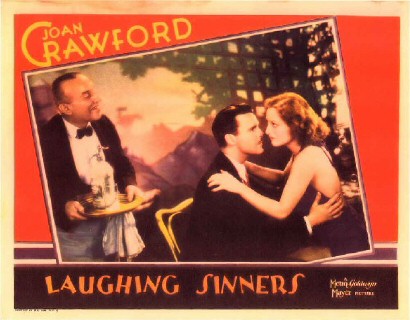
In 1931, a legendary film partnership began. Joan Crawford and Clark Gable appeared together for the first time in Laughing Sinners, a pre-code romance. We meet Ivy 'Bunny' Stevens (Crawford) in love - with Howard 'Howdy' Palmer (Neil Hamilton), a traveling salesman. It's quite clear that the two are lovers, and that Howdy has promised to marry Ivy (or Bunny, as he calls her). But while marriage IS on his mind, it's not marriage with her. He has decided to marry the boss' daughter, and coward that he is, he runs away, leaving her a note about his intentions. Some time later, Ivy tries to commit suicide, but is stopped by Carl Loomis (Clark Gable). Carl, a Salvation Army worker, encourages her to leave her current life, and become a part of his world. Giving to others, he feels, is what helped him to recover from the pains of a world that nearly destroyed him. Within a short time, Ivy too has become part of the Salvation Army. But then Howdy returns. That this film is from the pre-code era is instantly apparent. Ivy and Howdy are obviously having an affair; and a one-night stand is neither condoned nor condemned. And all that is required for forgiveness to happen is honesty on the part of the parties involved, and a true attempt at repentance. Because of Gable's forthrightness, Carl is shown as sympathetic and forgiving -
not preachy. He truly believes you can always
restart your life, and his talks center on living life squarely. God is not brought into the equation. Relatively speaking, the part of Carl is a small one, and we would have liked to have seen more of him. Gable gets third billing in the film - behind Neil Hamilton, and Crawford (whose name is above the title). By the time he films Sporting Blood that same year, he has begun to be listed first; by the following year, his name is routinely above the title.
The Salvation Army is portrayed
positively; and again, there is little emphasis on the religious aspects of the
organization. Rather, it is shown as a means of helping people get
through difficult times in their lives. The Great Depression, which was
still severely impacting the lives of Americans in 1931 is a major focus
of the film. Helping your fellow man is the means of both ending the Depression, and finding inner salvation.
As always, much of our conversation focused on Joan Crawford. She is so exquisitely beautiful in
this film, and her portrayal of Ivy is spot on. Crawford manages to touch gently on the dilemma faced by her character, and to make her likeable and sympathetic. Though her reformation requires that Ivy quit her job, she is never condemned for working in what appears to be a speakeasy.
The portrait painted of the traveling salesmen in the film, however,
shows them as carousing boozers. Again, the pre-code aspects of the film are obvious - the purchase of alcohol is still illegal in 1931, yet the salesmen buy it with easy. And since they seem to travel in bunches,
they egg one another into bad behavior. Laughing Sinners has a short, but tightly written script, based on Kenyon
Nicholson's play, Torch Song, which opened on Broadway on 27 August 1930. Guy Kibbee here reprises the role of Cass Wheeler which he originated in that
production, the only member of the cast to come over to the film (and Mayo Methot, who would become the wife of Humphrey Bogart, starred as Ivy). Interestingly, Johnny Mack Brown was originally cast as Carl, but bad previews
caused them to reshoot the part with Gable (for more information, see this TCM article).
When waitress Mabel O'Dare (Marion Davies) loses her job thanks to Aloysius K. Reilly (Roscoe Karns), he gets the bright idea to introduce her to a Broadway producer. Mabel ends up with a job, only because the star has just quit. But there's a problem - Mabel can dance, a little, but not enough to lead a Broadway show. Her dreams of stardom are all but gone when Reilly decides to get some publicity for her by claiming a love affair between Mabel and up-and-coming boxer Larry Cain (Clark Gable). But again, there is a little problem - Larry and Mabel loathe one another. Thus begins Cain and Mabel (1936), a little froth of a comedy, with a few musical numbers thrown in. While it was fun to see Clark Gable in this very early role, and Marion Davies is a delightful performer, this was probably not the best movie either ever made. The musical routines were a bit tedious - they ended up changing the tone of the film. We know Mabel isn't a great dancer; all the routines do is emphasize that to no purpose. And though the film is a bit long, there are some delightful scenes. The early conversations between Reilly and Mabel are a hoot, and then there is the added presence of Allen Jenkins as Dodo, Larry's fight second. Any time Allen Jenkins is in a movie, you know you are going to have a good time.
We also have Ruth Donnelly as Aunt Mimi, who is also very
funny. It should be mentioned though that Mimi is a fairly despicable
person. She will go to any lengths to advance Mabel's career, because
it is keeping Aunt Mimi in the money. She has no worry that her actions might make Mabel
unhappy.
Another interesting appearance is that of Pert Kelton as Toddy, the
star whose departure makes way for Mabel. We've seen her in Bed of Roses, and as we mentioned then, later in her career as Shirley Jones' mother in The Music Man. Unfortunately, she doesn't get a whole lot to do here, which is a shame. Interestingly,
Dick Powell was originally slated to play Ronny Caudwell, Mabel's
co-star and almost boyfriend. However, the part went to
Robert Paige, because William Randolph Heart didn't like Dick Powell.
Hearst felt Powell was too attractive and that Davies liked him too
much. As I'm sure everyone is aware, Heart and Davies were longtime companions. An interesting bit of trivia - when Hearst was in financial trouble in the 1930s, it was Davies who came to his rescue. She was a very intelligent businesswoman, and used $1 million of her own money to bail him out (much of it invested in jewelry).
This TCM article also tells in some detail the story of how Clark Gable was cast as Larry. Davies did NOT want him in the part - she didn't think he was attractive enough to play Larry! She later changed her mind about him, but Gable never quite forgot the insult. All we have to say is HUH? Gable not attractive? On what planet? The film is a remake of the silent film The Great White Way, which was filmed by Hearst's company in 1924, which starred Anita Stewart. And while we can't whole-heartedly recommend this one, it has some nice moments. And then there is Gable. We close with the film's trailer:
Constance Bennett is back in the 1931 melodrama, The Easiest Way. She plays Laura Murdock, a department store saleswoman who is offered the opportunity to pose as an artist's model for the Brockton Advertising Agency. She readily agrees, and finds the work agreeable. However, she comes to the attention of Willard Brockton (Adolphe Menjou), who offers her a different kind of employment - that of his mistress. While visiting friends of Brockton in the country, Laura meets Jack Madison (Robert Montgomery). He knows of her life, but loves her unconditionally. She eagerly agrees to leave Brockton, and live a respectable life. Only problem is, Jack is leaving the country, and Laura will need to fend for herself 'til he returns. Can she do it? Or is the easiest way the only way for her?
This film very much reminded us of Primrose Path, where our heroine struggled to avoid the oldest profession. But, while that film was set in the early 40s, this one is set smack in the center of the Great Depression - it was hard for a man to get a job, much less a woman. And while Laura is working, she has a lot on her plate - siblings, a mother, and an alcoholic, perpetually unemployed father. The money that Brockton provides supports Laura in style, but also allows her to provide for her family. Mother Agnes (Clara Blandick) refuses to see Laura once she is living with Brockton, yet clearly Laura's money is supporting her. The only family member who refuses to live on Laura is her brother-in-law Nick (Clark Gable, in one of his first major films). While NIck is hard, he is true
to his principles; he doesn't approve of what she is doing, so he won't
take anything from her. Gable is able to give him that rugged handsomeness for which he was later known. TCM points out in that he was the hit of film - women came out of the film asking who he was.
Some interesting period views here - the film is obviously precode - among other things, we see Laura's parents in bed together. We see an old New York City railroad flat, and we are provided a view into the world of advertising, circa 1931. It was fascinating to see the rooms of artists providing copy for department stores; almost an assembly line of painters and models.
We found Robert Montgomery's Jack to be somewhat uncaring; he insists that Laura
abandon Brockton, but isn't concerned that she might not be able to earn a living, then stops writing for a time without telling her it might happen. He even tells her to return Brockton's expensive gifts of jewelry and furs (which might have supported her til Jack's
return). It's a relatively small part for Montgomery, but we always enjoy seeing him.
We were pretty sure that Brockton would have demanded the jewelry back anyway. Adolphe Menjou's Brockton is a very
callous, calculating individual. He is only interested in controlling a woman, and Menjou is VERY good in the part. He plays Brockton as matter-of-fact, rather than
over-the-top evil. We leave you with a glimpse of Laura's work as a model, and a hearty recommendation to give this film a look. With the paring of Constance Bennett and young Clark Gable, this is a definite winner.
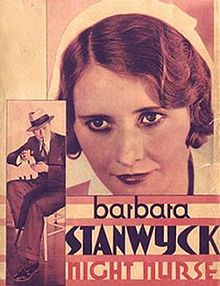
Several years ago, our group began our quest for pre-code films. We viewed the wonderful Barbara Stanwyck in Night Nurse (1931) at that time. Recently, I re-watched the film with a newer member of the group, and here share some of our thoughts. Stanwyck plays Lora Hart, a young woman who passionately wants to be a nurse. We meet Lora as she applies for a position in a hospital nursing school. However, Lora does not have a high school diploma - her mother's illness forced her to withdraw from school shortly before graduation - and the nursing matron will not accept her. As she leaves the hospital, she literally runs into Dr. Bell (Charles Winninger) who, it turns out, is the hospital administrator. Bell is quite taken with the attractive young woman, and decides to support her application. Lora becomes friendly with her roommate, Nurse Maloney (Joan Blondell), and Mortie (Ben Lyon), a bootlegger whom she assists (after he is shot). After graduation, she finds herself in a conundrum - her nursing oath demands that she obey the orders of the doctor in charge, but Lora quickly realizes that Doctor Ranger is in cahoots with Nick, the Chauffeur (Clark Gable) to murder two little children for their trust fund.
There is a lot of rowdy goings-on in this film. We have our heroine in a state of undress several times (and Ms. Maloney joins her in one of these slip-teases once). We have a bootlegger, who is not above asking his friends to take someone for a ride (we won't tell you who). We have a dipsomaniac mother, a doctor who may be on drugs, and a murderous chauffeur. And we possibly have an off-screen rape (see the TCM article for more on that). Want to see more, here is a clip of Stanwyck in one of the slip scenes:
We also have some outstanding performances. Joan Blondell as the gum-chewing Maloney is a hoot. She's not really interested in nursing - it's just the only job that will pay you to go to school! However, you like Maloney, who is quite good at her job, and a true friend. It's Maloney who first recognizes that the children are being mistreated, and her concern is real.
Clark Gable is very menacing as Nick - this was a breakthrough role for him, and it is understandable. Director William Wellman uses this up-and-coming star to good effect. In the TCM article we previously referenced, there is a discussion of Stanwyck and Blondell's reaction to this new man on the block. It's quite humorous. Finally, there is Stanwyck herself - her Lora truly wants to be a nurse. Watch the scene where the nurses take the Nightingale oath, and watch Stanwyck's eyes. Her idealism radiates (as opposed to Maloney, who keeps cracking her gum!). Also, watch her when she meets Dr. Bell, and later when she discusses him with Maloney. How DID she explain her predicament to him? Lastly, there are her interactions with the children - her tenderness is moving.
Join us next time for another film - the first of two versions of the same story.