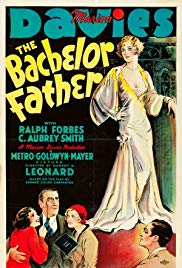
Sir Basil Winterton (C.Aubrey Smith) is The Bachelor Father (1931); though never married, he has managed to father three children with three different women. Now getting on in years and not in the best of health, he asks his lawyer John Ashley (Ralph Forbes) to locate the now-grown children: Geoffrey Trent (Ray Milland), Maria Credaro (Nena Quartaro), and Antoinette Flagg (Marion Davies), so that he can finally have a relationship with them. But, will they want a relationship with him? Marion Davies is thoroughly delightful as Tony (don't DARE to call her Antoinette!), a vibrant and winning young lady who is eager to discover a new family, but unwilling to compromised herself to do so. The audience knows early on that Tony is not actually the daughter of Sir Basil (she had a half-sister, also named Antoinette, who died before Tony's birth). The script - and Ms. Davies - make it transparent that Tony is not there for wealth, she's there simply to meet her father - and if she doesn't like him, she's leaving!! Marion Davies is an engaging actress who really should be seen more often. Though she was concerned about the move to talkies, she should not have been. Ignore the stories that she is the model for the untalented second Mrs. Kane in Citizen Kane - she's not. In his introduction to The Times We Had by Marion Davies, Mr Welles said: "Marion Davies was one of the most delightfully accomplished comediennes
in the whole history of the screen. She would have been a star if
Hearst had never happened. She was also a delightful and very
considerable person." (WellesNet) With all the stories about William Randolph Hearst being the model for Charles Foster Kane, it's often forgotten that Citizen Kane is a work of fiction. It is true that Hearst wanted her to succeed as a dramatic actress, but Ms. Davies far preferred comedy. Her comedic timing was impeccable, and while I'm sure she is an excellent dramatic actress, her gift really was in comedy, as is evidenced in this film (which she also produced).
There are many Marion Davies stories - this one is rather nice. After Cecil Beaton commented that she was one of the six most beautiful women in Hollywood, he was invited to photograph her. When she arrived, she was wearing a high-neck dress. He had hoped to photograph her with bare shoulders - so she cut up the dress to give him the picture he wanted (TCM article).
C. Aubrey Smith is delightful as the curmudgeony Sir Basil. Mr. Smith was reprising his role from the 1928 Broadway play. Even though this was a pre-code film, there were still issues (that were apparently disregarded) concerning the subject of the film. The Hays Office wanted the title of the film changed and no reference to the Broadway play, so that Sir Basil was not a bachelor, but multiply-divorced. As it was, because it was clear that the children were illegitimate, several countries and U.S. states changed the dialogue to muddy the children's status. As you can see by the advertisement below, the studio ignored the order. (AFI catalog).
This was Ray Milland's ninth film role, and while its not a big one, he does make an impression as Geoffrey, who despite his mother's antipathy (probably well-deserved) to Sir Basil, wants to form a relationship with his father. Mr. Milland worked for years, often as second lead, until he won an Oscar for The Lost Weekend (1945). But he had already done some really choice parts, including Gary Cooper's youngest brother in Beau Geste (1939), Ginger Roger's benefactor in The Major and the Minor (1942), and the musician who's house is haunted in The Uninvited (1944). Mr. Milland would act and direct until just before his death in 1986. He was survived by his wife of 54 years and two children.
Ralph Forbes doesn't have an awful lot to do - he's mainly there as a love interest for Tony (honestly, the butler, Larkin (played marvelously by Halliwell Hobbes) is more interesting than Mr. Forbes. Mr. Forbes had a substantial film career, that extended from silents to the television era; he also appeared in 14 Broadway plays between 1924 and 1950. He was briefly married to Ruth Chatterton and to Heather Angel. He died in 1951, at the age of 46.
A French version of the story, entitled Le père célibataire and starring Lili Damita, was released the same year as this version. Though successful upon release, the subject matter made sure it was not available for viewing after the Code was enforced. If you get a chance to see it, please do - we think you will enjoy it, and perhaps fall a little in love with Marion Davies.
This week, we're discussing Errol Flynn's first western, 1939's Dodge City. In it, Olivia plays Abbie
Irving, a young woman who is forced to move to the godless Dodge City
after the death of her father. Unfortunately, she has to get there with
her drunken brat of a brother (William Lundigan),
who starts a cattle stampede with his gun-play, and ends up getting
himself killed. Of course, Abbie blames wagon master Wade Hatton
(Flynn). Wade meanwhile, enters Dodge City to find it being run by
former adversary Jeff Surrett (Bruce Cabot), and after a horrible incident decides he is the one to bring law and order to Dodge.
This
movie is full to the brim with wonderful character performances. We
have the usual Flynn sidekick, Alan Hale as well as Guinn "Big Boy"
Williams. We have a rare character visit from the gorgeous Ann
Sheridan (one wonders if Jack Warner was angry at her that week to give
her such a small part), as well as the ever-wonderful Frank McHugh as newspaper
publisher Joe Clemens. And the adorable Bobs Watson as Harry
Cole, the reason that law comes to Dodge. With a cast like this, (and
these names are just the tip of the iceberg) can you really lose?
I
have major problems with seeing Bruce Cabot in pretty much anything
since I heard about his horrible actions to Errol Flynn later in their
careers. But one must admit he is truly loathsome here. Olivia is
spunky, in all the best senses of the word, especially in the later
portions of the movie (it is as though we get to watch Abbie grow up). Here is one of their love scenes:
It is truly funny to see the screenwriters making an excuse for
Flynn's presence in a Western (Wade is from Ireland, and has traveled
the world). Finally, we all adored Frank McHugh - he is funny and
touching in this small, but important role. His performance in the film is well worth emphasizing.