May 16th is National Classic Movie Day and to celebrate, I'm participating in this year's blogathon, Five Favorite Films from the Fifties. Be sure to follow the link to see the work of other bloggers, and find discussions of films you might never have thought to view. As I've mentioned before, my favorite films change from day to day, so I've opted to pick five films I truly love in five different genres - comedy, musical, film noir, suspense, and western. My caveat is, if you asked me tomorrow, you might get a totally different list. I'm also going to avoid discussions of films we've previously covered (I'll link you over to a few noteworthy ones within my chosen categories). Regardless, all of these films are remarkable and definitely worth seeing. If there are some with which you are not familiar, get hold of a copy asap. You won't be sorry.
Tony Hunter (Fred Astaire) has all but retired when his friends, writers Lester (Oscar Levant) and Lily Marton (Nanette Fabray) try to entice him back to work with their latest play. They plan to get Jeffrey Cordova (Jack Buchanan) to direct it. Cordova, however, has grandiose ideas, including the addition of ballerina Gabrielle Gerard (Cyd Charisse) to the cast. With misgivings ("I am not Nijinsky. I am not Marlon Brando. I am Mrs. Hunter's little boy, Tony, song and dance man."), Tony agrees, but conflicts arise as rehearsals begin. When it comes to musicals of the 1950s, Singin' in the Rain (1952) and An American in Paris (1951) (justifiably) come immediately to mind. But The Band Wagon (1953) is a film that should always be included in the list of great 1950s musicals. With Cyd Charisse and Fred Astaire performing one of the greatest dance numbers in movie history, plenty of comedy, and a love story, it's a film not to be missed. In 1931, Fred and Adele Astaire (along with Frank Morgan and Helen Broderick) starred in the Broadway play, The Band Wagon. It was a musical revue; this film has nothing to do with it, though I Love Louisa and Dancing in the Dark were both performed in the play. The film has a script by Betty Comden and Adolph Green, who loosely based the story on Mr. Astaire. He'd tried retirement for a few years, but was coaxed back to star in the very successful Easter Parade (1948); his most recent film, however (The Belle of New York) that had not done well (for more on Fred Astaire and The Band Wagon see this article in The Paris Review). The Martons were based on Comden and Green (though the real-life writing duo were not married), and Cordova was based on José Ferrer, who between 1946 and 1948 produced, directed, and/or starred in 8 Broadway plays - and did 10 more in the next three years! (TCM articles). Jack Buchanan was not the first choice for Gregory Cordova - Clifton Webb was approached initially; Edward G. Robinson and Vincent Price were also considered (AFI catalog). And while Vera-Ellen was at one pointed listed for the role of Gabrielle, one wonders if the failure of The Belle of New York led to her not being used. The film was well received upon release; the New York Timesreview by Bosley Crowther was enthusiastic. It was nominated for three Academy Awards for Best Story and Screenplay, Best Costume Design (Color) and Best Scoring of a Musical Picture. With all the wonderful musical numbers, the one for me that stands out is "Dancing in the Dark," perhaps Mr. Astaire's most romantic number since he and Ginger Rogers graced the screen. We'll close this section with a video of that delightful dance.
Dr. Benjamin McKenna (James Stewart) is on vacation in Morocco with his wife Josephine Conway (Doris Day), a well-known singer who retired to take care of their son Hank (Christopher Olsen). They are befriended by Louis Bernard (Daniel Gélin), a Frenchman who asks way too many questions for Jo's tastes. Bernard is murdered and whispers to Ben that a statesman is targeted for murder. But the would-be murderers have their own plan - snatch young Hank to be sure that Jo and Ben don't contact the police. The Man Who Knew Too Much (1956) is a remake of Hitchcock's 1934 film of the same name. The plots are similar, but this version has a lot more nuance. Hitchcock told François Truffaut that "the first version is the work of a talented amateur and the second was made by a professional" (Hitchcock by François Truffaut) James Stewart had already appeared in Hitchcock's Rear Window (1954) and Rope (1948); they would work together one more time in Vertigo (1958). Mr. Stewart was attached to the project from the beginning; Doris Day was also Mr. Hitchcock's first choice for Jo, especially since he wanted part of the conclusion to replicate the search for Richard the Lionheart by his troubadour Blondel. (TCM article). Her song, "Que Sera, Sera," won the Academy Award for best song, became her theme song, and was used in two more of her films (AFI Catalog). An excellent dramatic actress, she portrays a strong woman who ultimately refuses to be cowed by the danger threatening her child. Ms. Day's recent passing has already contributed many caveats to her exceptional skills as an actress and singer. This film is further proof that she was a talented dramatic actress. To my mind, The Man Who Knew Too Much is one of Hitchcock's great films that is often overlooked in discussions of his work. Perhaps because it was not seen for so many years - it was one of the five films that Hitchcock owned and refused to release (including Vertigo, Rear Window, Rope, and The Trouble with Harry) (Mental Floss article). The highly regarded Vertigo and Rear Window got much praise and viewing when the films finally came back to their audience in the 1980s. This one has just not received as much attention. If you are ready to watch the master of suspense spin his web, watch The Man Who Knew Too Much; here's a clip of the trailer, with a bit of Ms. Day doing her famous song.
Pregnant and dumped by her no-good boyfriend Stephen Morley (Lyle Bettger), Helen Ferguson (Barbara Stanwyck) boards a train with only her meager belongings - Morley gave her the ticket to get her out of town. She is befriended by newlyweds Patrice (Phyllis Thaxter) and Hugh Harkness (Richard Denning), who are on route to introduce Patrice - who is also pregnant - to Hugh's family. Patrice lets Helen try on her wedding band while they are in the ladies room; at that moment, there is a train crash. Helen awakens to discover both her new friends are dead, and Hugh's family thinks that she is Patrice. With her baby to think about, and No Man of Her Own (1950), Helen is faced with a massive decision - accept help from the Harkness family, or leave before they realize her deception. No Man of Her Own is on my list of favorite film noirs, as well as favorite Barbara Stanwyck films. As a woman abandoned by the man she loved, Stanwyck is remarkable (as always). Her ethical dilemma is obvious - the love she has for her unborn child, versus the need to lie to people as kind as Mr. & Mrs. Harkness (Jane Cowl & Henry O'Neill). There is the further complication of her growing affection for Hugh's brother Bill (John Lund). If it is a touch melodramatic, who cares? When you get a performer like Ms. Stanwyck telling the story, you want to watch. One of the things that really intrigues me is that Helen is clearly an unwed mother, yet there are no recriminations from anyone. Patrice is obviously aware that Helen has never had a wedding ring, and generously lets Helen slip on Patrice's ring. Originally, Helen was to have been a prostitute (AFI catalog), but in my opinion, Helen as a rejected lover makes for a more interesting story line. When the DVD was released in 2016, the New York Times provided some interesting commentary about the film (Bosley Crowther disliked it when it was released in 1950). The film was based on a Cornell Woolrich story (I Married a Dead Man), it has been remade several times, with versions in Japan (Shisha to no Kekkon (1960)), in France (J'ai épousé une ombre (1983)), in India (Kati Patang (1970), and in America (Mrs. Winterbourne (1996). This is top-notch Stanwyck - and not one that comes up all the time, so watch for it! This trailer will give you an idea of what to expect.
The beauty of The Quiet Man (1952) is that it is so much more than a comedy. It tells the story of Sean Thornton (John Wayne), who left his home in Ireland as a young boy to emigrate to America with his mother. He grew up with his mother's stories of his former home, their wee cottage, White-a-Morn and the roses that grew outside the house. Sean's life in America was a hardscrabble one, and as that life has become untenable, he retreats to Innisfree, and buys White-a-Morn. As he tries to settle into a country he doesn't know, he finds that his unwillingness to fight brings heartache to him, and to the woman he loves, Mary Kate Danaher (Maureen O'Hara). The Quiet Man was based on a short story by Maurice Walsh; John Ford acquired the rights in 1937 and yearned to make it into a film (AFI Catalog). Republic Studios finally agreed to make it IF Ford, O'Hara, and Wayne would make a Western (read moneymaker - Republic considered Ford's little film a vanity project that would lose money), so the trio first did Rio Grande. Filmed in Ireland, with various members of the cast's and crews' families working on the film, Ford was also under express orders to bring in a film no longer than 2 hours. But, his final cut ran 2:09 - he showed it to his execs, and stopped the projector at exactly the 120 minute mark. They agreed to the longer time (TCM articles).
For me, the film is important for its portrayal of a strong woman who is trying to maintain her independence in a society that limits a woman's choices. Mary Kate, in hounding Sean to get her dowry, is not asking for money - she's asking for her independence. With his American upbringing, all Sean can see is that what's his is hers. Mary Kate wants "her [own] things about her," for they are what make the house and the marriage all her own. I could go on for hours about this film. As a child, I would watch it every St. Patrick's Day (and growl when they cut crucial scenes out. Thank heavens for TCM and uncut films!). I've been in Ireland twice, and both times visited Cong, the little village in County Mayo where The Quiet Man was filmed. The Quiet Man is a song of joy about Ireland, and a tale of strength under pressure.
There are some truly remarkable westerns in the 1950s - Shane, The Searchers (1956), Johnny Guitar(1956), among others. But one film that should be in this list is the excellent Westward the Women (1951). The story of a group of 140 women who are recruited by rancher Roy E. Whitman (John McIntyre) as brides for his hands, the film portrays with as much truth as possible the dangers and hardships that faced the pioneers who went west. Leading the caravan is Buck Wyatt (Robert Taylor), a hard-nosed scout with little faith in the venture. The women are a tough bunch. There is our star, Fifi Danon (Denise Darcel), a saloon girl who wants a new start. The widowed Mrs. Maroni (Renata Vanni) wants a new father for her son Tony (Guido Marfuti). Patience Hawley (Hope Emerson) has lost her husband and son to the sea, and also wants a chance with a new husband. Robert Taylor is letter perfect as the man who decries Mr. Whitman's plan as foolhardy, but grows to respect the women in his charge. Early in the film, he speaks to the assembled group. He asks if any can shoot a gun - he's stunned when Maggie O'Malley (Lenore Lonergan) shoots the eyes out of a picture. His regard grows as he sees the women take on more and more responsibility as they struggle towards California.
Regardless of his star billing, this is a film about the women. Hope Emerson especially paints a portrait of a woman trying to begin a new life. She brooks no nonsense from her colleagues or from the men who lead the trail. She's brave and forthright, and you adore her from her first "hokum-smokum". Rose Myers (Beverly Dennis), a young woman pregnant with an illegitimate child is also an interesting character - accepted and loved by the group, with no condemnation of her past indiscretion. As this TCM article notes Westward the Women goes deeper into creating a female vision of the westward progression. These are the Pioneer Women (the film's working title) who would tame the western frontier. Frank Capra had planned to direct, with Gary Cooper as Buck, but eventually sold the project to William Wellman (AFI catalog), which I believe added a layer of realism that benefited the story enormously. Bosley Crowther in his New York Timesreview has certainly missed the point of the film; I suggest you take a look at
A Woman's View: How Hollywood Spoke to Women, 1930-1960 by Jeanine Basinger for further discussion on this very timely picture. In the meantime, take a look at the trailer:
And thus, our Five from the Fifties - there are many more excellent options (I didn't include a film I love, The Girl in White (1954). That's for another day). Just head over to Five Favorite Films from the Fifties and see the other wonderful films that were selected. In the meantime, Happy National Classic Film Day!
In celebration of National Classic Movie Day, and as part of the Classic Film and TV Cafe's blogathon, I'm going to venture on choosing the five (!!) movies I want with me when I'm stuck on a desert island. For someone with over 1,000 DVDs in her library, this is no easy task, but I'm going to give it a try with the caveat that the five I pick today may not be the same five I pick tomorrow! I know that when forced to choose, I'm going to want to mix up the genres a bit, so I'm not watching the same kind of film over and over,. Let's start with a musical, and my selection here is without equivocation. Whenever Singin' in the Rain is on, I have to watch the whole thing. I start out saying "I'll just watch this scene", and the next thing I know, the movie is over and I've re-watched it again. I actually do that with a lot of movies, which is probably not a surprise to anyone reading this. Regardless, Singin' in the Rain is special. With great music, wonderful dancing (Donald O'Connor doing "Make 'em Laugh" is an especial favorite), and terrific actors (Jean Hagen as Lola Lamont - she is perfection!) it has everything. It also serves as an introduction to the beginning of talkies. It's a film to which I frequently refer people, especially when they are puzzled as to why films look like they do in 1929 and 1930. Plus, it's a film that you will finish with a smile on your face and a song in your heart.
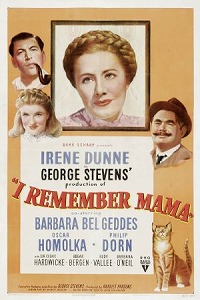
If you've never see I Remember Mama, you are missing a wonderful film. My pick for drama has several competitors (mainly A Tree Grows in Brooklyn, Johnny Belinda and The Enchanted Cottage), but for this week, I'm going with Irene Dunne in one of her last films. As the titular Mama, Dunne is perfect as Marta Hansen. Sure, Mama at time seems without fault, but it's hard to care or even notice as Dunne is so unbelievingly convincing as this warm and loving wife and mother. Narrated by the family's oldest daughter, Katrin (played beautifully by Barbara Bel Geddes), the story is a series of incidents in the life of the Hansen family over a number of years, which makes it perfect desert island viewing. Each "story" can be watched as part of the whole progression of the film, or as an independent short story. Especially poignant is an incident that revolves around the illness of the youngest daughter, Dagmar (June Hedin), and the inability of Mama to see her ailing child after surgery (hospital rules forbid any visitors for 24 hours post surgery. Wow, have things changed with time!) Dunne's heartbreak and guilt (she'd promised the child she would be there when she woke) in this segment reaches out from the screen and tears your heart. Ultimately, it is the strength of the family and the care that the immigrant mother and father show to their children as they try to avoid "go[ing] to the bank" that you will remember.
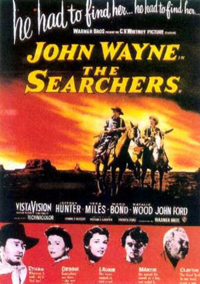
There are some really great westerns, and I have to admit that I had trouble deciding on just one. It came down to two: The Searchers and Westward the Women (add to the mix, a friend suggested Shane and The Big Country. Yes, my friends make my life harder). Ultimately, I chose The Searchers since it is again one of those movies I fall into each time I see it. John Wayne is exceptional as Ethan Edwards, a man driven to almost insanity by his hatred of Native Americans. When Ethan's niece, Debbie, is captured by a group of Indians who murdered the rest of her family, Ethan and Martin Pawley, a young man of mixed heritage who was raised by Debbie's parents, go on a quest to recover Debbie from her captors. But as the years pass and Debbie goes from childhood to young adulthood, it becomes clear to Martin that he must continue on the journey, no matter the cost. For, if he abandons it, Ethan will surely murder the young woman he now sees as a squaw. The story is intense, with Wayne creating a character that is impossible to like, but with whom the viewer feels a bond. Also notable are Jeffrey Hunter as Martin and Ward Bond as the Reverend Clayton, both characters that act as counterpoint to Wayne's driven loner. Finally, there are the magnificent vistas of Monument Valley, which director John Ford uses to tell his tale. It's a film with so many layers that, with each viewing, you'll see something new.
There are a number of comedies, especially romantic comedies which come to mind when asked to pick a desert-island selection: Victoria, Victoria, The Major and the Minor, Roman Holiday are just the tip of the iceberg. But I decided to select Bachelor Mother, starring Ginger Rogers as Polly Parrish, the temporary employee of Merlin and Son Department Store. When her job is about to come to an end, Polly goes out on her lunch break to find another job. She sees a woman abandoning a baby at a foundling home. Fearful the baby will roll from the stoop, Polly rushes in - and is mistaken for the baby's mother by the staff. As a result, Polly finds herself saddled with a baby, as well as a suitor, in the form of David Merlin, the "and Son" of the department store. The film is funny and sweet, the baby is adorable, and our romantic couple have a great chemistry. But what I love about this film are the attitudes of everyone towards this seemingly unwed mother. Sure, we, the audience, know that Polly is a "good girl", but the other characters don't, and uniformly they treat her with kindness and compassion. I especially love Polly's landlady Mrs Weiss (played to perfection by Ferike Boros), who, rather than condemn the girl, goes and gets her adult son's baby things and becomes Polly's go-to baby sitter! In an era where unwed mothers didn't exist, or were punished (usually by death) at movie's end, Bachelor Mother gives us a picture of a society that embraces the mistakes of a young woman, and ends by creating a happy family, all without violating the Code.
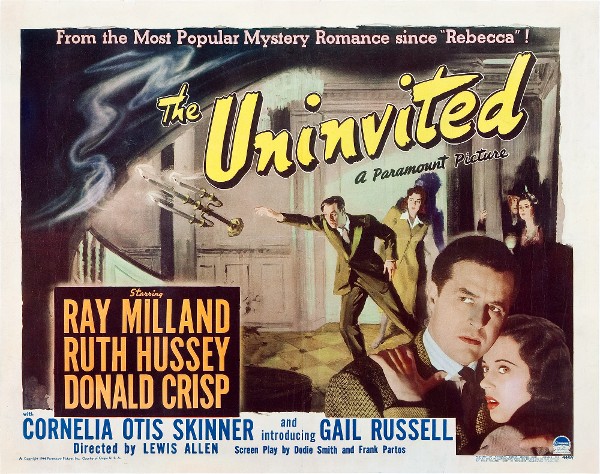
I'm not a huge horror fan, but I love suspenseful films. The Spiral Staircase is one film that I considered for this category, but really there was no contest in the ultimate winner: The Uninvited. It really does have everything - a phenomenal story, great cast, two ghosts, a really mysterious house, and a haunting musical score. (In an earlier blog entry, above, you'll find a link to a You-Tube video of the magnificent theme, Stella By Starlight). One of the problems with suspense films is that, once you know the answer, you don't always enjoy rewatching the film. ButThe Uninvited still is a pleasure even when you know what is coming. Much like Laura, it's the acting, and the relationships of the characters that keep you returning to this film. Ray Milland is exceptional as Rick, the new owner of Windwood House, as is Ruth Hussey as his sister Pam. But the person who steals the film from under everyone else is the ethereal Gail Russell, playing Stella Meredith, the object of Rick's love and the focus of the beings that haunt the house. The Uninvited is a movie that will make you believe in ghosts.
As I said, this is a list that could change at a moment's notice, and you'll notice that the list lacks a few films that one might expect to see on a desert island list. So, let's give a nod to To Kill a Mockingbird, Gone with the Wind, The Best Years of Our Lives,The Thin Man, Casablanca, just a few in a list of "essentials" that film fans love. These are wonderful; I own them, I would never give them up. I rewatch them regularly, but you all KNOW about these films. With my list, I hope I may have brought up a few films that might not have made your own "essentials" queue.
AFI Silver recently screened The Searchers (1956). Glenn Frankel, the author of The Searchers: The Making of an American Legend, was also there, to comment on the film and answer questions. It was a fascinating talk. Though we previously posted on this film, the opportunity to see it on a big screen, and the commentary by Mr. Frankel invites a revisit to perhaps best of all Westerns. The book, which is reviewed here (NY Times Review), looks not only at the film, but at the historical inspirations for it. In this Interview with author from CNN, the story of Cynthia Ann Parker, and her abduction by the Comanches is discussed. Like Debbie (Natalie Wood), Cynthia Ann (or Naduah, as the Comanches named her) was abducted at about age 11. She lived with the Comanche for 25 years, bearing 3 children. One of her sons was Quanah Parker, the last chief of the Quahada Comanche. (For more information on Naduah and Quanah Parker, visit the Texas State Historical Association) Though given opportunities to leave the Comanche, Naduah refused; she loved her husband and children. Eventually recaptured, Naduah was unable to return to her family, dying at age 45. Ethan Edwards' fears that Debbie is now fully Comanche is a reflection of historical facts. Ford emphasizes the importance of Ethan's fears when he encounters a group of recaptured white women and children. Forced again into a new world, two of the prisoners appear insane - a woman who apparently has lost her child, and a teenage girl. A third girl is terrified and weeping inconsolably. Edwards' face reflects his horror, but of what? Is it his fear that this is what will remain of Debbie when she returns, or disgust at the "savages" these supposedly civilized females have become? You can draw your own conclusions, but it seems that this might be the instant when Ethan contemplates killing Debbie.
Finally, a word on seeing The Searchers in a theatre. Nothing can prepare you for the grandeur of the scenery when seen in its proper environment. The people are dwarfed by the expanse of the valley. They appear as ants, stretching across an unending vista of stone and sand. Monument Valley shows us that no one, not the settlers, not the Comanche, can change the Valley. The Comanche have learned to live with the land. The settlers come to "tame" it. They never will. One look at the sky and land, and you realize the lunacy of even trying. I close with a trailer from the film, which gives a good idea of the vistas, and of Ford's vision of the West:
Our film this time is the 1942 anti-Nazi film Reunion in France. Released in January of 1942, this would have been produced before the United States entered World War II, but while our hero Pat Talbot is flying for the RAF, he is clearly an American - played by John Wayne! Here, Ms. Crawford plays Michele
de la Becque, a spoiled aristocrat whose world turns upside down when
the Nazis invade France. Her family dispersed (we learn her parents
have escaped to Lisbon), Michele struggles back to Paris, only to find
that her fiance, Robert Cortot (Philip
Dorn) is a Quisling. Thus, Michele begins her own form of resistance,
first by walking out on the promised easy life that Cortot would
provide; then by helping downed flyer Talbot get back to his unit in
England.
This is the only film in
which Wayne and Crawford ever appeared. They are actually quite good
together. Their unique acting styles come together nicely; but is it
surprising that Crawford looks good next to a strong male co-star?
Billing-wise, Crawford came first in list, with Wayne and Dorn listed
side-by-side under Ms. Crawford. And while we might expect Wayne to be
the romantic interest, he is, in fact, only a trigger to the action. We
won't say more than that, because this movie is more than just an
anti-Nazi propaganda film, and more than a romance. It is an espionage
film as well. Who is working with the Nazis? Who is working for the
Resistance? Watch the film - you will be pleasantly surprised by the way
director Jules Dassin makes the action unfold.
Some
nice supporting work here as well - we were especially pleased to see
Natalie Schafer as the snooty wife of a German officer, and John
Carradine as a Gestapo official. We very much enjoyed the scene in the
dress shop, where Michele and the dress shop staff try to keep Frau Schroeder (Schafer) from discovering money hidden in a coat that Frau Schroeder covets.
This
is an interesting movie, like some of the others we've viewed, rather
underrated. We think you might find this a good selection. Here's a trailer:
Again, we had a bit of a break in our meetings, but we are back together, and decided to follow up The Searchers with another (and very different John Wayne movie. This time, we saw Without Reservations,
a light comedy feature Claudette Colbert as hit writer Christopher
"Kit" Madden (think of her as Margaret Mitchell crossed with Ayn Rand),
whose best-seller is about to be turned into a motion picture. En route
to the west coast, Kit meets two fliers, Rusty Thomas (John Wayne) and
Dink Watson (Don DeFore). A few seconds with Rusty, and Kit is convinced
that he is the embodiment of her lead character, Mark Winston. She
attaches herself to him, in hopes that he will portray her character in
the upcoming movie.
We found it a bit disconcerting to see
Claudette Colbert going so totally gaga over a man as to be downright
silly. She doesn't want to tell Wayne her real name, so she adopts the
pseudonym Kit - short for Kitty - Klotch. Klotch?? She is a writer; one
would think she could write herself a better character. And then she
gets on a train without a ticket (because the boys are going on the less
expensive train. She has first class accommodations on the SuperChief).
Of course, hijinks ensue, and love - eventually - follows. Here's a scene on the train, in which Rusty discusses Kit's book:
On the
plus side was a cameo by Cary Grant (always welcome), and Don DeFore as
Dink was quite fun. We spoke at some length about DeFore, an actor who
we felt was highly underrated, and probably should have had a more
extensive career. But John Wayne making eyes at Dona Drake (as Dolores
Ortega) just made no sense when the lovely Claudette was there. We
kinda wondered why Kit would stand around doing dishes while the men
flirt with Dolores. The car they are in belongs to Kit. If WE were Kit,
we would have left them behind!! (And gone looking for Cary Grant).
Okay,
so not our favorite movie, but we didn't hate it. It's tongue is mostly
in its cheek, and it does seem to know how totally silly it all is.
With the second World War over, this lighthearted look at a couple of
fliers must have been a welcome relief.
We will be back soon. We'll be spending some time with the glorious Carole Lombard.
We haven't met for awhile (vacations and family issues), and
returned to our get-together with the decision to step away from
Pre-code for awhile. One member of our group had never seen The Searchers. So, we ventured into Monument Valley, to the land of Ford and Wayne.
It
is pointless to say this is a brilliant movie. My friend was struck
immediately by the beauty of the scenery. The cinematography here is
unparalleled. The vistas breathtaking. The differences between
the beauty of the country, and the almost dingy homes of the settlers
is, at times, unnerving: low doors compared to endless skies.
We
had to note this is NOT a holiday movie - with Christmas almost here,
it was a leap of faith for my friend to watch this. It is a relentless
film. At times, the pain is overwhelming. After the film, we looked
again at the scene where Ethan bids Martha goodbye, with Ward Bond
carefully not watching their interchange. With minimal dialogue, this
chaste kiss on the forehead becomes palpably heartbreaking. We know that
these two have a past; we know too, they have no future. Here is that scene:
Finally,
there is John Wayne. His Ethan Edwards is a revelation. Every one of
his critics should be forced to watch this brilliant performance.
Certainly, it is his best performance (and that is saying a lot, when
you consider his work in Red River, Stagecoach, The Quiet Man,
and the cavalry trilogy), and I think his most unusual. One doesn't
think of John Wayne being so callous. The character's bigotry is hard to
watch, but put in the context of the rest of the movie, he is, in many
respects, no different than the other settlers. Listen to Laurie
Jorgenson's (Vera Miles) attitude to Debbie's possible return. Even
Marty is tainted - his treatment of Look is unforgivable, in fact it
makes your skin crawl. The only character who is, I think, truly good
here is Olive Carey's Mrs. Jorgenson, who continues to love Debbie, no
matter where her life has turned.
Next week, we'll be heading to a more festive film. Hope to see you then.
 May 16th is National Classic Movie Day and to celebrate, I'm participating in this year's blogathon, Five Favorite Films from the Fifties. Be sure to follow the link to see the work of other bloggers, and find discussions of films you might never have thought to view.
 In 1931, Fred and Adele Astaire (along with Frank Morgan and Helen Broderick) starred in the Broadway play, The Band Wagon. It was a musical revue; this film has nothing to do with it, though I Love Louisa and Dancing in the Dark were both performed in the play. The film has a script by Betty Comden and Adolph Green, who loosely based the story on Mr. Astaire. He'd tried retirement for a few years, but was coaxed back to star in the very successful Easter Parade (1948); his most recent film, however (The Belle of New York) that had not done well (for more on Fred Astaire and The Band Wagon see this article in The Paris Review). The Martons were based on Comden and Green (though the real-life writing duo were not married), and Cordova was based on José Ferrer, who between 1946 and 1948 produced, directed, and/or starred in 8 Broadway plays - and did 10 more in the next three years! (TCM articles).
  Dr. Benjamin McKenna (James Stewart) is on vacation in Morocco with his wife Josephine Conway (Doris Day), a well-known singer who retired to take care of their son Hank (Christopher Olsen). They are befriended by Louis Bernard (Daniel Gélin), a Frenchman who asks way too many questions for Jo's tastes. Bernard is murdered and whispers to Ben that a statesman is targeted for murder. But the would-be murderers have their own plan - snatch young Hank to be sure that Jo and Ben don't contact the police.

 One of the things that really intrigues me is that Helen is clearly an unwed mother, yet there are no recriminations from anyone. Patrice is obviously aware that Helen has never had a wedding ring, and generously lets Helen slip on Patrice's ring. Originally, Helen was to have been a prostitute (AFI catalog), but in my opinion, Helen as a rejected lover makes for a more interesting story line.