Showing posts with label Walter Huston. Show all posts

Wednesday, October 21, 2020

Yankee Doodle Jimmy

From the stage of I’d Rather Be Right, George M. Cohan (James Cagney), famed actor and the composer/lyricist of Yankee Doodle Dandy (1942), is summoned to Washington DC to meet President Roosevelt. At the President’s request, Cohan recounts the story of his life.

This post is part of the Politics on Film Blogathon, hosted by the Classic Movie Blog Association.
 
James Cagney gives the performance of a lifetime as Cohan. Though the role was offered to Fred Astaire (Mr. Astaire said no - he felt he was wrong to portray Cohan; he was right), and finally was given to Mr. Cagney, who was eager to play the part (TCM article). Mr. Cagney had always considered himself a hoofer - his first job in the theatre was dancing in the chorus (Library of Congress biography) - and he was eager to get away from the gangsters to which his career had been relegated. He'd also on occasion been accused of being a communist (his activities in the Screen Actors Guild were part of the issue), and playing Cohan showed him as the ultimate American patriot.

Mr. Cagney was a perfectionist, and demanded long rehearsals to perfect his dancing.  He was coached by Johnny Boyle, a vaudevillian who was highly regarded as an Irish-American tap dancer. At the same time, he was not averse to improvisation - when he first meets Mary Cohan (Joan Leslie), Mr. Cagney improvised most of his "business." The stair dance at the conclusion of the film was also spur of the moment. The dancing style, however was very reminiscent of Cohan's style (you can see some brief clips of Mr. Cohan dancing in this video). His dynamic dancing makes the film - when he is on screen you cannot take your eyes off him.  He's no singer, but as Joan Leslie pointed out "Jim doesn't sing, because he doesn't sing worth a darn. He'd talk it, and every now and again, he'd hit a note...but he had some much energy and such a presence that it doesn't seem like he couldn't sing." (Michael Curtiz: A Life in Film by Alan K. Rode).

Joan Leslie is a strong counterpart to Mr. Cagney. She gives Mary just the right amount of naivete in the beginning, and slowing moves the character into a knowing and supportive partner. Ms. Leslie had an excellent singing voice, and could dance a bit; she follows Mr. Cagney's lead, as he improvises some of their scenes together, she responds easily.  Ms. Leslie is playing a primarily fictional character.  George M. Cohan was married twice - to Ethel Levey and Agnes Nolan. When he agreed to the film biography, he stipulated that he didn't want either of his wives discussed. Warner Brothers decided to create an amalgam of the two women and give her a different name, thus abiding by Cohan's requirement and still having him be married - as well as provide a motivation for the song "Mary's A Grand Old Name."

Yankee Doodle Dandy is very much a Cagney family affair. James Cagney's brother, William, served as the producer, and sister Jeanne Cagney appears as Josie Cohan. The easy relationship between the brother and sister, combined with the talents of Rosemary DeCamp (Nellie Cohan) and Walter Huston (Jerry Cohan) make for a strong family unit. Ms. DeCamp was actually 11 years younger than Mr. Cagney. Her autobiography comments on the difficulties she and Ms. Cagney had learning the complex dance routines (Tigers in My Lap by Rosemary DeCamp).
Walter Huston, however, had a theatre background - he'd worked in Vaudeville, and among his fourteen Broadway credits was the musical Knickerbocker Holiday. He has what is perhaps the most moving scene in the film - the death of Jerry Cohan. According to Rudy Behmer (in his commentary on the DVD), Michael Curtiz broke down sobbing as he watched Cagney perform. He ruined at least one take and can be heard in the background of the film if you listen carefully.

The film also features strong performances by Richard Whorf (Sam H. Harris) and Irene Manning (Fay Templeton). George Tobias (Dietz) appears as a would-be theatrical impresario. And S.Z. "Cuddles" Sakall (Schwab) has one scene as the man who stages Cohan and Harris first production. Though the scene is fine, Mr. Cagney was initially upset that Mr. Sakall was mugging through the filming - he asked Mr. Curtiz to tone Sakall down. Much of his work ended up on the cutting room floor.
Obviously, a lot of the history is incorrect - the frame story in particular is not anywhere the actual story.  World War II broke out while Yankee Doodle Dandy was being filmed (Ms. DeCamp related the company huddled around a radio on the set, listening to Franklin Roosevelt deliver his address to Congress). I’d Rather Be Right, however,  ran from November 1937 to July 1938. And Roosevelt gave Cohan the Congressional Gold Medal (NOT, as stated in the film, the Congressional Medal of Honor - the Medal of Honor is a military award) in May of 1940.  It had been awarded in June of 1936, but Cohan (a Democrat), disliked unions and though an early Roosevelt supporter was not fond of Roosevelt's pro-union stance. The photo below (from the Library of Congress), shows George M. Cohan receiving the Gold Metal from the President. Mr. Cohan died in November of 1942, a few months after the film was released (AFI Catalog).

Bosley Crowther's review in the New York Times was glowing: "as warm and delightful a musical picture as has hit the screen in years, a corking good entertainment and as affectionate, if not as accurate, a film biography as has ever—yes, ever—been made." A Roger Ebert review from 1998 was also complimentary.  The film received three Academy Awards (for Actor - Mr. Cagney, Sound Recording, and Scoring of a Musical). It was also nominated for five awards: Picture, Supporting Actor - Walter Huston, Director, Original Screenplay, and Film Editing).  In 1993, it was added to the National Film Registry. It is #18 on AFI's list of musicals, #100 on the original 100 Years, 100 Movies, and #98 on the 10th Anniversary list.

If you'd like to read more about this exceptional picture, take a look at "‘A Great American Service’: George M. Cohan, the Stage, and the Nation in Yankee Doodle Dandy" by  Elizabeth Titrington Craft from The Oxford Handbook of Musical Theatre Screen Adaptations Edited by Dominic McHugh Oxford Handbook Online and this American Heritage article. If you've never seen Yankee Doodle Dandy, treat yourself and get hold of a copy. In the meantime, here is the trailer:

This post is part of the Classic Movie Blog Association Blogathon, Politics on Film. Please visit the website to read some of the other wonderful posts.


Monday, June 10, 2019

Walter Faces a Bank Run

Thomas Dickson (Walter Huston) runs a successful bank in an unnamed city in 1932 America. His bank survived the beginnings of the Depression primarily because of Dickson's gift for choosing individuals to whom to loan money. Often, Dickson makes loans on the character of the person, regardless of their collateral, yet those to whom he lent money have unfailingly paid it back. But a bank robbery threatens the integrity of the bank when word is leaked that they are broke, starting an American Madness (1932).

Shown at the AFI Silver Theatre as part of a retrospective celebrating the works of Fay Wray and Robert Riskin, the film featured commentary by their daughter,  Victoria Riskin (who recently published Fay Wray and Robert Riskin: A Hollywood Memoir). Mr. Riskin wrote the screenplay - one of eight collaborations with Frank Capra (TCM article).

Frank Capra was not the first choice to direct the film - initially Allan Dwan was set to direct, but producer Harry Cohn was dissatisfied with his efforts, fired him and assigned Roy William Neill. Within a day, Neill was gone and Frank Capra, who was just back from a vacation, was pushed into the film. Scenes of the bank run are reminiscent of It's a Wonderful Life (1946) and the character of Thomas Dickson resembles George Bailey, even to his speeches as je attempts to calm the bank panic. It's an interesting opportunity to see the work that would later influence what many consider Capra's masterwork.
Walter Huston is impressive as Dickson, a man of principle facing a crisis of faith.  Dickson has spent his life relying on his ability to read people. Now, in an instant he discovers that a climate of fear brings out the worst in his fellow man. The character of Dickson was based on the chairman of the Bank of America, A. P. Giannini (AFI catalog ). Mr. Huston is always an impressive actor - see his work in Rain (1932), Dodsworth (1936), and The Treasure of the Sierra Madre (1948) for very different performances.  

Pat O'Brien plays Matt Brown, an ex-con hired - and promoted - by Dickson. He's in love with Dickson's secretary, Helen (Constance Cummings), and inadvertently witnessed what he thought was a romantic assignation between Dickson's wife, Phyllis (Kay Johnson) and fellow employee Cyril Cluett (Gavin Gordon). Mr. O'Brien has his best scenes when he is (unsurprisingly) accused of collusion in the bank robbery. His anxiety over preserving his boss' marriage (Matt accompanied Ms. Dickson home when he found her at Cluett's apartment) rather than provide himself with an alibi is well played - and an interesting contrast to Gavin Gordon.
Constance Cummings didn't have a big part in this film - her role is to support Matt and Dickson, but she does it well. When she was the Star of the Day in Summer Under the Stars, Michael Feinstein discussed her.  Her U.S. film career was short (she'd already had a Broadway career, which would continue until 1979); after her 1933  marriage to Benn Levy (they had two children and were together until his death in 1973), she moved with her husband to England, where she would continue working in films (Blithe Spirit (1945)) and the stage (Long Day's Journey into Night opposite Laurence Olivier in 1971). She won the Tony Award for Best Actress in a Play in 1979's Wings.  She died in 2005, aged 95
This is the first film role for Sterling Holloway (Oscar), who would go on to perform numerous character parts, television roles, and voice parts, include Mr. Stork in Dumbo (1941), the narrator of "Peter and the Wolf" in Make Mine Music (1946), and Winnie the Pooh. 

It's an interesting movie, and if you are a fan of Frank Capra, or would like to see the genesis of It's a Wonderful Life, definitely worth a viewing.  I'll close with an early scene, which introduces many of our characters.

Monday, May 14, 2018

Ronald Paints His Masterpiece

Richard Heldar (Ronald Colman) returns from the Sudan with a scar from a head injury he received saving the life of his best friend Torp Torpenhow (Walter Huston) and images from his life in the military. Dick is a painter, and gains success back home translating those images into highly successful paintings. Torp, however, is disappointed that Dick's views idealize the war; Dick pragmatically points out that idealism sells. But then Dick gets an idea for a painting of a woman - a Melancholy, which he knows will be his masterpiece. Using a local street girl, Bessie Broke (Ida Lupino), as model, Dick works steadily on his canvas. But Dick is under time constraints - due to his injury, he is going blind, and only has a few months to work. The Light That Failed (1939) is our film this week.

This film is the third based on an 1891 novel by Rudyard Kipling. The first two, silent films from 1916 and 1923, ended differently than our film. Kipling's novel originally had a very dark ending. But, under pressure, Kipling gave it a happy one. It was this ending that was used by the silent films. Director William Wellman, however, was not going to go for the whitewashed version. He used the original story, with its grim, hopeless conclusion. Bear in mind that Wellman wanted to give his pre-code film Wild Boys of the Road a bleak ending, and was prevented from doing so by the studio. We wondered if perhaps the studio should have intervened again.
Mr. Colman, who is willing to make Richard a nasty individual when called to do so, was not Mr. Wellman's first choice - he wanted Gary Cooper for the role (AFI Catalog), following their work together in Beau Geste. Mr. Colman and Mr. Wellman did NOT get along. According to this TCM article, Mr. Colman wanted Vivien Leigh (who was in the midst of filming Gone with the Wind) for the role of Bessie. Wellman refused - he had auditioned Ms. Lupino and wanted her in the part. This resulted in some on-set verbal sparring (Ida Lupino: A Biography by William Donati) and Mr. Colman finishing the scene without incident.

Despite the fact that she was unwanted by Mr. Colman, Ida Lupino nearly steals the movie in her breakout role as Bessie. Bessie is a complex and interesting character, and Ms. Lupino makes the most of it. In her able hands, Bessie is both sympathetic and unlikable at the same time. Born in England to performers, Ms. Lupino began working in British films in 1931. After several years in Hollywood in which producers did not know what to do with her, Ms. Lupino became "the poor man's Bette Davis" (her description; LA Times) picking up serious parts Ms. Davis had rejected. Her work in our film resulted in her casting in They Drive By Night (1940), as the mentally unbalanced Lana Carlsen. In 1949, she directed her first film Not Wanted, when Elmer Clifton became ill and was unable to finish the project. She would continue acting and directing, in both film and television until 1978. Ms. Lupino married and divorced three times (to Louis Hayward, Collier Young, and Howard Duff. Her only child was the result of her marriage to Mr. Duff). One of my favorite imaginary images are the reported meetings of the Directors Guild of America; the meeting opened with the words "Gentlemen, and Miss Lupino" (San Francisco Chronicle). Ms. Lupino may not have been the first female director, but she surely paved the way for women directors today.
Muriel Angelus doesn't really impress as Maisie. Where we dearly want Maisie to be an independent career woman, she comes across as a petulant brat. She invites Dick to see her work. When he provides honest criticism - which she had asked of him - she pouts, all the while pointing out that when men have previously praised her work, they had different intentions in mind. Maisie claims to love Dick, but she seems inherently selfish. You begin to wonder what exactly Dick sees in her.

Walter Huston, who is always a pleasure to see in any film, makes Torp a layered character. It is he who finds Bessie, and while we're pretty sure he has ulterior motives in bringing her to his lodging, he ends up feeding her and letting her get some sleep. He is a support to Dick, as well as his sternest critic.
Attitudes towards disability have changed since Kipling's time, making this a difficult movie to watch. But with good performances, and an interesting discussion of art it is a worthwhile film. Just be prepared that you may not like the ending.  

Wednesday, February 21, 2018

Humphrey Burns

The kickoff film for this year's TCM Presents was  The Treasure of the Sierra Madre (1948), which celebrates its 70th Anniversary this year. Humphrey Bogart stars as Fred C. Dobbs, a down-on-his-luck American stuck in Tampico, Mexico. He's broke, it's next to impossible to get a job, so he spends his day hitting up an American tourist (John Huston) for food money ("Can you spot a fellow American to a meal?"). When he finally is able to get a job, it's from a cheat named Pat McCormick (Barton MacLane), who disappears without paying Dobbs and his friend, Curtin (Tim Holt). Curtin and Dobbs are eventually able to locate McCormick, and "persuade" him to give them their pay. Using that money, and $200 that Dobbs wins from the lottery, the pair and prospector Howard (Walter Huston) head out to the Mexican hills to find gold. But gold can change people, Howard cautions, and Dobbs will become a victim of that change.

Director John Huston cast his father, Walter Huston as the knowing prospector. It's an amazing performance which won Walter the Academy Award for best supporting actor.  But it almost didn't happen.  A highly regarded leading man on both stage and screen (the little jig he does in the film was taught to him by Eugene O'Neill when Mr. Huston appeared on Broadway in Desire Under the Elms (Lincoln Center Film Society)), Huston Sr didn't object to playing an older man - he'd already played James Cagney's father in Yankee Doodle Dandy. But son John's insistence that he remove his dentures was just too much even for a father trying to support his son's career. John and Mr. Bogart would eventually resort to holding Mr. Huston down and forcibly removing the teeth, much to Walter Huston's chagrin. But the difference in his speaking voice was so noticeable that he finally agreed to appear without his teeth. (TCM articles). It's interesting to note that, on some of the poster art, the drawing of Walter Huston looks like him in most of his films, not as he appears in this film (see the poster below).
Born in Canada in 1883, Walter Huston began his career on the stage, primarily in touring companies. His first marriage postponed his acting career: he worked in an electric power plant to support his wife and son. When the marriage ended, he returned to the stage - this time vaudeville - working with his second wife, until he began getting roles on Broadway. Between 1924 and 1946, he would appear in 14 plays - musicals and dramas - including Dodsworth, which he would also bring to the screen. He was nominated 4 times for Oscars (Dodsworth (1936), The Devil and Daniel Webster (1941), Yankee Doodle Dandy (1942)), finally winning for this film. He worked with his son on other films, including The Maltese Falcon (1941) where he played the dying Captain Jacoby, and providing narration for John's wartime documentaries (i.e. Let Their Be Light (1946)). His third marriage in 1931 endured until his death of an aortic aneurym at age 67 in 1950. For more on Walter Huston, see this Los Angeles Times obituary.

Humphrey Bogart was not the studio's first choice for Dobbs - Edward G. Robinson was initially suggested, though John Huston badly wanted to Bogart for the part. Ronald Reagan and John Garfield were considered for Curtin, and Zachary Scott was in the running for the part of James Cody (which would go to Bruce Bennett). It's been said that Ann Sheridan did a walk-on as a prostitute, but the woman in question does not look a bit like her, so it's probably urban myth. (AFI catalog)

Bogart, of course, is amazingly good in a characterization that morphs so dramatically during the course of the film. He's not a bad man in the beginning - even when he forcibly takes his salary from Pat McCormick, he only takes the money due to him and Curtin. He even pays the bartender for the damage to the saloon from his own money. But as the gold starts to mount, so does his greed and paranoia. At one point, he most closely resembles Gollum in The Lord of the Rings, crouching and giggling over his wealth.
There are some uncredited performances to look out for. The Mexican Boy Selling Lottery Tickets is portrayed by Robert Blake, who would later star in the TV show Baretta.  Jack Holt, a silent and sound actor, perhaps remembered today for his appearance in San Francisco (1936) is one of the residents of the flophouse where Dobbs and Curtin meet Howard.  And the Lone Ranger's colleague Tonto, Jay Silverheels appears as the Indian Guide at Pier.

John Huston filmed much of the action for the film in Mexico; finally he was dragged back to Warner Brothers to complete filming when the costs became too high. He worked with an advisor, who Mr. Huston believed was actually the author of the novel, B. Traven. The advisor denied this, but the BBC later confirmed John Huston's theory.  Check out this New York Times article on the author, as well as the BBC broadcast.
Besides Walter Huston's Academy Award, the film also won for Best Direction and Adapted Screenplay to John Huston - the first time a father and son won Oscars (and the only time thusfar for the same film). It was also nominated for Best Picture, but lost to Hamlet). In April of 1948, Humphrey Bogart and Walter Huston reprised their roles for the Lux Radio Theatre; in February 1955 Edmund O'Brien and Walter Brennan performed the radio play for LuxThe Treasure of the Sierra Madre was #38 on AFI's 100 Years, 100 Movies, 10th Anniversary Edition (it was #30 on the original list), as well as being listed at #36 in their 100 Greatest Movie Quotes (for the oft midquoted: "Badges? We ain't got no badges! We don't need no badges! I don't have to show you any stinking badges!"), and #67 in the 100 Most Thrilling American Films. In 1990, it was added to the  National Film Registry (the second year of the registry).  

We'll leave you with the trailer for this excellent film. If you've not seen it before, you are in for a treat.

Wednesday, December 14, 2016

Errol Fights the Nazis

The 75th anniversary of the attack on Pearl Harbor just passed; our film this week commemorates the occasion with a look back to a film from the second World War.  Edge of Darkness (1943) takes place in Norway, circa 1942.  Told in flashback, the film tells the story of the village of Trollness.  The Nazis have taken over the country, and the populace are being starved and murdered by their conquerors.  Gunnar Brogge (Errol Flynn) a local fisherman, chaffs at his inability to fight for his country, and is about to leave the woman he loves, Karen Stensgard (Ann Sheridan) to join the resistance in England.  But when word comes that the British are planning to arm the population up and down the coast in an effort start a revolution in the country Gunnar determines to stay and fight.  He becomes the official leader of a resistance movement which includes Karen, Gerd Blarnesen (Judith Anderson), and Lars Malken (Roman Bohnen).  But not everyone is willing to fight. Karen's father, Dr. Martin Stensgard (Walter Huston) and his wife Anna (Ruth Gordon) prefer to live quietly within the strictures of the dictatorship.  And there remains the danger from the local Quislings, who include Karen's uncle Kaspar Torgerson (Charles Dingle) and brother Johann (John Beal).

When this film was released on April 24, 1943, America had been at war with Germany for just over a year.  Certainly, there had been films that dealt with Nazi atrocities before (To Be or Not to Be (1942) and The Mortal Storm (1940) are two examples), but this was perhaps the first one to portray ordinary people resisting the Nazi juggernaut.  And a powerful statement it is.  Even though the film starts showing the carnage of a decimated Nazi stronghold, and a Norwegian flag flying above it, we've no idea of who did it and what became of them.  The strength of this movie is the fact that many incidents are unexpected.  It keeps you engaged with both the multidimentional storyline and the characters. For more information on America's view of the situation in Europe during this period, see this New York Times book review of The Holocaust in America.
The depth of the characterizations is best exhibited by the minor characters that we expect to be tropes, but are not.  The talkative grocer, Lars Malken, as ably portrayed by Roman Bohnen, is the best example.  From the minute we meet him, we expect that he will betray the resistance with his anger and his need to express show off his commitment.  Another is the relationship between Gerd and the German soldier whom she loves.  Our initial reaction is that he will come to side with the resistance, and love will triumph.  But this film is not about the standard Hollywood tropes.  It's attempting to create a glimpse into the real horrors of the war in Europe.

Ann Sheridan is an actress who, in my opinion, is not given enough credit for her excellent portrayals, and she excels here.  Especially notable is the scene in which she discovers her brother, who has been working for the Nazis, is returning to Trollness.  Her reactions are subtle, but pointed.  Ms. Sheridan's career began in the sound era (and her lush voice is perfect for sound), and worked steadily through the 1930s and 1940s.  As her film career slowed in the 1950s, she segued into television, including a year on the soap opera, Another World.  In 1966, she accepted the lead in the TV series Pistols and Petticoats, but died of cancer (age 51) before the end of the first season.  She was married three times, including a one-year marriage to George Brent.  Allegedly, it was this film which ended the marriage, as Ms. Sheridan may have gotten a little too close to co-star Errol Flynn.  See this TCM article for more on the sexual shenanigans that plagued this film.  If you are not familiar with Ms. Sheridan, this film is an excellent start.  Then consider viewing The Man Who Came to Dinner, Nora Prentiss, I Was a Male War Bride, and (my favorite of her films) Tropic Zone
We were not as impressed with Ruth Gordon, who plays Ms. Sheridan's mother, Anna.  I personally am not a member of the Ruth Gordon fan club, and this is not a film that will make you one.  Anna is rather whiny, and comes across as peculiar and rather stupid.  Ms. Gordon didn't have an especially impressive film career, but with 33 Broadway plays to her credit (she was nominated for a Tony Award for her performance as Dolly Gallagher Levi in The Matchmaker in 1956), she kept busy.  She was also writing with her husband, Garson Kanin (they were nominated for three Oscars: for A Double Life (1947), Adam's Rib (1949) and Pat and Mike (1952).  But Ms. Gordon's film and television performances skyrocketed after she won the Oscar as Best Supporting Actress for Rosemary's Baby (1969). You can view her amusing acceptance speech here.  She died, aged 88, in 1985.  She was survived by her husband of 42 years, Garson Kanin, and her son Jones Harris (born in 1929), the result of a long-term affair with producer Jed Harris - though they never married, the couple openly acknowledged their son.
Edge of Darkness is based on William Woods novel of the same name (see this AFI Catalog entry  for more information on the film's background)Though it got a tepid review from the New York Times, we highly recommend it.  With a strong story, and impressive acting, it is definitely worth your time.  We'll leave you with a scene from the end of the movie:

Wednesday, October 5, 2016

Kay's Daughter Wants to Sing

Kay Francis returned to Warner Brothers in 1942 for Always in My Heart.  Kay plays Marjorie Scott, the mother of Victoria (Gloria Warren) and Martin (Frankie Thomas).  They live in a small coastal town of Santa Rita, California with their housekeeper Angie (Una O'Connor) and her little granddaughter Booley (Diana (Patti) Hale).  Marjorie (or Mudge, as her children call her) also has a suitor, Philip Ames (Sidney Blackmer), who is not above bribing Victoria and Marty to help him convince Marjorie to marry him.  But, unbeknownst to the children and Philip, Marjorie's heart lies elsewhere - with her husband, MacKenzie Scott (Walter Huston), who's been in prison for over ten years.

We really wanted to like this film, but in the long run, it was pretty hard to do so.  It's a waste of the wonderful Kay and Walter Huston (who we previously saw together in Storm at Daybreak)The film doesn't really know what it wants to be: comedy? drama? musical?  It does know that it wants to find the next Deanna Durbin in Gloria Warren.  As you can see from the ad below, even though Ms. Francis and Mr. Huston are the stars, it is Ms. Warren on whom the ad focuses.  This was the first of her five films (between 1942 and 1947), and she is, quite frankly, not well served.  To be sure, she has a magnificent operatic voice, but this film gives her nothing with which to shine.  Even the title song (more on that later) is done in a way that just makes it a bore.  Add a peripatetic plot, and you have a bit of a mess.
This New York Times review comments that "Miss Warren is . . .a bit mature for her reported fifteen years" and she does appear much older than 15.  But she was actually 16 when the film was released.  Obviously, her mature singing voice doesn't help one believe that she is only 15, but a mature voice never hurt Deanna Durbin.  What Ms. Warren lacked, it seems, were scripts.   The films she made are not remembered, and while she is pleasant enough, the public just didn't didn't take to her.  The director also places emphasis on the operatic quality of her voice, during a period of time when The Big Bands were soaring in popularity.  The one popular song she is given, Always in My Heart, is arranged with a very operatic style and probably didn't help much.  The song was nominated for an Oscar (it lost to White Christmas.  What wouldn't lose to White Christmas?)  Later, it was covered by, among others, Dean Martin.
According to this  TCM article, Kay Francis appeared in the film at Walter Huston's suggestion.  This was their fourth film together.  They do work well (especially considering they aren't given a whole lot of screen time, nor much to work with when they are on screen).  The film minimizes so many issues surrounding the adults - they are reluctant to tell us why Mac is in jail (we don't find out til the last 1/2 hour).  And why are there no pictures of him around the home? Sure, the children think he is dead, but no photographs to remember him by? And the kids never ask? It's an odd piece of writing.  Mr. Huston, however, does get to sing. He had previously appeared in the musical Knickerbocher Holiday (1938-1939) on Broadway, and had a pleasant singing voice and style (see this AFI Catalog article for more information). 

This was also the screen debut of Diana (Patti) Hale, who had almost as brief a career as Ms. Warren.  She was in five films, her last being Thunderhead - Son of Flicka (she had also appeared in the same part in 1943's My Friend Flicka) in 1945.  She returned to television in 1954 in an episode of Meet Corliss Archer, and then left the business.

Sidney Blackmer gets the thankless job of playing Philip, a bore and a stereotype.  Philip is a jerk, who uses his money to get around his beau's children.  He's a bit of a bully, and you spend most of the movie waiting for him to twirl a non-existent mustache as he ships the children far away from their beloved Mudge.  An excellent actor, with a remarkable speaking voice, Mr. Blackmer began his career in the silent era (in 1914) and continued acting in film and television until 1971.   See him as Seth Lord in High Society (1956) or This is My Affair (1937) as Teddy Roosevelt.

We'll leave you with this scene of Gloria Warren singing. Sorry we can't be more enthusiastic about the film, but do enjoy her lovely voice.

Monday, February 29, 2016

Kay Faces a Storm

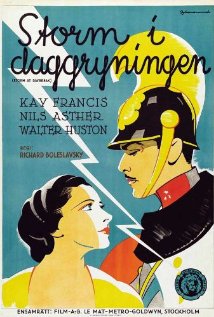
Following the assassination of the Archduke Franz Ferdinand and the Duchess Sophia, a small town in Hungary begins to feel the effects of the war.  Kindly mayor Dushan Radovic (Walter Huston) and his friend, Captain Geza Petery (Nils Asther) do what they can to minimize the effects, but, they have problems.  The first is that Radovic is a Serbian, while Petery is Hungarian.  The second is that Geza and Petery's wife Irina (Kay Francis) have fallen desperately in love. 

Storm at Daybreak (1933) could have been a good movie.  The elements are there.  Unfortunately, the film is way too long, and feels as though it were padded for no very good reason.  A party scene seems to go on forever, and to no apparent purpose - it attempts to inject humor into a situation where there is precious little.  A scene in a railway yard brings Geza momentarily back into the lives of Irina and Dushan, but for no reason; he's gone in an instant, and it doesn't forward the action a jot.  One wonders what the writers were trying to accomplish.

The script makes Walter Huston's Dushan comes across as a complete moron who is unable to see that his wife and his supposed best friend are having real problems.  Despite the fact that Irina makes it clear that she would rather Geza not be around their home, Dushan keeps bringing him back, making it hard for two people who want to forget their feelings for one another to function.  And Huston, a remarkable actor in so many other roles (watch him in Dodsworth, for example) overacts horribly.    Also opting for over-the-top is C. Henry Gordon as the villainous Panto Nikitch.  He manages to twirl his mustache without even having one.   One can almost hear the director (Richard Boleslawski - this TCM article provides a bit more information about him) shouting "Give me MORE!!"  We wanted a lot less.
The New York Times review (the reviewer was Andre D. Senwald), though calling the film "dull entertainment", was far more impressed than we were with Huston (who "blusters picturesquely"), but not very complementary of Ms. Francis  (she "hardly seems suited to the enigmatic and mysterious qualities demanded in the rôle of the wife.")  Quite honestly, Kay Francis is the best thing in the movie.  She doesn't have a whole lot to work with - the part is formulaic at best.  But she carefully underplays Irina, making her far more attractive.  That being said, a scene in which she runs out into a rainstorm in a huge dress (she could barely get it through the door) to warn her lover of impending doom, was almost ridiculous.  Not her fault - she actually GOT the dress through the door - but a true waste of her talents.
We have two favorite character actors present: Eugene Pallette as Janos, Geza's aide-de-camp, and Louise Closser Hale as Militza Brookska, the housekeeper in Dushan's home.  Attempts are made to milk their performances for some humor; mostly, it doesn't work (though Pallette does get all the best lines.)   By and large they are wasted, as is everyone else in the cast.

That the film is formulaic is not really a problem, usually it's a formula we like.  But this one is not going down as our favorite Kay Francis movie. 


Monday, May 2, 2011

Joan Needs an Umbrella

1932's Rain most assuredly falls into the Pre-code era.  Ms. Crawford starts as the notorious Sadie Thompson, a woman with a shady past, who is traveling through the Pacific.  Trapped on Pago Pago with a reformer (Walter Huston as the creepy Alfred Davidson), his snooty wife (Beulah Bondi), and Sgt "Handsome" O'Hara (William Gargan), Sadie immediately befriends O'Hara.  But when O'Hara is placed in the brig, she finds herself under attack from the other hotel residents.  Davidson convinces the governor to deport Sadie on the next departing ship, which happens to be going to San Francisco. A terrified Sadie begs for a reprieve, but to no avail; instead she finds herself the latest victim of Davidson's reform efforts.

Nowadays, we would recognize Sadie as a victim of Stockholm Syndrome.   Rain does a good job of showing Sadie's transformation from good-time girl to missionary.  Frankly, we thought Crawford was GORGEOUS once the heavy Sadie makeup was stripped off to reveal her true face.  The reformed Sadie IS almost saintly in appearance, with her long-sleeve, flowing robe, while Davidson resembles something along the line of an old-testament prophet. Without giving too much away, the ending is jarring, and one that would not be permitted once the code was strictly enforced.  Here is the scene where Davidson goes to work to demoralize Sadie:
 
Beulah Bondi is just wonderful as the prissy Mrs. Davidson, a part she originated on Broadway; It is also nice to see Guy Kibbee as Joe Horn, the resident hotel owner. He is sympathetic to Sadie, but powerless, if he is to be allowed future residence in Pago Pago.

There is an excellent article on the TCM website that will give you some further insight into this interesting film.  We hope you will join us next week for another early Crawford.