Showing posts with label Neil Hamilton. Show all posts

Monday, September 28, 2020

Kim Marries a Stranger

A man brags that he has ten thousand dollars in cash with him; the next day he is found murdered. That same day, new bride Millie Baxter (Kim Hunter) is on the train to New York City to meet her groom, Paul Baxter (Dean Jagger). A traveling salesman, Paul left almost immediately after the wedding; the couple married having only known each other for four days. Millie is about to find out what happens When Strangers Marry (1944).

A suspenseful film that keeps you on guessing throughout, this is a fun way to spend an evening. It's not a perfect film by any means, but it has some redeeming values, not the least of which is the performance of Dean Jagger.  It's unusual to see Mr. Jagger as a romantic lead. Often, he is the older, wiser man, but here he is love interest. Casting him threw this audience off balance; we are so used to him in more sinister roles that it was easy to accept that he might be the murderer. Paul Kelly, another actor with a bit of a sinister background (you can learn a bit more about his past in this post), was also considered for the lead (AFI catalog).

Kim Hunter also contributes to the film's success, though one has to shake their head at the character's stupidity.  Millie comes across as a traveling salesman groupie.  She's already had one unsuccessful relationship with Fred Graham (Robert Mitchum) - it ended, he said because of his job.  Yet Millie marries Paul after having been with him for four days in a three month period. This certainly makes Paul all the more suspect, but it also makes Millie appear very, very naive - almost to the point of stupidity. How can she have married someone she barely knows, who then
disappears for an extended period of time?
Kim Hunter began her film career in 1943, with a lead role in The Seventh Victim. After several years, she went to New York, where she joined the Actor's Studio, and was cast in the Broadway production of A Streetcar Named Desire as Stella DuBois Kowalski, a role she reprized in the film version. She continued to appear on Broadway on television in the 1950s, despite being blacklisted (Unfriendly Witnesses: Gender, Theater, and Film in the McCarthy Era by Milly S. Barranger). Television would continue to be her main medium until 1968, when she was cast as Zira in Planet of the Apes. She would appear in two more of the franchise's films. She died of a heart attack in 2002 - two years after the death of her husband of 49 years, Robert Emmett - at the age of 79.
This is one of Robert Mitchum's first credited roles. We are, of course, used to Mitchum as the cool leading man. At this point in his career, he is still learning, and it is obvious. Towards the end of the film, he overacts quite a bit.  Of course, it may have been that he was truly afraid for his life. The film was produced by Frank, Herman, and Maurice Kozinsky, aka the King Brothers (TCM article).  Mitchum agreed to do the film as a one-time thing, but the Brothers were eager to sign him to a contract. According to Kim Hunter, he would be harassed daily by men who Mr. Mitchum claimed had guns.  Luckily for him, filming was over in seven days, after which he signed a contract with RKO (Robert Mitchum: "Baby I Don't Care" by Lee Server). Once at RKO, he started to get parts in films like The Locket (1946), Crossfire (1947), and Out of the Past (1947).
William Castle was offered the opportunity to direct the film. The Kings told him that, if he could finish filming in 7 days, he would be given a $1,000 bonus. He asked his cast if they would consent to a rehearsal period of one week (with no pay!). They did, and filming was completed in the one-week period.
.
When the film was reissued in 1949, there was a change in title - it was now Betrayed, which kinda gives a lot of the plot away. It also had a new star.  Mr. Jagger was now third billed, with Mr. Mitchum dominating the poster (above). 
The film got good reviews on release - James Agee in Time, and Variety both were enthusiastic in their praise.  Orson Welles actually talked to William Castle about working together following this film's release.

While we didn't love this film, it was certainly a pleasant way to spend an evening - an interesting film noir, good performances, and a chance to see Robert Mitchum learning his trade. What's not to enjoy? We'll leave you with a scene from the film:

Friday, April 25, 2014

Joan Meets Her Mom


This Modern Age  (1931) stars a very blonde Joan Crawford as Valentine 'Val' Winters.  Val has been raised by her recently deceased father, who has left her a small income and a very little information about her mother, Diane (Pauline Frederick).  Diane, who now lives in Paris as the mistress of the very married AndrĂ© de Graignon (Albert Conti), has been absent from Val's life for many years (by court order).  De Graignon has set Diane up in a lovely apartment and given her a very comfortable life style.

Curious about her mother, Val journeys to Paris.  She is prepared to dislike the woman her father so abhorred; to her amazement, they love each other immediately.  Diane, determined to find a place for herself in her daughter's life, hides her past (and her present) and invites Val to remain with her in the apartment.  All is well until Val meets Bob Blake, Jr (Neil Hamilton), the son of a fairly snobby Boston family and they fall in love, much to the disdain of Mr. and Mrs. Blake, Sr.  And there is the problem of De Graignon, who is none too happy with the enforced celibacy brought on by Val's presence.

Though the pace of the film is a bit uneven - the middle seems very drawn out, while the ending is rushed and somewhat abrupt - this is an enjoyable movie.  The characters of mother and daughter are well drawn, and Pauline Frederick is a sympathetic figure as the  mother who doesn't want the life she chose for herself to impact her daughter.  Since we never see Val's father, and Val doesn't say much about him, we questioned what she knew about her mother, and what her father was really like.  All we know is what we learn from Diane prior to Val's arrival; we would have liked Val's opinion of him as well.


Joan Crawford is very good as Val.  She is both innocent and intelligent.  You believe that she is completely unaware of her mother's past.  You also believe in her deep affection for this woman who has been absent for most of her life.  

Also quite good is Monroe Owsley as Tony Girard.  For a change, Owsley gets to play a nice guy, and his Tony is a doll.  Yes, he drinks too much, but his genuine affection for Val is apparent.  Though a superficial person, he doesn't have a mean bone in his body.  He wants to love Val, but is so immature that he doesn't know how to love.

Neil Hamilton does a good job making Bob attractive as well.  When we are introduced to his family, it becomes hard to have a lot of regard for Bob, but Hamilton is able to keep you rooting for him.  There is an implication that Bob might have been a bit of a mama's boy - as soon as his parents realize that Bob is seeing someone seriously, they arrive in Paris to check her out.  One suspects they've been doing this to him for some time.  Of course, Boston and Harvard (Bob's alma mater) become synonyms for snobbery in this story.
A quick nod to the always talented Adrian for Crawford's magnificent dresses. Before we go, here is a snippet of the movie from YouTube, in which Val and Diane meet.  Watch Diane's subtle change of expression as she is introduced to her unknown daughter.  And take a look at Crawford's lovely white evening gown:


Monday, April 14, 2014

Joan Joins an Army

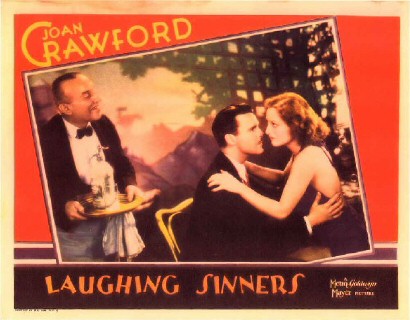
In 1931, a legendary film partnership began.  Joan Crawford and Clark Gable appeared together for the first time in Laughing Sinners, a pre-code romance.  We meet Ivy 'Bunny' Stevens (Crawford) in love - with Howard 'Howdy' Palmer (Neil Hamilton), a traveling salesman.  It's quite clear that the two are lovers, and that Howdy has promised to marry Ivy (or Bunny, as he calls her).  But while marriage IS on his mind, it's not marriage with her.  He has decided to marry the boss' daughter, and coward that he is, he runs away, leaving her a note about his intentions.  Some time later, Ivy tries to commit suicide, but is stopped by Carl Loomis (Clark Gable).  Carl, a Salvation Army worker, encourages her to leave her current life, and become a part of his world.  Giving to others, he feels, is what helped him to recover from the pains of a world that nearly destroyed him.  Within a short time, Ivy too has become part of the Salvation Army.  But then Howdy returns.

That this film is from the pre-code era is instantly apparent.  Ivy and Howdy are obviously having an affair; and a one-night stand is neither condoned nor condemned.  And all that is required for forgiveness to happen is honesty on the part of the parties involved, and a true attempt at repentance.  Because of Gable's forthrightness, Carl is shown as sympathetic and forgiving - not preachy.  He truly believes you can always restart your life, and his talks center on living  life squarely.  God is not brought into the equation.  Relatively speaking, the part of Carl is a small one, and we would have liked to have seen more of him.  Gable gets third billing in the film - behind Neil Hamilton, and Crawford (whose name is above the title). By the time he films Sporting Blood that same year, he has begun to be listed first; by the following year, his name is routinely above the title.

The Salvation Army is portrayed positively; and again, there is little emphasis on the religious aspects of the organization.  Rather, it is shown as a means of helping people get through difficult times in their lives. The Great Depression, which was still severely impacting the lives of Americans in 1931 is a major focus of the film.  Helping your fellow man is the means of both ending the Depression, and finding inner salvation.

As always, much of our conversation focused on Joan Crawford. She is so exquisitely  beautiful in this film, and her portrayal of Ivy is spot on.  Crawford manages to touch gently on the dilemma faced by her character, and to make her likeable and sympathetic.   Though her reformation requires that Ivy quit her job, she is never condemned for working in what appears to be a speakeasy. 
The portrait painted of the traveling salesmen in the film, however, shows them as carousing boozers.  Again, the pre-code aspects of the film are obvious - the purchase of alcohol is still illegal in 1931, yet the salesmen buy it with easy.  And since they seem to travel in bunches, they egg one another into bad behavior.

Laughing Sinners has a short, but tightly written script, based on Kenyon Nicholson's play, Torch Song, which opened on Broadway on 27 August 1930. Guy Kibbee here reprises the role of Cass Wheeler which he originated in that production, the only member of the cast to come over to the film (and Mayo Methot, who would become the wife of Humphrey Bogart, starred as Ivy).  Interestingly, Johnny Mack Brown was originally cast as Carl, but bad previews caused them to reshoot the part with Gable (for more information, see this TCM article).

As we depart, here is a trailer from the film:

Monday, April 22, 2013

Connie Goes to Court

Two Against the World (1932), on the service, appears to be your typical, 1930's romantic comedy - wealthy Adelle Hamilton (Constance Bennett) is on her way to a meeting.  She is late, and rude to the man (David Norton, played by Neil Hamilton) she believes to be an elevator operator.  Of course, he is not.  He is a lawyer, on the way to the same meeting.  He is the lawyer for the widow of a woman killed while working for Adell's family.  Adell and her brother Bob (Allen Vincent) cannot be bothered participating in the family discussion - they play tic-tac-toe.  The family seems not worth our time - there is also a philandering sister (Helen Vinson).  All-in-all, not exactly an admirable group.

Only this film is not a simple rom-com.  Things turn dark when the members of the family are involved in a murder, and Adell takes responsibility for the events.  We won't go into too much detail, here, but the film turns quite dark about mid-point.  The film asks us to sympathize with the murderer rather than the victim (Pre-Code, of course);   the murder is even staged in such a way as to minimize your interest in the victim. In the clip below, we see a scene as the intensity increases:


Let's spend a moment discussing the costuming by Orry-Kelly.  It is fantastic.  At one point, Ms. Bennett is wearing a raincoat that any one of us would have worn in a minute.  Also, a black dress that was to-die-for.  And Ms. Bennett, always lovely, wears them well.  You can get an idea from the clip, but better is to come in the film.

The film is a tad disjointed, but it is worth a look.  Certainly, it is never a hardship to watch Ms. Bennett.  She takes even the most mediocre script and makes it shiny.


Sunday, March 31, 2013

Connie Becomes a Star

We'll be starting a number of Constance Bennett movies over the next few weeks.  The first is What Price Hollywood? (1932) in which Ms. Bennett plays would-be actress Mary Evans.  The film opens with an unseen woman looking through a magazine.  The ads show us just what the stars use to make themselves beautiful.  The woman who is looking at the magazine is using the stockings, and makeup that the ads recommend.  The camera pulls back to show a our heroine, who is living in a tiny apartment, with a Murphy bed.  No star she, just a simple waitress waiting for her big break.  

That night at work, she befriends director Max Carey (Lowell Sherman), a good man, but one with too large an affection for alcohol.  He reluctantly agrees to help Mary, but her stiffness and inexperience is evident; he decides to recast the role with someone else.  The next day, Mary convinces him to give her one more chance. And thus, America's Pal is born - Mary Evans becomes a star.

Certainly, this is so close to A Star is Born as to be the original source material for the 1937 Janet Gaynor film.  But, we understand from the TCM commentary, no credit was given by either this film, nor the Judy Garland film in 1954, to this lovely movie (the former was produced by David O. Selznick, and the latter was directed by George Cukor, the producer and director of this film).  For those of you familiar with the later films, take a look at this clip, which is very reminiscent of something that occurs in both of the later versions:


And a wonderful film it is!  Several scenes are especially worth mentioning.  The opening scene we described above is one.  Here is a clip from that, which contains a small tribute to the man who would become the King of Hollywood, Clark Gable:


Another, is the scene in which Mary, having been fired from her first acting job by Max, goes home and spends the night practicing her lines.  Ms. Bennett is just fabulous as she stubbornly attempts to master her craft. 

We should also tip our hat to the male lead for this film - Neil Hamilton, best known to a generation as Commissioner Gordon in the 1960's television show, Batman.  As children of the Batman generation, it was fun to see Mr. Hamilton in a totally different (and much younger) role.

Next week, another Connie Bennett film.