Norah Larkin (Anne Baxter) is deeply in love with her fiance, George, a soldier serving in Korea. After a long silence, she receives a letter from him; she decides to save it so that she can open it on her birthday evening. Sitting alone in her apartment, a glass of champagne in her hand, she reads the letter to discover George has met someone else and is breaking his engagement to Norah. The telephone rings; a devastated Norah answers it. The caller, Harry Prebble (Raymond Burr) assumes Nora is her roommate, Crystal Carpenter (Ann Sothern). Harry, an artist who has been working in her office, invites Noar to dinner at The Blue Gardenia (1953) and hangs up. Norah decides she will keep the date, with shocking results.
Welcome to the world of Film Noir and our contribution to The Noirathon, a chance visit other blogs and read about some of the amazing - and oft ignored - films noir. Our contribution is a well-paced film with just the right number of twists and very little fluff - The Blue Gardenia, a thoroughly enjoyable and engaging mystery. It has an excellent cast, with strong performances from Raymond Burr, Anne Baxter, and Ann Sothern. Director Fritz Lang and cinematographer Nicholas Musuraca create an almost claustrophobic atmosphere, with much of the film shot indoors or at night (TCM article).
Allegedly, Margaret Sullavan had originally been approached for the role that went to Anne Baxter (Wikipedia). Ms. Baxter is convincing as a woman plagued by guilt for a crime that she doesn't remember committing. Her scenes with roommates Jeff Donnell (Sally Ellis) and especially Ann Sothern, add to our understanding of the character. Equally engaging are her interactions with Raymond Burr - she suffered a torn ligament in their fight scene (AFI Catalog) and the intensity of their battle translates to the screen. Ms. Baxter had already won an Oscar for her performance as Sophie in The Razor's Edge (1947), and been nominated for her role as Eve Harrington in All About Eve (1950). Though she moved to Australia for four years, following her second marriage to Randolph Galt (The Washington Post), she continued to work in film, television, and on Broadway until her death in 1986. [She wrote about her time in Australia in Intermission: A True Story.]
Prior to Perry Mason, Raymond Burr was best known as a villain, and he doesn't disappoint in this film. Harry Prebble is a serial rapist, pure and simple. He could be just a stock bad guy, but Mr. Burr manages to make him interesting. You don't, by any means, root for him. However, you grasp why women might succumb to his date requests, despite his reputation as a Lothario. Partly, it's his work as an artist; with many men aware in Korea, his competition is also diminished. But, it's mostly Mr. Burr's skill as an actor, talents he would get to really demonstrate on television. Like Ms. Baxter, Mr. Burr also worked up until his death, primarily in a series of Perry Mason movies that were hugely popular - and reunited him with his good friend, Barbara Hale. He'd spend much of his off-screen time raising orchids, one of which is named after Ms. Hale, with his life-partner, Robert Benevides. He died of liver cancer in 1993.
Ann Sothern is an actress who rarely missteps, and she is in top form in this film. She wisecracks, she teases, but she is a support to her friend in a time of need. It's rather a shame that she is so often a supporting player, rather than the lead, but it's also true that Crystal gets the best lines in the script, like " Honey, if a girl killed every man who got fresh with her, how much of the male population do you think there’d be left?" We were not as intrigued with Richard Conte as reporter Casey Mayo. It's not all that interesting a part, and unfortunately, Mr. Conte doesn't make it more compelling. Casey is supposed to be a powerful, popular journalist, but Mr. Conte not very dynamic. He also should be more comfortable with the police, as represented by George Reeves (Captain Sam Haynes). We wondered what would have happened if Mr. Conte and Mr. Reeves switched parts - quite frankly, Mr. Reeves is a lot sexier and stronger. As an aside, Ruth Storey, who plays Harry's former victim, Rose, was Mr. Conte's wife at this time.
The lovely title song is performed by the unforgettable Nat "King" Cole. As is often the case with African-American performers in films of the period, Mr. Cole is removed from the action - playing the piano in the Blue Gardenia nightclub. The only "interaction" he has with the cast is with Celia Lovsky (May, the blind flower vendor), who approaches the piano to place a flower on it. In venues that objected, the scene could have been eliminated. But the song could not, as it turns out to be integral to the storyline. Whether he was physically visible or not, Mr. Cole is felt throughout the film. In his interview with Fritz Lang in Who the Devil Made It: Conversations with ...
Peter Bogdanovich called the film "a particularly venomous picture of
American life" Lang replied that "it was the first picture after the
McCarthy business, and I had to shoot it in twenty day. Maybe that's
what made me so venomous." [Lang was never called before the committee,
but he did have difficulty getting work as a result of HUAC's
investigations (Continental Strangers: German Exile Cinema, 1933-1951 by Gerd Gemünden)]. I'm not sure that I would call the story "venomous" but in the era of #metoo, it is a sad reminder that women have long been victimized by men, whether it is the Harry Prebbles, Casey Mayos, or Georges of the world.
Based on the short story The Gardenia by Vera Caspary (it was re-titled to capitalize on the Black Dahlia mystery of 1947),the story was reprised on the Lux Radio Theatre in November 1954, this time starring Dana Andrews and Ruth Roman. Bosley Crowther didn't like the film in his New York Timesreview, calling it "routine melodrama. He also tries to ruin the film by revealing the ending, so be warned if you choose to read the review. We heartily recommend The Blue Gardenia for your viewing pleasure. We'll end with this trailer, featuring Nat "King" Cole:
David Starrling (Zacharay Scott) returns from a business trip; his daughter Susan (Gigi Perreau) is thrilled by his return. But his wife, Celia (Kristine Miller) is not. When David goes out of the apartment, he spots Celia in a car with Crane Weymouth (Tom Helmore) and their interaction are clearly intimate. When David questions her casually, Celia tells him she went to a play with a girlfriend, but that evening, when Celia's sister Dell Faring (Ann Sothern) arrives for dinner with her fiance - Crane - David is able to confirm that Celia and Crane are having an affair. As they argue in their bedroom that night, David picks up a gun, and Celia decks him with a metal handmirror. Dell's arrival a few minutes later precipitates another argument, resulting in Dell firing the gun and killing Celia. As Dell runs out of the bedroom, the screams of young Susan echo down the hall. Our film this week is Shadow on the Wall (1950). Though this is NOT a remake of The High Wall, the plot elements are remarkably similar - a spouse murdered, an orphaned child, a female psychiatrist trying to figure out what is going on, and a murderer who has no scruples when it comes to protecting his - or herself. And like Herbert Marshall in our last film, Ann Sothern is in far different acting territory in this film. She'd made a big success at MGM in the Maisie series, and had spent most of her career there doing light comedy. But with A Letter to Three Wives, she demonstrated her gifts as a dramatic actress. It's hard to sympathize with the dead Celia - she's spent her life backstabbing her sister and has graduated to cheating on her husband. But this film takes her crime one step further - Dell Faring will stop at nothing to protect herself, even if it involves the murder of a child. (TCM article). Ms. Sothern makes Dell sympathetic up to the point when she realizes that Susan is a danger to her. At that point, her obsession with getting rid of the girl turn the audience firmly to the Starrling family, and to Dr. Caroline Canford (Nancy Davis) who's attempting to piece together what Susan saw.
I'm not a fan of Nancy Davis (Reagan) ordinarily, but she is perfect in this film. She plays Caroline with an appropriate detachment that emphasizes the professionalism of the woman. Her conversations with Pike Ludwell (John McIntire) demonstrate her concerns about the Susan and her father, but she never lets it get in the way of her duties as a physician. Her subtle performance make Dr. Canford one of my favorite onscreen physicians. Zachary Scott's biography by Ronald L. Davis is entitled Zachary Scott: Hollywood's Sophisticated Cad. And while he certainly did play a lot of them, he doesn't here. David is a good man; he truly believes that he is guilty of the crime with which he is charged - albeit accidentally - and is ready to pay the price. His only concern is his child - everything he does while in prison hinges on his desire to find a safe and loving environment for Susan. That we know he is innocent helps in making him sympathetic, much of the credit goes to Mr. Scott's fine performance.
The role of Susan was originally intended for Margaret O'Brien (AFI catalog) - one can almost hear the screams echoing from her mouth! Regardless, Ms. O'Brien was not available for loan from MGM, so Gigi Perreau was cast. Ms. Perreau started her career at age 2, as Eve Curie in Madame Curie (1943). Two years later, she played Fanny Skeffington, Jr. in Mr. Skeffington. In 1956, she was the budding ballerina in Fred MacMurray's family in There's Always Tomorrow. Married and divorced twice, Ms. Perreau has four children. She taught drama for several years at her alma mater, Immaculate Heart High School, and for a time managed an art gallery with her brother Peter Miles (also a child actor). Like most child actors, she saw a gap in her career as she got older, but she is still working today, often as a voice actor.
If the two reviews posted in Ann Sothern: A Bio-Bibliography are any example, Shadow on the Wall was not really all that well received. It appears the reviewers had problems remembering that Ms. Sothern was not Maisie. Regardless, we found this an engaging film, with an excellent cast and well-written screenplay. We'll leave you with the trailer to the film, and the suggestion that you give it a try.
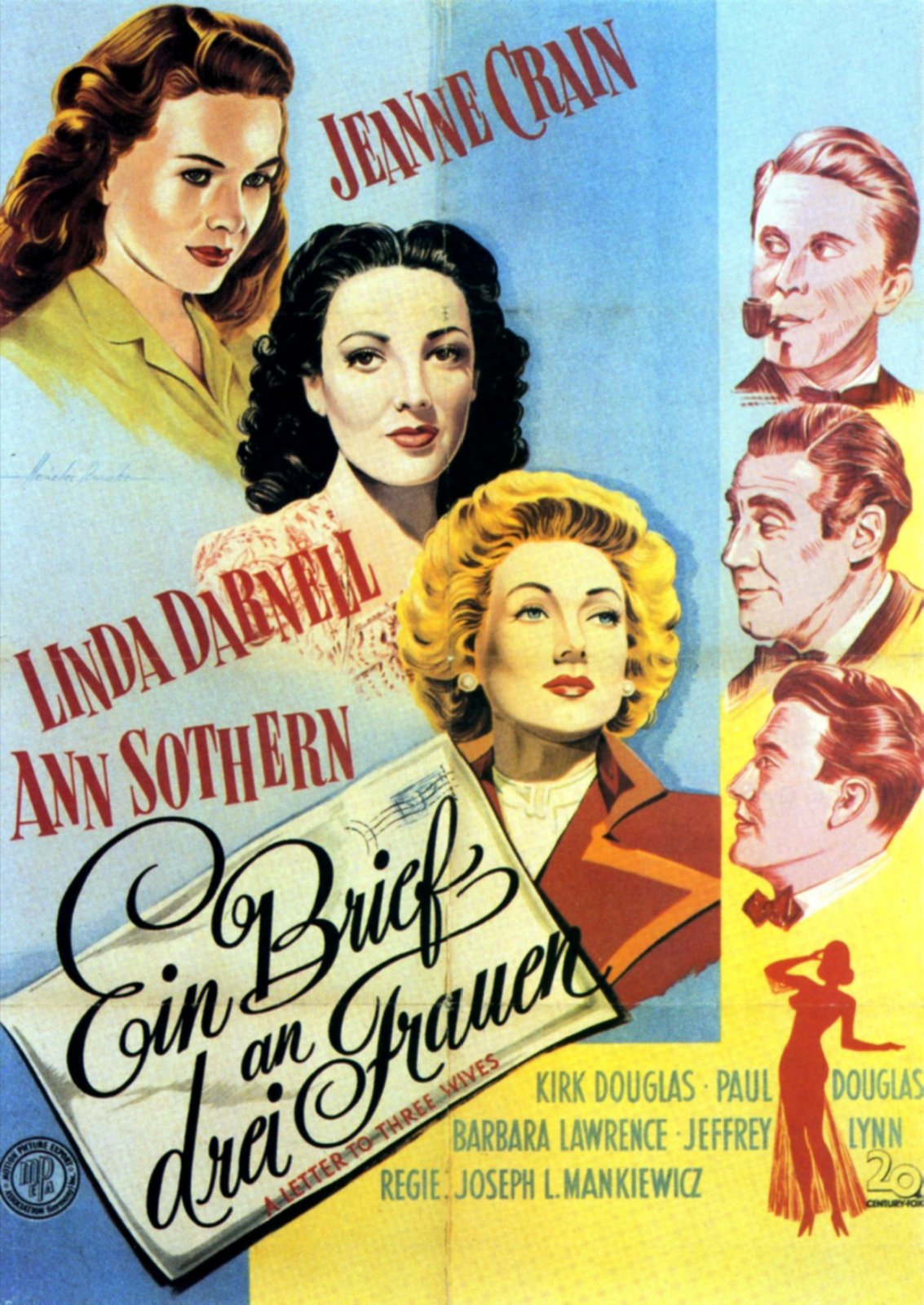
As Deborah Bishop (Jeanne Crain), Lora May Hollingsway (Linda Darnell), and Rita Phipps (Ann Sothern) are about to leave on a charity boat ride, a young man delivers A Letter to Three Wives (1949). The letter informs them that their "friend", Addie Ross (voiced with just the right amount of venom by Celeste Holm) has left town - with one of their husbands. Unable to leave the boat, the women spend the day worrying about their husbands and reviewing their marriages. Based on A Letter to Fives Wives by John Klempner (the film eliminated two wives, which tightens it up), this is an exceptional film, especially given that it is really a series of vignettes. The use of Addie's narration as a glue to hold together this tale of three marriages in trouble is both inspired and entertaining. That narration brings the tale to a different level, making the film a fully cohesive unit instead of a series of short stories. Two of the stories especially stand out. Rita and George Phipps (Kirk Douglas) are a relatively happy couple, but Rita, a successful radio writer, is trying to have it all - career, husband, and children. She's pretty good at doing it, but George is frustrated that he and their twins often take second place to the demands of her clients (ably represented by Mr. (Hobart Cavanaugh) and Mrs. (Florence Bates) Manleigh). Kirk Douglas plays George as an educated, reasonable and progressive man; he really doesn't mind that his wife works and that she out-earns him by quite a bit. Her job and her impressive salary afford them all a good life, and enable him to pursue his career - an underpaid high school teacher - without guilt. George loves his job and his wife. He just wishes that she wasn't constantly afraid, and would occasional say no to her clients unreasonable demands.
In flashback, we see the courtship of Lora May Finney (Linda Darnell) and Porter Hollingsway (Paul Douglas). Both are from the wrong side of the tracks (in Lora May's case, quite literally - she lives with her sister Georgianna (Barbara Lawrence) and mother, Ruth (Connie Gilchrist) on the edge of the train tracks). But Porter, the owner of a successful department store, is now well-off, and enamored of Lora May's beauty. But he is not interested in marriage; Porter's been married, and he didn't care for it. Plus, his ideal is Addie Ross - he keeps her picture on his piano, and talks about her "class," a quality he doesn't find in Lora May. Linda Darnell is impressive as the tough talking Lora May. The viewer is quick to realize that, despite her comments to the contrary, she loves Porter. But she knows the only way to keep him is to play the game his way - Porter likes to fight, and Lora May is more than willing to oblige him to get what she wants. To a point, of course. When Porter shows up at her front door, honking his horn for her to come out, Lora May ignores it: "Anybody wants me can come in and get me, this ain't a drive-in." For more on the life of Ms. Darnell, please see our blog post on her work in The Mark of Zorro (1940).
The third story, the marriage of Deborah and Brad Bishop (Jeffrey Lynn) is possibly the weakest of the three. It's not bad, its just that Deborah seems weak next to these two dynamic women. One sympathizes with her truly ugly dress, since we know she's not had time to procure a new one, but really, it is so hideous, it's hard to understand why even a simple farm girl would purchase it. And WHY does Rita have to TELL her to cut off those ugly flowers? But it should be acknowledged that Deborah has left the farm, the WACs, and her past life for a new, more upscale environment with a husband she really doesn't know - the story of Brad and Deborah is a brief glimpse into the marriages that began because of the war. Jeanne Crain began her film career at age 18, with a bit part in The Gang's All Here (1943). Winner of the Miss Pan Pacific pageant, she attracted the attention of film scouts; by 1945, she was starring in State Fair and Leave Her to Heaven. She could sing, dance, ice skate, and she was a pretty good actress, but also in 1945 she married Paul Brinkman, and began having babies - seven in total. She was pregnant during the filming of this movie, and may have lost the role of Eve in All About Eve due to one of her pregnancies. Regardless, her portfolio is quite impressive: I'm particularly fond of Cheaper by the Dozen (1950) and People Will Talk (1951) Ms. Crain and her husband remained married until his death in 2003, but after a messy divorce proceeding (which was never completed), they lived apart. She also lost two of her sons before she died in 2003 of a heart attack at age 78.
We've raved about Thelma Ritter (here playing Sadie Dugan) before, and she does not disappoint in this film. Whether it is her interactions with her pal, Ruth Finney or her sass when she is working as a maid for Rita Phipps, Ms. Ritter is the queen of the bon mot. Take, for example, her response to Rita's request that she wear a uniform: "The cap's out. Makes me look like a lamb chop with pants on." or her answer to the Manleighs about their radio program: "You know what I like about your program? Even when I'm running the vacuum I can understand it." At the same time, it is Sadie who cautions Ruth about her passion for her new refrigerator, when Ruth seemingly puts keeping it (in many respects, for Ruth, the refrigerator is a symbol of respectability) above her daughter's happiness: "
You got to make up your mind whether you want your kids happy or your icebox paid up." A number of different actors were proposed for the film, including both Joan Crawford and Ida Lupino as the voice of Addie Ross (AFI catalog). Though the film was nominated for Best Picture, Screenplay, and Directing Oscars (winning the latter two), no acting nominations came its way. Interestingly, Jeanne Crain, Kirk Douglas, and Celeste Holm were all nominated for other film work that same year (none of them won, however).
Contemporary critics received the film enthusiastically (see this New York Timesreview and this TCM article). Since then, regard for the film has increased, as is evident by this New Yorkerdiscussion, especially as a sophisticated examination of marriage. As Jeanine Basinger notes in her book I Do and I Don't: A History of Marriage in the Movies, films that actually examine marriage itself are rare. A Letter to Three Wives does this, and does it well.
Both Lux Radio Theatre (1950) and Screen Players Guild (1952) performed radio versions of the play. Then, in 1985, the story made its way to television, with Ann Sothern appearing as Ruth Finney in a version which starred Loni Anderson, Michele Lee, Stephanie Zimbalist as the three wives. We'll leave you with a trailer from the film - an introduction to the three wives.
 Norah Larkin (Anne Baxter) is deeply in love with her fiance, George, a soldier serving in Korea. After a long silence, she receives a letter from him; she decides to save it so that she can open it on her birthday evening. Sitting alone in her apartment, a glass of champagne in her hand, she reads the letter to discover George has met someone else and is breaking his engagement to Norah. The telephone rings; a devastated Norah answers it. The caller, Harry Prebble (Raymond Burr) assumes Nora is her roommate, Crystal Carpenter (Ann Sothern). Harry, an artist who has been working in her office, invites Noar to dinner at The Blue Gardenia (1953) and hangs up. Norah decides she will keep the date, with shocking results.