Showing posts with label Maureen O'Hara. Show all posts

Monday, November 23, 2020

John Fought for Spain

Following his escape from a Spanish POW camp, John "Kit" McKitrick (John Garfield) has been hospitalized in the US. While there, he discovers his best friend police lieutenant Louis Lepetino has died, allegedly the victim of an accidental fall from the window of a New York City high-rise. Kit is convinced that his possession of a war standard is the cause of Louie's death - and will also bring about his death next.  Our film this week is The Fallen Sparrow (1943). 

John Garfield is perfect as a man teetering on the edge of sanity. Yes, Kit has been hospitalized for what we would now call post-traumatic stress disorder, and has been discharged, but the death of his friend has summoned back all the demons he'd hoped to put behind him. Mr. Garfield brings a vulnerability to the character that does not detract from his strength of purpose. Given that Kit is in nearly every scene in the film, it's important that the audience identify with and support him; Mr. Garfield makes him a character you take to your heart. He wasn't the first choice for the part - RKO originally wanted James Cagney, but he turned it down (he'd been under some scrutiny because of his support for Loyalist Spain); Cary Grant, Randolph Scott, and George Brent also said no. (TCM article). Mr. Garfield, himself a supporter of Loyalist Spain, very much wanted the part and campaigned to get it. (John Garfield: The Illustrated Career in Films and Stage by Patrick J. McGrath).Stage by Patrick J. McGrath). Warner Brothers got the rights to remake Of Human Bondage from RKO in exchange for Mr. Garfield's services in this film (AFI catalog).
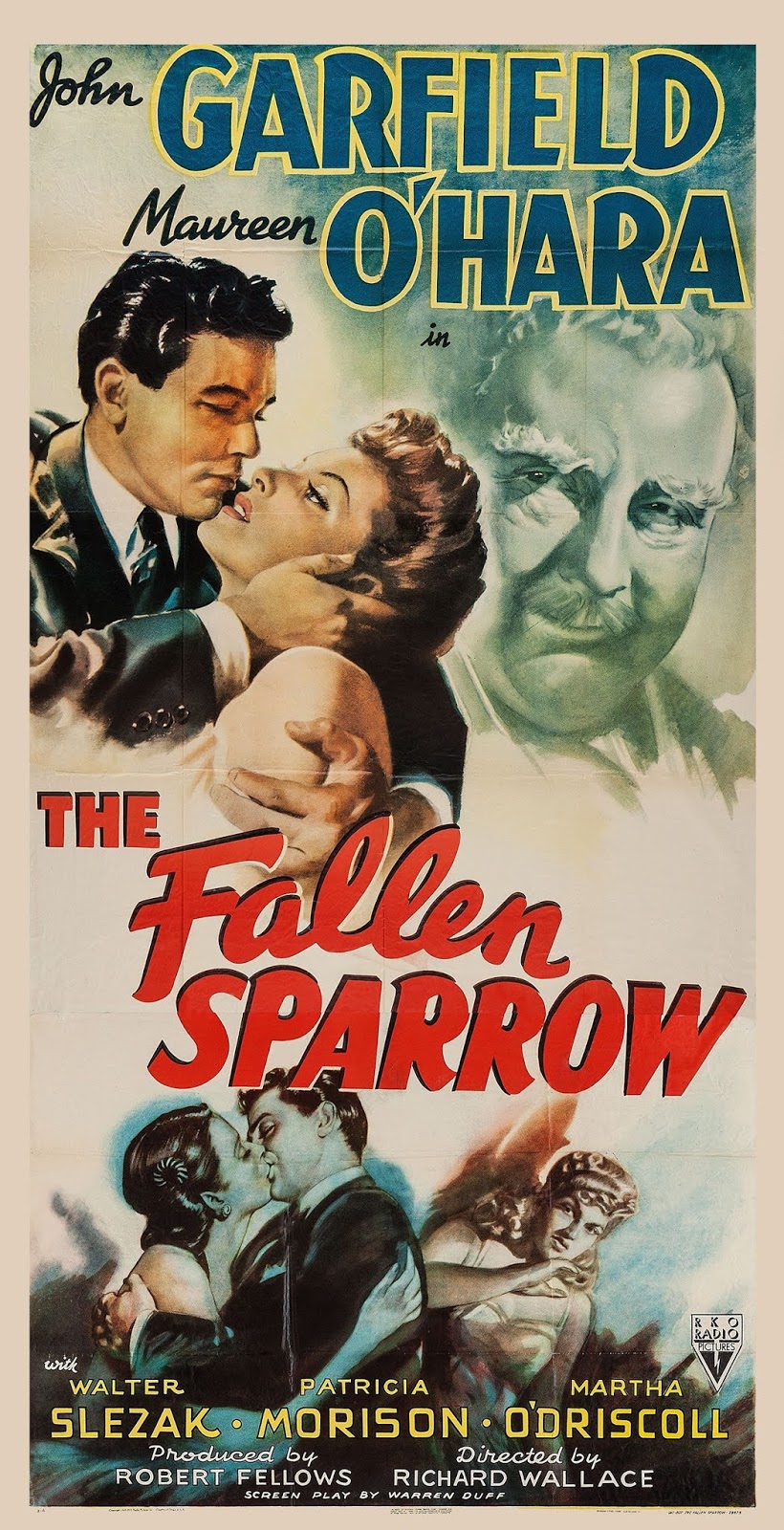
Maureen O'Hara (Toni Donne) takes on an unusual role - that of a possible Nazi spy. Toni is rather a cypher - you want to like her, you know that Kit wants to believe her, but in the final analysis, neither the audience nor Kit trusts her.  She's good in the part, because she is able to keep the audience on edge as to her intentions throughout the film; why she is working for the enemy is a question that hovers over the viewer.

While Ms. O'Hara keeps the audience guessing in an atypical role, Walter Slezak (Dr. Skass) does not. You know from the instant you see him that he is the villain. Sure, Mr. Slezak's early career was spent playing villains, but it's more than that. He fairly oozes evil - Dr. Skass' first conversation with Kit is a discussion of the beauty of water torture. We're told that Skass is a researcher - it's pretty apparent that he's the head of the spy ring, and no amount of screen subterfuge will convince you otherwise. If we had one regret in this film, it was that we would have appreciated a little more mystery surrounding the identity of the spy leader. 

We particularly enjoyed Martha O'Driscoll (Whitney Hamilton) as one of Kit's close friends. She is sweet and appealing as the one of the few people in Kit's life who is sincere. We especially enjoyed Kit's nickname for her - Imp. It seemed to happily sum up her personality and their friendship. 

Another character to watch is Inspector Tobin (John Miljan). Unlike too many police roles in movies, this is a character to observe carefully. There is more going on than meets the eye, and Mr. Miljan plays the part with an attention to detail.

The film's score was nominated for an Oscar (It lost to The Song of Bernadette).  While the New York Times review by Theodore Strauss (T.S.), was not keen initially on the film's story, Mr. Strauss' regard for Mr. Garfield's performance won him over: "by virtue of a taut performance by John Garfield in the central role, and the singular skill with which director Richard Wallace has highlighted the significant climaxes, The Fallen Sparrow emerges as one of the uncommon and provocatively handled melodramas of recent months." It would become one of RKO's high grossing films for 1944 (Variety) The story would appear as a Lux Radio Theatre broadcast on 14 Feb 1944, co-starring Robert Young,  Maureen O'Hara, and Walter Slezak. 

This is a movie worth seeing if for no other reason than to watch Mr. Garfield in action, but it has much more than that. We highly recommend it. In the meantime, here is a trailer:


Thursday, May 21, 2020

Classics for Comfort

2020 has been a year of interesting times, and in interesting times, we need comfort. What better comfort is there than a good movie?  So, from May 19-22, the Classic Movie Blog Association (CMBA) is hosting the Classics for Comfort Blogathon, in which we will all discuss those films that bring a smile to our lips or a song to our hearts.  In no particular order, I'm pleased to share with you five movies (and an honorable mention) that I turn to in times of trouble, stress, and/or sorrow that are comfort films for me.


No comfort film list is complete without something from Ms. Hayley Mills. She is a delight - a wonderful actress with a list of excellent films to her credit. Adding just one to this list was a hard choice - in the running were Pollyanna (1960), which I discussed in a previous blogathon, Summer Magic (1963), and The Moon-Spinners (1964).  But, I ultimately opted to select The Parent Trap (1961), because there are TWO Hayleys to make me glad.  

Sharon McKendrick and Susan Evers live on opposite sides of the U.S. Sharon is in Boston with her mother; Susan lives in California on her father's ranch. They accidentally meet at summer camp, loathe each other at first sight, only to discover that they are "separated at birth" twins - when their parents divorced, each took one daughter, planning to never meet again. It was also decided by the parents that they would not tell their children of her sibling's existence.  Knowing it's the only way to get to know the other parent, the sisters decide to change places.  But when Susan discovers that father Mitch (Brian Keith) is about to marry the gold-digging Vicki Robinson (Joanna Barnes), the girls hatch a plan to get mother Margaret (Maureen O'Hara) back with her ex. 

This was Ms. Mills second film with Disney, and she shines in the dual role. She gives the two sisters distinct personalities. Even when dressed alike, you can tell them apart (amusingly, their parents can't).  Sure, the story is a fantasy, but who cares? The early rivalry episodes are full of tween deviltry and the latter partnership includes deviousness of quite a different ilk - you'll cheer when the twins set their sites on the obviously bad Vicki. And when Ms. Mills sings "Let's Get Together," a dare you to not groove to the music.


We think of Edward G. Robinson (Martinius Jacobson) as a tough guy, but in Our Vines Have Tender Grapes (1945), he's the gentlest man you could ever meet. A loving husband to wife Bruna (Agnes Moorehead) and father to his daughter Selma (Margaret O'Brien), he works as a farmer in a small Wisconsin town.

In many respects, the film is a series of short stories, about Selma and her adventures (and arguments) with her younger cousin, Arnold (Jackie "Butch" Jenkins), about Martinius and his desire to build a new state-of-the-art barn, and about the budding romance between new teacher Viola Johnson (Frances Gifford) and newspaper editor Nels Halvorson (James Craig). The script hangs together beautifully, as the characters weave in and out of each others lives.

The beauty of the film hinges on the relationship between Ms. O'Brien and Mr. Robinson. There is a genuine tenderness between the two; adding Agnes Moorehead to the mix - an actress who, in my estimation, can do no wrong - only adds to the charm of the family connection. In one biography, Ms. O'Brien said she became very close to Mr. Robinson during filming (Margaret O'Brien: A Career Chronicle and Biography by Allen R. Ellenberger); this is certainly reflected on screen.

Yet the films avoids becoming schmaltzy. The town in which the Jacobson's live is not perfect. The town is poor; most of the young men are gone to the War; there is even a hint of child abuse. Ultimately, though, the film is about family and unity - the Jacobson's live in a community that comes together in crisis, even if it is only donating a calf to a cause.


When times are bad, you need to laugh, and nothing will make you laugh more than Ball of Fire (1941). Gary Cooper (Bertram Potts) plays an English professor at work with six colleagues on a new encyclopedia. Professor Potts is horrified to discover that his understanding of slang is archaic. How can he write the needed article for the encyclopedia without further research? So he ventures out of the their cloister to learn the language of the day. On his journey, he meets Sugarpuss O'Shea (Barbara Stanwyck), a night club entertainer who knows just a bit too much about gangster boyfriend, Joe Lilac (Dana Andrews). Joe's solution - stash Sugarpuss with Bertram and his colleagues until Joe can marry her and keep her from testifying against him.

The combination of Gary Cooper and Barbara Stanwyck is comic dynamite. She's forward and alluring; he's shy and retiring. But they spark on screen like nobody's business.  With her as the aggressor, Ms. Stanwyck is at her comic best - she needs him to become enamored of her, but there is danger in the air. She's never met anyone as gentle and considerate as him, and she finds herself falling for him (much to the consternation of Joe Lilac!)

There are so many wonderful scenes - Sugarpuss teaching the assembled professors the conga; Sugarpuss demonstrating the new slang to Bertram (in the form of yum-yum); Bertram learning to box. I could go on, but you get the idea.

We discussed this film at more length several years ago. But like so many of the great Ms. Stanwyck's films, it is a movie that cries for rewatching (and will have you in stitches throughout.


Take two remarkable actors, add in some suspense,  sprinkle it with comedy, write dialog that sparkles and you've got Charade (1963). It's easily one of the most re-watchable and entertaining mystery stories around - even when you KNOW the ending, you really don't care. You want to watch the film again to meet with the charming, intelligent, and witty Regina Lampert (Audrey Hepburn) and the man of mystery Peter Joshua (Cary Grant). They are a combination to be imbibed regularly.

Regina is on vacation at a skiing resort in the French Alps with her best friend Sylvie Gaudel (Dominique Minot) when Sylvie's mischievous son Jean-Louis (Thomas Chelimsky) "introduces" her to Peter. He's intrigued, but she "already know an awful lot of people, so until one of them dies I couldn't possibly meet anyone else." Regina returns to her home in Paris, determined to divorce her always-absent husband Charles, only to find her apartment stripped bare and a message from the police. Charles is dead - murdered and thrown from a speeding train. The appearance of three threatening men, who demand to know the whereabouts of money Charles stole from them, add to Reggie's distress. And then there is the question - just WHO is Peter Joshua?

Cary Grant didn't want to do the film - he thought he was too old to be romantically involved with Audrey Hepburn, so the script was altered - she pursues him, and the effect is magic. After all, what woman wouldn't want to woo Cary Grant? Combine their interplay with an engaging story and you have a film to watch over and over. You'll laugh, you'll gasp, but you will never be bored.


Sometimes, an inspirational film that brings tears to your eyes is just what you need when you feel blue. The true story of The Miracle Worker (1961) is one that does it for me. Based on the autobiography of Helen Keller (Patty Duke), a blind-deaf woman who lost both senses after a childhood illness, the movie introduces the uncontrollable child to Anne Sullivan (Anne Bancroft), herself almost blind, but as determined to teach Helen to communicate as Helen is to have her own way.

As a child, I was addicted to biographies of famous women. I think I read every one I could find in our local library. The woman that fascinated me most was Helen Keller. Her autobiography, The Story of My Life, was awe-inspiring. So too does this film bring a feeling of warmth and love that few movies are able to do. The strength of these two individuals, along with the unquestioning love of Helen's mother, Kate (Inga Swenson) make this a film of great passion.

Don't get me wrong - this is a film with humor as well, but I defy anyone to get to the end without a tear in their eyes. With Oscar-winning performances by Ms. Bancroft and Ms. Duke (both recreating their Broadway roles), The Miracle Worker is a film to lift your spirits.


Honorable Mention:   No list of my comfort films is complete without a mention of one of my primary sources of comfort since childhood. Sure, including To Trap a Spy (1964), is a bit of a cheat. It’s a filmed version of two Man from U.N.C.L.E. episodes, but for me it's one of the places I go when I need to feel better.

It was love at first sight when I saw Robert Vaughn in an early episode of the show. My father took me to a double bill of this and another U.N.C.L.E spinoff movie The Spy with My Face (1965). To say I was in heaven is an understatement.  

The show ended up forming the basis of my first close friendship - one that abides to this day. When times are tough, when I’m sad or anxious, it’s Napoleon Solo who can make everything just a little bit better. (And it doesn't hurt to have Illya Kuryakin as well!)


Don't forget to read some of the other blogs that are participating in the Classics for Comfort Blogathon. You're sure to find some other films that will brighten your days.

Thursday, May 16, 2019

5 From the 50s

May 16th is National Classic Movie Day and to celebrate, I'm participating in this year's blogathon, Five Favorite Films from the Fifties. Be sure to follow the link to see the work of other bloggers, and find discussions of films you might never have thought to view.

As I've mentioned before, my favorite films change from day to day, so I've opted to pick five films I truly love in five different genres - comedy, musical, film noir, suspense, and western. My caveat is, if you asked me tomorrow, you might get a totally different list. I'm also going to avoid discussions of films we've previously covered (I'll link you over to a few noteworthy ones within my chosen categories). Regardless, all of these films are remarkable and definitely worth seeing. If there are some with which you are not familiar, get hold of a copy asap. You won't be sorry.


Tony Hunter (Fred Astaire) has all but retired when his friends, writers Lester (Oscar Levant) and Lily Marton (Nanette Fabray) try to entice him back to work with their latest play. They plan to get Jeffrey Cordova (Jack Buchanan) to direct it. Cordova, however, has grandiose ideas, including the addition of ballerina Gabrielle Gerard (Cyd Charisse) to the cast. With misgivings ("I am not Nijinsky. I am not Marlon Brando. I am Mrs. Hunter's little boy, Tony, song and dance man."), Tony agrees, but conflicts arise as rehearsals begin.

When it comes to musicals of the 1950s, Singin' in the Rain (1952) and An American in Paris (1951) (justifiably) come immediately to mind. But The Band Wagon (1953) is a film that should always be included in the list of great 1950s musicals. With Cyd Charisse and Fred Astaire performing one of the greatest dance numbers in movie history, plenty of comedy, and a love story, it's a film not to be missed.

In 1931, Fred and Adele Astaire (along with Frank Morgan and Helen Broderick) starred in the Broadway play, The Band Wagon. It was a musical revue; this film has nothing to do with it, though I Love Louisa and Dancing in the Dark were both performed in the play. The film has a script by Betty Comden and Adolph Green, who loosely based the story on Mr. Astaire. He'd tried retirement for a few years, but was coaxed back to star in the very successful Easter Parade (1948); his most recent film, however (The Belle of New York) that had not done well (for more on Fred Astaire and The Band Wagon see this article in The Paris Review). The Martons were based on Comden and Green (though the real-life writing duo were not married), and Cordova was based on  José Ferrer, who between 1946 and 1948 produced, directed, and/or starred in 8 Broadway plays - and did 10 more in the next three years! (TCM articles).

Jack Buchanan was not the first choice for Gregory Cordova - Clifton Webb was approached initially; Edward G. Robinson and Vincent Price were also considered (AFI catalog).  And while Vera-Ellen was at one pointed listed for the role of Gabrielle, one wonders if the failure of The Belle of New York led to her not being used.

The film was well received upon release; the  New York Times review by Bosley Crowther was enthusiastic. It was nominated for three Academy Awards for Best Story and Screenplay, Best Costume Design (Color) and Best Scoring of a Musical Picture.  With all the wonderful musical numbers, the one for me that stands out is "Dancing in the Dark," perhaps Mr. Astaire's most romantic number since he and Ginger Rogers graced the screen.  We'll close this section with a video of that delightful dance.


Dr. Benjamin McKenna (James Stewart) is on vacation in Morocco with his wife Josephine Conway (Doris Day), a well-known singer who retired to take care of their son Hank (Christopher Olsen).  They are befriended by Louis Bernard (Daniel Gélin), a Frenchman who asks way too many questions for Jo's tastes. Bernard is murdered and whispers to Ben that a statesman is targeted for murder. But the would-be murderers have their own plan - snatch young Hank to be sure that Jo and Ben don't contact the police.

The Man Who Knew Too Much (1956) is a remake of Hitchcock's 1934 film of the same name. The plots are similar, but this version has a lot more nuance. Hitchcock told François Truffaut that "the first version is the work of a talented amateur and the second was made by a professional" (Hitchcock by François Truffaut)

James Stewart had already appeared in Hitchcock's Rear Window (1954) and Rope (1948); they would work together one more time in Vertigo (1958). Mr. Stewart was attached to the project from the beginning; Doris Day was also Mr. Hitchcock's first choice for Jo, especially since he wanted part of the conclusion to replicate the search for Richard the Lionheart by his troubadour Blondel. (TCM article). Her song, "Que Sera, Sera," won the Academy Award for best song, became her theme song, and was used in two more of her films (AFI Catalog). An excellent dramatic actress, she portrays a strong woman who ultimately refuses to be cowed by the danger threatening her child. Ms. Day's recent passing has already contributed many caveats to her exceptional skills as an actress and singer. This film is further proof that she was a talented dramatic actress.


To my mind, The Man Who Knew Too Much is one of Hitchcock's great films that is often overlooked in discussions of his work. Perhaps because it was not seen for so many years - it was one of the five films that Hitchcock owned and refused to release (including Vertigo, Rear Window, Rope, and The Trouble with Harry) (Mental Floss article). The highly regarded Vertigo and Rear Window got much praise and viewing when the films finally came back to their audience in the 1980s. This one has just not received as much attention.

If you are ready to watch the master of suspense spin his web, watch The Man Who Knew Too Much; here's a clip of the trailer, with a bit of Ms. Day doing her famous song.


Pregnant and dumped by her no-good boyfriend Stephen Morley (Lyle Bettger), Helen Ferguson (Barbara Stanwyck) boards a train with only her meager belongings - Morley gave her the ticket to get her out of town.  She is befriended by newlyweds Patrice (Phyllis Thaxter) and Hugh Harkness (Richard Denning), who are on route to introduce Patrice - who is also pregnant - to Hugh's family. Patrice lets Helen try on her wedding band while they are in the ladies room; at that moment, there is a train crash. Helen awakens to discover both her new friends are dead, and Hugh's family thinks that she is Patrice. With her baby to think about, and No Man of Her Own (1950), Helen is faced with a massive decision - accept help from the Harkness family, or leave before they realize her deception.

No Man of Her Own is on my list of favorite film noirs, as well as favorite Barbara Stanwyck films. As a woman abandoned by the man she loved, Stanwyck is remarkable (as always). Her ethical dilemma is obvious - the love she has for her unborn child, versus the need to lie to people as kind as Mr. & Mrs. Harkness (Jane Cowl & Henry O'Neill). There is the further complication of her growing affection for Hugh's brother Bill (John Lund). If it is a touch melodramatic, who cares? When you get a performer like Ms. Stanwyck telling the story, you want to watch.

One of the things that really intrigues me is that Helen is clearly an unwed mother, yet there are no recriminations from anyone. Patrice is obviously aware that Helen has never had a wedding ring, and generously lets Helen slip on Patrice's ring. Originally, Helen was to have been a prostitute (AFI catalog), but in my opinion, Helen as a rejected lover makes for a more interesting story line.

When the DVD was released in 2016, the New York Times provided some interesting commentary about the film (Bosley Crowther disliked it when it was released in 1950). The film was based on a Cornell Woolrich story (I Married a Dead Man), it has been remade several times, with versions in Japan (Shisha to no Kekkon (1960)), in France (J'ai épousé une ombre (1983)), in India (Kati Patang (1970), and in America (Mrs. Winterbourne (1996).

This is top-notch Stanwyck - and not one that comes up all the time, so watch for it! This trailer will give you an idea of what to expect.


The beauty of The Quiet Man (1952) is that it is so much more than a comedy. It tells the story of Sean Thornton (John Wayne), who left his home in Ireland as a young boy to emigrate to America with his mother. He grew up with his mother's stories of his former home, their wee cottage, White-a-Morn and the roses that grew outside the house. Sean's life in America was a hardscrabble one, and as that life has become untenable, he retreats to Innisfree, and buys White-a-Morn. As he tries to settle into a country he doesn't know, he finds that his unwillingness to fight brings heartache to him, and to the woman he loves, Mary Kate Danaher (Maureen O'Hara).

The Quiet Man was based on a short story by Maurice Walsh; John Ford acquired the rights in 1937 and yearned to make it into a film (AFI Catalog). Republic Studios finally agreed to make it IF Ford, O'Hara, and Wayne would make a Western (read moneymaker - Republic considered Ford's little film a vanity project that would lose money), so the trio first did Rio Grande. Filmed in Ireland, with various members of the cast's and crews' families working on the film, Ford was also under express orders to bring in a film no longer than 2 hours. But, his final cut ran 2:09 - he showed it to his execs, and stopped the projector at exactly the 120 minute mark. They agreed to the longer time (TCM articles).

For me, the film is important for its portrayal of a strong woman who is trying to maintain her independence in a society that limits a woman's choices. Mary Kate, in hounding Sean to get her dowry, is not asking for money - she's asking for her independence. With his American upbringing, all Sean can see is that what's his is hers. Mary Kate wants "her [own] things about her," for they are what make the house and the marriage all her own. 

I could go on for hours about this film. As a child, I would watch it every St. Patrick's Day (and growl when they cut crucial scenes out. Thank heavens for TCM and uncut films!).  I've been in Ireland twice, and both times visited Cong, the little village in County Mayo where The Quiet Man was filmed. The Quiet Man is a song of joy about Ireland, and a tale of strength under pressure.


There are some truly remarkable westerns in the 1950s - Shane, The Searchers (1956), Johnny Guitar (1956), among others.  But one film that should be in this list is the excellent Westward the Women (1951). The story of a group of 140 women who are recruited by rancher Roy E. Whitman (John McIntyre) as brides for his hands, the film portrays with as much truth as possible the dangers and hardships that faced the pioneers who went west. Leading the caravan is Buck Wyatt (Robert Taylor), a hard-nosed scout with little faith in the venture.

The women are a tough bunch. There is our star, Fifi Danon (Denise Darcel), a saloon girl who wants a new start. The widowed Mrs. Maroni (Renata Vanni) wants a new father for her son Tony (Guido Marfuti). Patience Hawley (Hope Emerson) has lost her husband and son to the sea, and also wants a chance with a new husband.
 
Robert Taylor is letter perfect as the man who decries Mr. Whitman's plan as foolhardy, but grows to respect the women in his charge.  Early in the film, he speaks to the assembled group. He asks if any can shoot a gun - he's stunned when Maggie O'Malley (Lenore Lonergan) shoots the eyes out of a picture. His regard grows as he sees the women take on more and more responsibility as they struggle towards California.


Regardless of his star billing, this is a film about the women.  Hope Emerson especially paints a portrait of a woman trying to begin a new life. She brooks no nonsense from her colleagues or from the men who lead the trail. She's brave and forthright, and you adore her from her first "hokum-smokum". Rose Myers (Beverly Dennis), a young woman pregnant with an illegitimate child is also an interesting character - accepted and loved by the group, with no condemnation of her past indiscretion. As this TCM article notes Westward the Women goes deeper into creating a female vision of the westward progression. These are the Pioneer Women (the film's working title) who would tame the western frontier.

Frank Capra had planned to direct, with Gary Cooper as Buck, but eventually sold the project to William Wellman (AFI catalog), which I believe added a layer of realism that benefited the story enormously.  Bosley Crowther in his New York Times review has certainly missed the point of the film; I suggest you take a look at A Woman's View: How Hollywood Spoke to Women, 1930-1960 by Jeanine Basinger for further discussion on this very timely picture.  In the meantime, take a look at the trailer:


And thus, our Five from the Fifties - there are many more excellent options (I didn't include a film I love, The Girl in White (1954). That's for another day). Just head over to Five Favorite Films from the Fifties and see the other wonderful films that were selected. In the meantime, Happy National Classic Film Day!

Monday, March 5, 2018

Clifton in Suburbia

Henry (Robert Young) and Tacy King (Maureen O'Hara) live in the small town of Hummingbird Hills. Henry is a young lawyer trying to get ahead in his firm, which requires the Kings to socialize with his boss, Horatio Hammond (Ed Begley) and his wife Martha (Josephine Whittell) on command. The Kings have a another problem that complicates these command performances - their three rambunctious boys make it impossible for them to keep a maid, or hire a local babysitter. So, Tacy puts an ad in the Saturday Review for a live-in babysitter, and gets an immediate response. But there is a complication - the applicant, Lynn Belvedere is a man (Clifton Webb). Our film this time is Sitting Pretty (1948).

Set in counterpoint to our last film, All That Heaven Allows, we have the same suburban mentality looked at from both the dramatic and the decidedly comic points of view. The role of the vindictive neighbor here is taken on by Richard Haydn as Mr. Clarence Appleton, an effete botanist who lives with his deaf (and equally nosy) mother. Mr. Appleton takes great pleasure in snooping around the community, looking in his neighbors' garbarge and opening up their mail. He's quite as malicious as Mona Plash, but it's all in the attitude. Where Sara and Cary fear Mona, Mr. Belevedere and Tacy view Mr. Appleton with disdain.
As in the last film, the gossip affects the family dynamic, with Henry constantly fearful of the appearance of their living circumstances, while Tacy turns up her nose at such nonsense. But with a family of five to support, and a job in which he is at the mercy of a stuffy and judgemental boss, Henry perhaps has a right to be nervous.

As played by Mr. Young, the one thing that makes Henry problematic is his lack of presence in his boys' lives. He frequently seems removed from them - too busy to pay attention. As a result, these are youngsters who need a firm hand, and neither Henry (nor Tacy) seem capable of supplying that discipline.

Which is where Mr. Belvedere comes in; as an expert in children (he is, he declares, a genius, with experience in a wide variety of areas) who claims to not particularly like them, it is apparent that he is willing to spend time with the boys. Within a day of his arrival, he has cured the youngest son of pelting everyone at the kitchen table with his food (check out this TCM article for Clifton Webb's account of the filming of the scene) and taught the youngest two boys some yoga poses. As portrayed by Clifton Webb, Mr. Belvedere is a man with definite beliefs, who practices what he preaches. The boys need attention, therefore, he gives it to them, and makes them nicer children.
In one scene late in the film, Tacy encounters Mr. Belvedere at a ritzy restaurant lounge. After her comment that Henry is a lousy dancer, Mr. Belvedere invites her to dance, and she compliments him on his terpsichorean skills (you can see that scene below). In fact, Clifton Webb began his career as a professional ballroom dancer, eventually becoming a Broadway star in both comedies and musicals. His 23 Broadway credits include The Importance of Being Earnest, Blythe Spirit, and Present Laughter. In fact, if you go to the outer lobby of the Music Box Theatre today (where he performed in As Thousands Cheer), you'll find a poster discussing the history of the theatre - and on it is a picture of Clifton Webb. In 1945 Mr. Webb (who had had a few small roles in silents and one early talkie) starred in Laura (1945). He made the role of Waldo Lydecker his own, and appeared on the big screen from that point on. Primarily out of touch with his father (who had left his mother shortly after his birth) he was extremely close to his mother, Mabelle. They lived together, hosted parties together, and were, to all intents and purposes, a couple. She died at age 91, in 1960. Mr. Webb only survived her by six years, dying of a heart attack at the age of 76.  He did begin an autobiography, but was never able to complete it. It was published, in 2016 by Robert Wagner (not the actor) as Sitting Pretty: The Life and Times of Clifton Webb

John Payne was considered for the role of Henry, and Celeste Holm was also proposed for a part in the film (probably that of Edna Philby, which was ably filled by Louise Albritton in the final version). (AFI Catalog).  Larry Olsen, who played Larry King, the King's eldest son, is the brother of Susan Olsen of Brady Bunch fame. He stopped acting at the age of 16; he died in 2015, aged 77. Betty Ann Lynn, who appeared as Ginger the babysitter would later appear as Thelma Lou on The Andy Griffith Show (by then, her name was Betty Lynn). She'll be 92 this year. John Russell (Bill Philby) is probably best remembered today for his role on TV's Lawman. He died in 1991 at the age of 70.
 
The New York Times was quite pleased in their review of the film. And the film was successful enough to result in two other movies - Mr. Belvedere Goes to College (1949) and Mr. Belvedere Rings the Bell (1951). Three more films were originally planned, but Mr. Webb's reluctance to continue in the role cancelled them. Mr. Webb did, however, reprise his role in this film on the February 1949 Lux Radio Theatre broadcast. When the 20th Century-Fox Hour performed a television version, Reginald Gardner took over the part of Mr. Belvedere; in 1965, it is believed Victor Buono took on the part for a pilot that never saw the light of day. Finally, in 1985, a successful television series, starring Christopher Hewitt as Mr. Belvedere ran for five years.

We'll leave you with Ms. O'Hara and Mr. Webb cutting a rug.

Thursday, January 28, 2016

Santa Claus Comes to NYC

Though Christmas is now but a memory, the TCM presentation of Miracle on 34th Street (1947) on the big screen was a real treat for the holiday season.  The story focuses on Kris Kringle (Edmund Gwenn), an elderly gentleman who takes Christmas quite seriously.  When he encounters a drunken Santa Claus at the Thanksgiving Day Parade in New York City, he confronts the parade's organizer Doris Walker (Maureen O'Hara), who immediately hires him as a substitute Santa, both for the parade, and later to work in the store.  Doris is rather matter of fact about Christmas; she's raised her daughter Susan (Natalie Wood) to view it as a commercial holiday - Santa Claus isn't real nor are fairy tales to be regarded as anything more than silly fictions.  There is, she tells Susan, no such thing as "happily ever after," something their neighbor Fred Gailey (John Payne) finds distressing, since he is hoping for a "happily ever after" with Doris.  So, when Kris announces he IS the real Santa Claus, and is labeled as mentally incompetent by Mr. Sawyer (Porter Hall), the Macy's staff psychologist, Fred decides to represent Kris in court - and prove Kris is the REAL Santa.

As someone who grew up in New York City, shopping at Macy's and Gimbel's, this film has resonances that cannot be escaped.  At one point, we see a shopper's book that Macy's has created to help guide customers to products they don't carry (but that other stores do - one of Kris' innovations).  Most of the stores in the book, including Gimbels - have since closed.  I've been to the Parade once, and watched it on television nearly every year - and the metamorphosis of the Parade from a "home town" event to an advertisement for New York City tourism is something this film makes very apparent.  (I'm not complaining - I like seeing the Broadway plays show their stuff).  So, regardless that this is an annual event, the film provides a time capsule view of a New York that is long gone, when the parade was a local event run by a local store, not a national pastime.  (To this day, Macy's in Herald Square uses Miracle on 34th Street as a window display at Christmastime.)
This Fathom presentation of the film was made especially poignant by the death of Maureen O'Hara on October 24, 2015.  The last survivor of the lead actors in the cast, her portrayal of Doris is on spot.  She makes the character tough, but never heartless - her affections radiate from her lovely eyes, but she is always in charge of her home and her business.  Born in Ireland as Maureen FitzSimmons in 1920, Ms. O'Hara started her career at the Abbey Theatre in Dublin.  After a screen test, Charles Laughton signed her to a contract and starred her, with him, in Jamaica Inn (1939).  The rest, as they say, is history.  In 1941, she appeared as Angharad in director John Ford's How Green Was My Valley, the first of their 4 films together.  Her most famous screen partner was certainly John Wayne - a collaboration that didn't begin until 1950 in Rio Grande.  Never even nominated for an Academy Award (is that even possible), Ms O'Hara was finally given an Honorary Oscar in 2014.  With her flaming red hair and a complexion that looks like pure butter, Ms. O'Hara was so staggeringly beautiful in color films she was sometimes called The Queen of Technicolor.  Regardless of that beauty, she was an actor without compare.  
Edmund Gwenn actually appeared as Santa in the 1946 Thanksgiving Day Parade, and other members of the cast (like Ms. O'Hara) were shot in the parade to add scenes to the film  (see these TCM articles and the AFI catalog for more background on the film).  Ms. O'Hara was initially reluctant to appear in the film, as she had JUST been allowed to visit her family in Ireland (she was barred from visiting her homeland because of War restrictions.  Ireland was a neutral country during World War II), and was now being called back immediately to appear in " silly little movie about Santa Claus".  She stated that, once she saw the script, she changed her mind - the film, by the way is still #9 in AFI's 100 Years, 100 Cheers.
There have been other attempts to trap the lightning in a bottle that is Miracle on 34th Street, with limited success.  Maureen O'Hara, John Payne and Edmund Gwenn reprised their roles for the Lux Radio Theatre version on December 22, 1947.  In 1955, Thomas Mitchell appeared as Kris in a live television version (also starring Teresa Wright and MacDonald Carey) for the Twentieth Century Fox Hour.  Meredith Wilson (of The Music Man fame) wrote a musical version of the tale in 1963 entitled Here's Love, which ran for 334 performances and starred Laurence Naismith as Kris.  On December 14, 1973, another television version ran, starring Sebastian Cabot as Kris and Jane Alexander as Doris (now named Karen!).  Finally, a big screen version was again attempted in 1994, with Richard Attenborough as Kris - Macy's refused to allow their name to be used in the film!  Even star John Payne tried for many years to produce a sequel to the story, based on his own screenplay, but the attempts ended when he died in 1989.
Many character actors contribute to this film - Gene Lockhart as Judge Henry X. Harper, the man who must rule on the reality of Santa Claus; William Frawley as Charles Halloran, Judge Harper's cagey political advisor; Jerome Cowan as district attorney Thomas Mara, whose own son is called to testify as to the reality of Santa Claus (how does Tommy know there really is a Santa Claus:  "Because my Daddy told me so"), and Philip Tonge as Doris' colleague Mr. Shellhammer.  But in many senses, the film is stolen in one brief scene by Thelma Ritter as the harried mother who can't find the fire truck her son wants in time for Christmas.  This was Ms. Ritter's first role, and of course, she shines.

We'll close with the scene in which Doris asks Kris to tell Susan he isn't really Santa Claus: