Beginning during his tenure as leader of the Marine Corps Band, and continuing through the end of the Spanish-American War, the life of composer and band leader John Philip Sousa (Clifton Webb) is the subject of our movie this week, the biopic Stars and Stripes Forever (1952). This is a fun movie, primarily because of fine performances by Clifton Webb, Robert Wagner (Willie Little) and Ruth Hussey (Jennie Sousa), and the interspersion of Sousa's rousing marches. Much of the story about Sousa himself is accurate (the dates of the creation of certain of his marches are changed (The Great Composers Portrayed on Film, 1913 through 2002by Charles P. Mitchell)), though the Lily Becker (Debra Paget)/Willie Little story is completely fictitious. It was inserted to add some romance to the plot, and probably because Mr. Sousa's life was not in the least tumultuous. After a successful period in the Marines, he went on to a hugely renowned career as a bandleader. He was happily married to his wife for 53 years (until his death in 1932), and had three children. As pointed out by Jeanine Basinger in I Do and I Don't: A History of Marriage in the Movies "a marriage story is a screenwriter's nightmare.... Marriage had no story arc..." Thus, the Sousas relatively trouble-free union had little for the screenwriters to build on.
To give the story some spice, we have the insertion of Lily and Willie. Willie is an eager beaver who pursues everything - a job with Sousa, his relationship with Lily - with verve. He invents the Sousaphone to get a position with the Marine band (the Sousaphone was actually invented by J.W. Pepper, with input from Sousa, as a means of marching with a tuba. It was lighter and smaller, and the sound went OVER the heads of the other musicians, resulting in better music for the audience, and less chance of deafening the other marchers), pursues the career-driven Lily even when told that his wife cannot travel with him while he is with the band, and convinces Sousa that Lily is an asset to the band as a singer. Robert Wagner is delightful in the part. This was a huge role for him. He'd come to the attention of the public that same year with a small part in With a Song in My Heart, which resulted in his being cast here (Rory Calhoun had been an early choice.) (AFI catalog)
The women in the film - Debra Paget and Ruth Hussey - don't get a lot of screen time. Certainly Ruth Hussey is hardly present, but she makes the most of the screen time she is given. One particular scene, in which she plays piano for her husband's latest ballad, was delightful. Mr. Sousa wanted to write successful ballads (TCM articles), but he was obviously much better at marches; so, his wife begins to play his latest ballad to a much catchier march beat. Another scene involves Mr. Sousa observing Willie sneaking into Lily's train cabin. Ms. Hussey's blasé response is perfect. We weren't as impressed with Ms. Paget, who is okay as the volatile Lily. Most of the time, we really wanted her to relax a bit. However, a scene between her and Ms. Hussey is excellent, as the two women discuss men and marriage. June Haver was first choice for the part, but we suspect it is more the way the character is written than the actress' performance.
Which brings us to the star of the film, Clifton Webb. As always, he is excellent. We get to see him dance and sing (which is always a pleasure. As we mentioned in a prior post, Mr. Webb began his career as a professional ballroom dancer, and he had lost none of his ability in that area). Mr. Webb very much wanted this part, and the reviews and the success of the film must have been gratifying to him. There is a strength and warmth to his performance that makes Sousa quite endearing. (Sitting Pretty: The Life and Times of Clifton Webb by Clifton Webb)
We discovered that George Chakiris has an uncredited role as a Ballroom Dancer; blink and you'll miss him (we did). Stars and Stripes Forever was a critical and financial success, and propelled both Mr. Webb and Mr. Wagner into Titanic the following year. We'll leave you with this trailer from the film. It's certainly worth a viewing.
It's been two years since Tracy Samantha Lord Haven (Katharine Hepburn) divorced her husband, C.K. Dexter Haven (Cary Grant) and Tracy is about to remarry. Her fiance is George Kittredge (John Howard), an up-and-comer who is completely different from the wealthy Dexter. Tracy, however, is not happy. She seethes with resentment towards Dexter, and towards her father, Seth Lord (John Halliday), who has been cavorting with a dancer in New York City. So, when Dexter shows up the day before her wedding with two reporters from the scandal sheet "Spy Magazine" in tow, Tracy is ready to give Macaulay Connor (James Stewart) and Elizabeth Imbrie (Ruth Hussey) the ride of their lives. TCM Presents for February was the delightful The Philadelphia Story (1940). Katharine Hepburn is perfection as the intolerant Tracy, a woman of strict principle who finds herself torn among 3 men on the eve of her wedding. She never misses a step as Tracy discovers the true meaning of love as her inhibitions fall away. Katharine Hepburn came to Hollywood to star in A Bill of Divorcement (1932) with John Barrymore. Two years later, she won her first (of four) Oscars for Morning Glory. But, by 1938, with her films not doing well, she bought out her contract, and departed from Hollywood (after she was included in a list of actors termed Box Office Poison), Ms. Hepburn returned to New York, where she appeared in the Broadway production of The Philadelphia Story, a play which had been written by Philip Barry with her in mind. The play was a huge hit (it ran for 417 performances in New York, then opened on National Tour). All the major studios wanted it, but there was a catch. With the help of her friend Howard Hughes, Ms. Hepburn had purchased the rights to the play. No film would be made without her in the lead, and without her approval of her leading men. MGM bit the bullet, and bought the film, hired Philip Barry to write the screenplay, and (with Ms. Hepburn's approval) hired Cary Grant to play Dexter (even with his high salary demands and insistence on top billing!) This Philadelphia Magazinearticle has more behind-the-scenes information on the production. For more on Ms. Hepburn's fascinating life and career, check out her autobiography Me, and the authorized biography that was published just after her death, Kate Remembered by A Scott Berg.
James Stewart is equally good as the angry young man who disrupts Tracy's life, a part that Ms. Hepburn intended for Spencer Tracy (they had not yet met). Mr. Stewart brings both a swagger and sass to Macauley Connor. He begins by resenting Tracy and all she represents, but ends deeply infatuated with her. Mr. Stewart would win his only Best Actor Oscar for his work in this film. His scenes with all three of his co-stars crackle with energy. Cary Grant, however, was NOT nominated for his role as Dexter. Why will always be a mystery to me. He is wonderful (as always) in a part that Ms. Hepburn intended for Clark Gable. She asked Mr. Grant to appear when Gable was unavailable, and he agreed - provided he got top billing and a salary of $137,000 (which was given to British War Relief) (TCM article). As with their three prior parings (Sylvia Scarlet (1935), Holiday (1938), and Bringing Up Baby(1938)), their interplay is dynamic. There is an ease in their conversations that make them all the more real. Mr. Grant is equally adept at sparring with Mr. Stewart. And his scenes with Virginia Weidler (as Tracy's younger sister Dinah Lord) are a pleasure to watch.
The other nominated actor in the film is the always excellent Ruth Hussey (best supporting actress). If you have never encountered Ms. Hussey, treat yourself with this film or with The Uninvited (1944). There is a world-weariness to Liz, but it has not eliminated her hope for a future with Mike. Ms. Hussey began her career in Providence, RI as a radio commentator. She eventually moved to New York where she modeled, and found jobs with theatrical touring companies. That got her an MGM contract, where she appeared films such as The Women (1939), Another Thin Man (1939), and H.M. Pulham, Esq (1941). She also appeared on Broadway in State of the Union (in the role Katharine Hepburn would play on film), and Goodbye, My Fancy (Joan Crawford's movie outing). Ms. Hussey appeared on radio and television as well until her retirement in 1973. She was married for 60 years to talent agent Bob Longenecker until his death in 2002; the couple had three children. She died in 2005, following an appendectomy, at the age of 93.
Donald Ogden Stewart won an Oscar for adapted screenplay, and director George Cukor was nominated. The film is listed as #44 in the100 Years, 100 Movies, 10th Anniversary Edition (interestingly, the rating went up from the original list, where it appeared at #51). It's also #44 on the 100 Years, 100 Passions list. In 1995, it was added to the National Film Registry. The Lux Radio Theatre adapted the film twice: in July, 1942, with the original cast, and in June, 1943 with Robert Taylor, Robert Young, and Loretta Young. (AFI catalog). It would be remade as the musical High Society in 1956, starring Gracy Kelly, Bing Crosby, Frank Sinatra, and Celeste Holm, with glorious music by Cole Porter. The New York Timesreview was glowing when the film opened at Radio City Music Hall, and quite honestly, what's not to love. We'll leave you with the trailer to this outstanding film:
A wealthy woman decides she has found religion in Susan and God (1940). Joan Crawford stars as Susan Trexel, the estranged wife of Barrie Trexel (Fredric March). Susan has been in England for several months, and as the action of the film opens, has returned to America, accompanied by her mentor, Lady Millicent Wigstaff (Constance Collier), the founder of Susan's new obsession. While Susan's friends are not amused by her ardent proselytizing, they like her a lot more than they like her husband, a drunk who can be rather unpleasant in his cups. They plot to keep the two apart as long as possible, to avoid the inevitable scene. But, when Barrie and Susan finally do meet up, they agree to reconciliation of sorts, primarily for the sake of their daughter, Blossom (Rita Quigley). Susan has one proviso - if Barrie takes another drink, she gets a divorce. We are big fans of Crawford, and she does not disappoint in the film. Susan's obsessive personality is very reminiscent of two portrayals that were years off - the over-the-top mother in Mildred Pierce and the maniacal homemaker in Harriet Craig. Crawford purposefully makes Susan annoying, with a patronizing voice and attitude that make you want to throttle her. The minute we meet her, we understand her friends' mixed reaction to her return - she's unable to do anything without making everyone else a party to her interest.
Crawford was stepping into some big shoes in this character - on Broadway (the play by Rachel Crothers opened in October of 1937), the role of Susan was played by Gertrude Lawrence. Added to that, MGM had purchased the play for Norma Shearer (who is reputed to have turned it down due to her reluctance to play the mother of a teenager), and later considered Greer Garson (who, the year before had played her breakthrough role in Goodbye, Mr. Chips) for the part (briefly noted in the AFI Catalog).
Frederic March, usually a very powerful actor, plays Barrie as a very weak man. The slightest pressure results in his again hitting the bottle. It's hard to understand what Barrie and Susan ever saw in one another, because they are so totally different and so unkind to one another. It sometimes feels that Barrie is still married to Susan so he has an excuse to drink. Without giving too much away, we were disappointed with the story line, which we felt really needed a lot of tweeking. The ending was too off-center, and felt as though it came out of nowhere. The screenwriter is Anita Loos, no stranger to comedy, or to satire, but the film doesn't really continue the satirical tone that allegedly made the play popular, though this TCM article maintains that some felt the film improved on the play. Without comparison, it's hard to say, but we felt that the satire was severely muted by the film's conclusion.
The film is rich, however, in supporting players: John Carroll in an exceedingly small part as Clyde Rochester, Nigel Bruce as 'Hutchie', Bruce Cabot as Michael, a very young Gloria De Haven as Enid, Blossom's rival for the affections of a boy and Rita Hayworth as Hutchie's young bride, Leonara. But the person who really shines is Ruth Hussey as Charlotte, probably the only decent human being among Susan's cadre of friends. Hussey is a longtime favorite - especially as Ray Milland's sister Pamela in The Uninvited (one of my personal favorite films, and perhaps the best ghost story ever put to film - we can argue between that and The Ghost and Mrs. Muir, but I digress). She really never seemed to get the lead parts (which is a shame) - the preceding year, she had appeared for what seemed an instant as the over-efficient Miss Watts in The Women. She started in films in 1937, had the lead in a few "B" movies like Bedside Manner (1945), and eventually moved over to television, where she appeared in shows like Marcus Welby, M.D. (which starred her H.M. Pulham, Esq. co-star Robert Young) and The Jimmy Stewart Show (featuring her love interest in The Philadelphia Story). Married for 60 years (and the mother of 3 children), she also performed on Broadway in the 1940s and 1950s (including the lead in State of the Union). She died in 2002, aged 93. While not the best of Crawford's film, Susan and God is rich in excellent performances. Here is a trailer to get you acquainted:
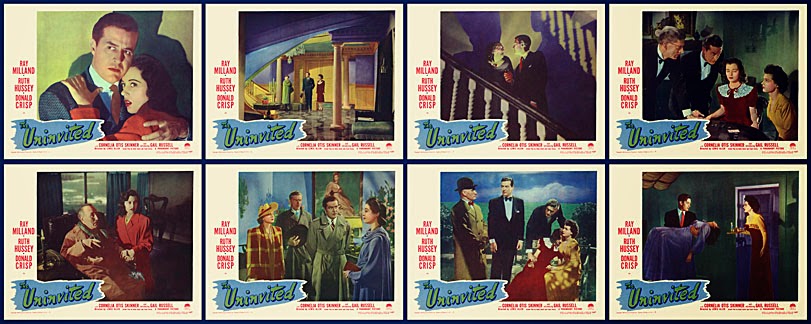
This week, we revisited one of my favorite movies, the suspenseful The Uninvited (1944). Ray Milland
stars as Roderick Fitzgerald, a music critic for a London newspaper who is vacationing on the Cornwall coast with his sister Pamela (Ruth Hussey). Rick and Pam are NOT rich. They have enough money to get by, and some small savings, but on this fateful day, they encounter a wonderful old house that apparently has not been inhabited for some time. The house reminds the siblings of their childhood home, the view and seaside location are breathtaking; the Fitzgeralds decide immediately to pool their savings and try to buy the house. To their surprise and delight, Rick and Pamela find that the owner of Windward House, Commander Beech (Donald Crisp), is eager to sell the house at a price they can afford. However, it is over the loud protests of his young granddaughter,
Stella Meredith (Gail Russell). The brother and sister take possession of their new home and Rick finds himself becoming involved with the "sleeping beauty" quality that is Stella Meredith. But before he can move in, Rick must return to London to settle affairs with his employer. When he returns, he finds Pamela's dog, Bobby, has run away, and Pamela seems tense and withdrawn. That evening, Rick's first in Windward House, all becomes clear. The sound of a woman sobbing reverberates through the house. Only no one is there. The fabulous thing about this film is that it never denies the existence of ghosts. It doesn't end by having all the fantastic occurrences explained away by natural phenomena. The house is haunted; there are ghosts, and while ghosts can be either good or evil, they remain on earth for a reason. And that goodness or evil is a reflection of their human personality, not something that came after death. It is up to the mortals to determine WHY the ghosts are in the house and try to satisfy them, so both ghost and mortal can at last have peace. This TCM article goes into more detail on the unique nature of this film.
As the article mentioned above states, by today's standards, this is NOT a scary film - no one gets killed in some particularly gory manner, nor are there long chase scenes by a masked stalker with a chainsaw. But what there is is a delightfully eerie feeling - enough to put you on edge and keep you there. Much of this is thanks to the acting, especially the remarkably talented Ray Milland and Gail Russell. Milland is able to give Rick a controlled panic - he's just invested his life savings in a house that may be uninhabitable, and the girl he loves is dangerously attracted to a house that seems to want to harm her. And so as Rick, Pamela, and Dr. Scott (Alan Napier) begin to investigate just WHAT causes spirits to stay at Windward House, and why they would want to harm Stella, Milland remains the focal point for the audience. He is our anchor to reality and our connection to the supernatural; we trust the ghosts are real because HE believes it. Which brings us to Gail Russell. Much has been written about her beauty and her sad, short life. An alcoholic, originating from her severe stage fright (and probably started while filming The Uninvited), she ended up dead at age 36 from malnutrition and liver disease. (This Los Angeles Times history outlines Ms. Russell's unfortunate life). But her history should not detract from her performance. Her Stella is delicate, but determined; innocent yet wise in many things. She is the glue that binds Rick to Windward, she is the song he composes. Who can hear "Stella by Starlight" and NOT see Gail Russell's lovely face rise as the inspiration? She gives Stella a heart that makes you want her to finally live in the house she loves, and find the man of her dreams. In some senses, she is the soul of The Uninvited.
If Stella is goodness incarnate, then Miss Holloway, as portrayed by Cornelia Otis Skinner is the human link to pure evil. The dear friend of Stella's mother, Mary Meredith, Miss Holloway hates Mary's daughter with the same passion that she adores Mary. As the TCM article above mentioned, there is a lot in common between Miss Holloway and Rebecca's Mrs. Danvers, not the least of which is both of their overtly sexual obsession with a long-dead intimate. Ms. Skinner, a noted stage actress and author, had a very limited screen career - only four films (one silent) and several appearances on television. She's wonderfully spooky here, letting the viewer glimpse the madness that is underneath her calm exterior.
There is another rarely seen actress, Dorothy Stickney
as Miss Bird, a resident at the Mary Meredith home. Though Miss Bird is supposed to be the one who is sick, she seems a lot saner than Miss Holloway! We'd seen another one of Ms. Stickney's rare film appearances - she appeared as Henry Fonda's obnoxious mother in I Met My Love Again. Ms Stickney had a very distinct voice, which led to her portraying a number of eccentrics on film and on stage. She had a long career on Broadway, from her debut in 1926 in The Squall to the mid-1970s, when she appeared in Pippin (assuming the role of Pippin's grandmother after Irene Ryan's sudden death). Of her many stage roles, two are worth mention here: in 1928, she played Mollie Malloy in The Front Page and, beginning in 1939, she appeared as Lavinia in the original production of Life with Father. She was, in fact, in that play for its entire run (til 1947), following it up with a short run, again as Lavinia, in Life with Mother. Ms. Stickney died in 1998, just shy of her 102nd birthday.
The film was given a well-deserved cinematography nomination by the Academy of Motion Picture Arts and Sciences (it lost to Laura), but interestingly, the song "Stella by Starlight" was not even nominated, nor was the film's score. The songs that were nominated include some standards like "The Trolley Song" (Meet Me in St. Louis), "Long Ago and Far Away" (Cover Girl), "I'll Walk Alone" (Follow the Boys), and (the winner) "Swingin' on a Star" (Going My Way). Regardless, "Stella by Starlight" became a popular and jazz favorite, performed by such artists as Frank Sinatra, Ella Fitzgerald, Sarah Vaughan, Ray Charles, and Miles Davis.
Though it appears that the NY Times' Bosley Crowther was not paying attention during his viewing of the film in 1944, we know you will enjoy it. We'll leave you with a trailer from this wonderful fillm.