Showing posts with label Carol Ohmart. Show all posts

Monday, June 15, 2020

Vincent's House is Haunted

Millionaire Frederick Loren (Vincent Price) is having a haunted house part for his wife, Annabelle (Carol Ohmart). He has invited five strangers to the House on Haunted Hill (1959), with the understanding that he will pay them each $10,000 for spending a night. Once the doors are locked at midnight, they cannot leave until 8am. The "guests" - pilot Lance Schroeder (Richard Long), psychiatrist Dr. David Trent (Alan Marshal), office worker Nora Manning (Carol Craig), columnist Ruth Bridges (Julie Mitchum), and the house's actual owner Watson Pritchard (Elisha Cook) all need the money. But can they survive the night?

If you like short, campy movies with special effects so low budget that you can see the wires, this is the film for you. The inimitable William Castle directed and produced the production which goes, as always, for the shock value. A believer in promotion, Mr. Castle felt it "should be an integral part of the entire movie going experience." (Showmanship: The Cinema of William Castle by Joe Jordan). He would design gimmicks for his films, like vibrating motors attached to some seats for the thriller, The Tingler (1959) or voting on the main character's fate in Mr. Sardonicus (1961). The House on Haunted Hill, too, had its gimmick, which we'll discuss later on.
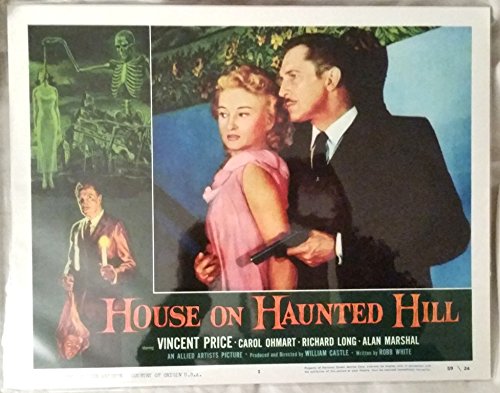
Without Vincent Price, this movie would be nothing. He gives it cache - he plays the role with his tongue firmly implanted into his cheek. As a result, the audience can sit back and enjoy the proceedings, understanding that taking ANY of it seriously would be a drastic mistake. Mr. Price had just lost a role in a Western film - he was judged too tall to play opposite the new star, Alan Ladd. Mr. Castle offered Mr. Price the lead in The House on Haunted Hill, which was in development. In exchange, Mr. Castle gave him a piece of the movie, which ended up netting Mr. Price a new painting for his extensive collection, and a new career as the king of the horror film (The Price of Fear: The Film Career of Vincent Price, In His Own Words by Joel Eisner).

Vincent Price was very much a Renaissance man. He began his acting career in London with The Mercury Players, after having worked as a teacher and studied fine arts. By 1936, he was working on Broadway, playing Prince Albert to Helen Hayes' Victoria Regina. He would appear in 11 Broadway productions, including the Mercury Theatre production of  Heartbreak House, starring Orson Welles (1938),  Angel Street (1944), and Richard III, playing the Duke of Buckingham to Jose Ferrer's Richard (1953). He'd moved to Hollywood by 1938, with a co-starring role with Constance Bennett in Service de Luxe.  While he played good guys on some occasions, it seems he was destined to specialize in villains or weaklings, like Nicholas Van Ryn in Dragonwyck (1946) and Shelby Carpenter in Laura (1944). He moved easily from film to radio to television (where he appeared as one of my favorite villains in "The Foxes and Hounds" episode of The Man from U.N.C.L.E). A highly regarded art collector, Mr. Price donated works from his collection to form the basis for The Vincent Price Art Museum, so that students at East Los Angeles College would have access to a teaching collection. He also wrote several books on gourmet cooking with his second wife, Mary Grant.  His final on-screen film role was in Edward Scissorhands (1990), but he contributed his vocal talents to a number of films, and even to the music video Thriller. Mr. Price died of emphysema in 1993 at the age of 82.
I was unimpressed with Carol Ohmart when I saw her in The Scarlet Hour; the group opinion was not any different. She's an expressionless actress, who thinks making a moue with her mouth is the epitome of fine acting. It's not. In 1955, James Bacon called her a "female Brando" for her "savage realism" (Chicago Daily Herald, 3 July 1955).  One wonders how much Paramount paid him for that compliment. 

Carol Craig gets to scream a lot during the film. The one character who is truly terrified by what is going on, Nora has the brains of a pea. She goes wandering off behind curtains and into empty rooms. Why someone that frightened would be wandering this revolting house alone is beyond us.
Though she doesn't have a lot to do (except for some Lady Macbeth hand cleaning), Julie Mitchum is worth noting as Robert Mitchum's sister.  We also enjoyed Richard Long as the "hero" of the piece. He's effectively stalwart, with not a lot of screen time. And let's not forget Elisha Cook, who keeps warning the audience about the dangers of the house and the ghosts. He's a puzzling character, who remains a question even as the film ends.

The exterior of the house is a Frank Lloyd Wright home - Ennis House, in the Los Feliz neighborhood of Los Angeles (The house was also used as Spike and Drusilla's residence in Buffy, the Vampire Slayer). (Los Angeles Conservancy) The inside is studio created - it's an upscale albeit rather dirty haunted house, though you might find a head in your luggage.
Always the showman, William Castle devised a special gimmick for this film. Called "Emergo," it involved a glow-in-the dark skeleton appearing over the audience's head at a pivotal point in the movie (TCM article). According to Joel Eisner, the first time he tried this trick was at a private screening for major producers. The skeleton was operated from a fishing reel in the projectionist's group, which worked at first. Unfortunately, the line snapped, and fell on the assembled producers.  Mr. Castle had to redesign the skeleton, so that, if it fell in a real theatre, it was light enough to not hurt any audience members!.

The New York Times review  by Howard Thompson, called the film "a stale spook concoction. " However, in a review of a 1999 remake, Lawrence Van Gelder said the new film was "a sorry reincarnation of the 1950s William Castle horror film". That rendition starred Geoffrey Rush in the Vincent Price part (AFI catalog). Today, Mr. Price's version is considered a cult classic.

We'll leave you with a trailer: 

Monday, March 16, 2020

Tom Loves a Bad Girl

E. V. "Marsh" Marshall (Tom Tryon) and his lover Paulie Nevins (Carol Ohmart) meet clandestinely in a wooded area outside Los Angeles. As they are leaving, they notice three men meeting. The couple sneak over to listen and hear the men discussing the robbery of a local home - the takeway will be $350,000 worth of jewelry. Paulie decides that, if they steal the loot from the thieves, it's not a crime, and they can use the money to run away from her husband - and his boss - Ralph Nevins (James Gregory). Our film is The Scarlet Hour (1956).

Noir City DC aired this rarely seen film. It's an interesting plot, but it suffers from a big problem - the three lead actors (Tom Tryon, Carol Ohmart and Jody Lawrance) can't act. Thankfully, there are other people in the film who can, so one ends up ignoring the leads, and concentrating on James Gregory and Elaine Stritch (Phyllis Rycker). 

 Directed by Michael Curtiz, the film "introduces" Tryon, Ohmart, Lawrance (and Ms. Stritch, though not listed as such). For Mr. Tryon, Ms. Ohmart, and Ms. Stritch, this was their first film. All had appeared on television; Ms. Lawrance however had appeared in several film prior to The Scarlet Hour, including a starring role in Ten Tall Men (1951) with Burt Lancaster.  Nevertheless, Paramount and Mr. Curtiz wanted to emphasize the "new faces" in the film; thus, they were "introduced" (AFI Catalog). 


Tom Tryon is just adequate as a man who can't make up his mind about much of anything. Mr. Tryon expresses everything - concern, fear, love, anguish - by furrowing his brow. It's not really convincing. He'd started on Broadway as a waiter in Wish You Were Here (the play starred Jack Cassidy). He continued worked in films and on TV, most famously on The Cardinal (1963), a film he disliked because of the abuse he suffered at the hands of Otto Preminger (The World and Its Double: The Life and Work of Otto Preminger by Chris Fujiwara). Preminger fired Mr. Tyron in front of his parents (later rehiring him). The abuse continued when Tryon was cast in Preminger's In Harm's Way (1965). It ceased when Kirk Douglas walked off the set in protest. Mr. Tryon eventually left acting and became a successful novelist. He died in 1991 of stomach cancer at the age of 65. 
Both Ms. Ohmart and Ms. Lawrance (Kathy Stevens) are simply okay as the Bad and Good Girls. Ms. Ohmart is rather flat; emotions rarely cross her face. Ms. Lawrance, on the other hand, simply oozes sympathy as she emotes in Mr. Tryon's direction. What's not clear is why she would be in love with this banal man who doesn't look in her direction.
The actor who makes this film worth watching is the always wonderful Elaine Stritch (Phyllis Rycker), playing Paulie's best friend from their days as B girls. While Paulie has married rich - and miserably - Phyllis has married a plumber, Tom (Billy Gray) and they are ecstatically happy. Ms. Stritch bubbles with joy, and does it all without being saccharine.
Elaine Stritch began her Broadway career in 1946; she would eventually be nominated for four Tony Awards (for Bus Stop, Sail Away, Company, and A Delicate Balance), and won Emmy Awards for appearances in Law and Order and for her one-woman show Elaine Stritch: At Liberty (which also won a Tony for Best Special Theatrical Event as well as two Drama Desk Awards). She didn't make many films, but was a frequent guest star on a number of television shows (including a one-year stint as Ruth Sherwood in My Sister Eileen). Much of her life is outlined, along with her stellar Broadway career, in At Liberty and a follow-up Elaine Stritch: Shoot Me. She retired to Michigan in 2013, and died there the following year.  You can see her performing the song "Zip" from Pal Joey in her one-woman show, as well as discussing her adventures getting to the previews.
James Gregory (Ralph Nevins) is back to playing a villain in the piece, and he is a doozy. Yes, his wife is a philanderer, but the film implies that she started fooling around when she discovered he was an abusive brute. It's really hard to have any sympathy for the character; were our lovers nicer people, we might end up rooting for them. 

Watch for E. G. Marshall  and Edward Binns as police officers Lt. Jennings and Sgt. Allen. And we get the pleasure of Nat "King" Cole singing "Never Let Me Go" in a nightclub. And though IMDB lists Billy Gray as Phyllis' husband, it's not the right Billy Gray (the star of Father Knows Best was only 18 years old when the film was released); our Billy was well into his 40s.
You can read more about the film in this article from the Film Noir Foundation, which it says of  "brings that arc of the noir cycle to a close—an arc that wouldn’t be reopened until Body Heat." If you are a noir fan, it's worth a viewing - and if you've never seen Elaine Stritch, watch to see her take control of the action. In the meantime, here is a trailer: