Showing posts with label Bette Davis. Show all posts

Monday, October 11, 2021

Bette Doesn't Age

Reknowned New York beauty Frances Beatrice "Fanny" Trellis (Bette Davis) is being pursued by most of the eligible bachelors in the City.  Fanny relishes the attention; even though she and her brother Trippy (Richard Waring) are deeply in debt. One evening, Mr. Skeffington (1944), Trippy's boss arrives to inform Fanny that Trippy has stolen $24,000 from his company.  Intrigued that Job Skeffington does not seem to respond like her other suitors, Fanny elopes with Job, alienating Trippy.

It's Interesting that the film is named Mr. Skeffington when Job disappears for most of the latter part of the film. As you can see from the Italian poster, they just changed the title to reflect the real focus of the film, the beguiling Fanny Skeffington. But the title change misses a point. Yes, the film is about Fanny, but it is Fanny as reflected by Job.  Even when he is gone, Job Skeffington is an influence on Fanny's life, much to her chagrin.

Bette Davis was not the first choice for the role of Fanny Skeffington - Katharine Cornell was originally approached; when she declined, Irene Dunne and Claudette Colbert also turned it down. Next up was Tallullah Bankhead; that deal was nixed by Hal Wallis (Dark Victory: The Life of Bette Davis by Ed Sikov), after which, Ms. Davis was approached. She was reluctant - she worried about the aging of the character, which originally had the story told in flashback (and Fanny going from old to  young and back again).  Adding to her anxiety, her husband, Arthur Farnsworth died just as production was to begin (TCM article),  Regardless of her fears, she is letter-perfect making it Fanny's charm that is the attraction, not her beauty.

The film, however, lives and dies on the character of Job Skeffington, and Claude Rains does not disappoint.  He is marvelous as a man floored by his love for a woman who is incapable of loving anyone but herself.  You might ask why such a sensible man would fall for such a woman, but Mr. Rains makes us appreciate his feelings, and his growing sorrow as he realizes that Fanny will never love him. Both James Stephenson (Mr. Stephenson died before production began) and Paul Henreid were considered for Job (AFI catalog).

Walter Abel (George Trellis) is also excellent as Fanny’s tolerant cousin.  A good man, who cares deeply for Fanny and Trippy, he also forms a bond with Job following Job’s marriage to Fanny.  George acts as a conscience for Fanny, reminding her when she is being more selfish than normal - not that she pays much attention!

There are some excellent performances by other members of the cast. Marjorie Riordan as the grown Fanny Rachel Trellis, who has lived in her mother's shadow all her life, is quite good as a daughter battling her dislike of her mother with her father's desire that she always treat her mother with affection. The trio of suitors played by John Alexander (Jim Conderley), Jerome Cowan  (Edward Morrison), and Peter Whitney (Chester Forbish) are delightfully ridiculous, with Jerome Cowan leading the pack in the last section of the film. 

New York Times review by Bosley Crowther was not enthusiastic. Regardless, the film did well at the box office.  It was adapted for the Lux Radio Theatre in October 1945 with Bette Davis and Paul Henreid as the two leads.

This is an excellent film, and while a tad long, well worth the time.  We'll leave you with a trailer:


Monday, June 21, 2021

Bette Writes a Letter

Nighttime at a rubber plantation in Singapore; most of the workers are sleeping peacefully when shots ring out. A man stumbles from the main house, pursued by a woman with a gun. She fires into the man over and over again. She then calmly sends one of the workers for the district officer, saying it was an accident. We are discussing The Letter (1940).

This film features one of the more dramatic openings in movie history - a peaceful night interrupted by gunfire, as a woman pursues a fleeing man.  The report of the gun, the sounds of the previously quiet jungle screaming with panic - director William Wyler did 33 takes of the scene, though producer Hall Wallis told Wyler that it was the first take that he used in the final film (TCM Behind the Scenes). 

Bette Davis is the dominant force in the film. She is powerful even in scenes of quiet. While you are suspicious of Leslie Crosbie from the start (we did after all watch her gun down a man), Ms. Davis gently feeds the information to us strand by strand, much like the crochet lacework that is constantly in her hands. Ms. Davis was eager to work with Mr. Wyler - they'd previously worked together on the Jezebel, a performance which had won Ms. Davis an Oscar. (TCM The Big Idea). Nonwithstanding of their mutual affection and regard for one another, they still had disagreements - in a late scene, Mr. Wyler insisted that Ms. Davis look into Herbert Marshall's (Robert Crosbie) eyes to tell him she loved another. Ms. Davis was horrified - it was too cruel, she said, but Mr. Wyler insisted.  When she won the AFI Lifetime Achievement Award, Mr. Wyler was in attendance. "Even today 37 years later," he said, "we still disagree on it. Well, Bette read it the way I asked her to, but I'm sure she would like nothing better right now than to drive over to Warner Bros. and re-shoot the scene her way." The camera caught Ms. Davis nodding her head vigorously in agreement (TCM Trivia)

James Stephenson brings nuance to the character of lawyer Howard Joyce, the man who first grasps the levels of Leslie's duplicity.  He'd appeared in a variety of parts since he began in films in 1937 but this film was the first to use him to good effect.  He had his issues with Mr. Wyler, but Ms. Davis would convince him to try Wyler's way. Ultimately, he was nominated for an Oscar for Best Supporting Actor (he lost to Walter Brennan in The Westerner).  Sadly, Mr. Stephenson would only appear in five more films - he died in 1941 of a heart attack.  

The first actress considered for Mrs. Hammond was Anna May Wong, but William Wyler felt she was too young and too attractive to portray the sinister widow.  Instead, Gale Sondergaard was given the part, and she is excellent in a part that relies on facial expression and body language for her communication with the audience (Mrs. Hammond does not speak English). Ms. Sondergaard would eventually be forced to leave Hollywood for the New York stage when her husband Herbert Biberman was accused of being a communist.  She eventually returned to Hollywood, where she worked in film and television until her retirement in 1982. 

Herbert Marshall is very good in what is basically a thankless role as the cuckolded husband.  He'd appeared in the 1929 version of the film (as the murder victim) (TCM Pop Culture). He has several heartbreaking scenes at the end of the film that reveal much about this misused man.  

It's worth noting the presence of Frieda Inescort (Dorothy Joyce) in a very small role as defense lawyer Joyce's wife. Victor Sen Yung (here billed as Sen Yung) is quite convincing as Ong Chi Seng, the somewhat shady lawyer in training, who is the first to reveal the existence of the Letter. 

There is one other character in the film, and that is Leslie's lace crochet.  We see it immediately after Geoff's death, and slowly the project grows as Leslie's lies become more and more intricate.  The dropped lace project at the end signals the film's ultimate conclusion, much like the three fates weaving out the lives of mortals.

The New York Times review by Bosley Crowther was glowing, and the film was ultimately nominated for Academy Awards in the categories of Picture; Supporting Actor, Actress, Editing, Direction, Original Score, and Black and White Cinematography (it didn't win in any category) (AFI catalog).

Jeanne Eagles starred as Leslie in the 1929 film version (which had a very different ending, the Production Code not being an issue at that point).  There were three Lux Radio Theatre productions - May 1938 with Merle Oberon and Walter Huston; April 1941 with Bette Davis, Herbert Marshall, and James Stephenson; and March 1944 with Bette Davis, Herbert Marshall and Vincent Price.  The October 1956 Producer's Showcase television version was directed by William Wyler and featured Siobhan McKenna, John Mills, and Anna May Wong (who finally got to play Mrs. Hammond). Lee Remick starred in a 1982 television movie remake; also featured in that version was Sarah Marshall, the daughter of Herbert Marshall.

We'll leave you with a trailer of this remarkable film:


Monday, June 7, 2021

Bette Deceives

Christine Radcliffe (Bette Davis) races to a concert at a local college. A solo cellist, Karel Novak (Paul Henreid), new to the United States, performs to great acclaim. Before the war, he and Christine were lovers in Germany, but Christine has long believed him to be dead.  Their reunion is joyful, until the jealous Karel demands an explanation for Christine's luxurious life style. The Deception (1946) begins when Christine lies about her life since the war, and her relationship with the brilliant, but ego-maniacal composer Alexander Hollenius (Claude Rains).

Just who is the villain is one of the questions in this film. On the surface, one's instinct is to place Hollenius, a self-absorbed egoist if ever there was one, in that position. But, it's clear from the start that Christine has long ago learned how to deal with Hollenius' moods and demands, so why is she so spooked by him? The answer may be that Karel's jealousy is deranged. He almost strangles Christine when they meet again. His mania and her fears start the string of lies that lead to Christine's downfall.  What certainly is clear is that Christine has lousy taste in men.

Beyond a doubt, this is Claude Rains movie. As domineering as Hollenius is, it's hard to actually dislike him. He glories in his power and in his talent. He enjoys his life, and while he isn't actually mean, he doesn't appreciate anything that thwarts what he wants. The problem for Christine is that Karel thwarts Hollenius, and while she is immune to his head games, the troubled Karel is not. To see Mr. Rains at his absolute best, watch him manipulate Christine and Karel when they dine out. It is a masterwork of acting (TCM article).  In his commentary on the DVD, Foster Hirsch mentioned that some people claimed Mr. Rains stole the scene from Bette Davis - clearly (as Mr. Hirsch pointed out) no one steals a scene from Ms. Davis. If you watch her during the scene, she's reveling in Mr. Rains performance. 

Paul Henreid has the unenviable job of playing a man who is just short of being insane. His fits of anger are positively scary; he's worse then Hollenius in many respects because he has no clue that his self-absorption is so complete.  Mr. Henried does a good job playing an abusive individual and does make you feel that some of his behavior stems from his experiences during the war (though not all of it).

While Bette Davis could play the piano (and practiced hard to do the one scene in which she played), Jack Warner asked her to not worry about it - they would get a pro to do the actual music (but you can tell by her hands that she knows what she is doing).  Paul Henried, however, did not know how to play the cello, and had to have two actual cellists use their arms to make it appear that he was actually playing. 

This was the first Warner Brothers film in which Ms. Davis appeared that did not make money (partly due to the production running overtime, due to Ms. Davis' illness). She would only make three more films for Warners.

Based on the play Obsession, which was on Broadway in revival when the film opened, the original was a two-character presentation - just Karel and Christine. It was at one point intended as a vehicle for Barbara Stanwyck and Paul Henreid (AFI Catalog). 

The New York Times review by Bosley Crowther was not particularly complimentary - but Mr. Crowther didn't like the play much either.  He was, however, very taken with Claude Rains who "fills out a fascinating portrait of a titanic egoist".

This is not Ms. Davis' best film, but it is a tour de force for Mr. Rains, and as such worth your time.  We'll leave you with the trailer:


Monday, February 8, 2021

Bette is Poison

George Bates (Gary Merrill) is on the run. He pulled a bank job with another man - Preston - and a guard was shot. George arrives at the home of Preston's estranged wife, Janet Frobisher (Bette Davis) to find that Preston is dead - Janet killed him when Preston started beating her. But George needs to use Janet's estate to hide out. Tonight we'll discuss Another Man's Poison (1952).

Not unexpectedly, Bette Davis dominates this film as a strong, selfish, and malevolent woman who likes her horse far better than she likes men. It's obvious that men serve one purpose in her life (since this is a PG-rated blog, I won't go into detail). Her taste in men is also decidedly bad. Her husband was a bank robber and abuser; her current lover, Larry Stevens (Anthony Steel) is a bore; and George Bates is treacherous piece of work. You'd think a woman with her brains could pick someone more agreeable. Were it not for the way she accomplished it, you could almost sympathize with the killing of her husband. It's quite clear that he beat her severely before George's arrival.

Emlyn Williams (Dr. Henderson) is also quite good as the veterinarian who suspects George is not exactly he appears. The audience gradually realizes that Henderson is quite smart, and is not letting on all he knows. Viewers today would be reminded of Columbo, as Henderson tries to worm his way into George's trust.  Mr. Williams is best known as a playwright - the author of The Corn is Green. His presence in this film was one of the reasons that Ms. Davis was interested in appearing in it.  Mr. Williams thrilled her when he introduced her to the woman who was the model for Miss Moffat. (TCM article).

The rest of the cast is, at best, adequate. We're none of us particularly fans of Gary Merrill. His best role was in All About Eve, and quite honestly, he was never all that impressive in other parts. George is a nasty, petty opportunist, and we found nothing to like about him. Mr. Merrill is very over-the-top in his performance, and it would have helped if he'd been toned down a bit. The only plus was that we looked forward to seeing Janet best him; he's just no match for her on any level, which was obvious from the start. 

Ms. Davis married Mr. Merrill in 1950 (after a passionate affair during All About Eve) - both needed to resolve other marriages first. When the couple headed to England to make this film, the marriage was new and relatively happy. The Merrills considered it a honeymoon, though they made the trip accompanied by their two children, two nannies, and a maid. Their union lasted for 10 years and most of it was unhappy. Sam Staggs, in his book All About "All About Eve": The Complete Behind the Scenes Story of the Bitchiest Film Ever Made,  called the association "a parade of depressing floats: drunkenness, strife, abuse."

Which brings us to the Larry Stevens (Anthony Steel) / Chris Dal (Barbara Murray) subplot, which we found to be a total waste of time. As we mentioned before, Larry is totally uninteresting, and the only benefit to Chris is that she is a good match for him - equally dull. There is a scene midway through the film when Chris admits to knowing of Larry's relationship with Janet. It is so banal, we found we could mouth the dialog with her.

The film was based on a play (Deadlock) that was inspired by Emile Zola's Thérèse Raquin (AFI Catalog).  The New York Times review by A.H.Weiler (A.W.) was lukewarm, calling it "a static affair that rarely escapes from its sets or the scenarist's verbosity." What praise he gave to the film was saved for Ms. Davis. Sadly, we concur. If you are a Bette Davis completest, then give it one viewing (it doesn't deserve more than that). Otherwise, this might be one to pass on (and just watch All About Eve again). 

We'll leave you with a trailer:


Monday, November 16, 2020

Bette's Negative Prognosis

Judith Traherne (Bette Davis) is suffering from frequent and disabling headaches. At the urging of her best friend, Ann King (Geraldine Fitzgerald) and her family doctor, Dr. Parsons (Henry Travers), she sees neurosurgeon Dr. Frederick Steele (George Brent). He diagnoses a glioma, and brain surgery. Will the results be a Dark Victory (1939)?

Bette Davis won an Oscar in for Jezebel (1938); her performance here is also Oscar-worthy. Of course, next to the juggernaut Gone With the Wind, it was not in the cards for her to win again, but she did receive a well-deserved nomination for the doomed Judith Traherne. In an era in which Elisabeth Kubler-Ross's stages of grief were unknown, Ms. Davis portrays Judith's reactions: first to her supposed cure, and then to the realization that, at age 23, she only has a few more months of life. Like Julie Marsden in Jezebel, Judith is alone in the world, but there the similarities end. Judith is very much alone in the world - her beloved father died of alcoholism and her mother has abandoned her to play in Europe. To make up for her lack of family, Judith surrounds herself with friends. And while she may burn the candle a bit at both ends, we soon realize that her devotion to her friends (and theirs to her) is real and lasting. Ms. Davis was not the first choice for the film. It had originally been considered for purchase by MGM for Greta Garbo; when she was not interested, Merle Oberon, Carole Lombard, and Janet Gaynor were considered. Eventually, Ms. Davis convinced Hal Wallis to purchase it for her. (AFI catalog).
Her dearest friend is played by Geraldine Fitzgerald in her first American film. The character of Ann was created for the film, and having her is an asset to the plot.  Ann acts as a buffer for Judith, while giving Ms. Davis someone tangible to bounce off. Since Ann is the first person to discover Judith's fate, it is HER grieving that we concentrate on. When Judith ultimately finds out her diagnosis, the audience is ready to empathize with her, having already experienced the initial shock with Ann. Without Ann, the audience would have no outlet for their grief. 

George Brent is the picture of professionalism as Dr. Steele.  He's strong when he needs to be, but you believe in his frustration with his career - the high death rate for his patients have worn him out. He still wants to practice medicine, but needs a respite from the daily grind of death. In our age of informed consent, it is appalling that holds back the facts from his patient, but this was standard practice before Kubler-Ross.
Mr. Brent was not the first choice for the film - both Fredric March and Spencer Tracy were early choices (Edmund Goulding's Dark Victory: Hollywood's Genius Bad Boy by Matthew Kennedy ). Mr. Brent's interplay with Ms. Davis is delightful - they spar, but you can see the affection growing between them. The couple would appear in 11 films together during their careers; prior to this film, both were married. But, on this set, both were unattached - Mr. Brent had recently divorced Ruth Chatterton and Ms. Davis was finalizing her divorce from Harmon Nelson. The result was a romance that lasted several years, though Mr. Brent was unwilling to marry, fearing they could not have a long-lasting relationship. Ms. Davis would later say "Of the men I didn't marry, the dearest was George Brent" (TCM article).

The commentary that accompanied my DVD of the film immediately launched into a diatribe against Humphrey Bogart as horse trainer Michael O'Leary - miscast, a leading man shoved into a supporting part, etc. Except, Bogart was only starting to take on leading roles (like the gangster in King of the Underworld). His portrayal of Michael gives the film a character who is an equal to Judith. He works well with Davis, and their good-humored, toe-to-toe arguments about her horse are a breath of fresh air.  He also brings a masculinity to the part that is important later in the movie. You can understand Judith's overtures to Michael when her life has literally fallen away from her.  His response is appropriate, and paves the way for Judith's eventual healing process.
Ronald Reagan (Alec Hamin), on the other hand, is pretty much invisible in the film. He's there (Alec spends most of the movie drunk), but we found you don't pay much attention to him.  Director Edmund Goulding wanted to make more of the part, and asked Mr. Reagan to play the part as a gay man - Mr. Goulding wanted to make it clear there was no possible relationship between Judith and Alec.  Unsurprisingly, Mr. Reagan refused. (Dark Victory: The Life of Bette Davis by Ed Sikov).

The film was based on a Broadway play ran for six weeks, with Tallulah Bankhead starring as Judith.  It premiered on the radio in 1938, when Barbara Stanwyck and Melvyn Douglas starred in a Lux Radio Theatre version. In 1939 Ms. Davis and Spencer Tracy starred in another Lux episode. The story was remade on film in 1963's Stolen Hours and starred Susan Hayward and Michael Craig. In 1976, NBC broadcast a television version starring Elizabeth Montgomery and Anthony Hopkins.
Frank S. Nugent review in the New York Times when the film opened at Radio City Music Hall was glowing, especially in his praise of Bette Davis:"Miss Davis is superb. More than that, she is enchanted and enchanting." The film received three Oscar nominations, for Picture, Actress, and Original Score (Max Steiner). It is #32 on AFI's 100 Years...100 Passions

This is a fantastic film, and one you should go out of your way to view. We'll leave you with a trailer from the movie.

Monday, November 2, 2020

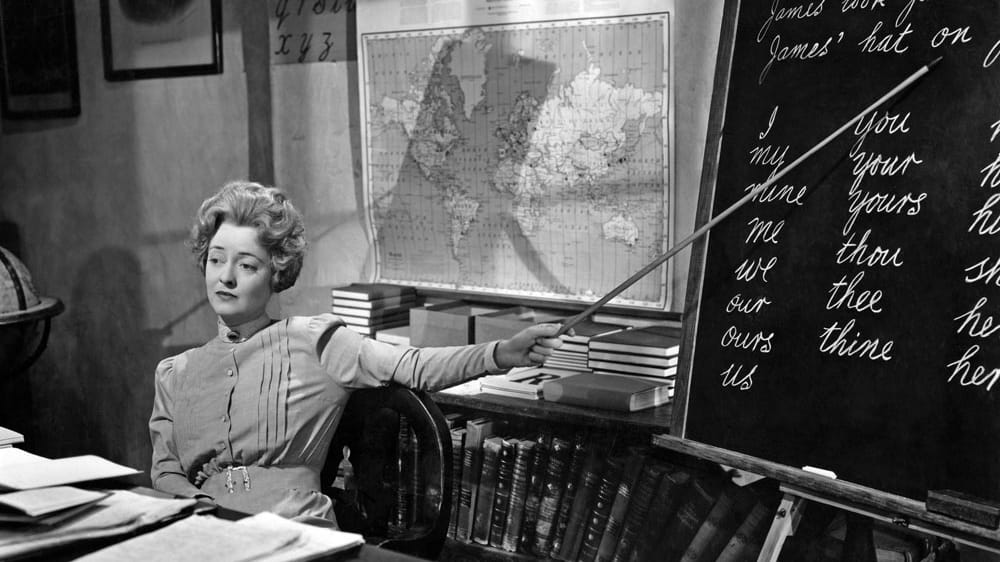
Teacher Bette

The Welsh mining town of Glansarno is in a tizzy - the new owner of one of the larger estates is arriving that day. They are shocked to discover that LC Moffat, M.A. is a woman - Lily Cristobel Moffat (Bette Davis), an educated woman who intends to use her inheritance to start a school for the local children. She enlists the services of Mr. Jones (Rhys Williams) and Miss Ronberry (Mildred Dunnock) to act as instructors in her free school but despite the high levels of illiteracy in the town, she finds herself in a battle with Sir Trevorby, the local Squire (Nigel Bruce) and pub owner Will Davis (Arthur Shields), both of whom see the school as a threat to their livelihoods.  Our film this week is The Corn is Green (1945).

Bette Davis shines as the tough-as-nails Miss Moffat in this retelling of the Broadway play.  Loosely based on the life of  playwright Emlyn Williams, the Broadway production starred Ethel Barrymore as the independent educator. Ms. Davis was only 36 when she took on the part - and would later say that she was perhaps a bit too young (Ms. Barrymore was 61 when she appeared in the play, and Miss Moffat was supposed to be in her 50s) - but Bette Davis was not averse to looking older for the film (TCM article). She brings grit and, when required, warmth to this single-minded woman.
The film introduced Joan Lorring (Bessie Watty) to the screen. Bessie is an avaricious, nasty piece of work, though with her mother, it's not hard to imagine WHY Bessie is the manipulator that she is. She especially loathes Miss Moffat (who she sees as the reason for everything that is wrong with her life), and goes out of her way to strike out at her nemesis.  Originally, Bette Davis wanted Ida Lupino for the role of Bessy Watty (Dark Victory: The Life of Bette Davis by Ed Sikov), but she was not available.  Angela Lansbury, Betty Field, and Andrea King were all tested - Ms. Davis selected Ms. Lorring, who got an Oscar nomination in the supporting actress category, and who called Ms. Davis one of her "teachers". 

Though Richard Waring (who played Morgan Evans on stage) was director Irving Rapper's first choice, Mr. Waring's military service prevented him from being cast. John Dall, like Ms. Lorring, was introduced for this film. He's convincing as Morgan, who goes from flippant to bitter to ambitious, and all done with great conviction. His scenes with Ms. Davis are especially strong - he would credit her with assisting in his performance - in his close up scenes, Ms. Davis stood "behind the camera, facing me, giving the scene the same acting as if she were before the camera."
Several wonderful actors repeated their Broadway roles. Mildred Dunnock who doesn't know how to give a bad performance, reprised Miss Ronberry; Rhys Williams as the minister Mr. Jones and Sara Pugh (Gwyneth Hughes) are also excellent (AFI Catalog),. Nigel Bruce, however, was new to the cast and is at his fubsy best as the rather clueless Squire.  Also added to the film cast was Arthur Shields, who makes a menacing publican. 

Also repeating her Broadway role was Rosalind Ivan (Mrs. Watty). Mrs. Watty is both funny and dismaying simultaneously. Her utter disregard for her daughter makes the viewer want to cringe - then again, with a daughter like Bessie, it's hard to argue with Mrs. Watty's attitude.  Ms. Ivan was over 60 when she played Mrs. Watty, yet you believe her as Bessie's mother - her face, while not that of a beauty, is also not old.  Because she frequently played women who were not very likeable, she acquired the nickname "Ivan the Terrible" (Accustomed to Her Face: Thirty-Five Character Actresses of Golden Age Hollywood by Axel Nissen). Ms. Ivan would continue in films for another nine years after The Corn is Green,  including Johnny Belinda (1948) and Scarlet Street (1945). After appearances in a couple of television shows, she retired.
One interesting aspect of the film (which is set in 1898) is that part of Miss Moffat's mission is to teach English to the locals. As was done in Ireland and Scotland, use of the native language was banned in place of English. Though it did not always prevent the locals from using the language, its use in the courts or even in places of business was illegal (Historic UK). As time progressed, Welsh began to die out; there were fears that it would no longer have any native speakers. However, in recent years, the number of native speakers has risen, and there is now hope the spoken language will continue to live (BBC).

As mentioned, the film was based on the 1940 Broadway play by Emlyn Williams with Ethel Barrymore as Miss Moffat. There were three other productions of the play: 1943 (with Miss Barrymore); 1950 (Eva La Gallienne); 1983 (Cicely Tyson). There was also an unsuccessful attempt of a musical (starring Bette Davis in the title role and Dorian Harewood as Morgan Evans) - Miss Moffat - that never made it to Broadway.  Helen Hayes took on the lead in the December 1947 Theater Guild of the Air radio production.  Lux Radio Theatre presented the story twice - with Olivia de Havilland and Richard Basehart as the teacher and student, in June of 1950 and again with Claudette Colbert and Cameron Mitchell in May of 1954. The story also made it to television in 1979, with Katharine Hepburn as Miss Moffat.
While Bosley Crowther enjoyed Bette Davis' performance in the film, his review in The New York Times was not complimentary of the director nor of the film overall, saying "this humble, human story is not as intimate and moving on the screen as it was on the stage." But, Mr. Crowther spends a lot of copy comparing the film to Ms. Barrymore's stage performance - a performance that (unfortunately) that the rest of us will never be privileged to see.

We all enjoyed the film thoroughly, and heartily recommend it for your enjoyment.  We'll leave you with a trailer:

Thursday, October 8, 2020

Bette is Marked

Gangster Johnny Vanning (Eduardo Ciannelli) has purchased the Club Intime, forcing hostesses Mary Dwight Strauber (Bette Davis), Gabby Marvin (Lola Lane), Emmy Lou Egan (Isabel Jewell),  Estelle Porter (Mayo Methot), and Rosalind Marquis (Florrie Liggett) to work for him. Mary is well aware of the hazards of being in Johnny's employ - he murdered a hostess in another of his clubs - but she figures if she does her job and keeps her distance, all will be well.  But things go awry when her younger sister Betty Strauber (Jane Bryan) arrives for a visit on the same day that Mary is arrested for the murder of club client Ralph Krawfurd (Damian O'Flynn), an out-of-town visitor who stiffed Johnny. Our film this week is Marked Woman (1937). 


Jack Warner read the newspapers regularly - he considered them a source for stories for his studio. The reports on the arrest and prosecution of Charles "Lucky" Luciano by New York Attorney General Thomas E. Dewey piqued his interest. The charge was compulsory prostitution, and several prostitutes were convinced to testify against Luciano, despite the danger implicit in such an action (Marked Women: Prostitutes and Prostitution in the Cinema by Russell Campbell). While the movie denies its relationship "to any person living or dead," Mr. Warner had clearly ordered a story based on this famous trial. (DVD Documentary: Marked Woman: Ripped from the Headlines)

Bette Davis had just returned to Warner's after losing a court battle against the studio (TCM article). However, she came back to a strong role in an excellent film.  Ms. Davis as Mary Dwight is the lynch pin in the story - she is strong, intelligent, determined, but she is also a woman with a human side. Her love for her sister is the most important part of who she is, and Ms. Davis gives a performance that clicks on all levels.  She was determined to make Mary believable. For her appearance in a later scene (after Mary is beaten for her refusal to cow-tow to Vanning), Ms. Davis went to her own doctor to get properly bandaged and "damaged" for the hospital scene, as she thought the Warner's makeup department made her look as though she was wearing "a cream puff of gauze" (Dark Victory: The Life of Bette Davis by Ed Sikov). When she returned (and a horrified guard called the office to report that Ms. Davis had been in a horrible accident), Warner and producer Hal Wallis agreed to her makeup, as long as she removed the broken nose she was sporting! 

In 1937, Humphrey Bogart was not known for playing heroes. He came close in The Great O'Malley, playing a family man who is sent to jail by a by-the-book cop. But he'd also appeared as a white supremacist in Black Legion and as gangsters in Dead End, Kid Galahad, and San Quentin that same year. Here, Bogart takes on the mantle of Thomas Dewey, playing a crusading district attorney. He's excellent throughout the film, but is especially wonderful in a scene where he has to deliver some bad news to Ms. Davis

It was on the set of this film that Mr. Bogart met Mayo Methot (who gives a touching performance as Estelle); both were married at the time, but that didn't stop them from beginning a relationship. They married they following year, but the marriage was notorious for its violence. (Hollywood's Hard-Luck Ladies: 23 Actresses Who Suffered Early Deaths, Accidents, Missteps, Illness and Tragedies by Laura Wagner)  Nicknamed "The Battling Bogarts," they drank deeply and often, usually resulting in violent arguments - his nickname for her was "Sluggy". (Architectural Digest, 2016). As time wore on, Mr. Bogart came to fear and pity Ms. Methot; when he met young actress Lauren Bacall in 1944, he finally asked for a divorce. Suffering from alcoholism and depression, Ms. Methot eventually moved to her home town of Portland, Oregon, when she died in 1951. Mr. Bogart sent flowers to her gravesite until his own death (Portland Monthly, 2011)

The film is enhanced by the talents of number of magnificent character actors working at Warner Brothers. Allen Jenkins (Louie), always a delight, has a brief moment as a dress salesman. John Litel (Gordon) is convincing as Johnny Vanning's lawyer. Ben Welden is frightening as Vanning's henchman Charlie. After a substantial career playing small parts in film, Mr. Welden would move onto television, where he again took on character roles - including appearances in 8 episodes of The Adventures of Superman.  Eduardo Ciannelli is effective as the menacing Vanning. Casting Mr. Ciannelli also emphasizes the fact that Vanning is supposed to be Luciano. Sure, "Johnny Vanning" isn't an Italian name, but using the very Italian Ciannelli in the part eliminates any doubt of who Vanning is supposed to be.

The ladies who work as the club hostesses are also excellent. We've touched on Ms. Methot, but it is worth mentioning the efforts of Lola Lane and Isabel Jewell. Neither actress ever gets the attention they deserve - Ms. Jewell always turns in memorable performances, that you forget are her because she so inhabits the character, as she does here. 

Jane Bryan is also good in her small, but pivotal role. Ms. Bryan started her career at the Hollywood Theatre Workshop. A contract with Warner Brothers and support from Bette Davis led her to make 18 pictures (four with Ms. Davis) between 1936 and 1940 (She's featured in this Life article, when she appeared in The Old Maid). In 1939, Ms. Bryan retired from films after she married head of Rexall Drugs, Justin Dart (The Independent, 2009). The couple were married for 45 years and had three children (until Mr. Dart's death in 1984). Ms. Bryan worked as a governor of the Los Angeles Natural History Museum and advocated for the arts. She died, age 90, in 2009.

Originally titled The Men Behind  (AFI catalog), the film got a good review from Frank S. Nugent in the New York Times ("a dramatically concise script, a shrewd director, and an extremely capable supporting cast") Life similarly praised the film in this article from April 19, 1937. This is an excellent and compelling drama, well worth your time. We'll leave you with this trailer: 


Monday, January 6, 2020

Bette is a Librarian

Librarian Alicia Hull (Bette Davis) finds herself in a Storm Center (1956) when she is asked to remove a book, The Communist Dream, from the Kenport Public Library. Torn between her desire to get a new children's wing for the library, and her belief in free access to books, Alicia has to decide what is best for her library and for the community in general.

While one member of our group found the film hard to sit through - specifically the parts that involved young Freddie Slater (Kevin Coughlin) and his meltdown - all members of the group agreed this is an important film, and deserves to be seen and discussed more frequently.

The character of Freddie is included to create one specific scene towards the end of the film. While we salute the imagery that the writers and director were inserting, Freddie is a frustrating character who lessens the impact of the film. The child is badly damaged, primarily by his tentative relationship with a bigoted, unintelligent, and obnoxious father. George Slater (Joe Mantell) bullies his child because the kid is too smart, and wants a boy who will do what he sees as manly things, like play baseball. Mother Laura (Sallie Brophy) encourages Freddie's intellectual growth (she is a talented pianist), but she is undercut by her husband, and weak enough to put up with his nonsense. Why she would marry this neanderthal is beyond our understanding, and is a weakness in the story.
Kevin Coughlin is over-the-top as Freddie; according to this TCM article, director Daniel Taradash was not comfortable directing a child (this was, in fact, Mr. Taradash's only directing credit). Coughlin's mother horrified both Ms. Davis and Mr. Taradash when she pinched her son until he cried, so as to elicit tears for the camera. This was Mr. Coughlin's first film role; he would later play Billy in The Defiant Ones (1958). Most of his career, however, was on television. He died in 1976, at the age of 30, hit by car speeding by his home in Malibu.

Bette Davis was not the first (nor the second) choice for Mrs. Hull (AFI catalog). Originally, the part was intended as a comeback for Mary Pickford, however Ms. Pickford bowed out, ostensibly because the film was not being shot in color. It is believed, however, that she was pressured to withdraw from the picture by Hedda Hopper who was infuriated by the anti-McCarthy sentiments of the movie.  Ms. Hopper's influence may have also had the same effect on Barbara Stanwyck, Irene Dunne, and Loretta Young. Ms. Davis, however, is magnificent as Alicia. She gives Alicia both the strength of character and vulnerability needed to play a woman who is being crucified by the town she loves, simply for being true to her duties as a librarian.
Brian Keith plays councilman Paul Duncan as an innocuous man who is even more dangerous because he seems so personable. Engaged to the librarian Martha Lockridge (Kim Hunter), he uses her collegiality with Alicia to find information that he can use against Mrs. Hull in a smear campaign. Though only one character makes mention of their complicity, it's clear to the viewer that Martha is not averse to the benefits that come from Alicia's dismissal.  There are strong performances as well from other actors in the cast, including Paul Kelly as sympathetic judge Robert Ellerbe, Edward Platt as the Reverend Wilson, Joseph Kearns as Mr. Morrisey, and Kathryn Grant as Hazel.
The story was based on an actual event (though the reason for the firing was altered). Ruth Brown was a librarian in Oklahoma, who was active in local civil rights organizations. In 1950, she was fired from her job ostensibly for being a communist - the actual reason was her involvement in desegregation activities. (The Dismissal of Miss Ruth Brown: Civil Rights, Censorship, and the American Library by Louise S. Robbins ). 

Daniel Taradash and Elick Moll, the screenwriters, were familiar with the case and saw Storm Center as "a dangerous picture about dangerous ideas." Original titles for the film were: The Library, This Time Tomorrow, and Circle of Fire, but none of them were felt to be strong enough.  The American Library Association, which had supported Ms. Brown through her fight in Oklahoma, hosted an advance screening, during which a letter from Bette Davis was read, saying she hoped she had "reflected accurately their dedicated service and had made communities more aware of the role of librarians"  (Louise Robbins. Fighting McCarthyism through Film: A Library Censorship Case Becomes a "Storm Center". Journal of Education for Library and Information Science Fall, 1998. 39(4) 291-311).

Not surprisingly, there were censorship issues with the film. The Catholic Church's Legion of Decency came up with a whole new category just for this film (The Catholic Crusade Against the Movies, 1940-1975 by Gregory D Black; Transforming the Screen, 1950-1959 by Peter Lev), stating that "the highly propagandistic nature of this controversial film (book-burning, anti-communism, civil liberties) offers a warped and strongly emotional solution to a complex problem of American life."


The New York Times review by Bosley Crowther was reluctantly negative, but Mr. Crowther pointed out:  "This is too bad, because the purpose and courage of the men who made this film not only are to be commended but also deserve concrete rewards. They have opened a subject that is touchy and urgent in contemporary life. It should be presented so adroitly that it would fascinate and move people deeply.Furthermore, they have got from Bette Davis a fearless and forceful performance as the middle-aged widowed librarian who stands by her principles. Miss Davis makes the prim but stalwart lady human and credible."  
While this is not be best picture ever made, it is a significant film, one that is still worth watching. Unfortunately, we still have to deal with communities banning books (American Library Association list of Banned Books) and individuals deprived of their liberties because of the beliefs, place of birth, religion or skin tone.  As a librarian myself, I wanted to stand up and cheer at the end of Storm Center.

We'll leave you with a trailer from the film:

Monday, July 15, 2019

Bette Designs

Con man Sherwood Nash (William Powell) decides to forgo financial scams in favor of fashion scams when he meets would-be designer Lynn Mason (Bette Davis). Using Lynn's talent for sketching and eye for successful dresses, Nash "borrows" dresses en route from Paris to New York design houses, and sells cheap copies ("designed" by Lynn) to low-end competitors. He then convinces the New York designers to send him to Paris to do the same for them - get the  Fashions of 1934 (1934) to them at a lower price.

Part of the AFI Silver Theatre's Library of Congress Film Preservation Showcase. Fashions of 1934 was projected with a newly restored 35mm print of this film. Like it's sister film, In Caliente, Fashions of 1934 is an excuse for elaborate musical numbers as well as stunning dresses exhibited in various fashion shows. If you've seen The Women, you are familiar with this kind of scene - lovely, period dresses, but the kind no member of the film audience would probably ever be able to afford. However, add a little Busby Berkeley magic, and you've got production numbers that you will long remember.

The biggest number involves human harps - yes, you read that right. The image below will give you just an idea of the piece. The trailer will show you another - lovely ladies with feather fans that are used to create gorgeous shapes. There's no way these routines would ever be on a stage at a fashion show, but I doubt anyone really cared.
William Powell is delightfully suave as the con man extraordinaire "Sherry" Nash. The part is reminiscent of the role he played in Jewel Robbery (1932). Even though he's unabashedly dishonest, the audience roots for him - he's just charming. He also has quite a good rapport with his two female co-stars, Bette Davis and Verree Teasdale (Grand Duchess Alix/Mabel McGuire), two very different actresses with extremely different acting styles.  With Mr. Powell there, you don't notice a change of tone.
Not surprisingly, Bette Davis was not thrilled to be in this picture. She wanted meatier parts, and this certainly was not what she was looking for. She stated that she was "all done up like a third-rate imitation of the MGM glamour queens. That isn't me. I'll never be a clothes horse or romantic symbol." (TCM article). Regardless of her discomfort with the part, she acquits herself well (though she is much better looking as a brunette). As for her desire for better parts, she would get her wish later that year, when she FINALLY was given permission to play Mildred in Of Human Bondage (1934) (The Lonely Life: An Autobiography by Bette Davis).

Verree Teasdale is amusing as Hoboken native and faux countess Alix. Ms. Teasdale started on Broadway, ultimately performing in 13 plays between 1924 and 1932; she appeared in her first film in 1929, and worked fairly steadily until 1941; thereafter, she did some radio work, often with her husband, Adolphe Menjou. Their marriage lasted from 1935 until his death in 1963 (they had one child). Ms. Teasdale died in 1987 at the age of 83.
In a part reminiscent of his character in One-Way Passage (1932),Frank McHugh plays Snap, a photographer - and con man/thief - who is Sherry's right-hand man.  Mr. McHugh makes the most of what he's got, though the part is mostly comedic.  It must be mentioned that, as intriguing as his little cane camera is, it's odd that he has to constantly hold it up to his eye to get pictures - resulting in the "secret camera" being not very secret.  There is an emphasis on this particular gimmick, and our reaction was that you'd have to be particularly stupid to not figure out what he is doing.

Several other character parts are worth mentioning - Hugh Herbert (Joe Ward) is actually not annoying in this film.  Reginald Owen (Oscar Baroque) and Henry O'Neill (Duryea) as part of the fashion industries in Paris and New York (respectively) are frankly as dishonest as Sherry and his crew.  Arthur Treacher makes a brief appearance as - what else - a butler.
Originally titled King of Fashion (AFI Catalog), this is a pleasant film with some lovely Berkeley numbers. Certainly, it is reminiscent of other films released around the same time, but with William Powell delivering the dialogue, you barely notice that it's typical.  I'll leave you with a trailer from the film (and a preview of one of the amazing dance routines.

Friday, December 29, 2017

Mae Crosses the Bridge

England is under siege from the Germans in World War I. As civilians scramble for cover during a raid on Waterloo Bridge (1931), prostitute Myra Deaville (Mae Clarke) assists, and then attempts to seduce a young soldier, Roy Cronin (Kent Douglass). Roy, an innocent if ever their was one, is immediately attracted to Myra, not comprehending what she does to pay her rent. He pursues her and brings her to his parents' home. Myra, however, resists - she loves him deeply, but knows her past will be a barrier to their happiness.

Before we started this blog, we viewed this version of Waterloo Bridge with a group of other Pre-code films. We decided to revisit it, but will be pairing it (next week) with the 1940 remake starring Vivien Leigh and Robert Taylor. Given the conclusion of this film, it's almost hard to believe that it is a pre-code film, as there is a sense of cosmic punishment being visited on Myra for her actions. Since Myra is a good person who has made some really poor decisions in her life, the ending is quite shocking and unexpected.
Based on a play by Robert Sherwood (which was based on an encounter in his own life in London during the WWI. See this TCM article  for more on the story) that ran for 64 performances on Broadway, Waterloo Bridge has been on the screen three times - this film, the Vivien Leigh version we'll discuss next time, and Gaby (1956), starring Leslie Caron. It was also done as a radio play in 1941 with Brian Aherne and Joan Fontaine, in 1946, with Robert Taylor and Barbara Stanwyck in the lead roles; and in 1951 with Norma Shearer as Myra. 

Mae Clarke is quite good at Myra. Ms. Clarke does not try to whitewash the character a bit. When we first see Myra, she is quitting her job in the chorus of a West End play to take up with a wealthy man. He's given her a fur wrap, and she expects more gifts from him, as well as support in the style to which she would like to become accustomed. But, in the next scene, we see that play that she left is still running, but Myra's affair is not. Unable to get a job in another show, she has turned to the streets to support herself. Ms. Clarke plays Myra as selfish and ignorant. She doesn't like working the streets, but primarily because she wanted wealth and leisure for herself and doesn't have either. The morals - or lack thereof - of working as a prostitute does not bother her until she falls in love with Roy. And Ms. Clarke makes that transformation realistic and understandable; we watch the Myra lose her gold-digging instincts to become the person that Roy envisions her to be. Ms. Clarke was not the first choice for Myra - Rose Hobart was originally considered (AFI Catalog); to our thinking, the right casting choice was made.
That we believe Ms. Clarke's love for Roy is a credit to her ability as an actress. Kent Douglass, however, is not a great actor, and we have to believe that Roy is so obtuse he can't see what Myra does for a living. Mr. Douglass would later change his name to Douglass Montgomery, the name he'd used on the New York stage (MGM didn't want him using Montgomery to avoid confusion with Robert). With 32 credits to his career, he did not have a wide range of roles, though he is remembered today as Laurie Little Women (1933). In 1934, he was the victim of an attempt on his life, when someone sabotaged his car; no suspects were ever found. Following service in the Canadian infantry during World War II, Mr. Montgomery relocated to the UK. He returned to the US in the 1950s, to do some television. In 1966, at the age of 58, he died of spinal cancer (he was living in Connecticut at the time). He was survived by his wife of 14 years, British actress Kay Young.
Bette Davis has a small part (this was her third film appearance) as the generous Janet Cronin, Roy's sister. The whole Wetherby/Cronin family are shown as loving, caring people - not only towards Myra and Roy, but for each other. Though we are informed early on that Mrs. Wetherby (Enid Bennett) remarried and moved with her children to the UK to be with her husband, Major Wetherby (Frederick Kerr), there is no wicked stepfather here. The affection between the Cronin children and their loving - and rather dotty - stepfather is apparent immediately. It makes a nice touch, and helps to explain Roy's rather innocent attitudes.

At one point in the film, allusion is made to the practice of women marrying several times to collect the salaries (and hopefully death benefits) of their soldier husbands. We found it interesting that the practice would be discussed regarding both wars, as we saw in Allotment Wives.

The New York Times review was complimentary of both Mr. Douglass and Ms. Clarke, and enjoyed the story. Danny at Pre-Code.com did not; however we agreed wholeheartedly on Ms. Clarke's inspired performance. As promised, next week we will look at the Vivien Leigh version of the film, which you'll find has a lot more exposition. We'll leave you with this scene from the start of the film, and hope you will join us again next time.