As I've mentioned before, when an extraordinary opportunity to see a classic film happens in the greater Washington DC area, I'm going to tell you about it. Recently, the National Portrait Gallery hosted a screening of Flying Down to Rio (1933), and there to comment on the film was TCM's own Robert Osborne. I was very excited to attend the film screening, as well as a reception for Mr. Osborne, who was kind enough to sign my copy of his latest book 85 Years of the Oscars. Add to this, the opportunity to ask questions about the film and to see the film on a big screen - it was an amazing night! Flying Down to Rio is the first Astaire-Rogers film. Technically, it's a Dolores Del Rio-Gene Raymond story, though, as Ginger and Fred are only minor players in it: they get fourth and fifth billing, respectively. And they only get one dance number together - "The Carioca", which was nominated for the Best Song Oscar (it lost to "The Continental" from The Gay Divorcee). But, as always, their dancing is so amazing, they stole the picture from the stars, and the rest is history.
The plot of the film is fairly ordinary. Roger Bond (Gene Raymond) is the leader of a fairly successful orchestra, however, Roger likes two things far better than working - flying and the ladies. As a result, he is constantly getting the band fired either because he was late for a broadcast, or for consorting with the guests. Into his club walks Belinha de Rezende (Dolores Del Rio), a wealthy Brazilian traveler, who immediately captivates Roger. The management fires the band when Roger is caught dancing with Belinha instead of working, but their joblessness doesn't last long - they have been hired by the Hotel Atlantico in Rio, and off they go. Of course, the hotel is owned by Belinha's father. Further complications ensue as Roger and Belinha realize they are in love, though Belinha is engaged to Julio Rubeiro (Raul Roulien), and when the band discovers that the Hotel is in the midst of a hostile takeover by a consortium. In order to keep their job, Fred Ayres (Fred Astaire) and Honey Hale (Ginger Rogers) come up with a production number to end all production numbers - it's danced in the air!
The introduction by Robert Osborne provided us with some interesting facts. Originally, Honey Hale was to have been played by Dorothy Jordan, but just before filming began, she married Merian C. Cooper and retired. In the 1950s, she made three more films, one of which is quite notable. It's The Searchers, in which she played Martha Edwards, Ethan's sister-in-law and great love. (We talked about The Searchers twice. Here is the most recent article.) Her marriage to Cooper lasted until his death in 1973; she died in 1988, at the age of 82.
With Jordan's departure, a new Honey Hale was needed, so the studio turned to Rogers. She and Astaire knew one another - they had met - and dated - in New York City when he worked as a choreographer in play in which she appeared. Though neither was looking for a dance partnership (Astaire had decided not to have another partner after sister Adele retired), this was a one-shot in a minor role. Little did they know they would be making film history. This TCM Article talks about these facts, as well as another partnership that was formed during the film - Astaire's meeting with Hermes Pan, the assistant choreographer here. It also discusses the magnificent art deco sets - they are of themselves works of art.
The film is also VERY pre-code. From Ginger Rogers see-through evening gown to the dancers whose dresses are literally blown off while performing on an airplane wing, we get to see a lot of some lovely ladies. Add to that some suggestive lines ("What's this business with the forehead?" "Mental telepathy." "I can tell what they’rethinking about from here.”) and you have a delightfully naughty film.
A quick tip of the hat is due to actor Raul Roulien, who plays Belinha's fiance. He makes Julio so very likeable that, by film's end, you wonder WHY Belinha would pick such a lightweight as Roger, when she has a wonderful, stable, loving guy like Julio at hand. We don't have a lot of hope for that marriage. One suspects Roger will be gadding about once the novelty of Belinha and Rio wears off. However, we think that Fred and Honey will take the band to new heights of popularity (once they get away from Roger and his hijinks). We leave you with Fred and Ginger dancing "The Carioca":
When waitress Mabel O'Dare (Marion Davies) loses her job thanks to Aloysius K. Reilly (Roscoe Karns), he gets the bright idea to introduce her to a Broadway producer. Mabel ends up with a job, only because the star has just quit. But there's a problem - Mabel can dance, a little, but not enough to lead a Broadway show. Her dreams of stardom are all but gone when Reilly decides to get some publicity for her by claiming a love affair between Mabel and up-and-coming boxer Larry Cain (Clark Gable). But again, there is a little problem - Larry and Mabel loathe one another. Thus begins Cain and Mabel (1936), a little froth of a comedy, with a few musical numbers thrown in. While it was fun to see Clark Gable in this very early role, and Marion Davies is a delightful performer, this was probably not the best movie either ever made. The musical routines were a bit tedious - they ended up changing the tone of the film. We know Mabel isn't a great dancer; all the routines do is emphasize that to no purpose. And though the film is a bit long, there are some delightful scenes. The early conversations between Reilly and Mabel are a hoot, and then there is the added presence of Allen Jenkins as Dodo, Larry's fight second. Any time Allen Jenkins is in a movie, you know you are going to have a good time.
We also have Ruth Donnelly as Aunt Mimi, who is also very
funny. It should be mentioned though that Mimi is a fairly despicable
person. She will go to any lengths to advance Mabel's career, because
it is keeping Aunt Mimi in the money. She has no worry that her actions might make Mabel
unhappy.
Another interesting appearance is that of Pert Kelton as Toddy, the
star whose departure makes way for Mabel. We've seen her in Bed of Roses, and as we mentioned then, later in her career as Shirley Jones' mother in The Music Man. Unfortunately, she doesn't get a whole lot to do here, which is a shame. Interestingly,
Dick Powell was originally slated to play Ronny Caudwell, Mabel's
co-star and almost boyfriend. However, the part went to
Robert Paige, because William Randolph Heart didn't like Dick Powell.
Hearst felt Powell was too attractive and that Davies liked him too
much. As I'm sure everyone is aware, Heart and Davies were longtime companions. An interesting bit of trivia - when Hearst was in financial trouble in the 1930s, it was Davies who came to his rescue. She was a very intelligent businesswoman, and used $1 million of her own money to bail him out (much of it invested in jewelry).
This TCM article also tells in some detail the story of how Clark Gable was cast as Larry. Davies did NOT want him in the part - she didn't think he was attractive enough to play Larry! She later changed her mind about him, but Gable never quite forgot the insult. All we have to say is HUH? Gable not attractive? On what planet? The film is a remake of the silent film The Great White Way, which was filmed by Hearst's company in 1924, which starred Anita Stewart. And while we can't whole-heartedly recommend this one, it has some nice moments. And then there is Gable. We close with the film's trailer:
The sexual appetites of Catherine the Great are the subject of A Royal Scandal (1945), starring Tallulah Bankhead as Catherine. The action opens as Catherine has had a spat with her most recent favorite. Enter Alexei Chernoff (William Eythe), who sneaks into the palace to warn Catherine of a plot against her. Catherine however, is far more interested in Alexei than any plot. Alexai becomes the new favorite, much to the annoyance of Chancellor Nicolai Iiyitch (Charles Coburn), who was hoping that the French ambassador Marquis de Fleury (Vincent Price) could fill the vacant position, and thus create a closer relationship with France. But once Catherine sees Alexai, she does everything but lick her lips. She wants him, and his engagement to her ladies' maid Countess Anna Jaschikoff (Anne Baxter) is no barrier to the Queen lust. A Royal Scandal is remake of the silent film Forbidden Paradise (1924), which Lubitsch did direct, and in which Poli Negri played Catherine and Adolphe Menjou played the Chancellor. Though this version is a farce, the dialog is a bit stilted. There are some really funny lines, and some quite humorous performances, but all in all, A Royal Scandal leaves a lot to be desired. Produced by Ernst Lubitsch, directed by Otto Preminger, the film feels like neither is involved. Lubitsch had intended to direct A Royal Scandal, but he became ill, and Preminger stepped in. (Interestingly, when Lubitsch died in 1948, Preminger again took over the direction and completed That Lady in Ermine. For that film however, Lubitsch received sole director credit.) Another problem is that A Royal Scandal takes place entirely indoors, giving it a stagey and claustrophobic feel.
On the plus side is the presence of Charles Coburn, who steals the movie. He gets the best lines and his character is the both the most likeable and the most intelligent. The Chancellor knows his Queen, and for the most part, knows how to handle her. You can watch the twinkle in Coburn's eye, and waits for him to return when he is not on screen. We also get a brief time with Vincent Price. Always a delight, we wished he had more screen time. The same cannot be said for William Eythe. His Alexei is dull. What Catherine sees in him is beyond our ken. Sure, he is attractive enough, but really, listening to him is torture. One roll in the hay should have been enough for her. While Tallulah Bankhead is certainly right for the role of Catherine, one wonders what Greta Garbo would have been like in the part. It seems Lubitsch actually wanted Greta
Garbo, however when he took over, Preminger decided to stick with
Bankhead, who had already been signed. Some of the casting issues are described in this TCM article. We also learned from Robert
Osborne's introduction that Alexei was
meant for Tyrone Power, but Power turned it down. Charles Boyer was also considered. Both actors are far too intelligent to play the buffoon Alexei, but a more dynamic actor would have a least made us understand Catherine's desire to keep him around. Anne Baxter is totally miscast here. She tries hard, but hasn't much to work with. And in scenes with Bankhead, Baxter is blown out of the water.
For a look at the contemporary opinion on the film, we direct you to this New York Times Overview and link to a review. They weren't keen on it either. Before we say goodbye, here are some clips from the film, with Bankhead, Baxter, Price, and Eythe, and the film's magnificent costuming by Rene Hubert:
As part of their 100th Birthday salute to Vivien Leigh AFI Silver ran the 1938 film A Yank at Oxford. I had never seen this film before, so it was with a great deal of pleasure that I was able to go and see it for the first time on a big screen. Robert Taylor stars as Lee Sheridan, a highly lauded jock at Lakedale State College. Though well-liked by fellow students, and by his instructors, Lee has a notoriously big head. This attitude has been aided and abetted by his father, Dan (Lionel Barrymore), editor of the local newspaper, who thinks nothing of holding up delivery of the paper so he can put in a headline about Lee's latest sports achievement. Lee's starring role in the athletics department has not, however, caused him any scholastic damage. He has done well enough that he has been selected by the College dean for a scholarship to Cardinal College, Oxford University. While at first reluctant to leave his father and the newspaper job that awaits him, Lee finally agrees to his father's wish that he attend Oxford. Of course, Lee being who he is, the first thing he does upon meeting some Oxford classmates is to brag about his athleticism, and what a break Cardinal College is getting in having his skills at their disposal. So, Paul Beaumont (Griffith Jones), Marmaduke Wavertree (Robert Coote), and Paul's sister Molly (Maureen O'Sullivan) collaborate in a plan to put Lee down a peg. When Lee discovers the trick, he is bound and determined to return to the U.S., but the intervention of his servant, Scatters (Edward Rigby) convinces him to stay. He excels at Cardinal, both academically and athletically. He also falls in love with Molly. The complications? He is being pursued by a married woman, Elsa Craddock (Vivien Leigh), who is also pursuing Paul. And he has annoyed the Dean of the College (Edmund Gwenn).
A Yank at Oxford was filmed in the U.K., using British actors, a British director, and British film crew. MGM had to find ways to circumvent the Cinematograph Films Act of 1927, which imposed quotas on the number of foreign films in the country, and therefore (hopefully) bolster the British film industry. By sending heart-throb Robert Taylor over to England, MGM would fulfill the letter, if not the spirit of the regulation - they would get this film into distribution in Great Britain. And, if the experiment worked, it was a way of producing other films that could more easily be marketed in Great Britain - and the United States - creating a revenue stream for the studio. This TCM article on the film, as well as the substantial essay, British Films, 1927-1939 discuss the Cinematograph Films Act of 1927 and its affects on British and American production.
Robert Taylor is quite good in this film. He succeeds in making Lee likeable, but also in making you want to smack him for his inflated ego. He really is the focus in this film; the other characters revolve around him, and he does an excellent job in holding it all together.
The casting of the women is very interesting. Maureen O'Sullivan plays an ingenue, but an intelligent one. She is also attending Oxford, and clearly is no slouch academically. She also has a definite moral compass, and it is Molly, more than anyone else, who succeeds in teaching Lee about being a team player. Vivien Leigh, on the other hand, portrays a rather sly character. A year before she will come to American attention as Scarlett O' Hara, Leigh plays a philandering wife who is loyal to nothing but her own sexual desires. Interestingly, given the time period, she isn't really punished for her appetites.
It's also a pleasure to see Edmund Gwenn, Lionel Barrymore and Robert Coote in small roles. Coote had already appeared in two American films, but most of his work was in the U.K. His Wavertree, a fairly innocent young man whose major goal is to get sent down (expelled) from Oxford (in an effort to impress a wealthy uncle) is a riot. Try as he might, Wavertree is just too naive to succeed in being bounced. One wishes there was more screen time with Gwenn and Barrymore; regardless, they stand out in the scenes in which they appear. All and all, this is an excellent film, made even better by seeing it on a big screen. Here is a trailer from the film, in which the British production angle of this film is emphasized:
The Housekeeper's Daughter (1939) is a light little comedy that is quite funny. Hilda (Joan Bennett) has been "working" for Floyd (Marc Lawrence) as his moll and his shill. She's sick of it, and decides to leave him, returning to the home where her mother, Olga (Peggy Wood) works as housekeeper. There should be plenty of room in the house, as the family is about to go on vacation. However, the son and heir, Robert Randall (John Hubbard) decides to stay behind. He has ambitions to become an crime reporter, and, encouraged by Hilda, he heads to the newspaper office, where he offers his services to Editor Wilson (Donald Meek). Reporters Deakon Maxwell (Adolph Menjou) and Ed O'Malley (William Gargan) are covering the murder of Gladys Fontaine (Lilian Bond). Randall, in a druken stupor (Deak and Ed have gotten him drunk) is told by Benny - the actual murderer, more on him later - that Glady's dead body was thrown off a house boat. When that hits the papers, Robert becomes a hero - and the target of Floyd's ranker. This flick has a little bit of everything - romance, suspense, mystery, and random silliness. And while a couple of scenes became tiresome (Deak and Ed on the roof of the Randall house throwing fireworks at each other got ridiculous after a few minutes), mostly this is a fun picture that keeps your attention. Especially funny were two interactions towards the end of the film between Mrs. Randall (Leila McIntyre) and Editor Wood. Mrs. Randall's particularly deadpan response to the chaos around her was an absolute riot.
We promised more information on the character of Little Benny. As portrayed by George E. Stone, you know almost immediately that there is something not quite right about Benny. Regardless, the women in the film, our victim Gladys Fontaine and Hilda, both seem to find him cute, and both agree to be "his girl". For Gladys, that promise spells her doom when Benny, who is a master at making poisoned coffee, inadvertently kills Gladys when Benny prepares his deadly potion, intending it for Floyd (who Benny sees as a danger to Gladys). Stone manages to give Benny a spooky, but also rather cute, demeanor. The film has a number of rather appealing actors. Adolphe Menjou is particularly appealing, not the least because it is the older woman, Olga, who captures his heart. He spends most of the film getting into trouble with a twinkle in his eye. Also present in the film (he's listed WAY down in the credits) is Victor Mature as Lefty, one of Floyd's gang members. He's probably the only member of the gang who is likeable, because he is the only one who seems to care about Hilda. On the other hand, we found John Hubbard
(Robert Randall) to be a rather banal actor. It turns out we've all seen him on TV and none of us recall him; in fact, I had JUST seen him on an episode of Maverick, and could NOT remember who he was.. Unfortunately, with so many
strong character actors, Hubbard just fades into the background. Joan
Bennett is quite lovely. Her Hilda is strong and attractive, both physically and emotionally. She is a good influence on Robert Randall, trying to encourage him to follow his dream. She is kind to Benny, and a loving daughter. Her biggest fault, of course, is that she lies to her mother and to Robert about her prior "employment". Bennett had a very long career. Beginning in the silent era (1916), she worked until 1982. Among her notable films are the 1933 Little Women, Scarlet Street, Woman in the Window, and Father of the Bride. As her career started to wane, she became a regular on a soap opera, entitled Dark Shadows, which brought her new fame. "I feel positively like a Beatle." she is reported to have said about the reactions to Dark Shadows. She died at aged 80 in 1990.
A quick note about Lilian Bond, the lovely actress who played our murder victim. She was, it seems, photographed in the nude by Alfred Cheney Johnston, a photographer who specialized in nudes, and was the photographer for the Ziegfeld Follies (Bond was in both the Follies Earl Carroll's Vanities). She had a fairly long career - from 1929 until 1958.
One notable appearance - a tribute to her beauty - is as Lily Langtry, the object "Judge" Roy Bean's adoration in The Westerner. She died in 1991, at the age of 83. We leave you with a brief snippet from the film:
I recently had the opportunity to see a pre-code film, Sailor's Luck (1933) at a Raoul Walsh Film Festival at AFI Silver. It's a silly little movie, but as an example of pre-code film, it's quite interesting.
Three sailors, James Fenimore Harrigan (James Dunn), Bilge Moran (Frank Moran) and Barnacle Benny Cohen (Sammy Cohen) arrive in port, intent on having an entertaining shore leave. Benny is in search of his girlfriend, Minnie Broadhurst (the character is also known as Mme. Marvelle, and is played by Esther Muir), while Jimmy wants to find a girl - any girl. Bilge is happy to tag along with Benny. After our trio rob a man of two hands of bananas, Jimmy meets Sally Brent (played by Sally Eilers), and follows her to a swimming pool, where she has just landed a job as a swim instructor - despite the fact that she can't swim. Racism, sexism, and - well, add your favorite ism here - are rampant in this film. The banana salesman who gets robbed and the landlord in Sally's building are both Italian, and played with all the caricature possible. The Baron Portolo (Victor Jory), for all the world reminiscent of a low-level Mafia-style gangster, also seems to be Italian. We have a gay bath attendant at the swimming pool (and oh, my, is he a stereotype), a Jewish sailor (Barnacle Benny), who at one point pronounces his name as "Quinn" spelled C-O-H-E-N, with a pause for a laugh. Why would that be funny? Well, the photo below gives you an idea of Sammy Cohen's very ethnic appearance (he's in the center).
The one character
who is NOT a stereotype is Bilge. Again, you can see him in the poster above (to the left). He appears, to all intents and purposes to be a big, ignorant
lug. Yet, he plays classical music perfectly and with feeling, and
reads philosophy. He also seems to be engaged in a menage a trois with Minnie and Benny. It gives one pause.
The film also manages to keep the lovely Sally Eilers as undressed as is humanly possible. We even find her sleeping au naturale. She is constantly being leered at and manhandled. And though she is careful of the proprieties, our Sally still allows a sailor to set her up in a hotel room, since she has no money. It's clear she is not willing to sleep with him when they get to the hotel. It's also clear that HE thought that she was. It's rather fascinating that the film got a very nice review from New York Times back in 1933. It's not that it is a bad film. Sure, it's rather silly and far-fetched, but the very things that make it pre-code are rather shocking to us in 2014. It is, by far, the most politically incorrect film I think I've ever seen.
Sally Eilers is very appealing in the film. Having never seen her before, we were very intrigued with her as an actress. She had a very substantial career, appearing in films from 1927 through 1950, though many were B pictures. By the 1940's, she was only in a few films, and does not seem to have made the transition into television as did many of her contemporaries. An interesting bit of trivia appears on the IMDB concerning her start in pictures. She was discovered by Mack Sennett while visiting the studio to have lunch with an old friend named Jane Peters - better known these days as Carole Lombard. After four marriages - husband number one was Hoot Gibson - and one child (who became a screenwriter), Eilers died in 1978 at age 70.
Mention should also be made of child actor Buster Phelps, who appears as Elmer Brown, Jr. He is quite adorable in this film. I had seen him a few times before (in Libeled Lady and in One Man's Journey), but his presence does a lot to show Sally in a more sympathetic light. Her genuine affection for little Elmer make plain her innate goodness.
Luckily, we can give you a little taste of this odd little film. Here we see Sally waking up after her night alone in the hotel. And notice her lack of garb:
Our Blushing Brides (1930) introduces us to three roommates and colleagues in a local department store: Jerry March (Joan Crawford), a no-nonsense young woman, focused on her career, who doesn't have a whole lot of regard for men; Franky Daniels (Dorothy Sebastian), a lazy person, looking for a husband - any husband; and Connie Blair (Anita Page), a fairly naive girl who is deeply in love with the boss (David Jardine, played by Raymond Hackett), and who sees him as her ticket to a life of ease and happiness. After a date with Marty Sanderson (John Miljan), Franky, in a drunken stupor, elopes with him. It doesn't hurt that he appears to be quite wealthy. Then, Connie moves into an apartment that David has rented for her - without benefit of marriage. But Connie is sure they will wed, as soon as David convinces his father of their deep love. Jerry meets Tony Jardine (Robert Montgomery), David's older brother, who woos her. But when she realizes he is interested only in a quick visit to his bachelor pad treehouse (yes, you read that right - a treehouse), she walks out. We were really impressed by the art design in this film. The settings are attractive, but appropriate to each economic level. The apartment Jerry shares with Connie and Franky is slightly more upscale than the one she ends up in when she is alone, and appropriately so. But the designers still make the apartments places that young women would live, not just sets. The one exception to this was Tony's treehouse - it is just much too large on the inside to fit the dimensions outside. Perhaps Tony knows how to cast an Undetectable Extension Charm (a la Harry Potter).
Jerry works in the store not only as a model, but as a salesperson. One of our group recalled that her mother told her of a store practice in which salespeople did try on clothing for their preferred
customers. We felt that the film gave us a little insight into the business world of the 1930s. The emphasis on clothing in the film also provides a display of some lovely dresses of the period (all far more expensive than the average woman would be able to afford), but the fashion shows finally got a bit
over the top. In the last one, it looked like they were channeling Busby Berkeley. As
always, Robert Montgomery is a pleasure to watch. He makes Tony
attractive, though he is not afraid to show him as a bit of a cad. But he also allows us to see Tony
grow as a person. We found the male characters in general to be interesting. They run the gamut from coward to thief to someone who grows into a good guy. We were very impressed both with Joan Crawford, as well as with her character. Jerry
is a good person, very devoted and loyal to her friends. When she sees David in a movie theatre with his fiance, Evelyn Woodforth (Martha Sleeper), Jerry goes to Connie to be a support, but cannot bring herself to tell her of what she witnessed. The beauty of this section is Crawford's reactions. Without speaking a word, we see all the emotions running through her head - Crawford's silent film training is evident. Jerry's loyalty to her friends is also admirable because of the obvious differences between her, Connie and Franky. Quite honestly, Jerry is a lot smarter and more ambitious than either of them - Connie, especially comes across as a complete dolt. Yet, Jerry sticks with them, even when their stupidity has gotten both of them into untenable situations.
We have a wealth of interesting performances here. Hedda Hopper is back for a brief bit as Mrs. Weaver,
a woman who is quite unpleasant. We also have Edward Brophy as Joe Munsey for some comic relief. Brophy's long career extended from 1920 until 1961. He died in 1960, at age 65, during production of his final film, Two Road Together.
Anita Page also had an interesting career. She appeared in many films from 1925 until 1936. Then, after a long break, she appeared in a few more movies, first in 1961,
then again in 1996. She died in 2008, at age 98; her final film was released in 2010. Dorothy Sebastian acted until 1948, dying in 1957 (age 53) after a long bout with cancer. Interestingly, Crawford and Paige had already starred in the silent films Our Dancing Daughters (1928) and Our Modern Maidens (1929), MGM's "jazz age" trilogy (. Sebastian joined them in Our Modern Maidens. This TCM article gives a bit more detail on the film and the trilogy. The opening scene immediately places us into the world of the film,
and introduces us to our heroines and their various personalities. We
see the girls clocking into work and listen to their discussions of
their jobs and men. Though the final scene in the film is a bit jarring
in its abruptness, all in all, this is a well-paced film. We should mention, however, that the title is more ironic than a reflection of the story. Before we go, here is an introduction to Jerry and Tony:
Gary Cooper stars in the title role as Casanova Brown (1944), a man who discovers that his one-day marriage to Isabel Drury (Teresa Wright) has resulted in a daughter - a child she is planning to give up for adoption. Upon returning from a trip, Cas Brown rushes to the home of Madge Ferris (Anita Louis), intent upon asking for her hand in marriage. Her father (Frank Morgan) is determined to circumvent him - Mr. Ferris is not keen on marriage, having been unhappily with Madge's mother for over 20 years. When Cas receives a note from a Chicago maternity hospital, Mr. Ferris' curiosity forces Cas to reveal that he was briefly married about 9 months before. His bride's family took an immediate dislike to him, and when he carelessly allows a cigarette he is hiding (Mrs. Drury, played by Patricia Collinge, despises "cigarette fiends") to set fire to the house, his goose is proverbially cooked. He leaves in disgrace, and without his wife. The marriage is quickly annulled. Though Mr. Ferris discourages it, Cas travels to Chicago to investigate the mysterious letter, only to find out that his former bride has a baby girl she has decided to give up. A horrified Cas cooks up a scheme to take possession of the infant. As films go, this one has a fairly absurd plot, with scenes that go on for much too long. Much of the film is over the top. The scene in which the Drury's home becomes an inferno is played for laughs (watching a beautiful home and all its contents become an inferno is funny?). And then, there
is the section where Cas arrives at the maternity hospital: men assume CAS
is pregnant (huh?) and Cas blithely allows a complete physical to be
performed without ANY questions. We wondered on what planet anyone
would accede to multiple blood tests, physicals, and x-rays with nary a
question? In an age of escalating health care costs and uninsurance
woes, this just doesn't age well. Also
ludicrous is Cooper's ability to merely don scrubs in order to sneak his
daughter out of the newborn nursery. He's a man in scrubs - naturally,
he is a doctor... (?!)
The film plays the Drurys as a farcical couple; Mrs. Drury's penchant for astrology is annoying. Assumedly, a 1940's audience would find her aversion to cigarettes to be odd as well (though as non-smokers in the 21st Century, we applaud her for that). Luckily, we don't have to put up with her all that long; she is only in the one, extended scene. Quite frankly, Patricia Collinge is totally wasted.
We also found it distasteful that the hospital literally sneaks in the news that baby Drury (the name on the bassinet) is being put up for adoption. The rights of the father (and we know that the doctor and staff are well aware that Isabel and Cas were married at one point) are completely ignored. Cas' panic at the loss of his daughter is understandable. And Cooper, with his wide, lovely eyes and amiable demeanor makes Cas' predicament all the more sympathetic. He is one of the reasons that the film ends up being somewhat enjoyable. The other is his reunion with Teresa
Wright. They are an enjoyable couple (just watch them together in Pride of the Yankees). One just wishes they had a bit more to work with. We found it fascinating that the film was nominated for
three academy awards: music, art direction, and sound recording.
The competition in Dramatic or Comedy Score category, which had 19 nominations included Max Steiner (for Since You Went Away and
The Adventures of Mark Twain), Miklos Rozsa (Double Indemnity, Women of
the Town), and Alfred Newman (Wilson). Since You Went Away took the prize. Art Direction had 7 nominations (including Gaslight and Laura. Gaslight won). Sound had 10 nominations, with Wilson taking the prize from Kismet, Double Indemnity and Cover Girl). Though filmed right in the middle of World War II, Casanova Brown makes no mention of the War. Perhaps it was considered escapist fare, but we found it strange that the War was so completely ignored. It was also the first feature of Independent Pictures. For more information on Independent Pictures, see this TCM Article on Casanova Brown. Though several worthy supporting players grace this film, with the exception of Frank Morgan, most have little to do. We already mentioned Patricia Collinge; Anita
Louise is similarly wasted. She really appears as a pretty face with no job but look lovely (which she does do quite well). The always amusing Mary Treen gets a bit more screen time as
the nurse, Miss Clark, and while she is amusing, this clearly is Cooper's film. He is in nearly every scene, and when he is in the scene, the film focuses on him. And of course, Frank Morgan is a delight as a character who, in close analysis, one would find despicable in real life. Finally, a quick mention of Jill Esmond as Dr. Martha Zernerke. It's always fun for me to find a film with a woman doctor. Interestingly, Zernerke's sex is not dwelt upon; she is portrayed as competent, and ultimately sympathetic. Her sex has no impact on her ability to do her job. Esmond, by the way, was Laurence Olivier's first wife and the mother of his eldest son, Tarquin. In closing, we leave you with Cooper arriving at a clinic for testing.
Marlene Dietrich plays a stage actress who falls in love with a baby and runs off with him in The Lady is Willing (1942). Elizabeth 'Liza' Madden (Dietrich) is walking home from the theatre one evening when she happens upon an altercation. A baby has been found abandoned in a building and the neighborhood is in a tizzy. A police officer hands Liza the baby, and it is love at first sight. So, since the baby has no parents to speak of, Liza simply takes him home, and begins the role of Mom. Of course, Liza quickly discovers that it's not that easy for a single woman to adopt a baby, much less a woman who is up to her ears in debt. You see, Liza has a lovely apartment, wonderful clothing, and lots of debts. She has a tendency to financially support relatives and friends - or dead-beats, as her assistant, Buddy (Aline MacMahon), calls them. So, Liza must marry, and marry fast or little Corey (David James) will be taken from her. She approaches Dr. Corey McBain (Fred MacMurray) to take on the dad role (Yes, there is a reason for the fact that Dr. and baby have the same name). In exchange, he can switch from his specialty of pediatrics to what he really loves, research. Of course, it will be a marriage in name only, and of course, Corey and Liza will begin to want a more lasting relationship. This is a cute film; while not great literature, it was fun to see Marlene Dietrich doing a comedy. Being, Dietrich, she is still intense, but she also makes the character likeable, if not a trifle naive. And while Liza is not the brightest bulb in the pack (for example, she has a lot of trouble understanding Mr. Micawber's basic rule for financial happiness: “Annual income twenty pounds, annual expenditure nineteen six, result happiness. Annual income twenty pounds, annual expenditure twenty pound ought and six, result misery."), she has a kind and loyal heart. Naturally, she also has a magnificent apartment (thanks to production designer Lionel Banks) and spectacular gowns (by Irene). Amusingly, when she needs another apartment, she is easily able to get the one next door. As New Yorkers, we found that quite funny (though, I have to admit, it was a lot easier to find housing in NYC in 1942 than it is today). A bit of trivia about the clothing: In this TCM article,
we learn that Dietrich injured her ankle very early in the production
and was required to wear a cast. She twisted her ankle attempting to
protect the little David James, whom she was holding at the time. Thus,
for most of the film, she is wearing long evening gowns or slacks.
There is a brief glimpse of the magnificent Dietrich legs, but nothing
more than that. But it is a small price to pay to see some of the
clothing she gets to model. This brief YouTube Video gives you a picture
of the fall that caused the injury and the resulting cast:
Fred MacMurray is also very good as the pediatrician who dislikes children. Corey McBain is
initially hard to figure out. He's cold and somewhat aloof, but
once we meet his ex-wife, Frances (Arline Judge),
and find out that his deeper ambition is to be a researcher, his
alienation is much more understandable. His soberness acts as a lovely
contrast to Dietrich's exuberance. But, for us, the standout performance in the film is Aline MacMahon. She is always so good, sharp but affectionate. Her regard for Liza is obvious, but not forced or phony. As usual, MacMahon gets some
of the best lines in the film, and even without words, she is a riot (watch the clip from the film below to get a look her some of her excellent silent moments. The film is filled with excellent character moments. Charles
Lane as ambulance-chasing lawyer K. K. Miller is at his abrasive best. Elizabeth Risdon as the child services worker Mrs. Cummings brings some interesting perspectives to what could be just an old-maid villain. A married, working woman with children, Mrs. Cummings is a caring professional, who understands the yearning for a baby. We found it Interesting that she is
"permitted" to work in an era when married women, especially were often banned from jobs. (Though released in 1942, The Lady is Willing was actually filmed in 1941, prior to U.S. involvement in World War II.)
The film also has some aspects that fly in the face of censorship. When Lawyer Miller arrives with a couple who claim to be baby Corey's parents, Dr. McBain proposes a blood test to determine parentage. Or, he queries, is the wife afraid that the test will prove her husband is not the father! Liza's Broadway co-star, Victor, seems to be interested in her, but when McBain comments on Victor's bestowing a kiss on Liza, she remarks that "he kisses everyone". Could Victor be gay? We should add that we were impressed with Victor (Roger Clark), who proves to be a true friend to Liza in the end. The one drawback to the story was the sub-plot of McBain's ex-wife. The storyline is contrived and the film would have been much stronger without her. She felt like she stepped in from another movie; she never quite fit the picture we had of McBain, and her impact could have been compensated for in a more imaginative way. We refer you back to the TCM article listed above for a story about Dietrich making a play for MacMurray during the filming (he wasn't interested). The article also contains a summary of a rather scathing review from The New York Times. We felt that Mr. Crowther was not seeing the same film we were. Variety, on the other hand, enjoyed it, as did our group. We hope you have the opportunity to judge for yourself.
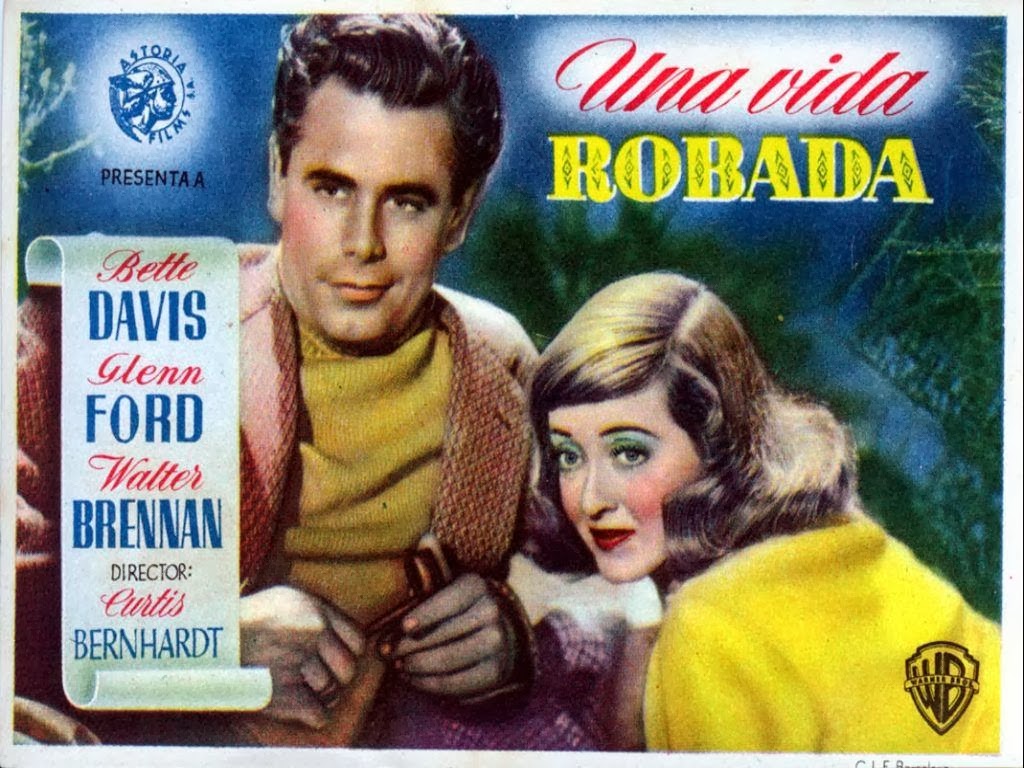
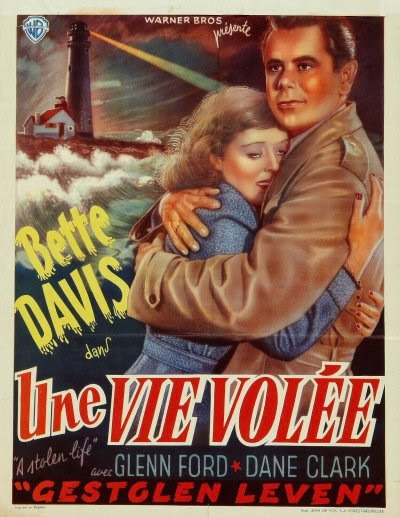
Two times the Bette Davis equals two times the passion in 1946's A Stolen Life. The inimitable Ms. Davis plays sisters Katherine and
Patricia Bosworth, twins who are identical in appearance, if not in temperment. We meet would-be artist Kate, on her way to an island off the Massachusetts coast. Having missed her connection, Kate asks for a lift from Bill Emerson (Glenn Ford). She is immediately attracted to Bill, a solitary man who loves the quiet island, and who has no real ambitions to live any other life but the one he already has. They seem an ideal pair until Pat Bosworth enters the picture. Once Pat realizes that Bill is attracted to Kate, she goes after him with a vengeance. The result, Bill marries Pat, leaving Kate bereft. We were all VERY impressed with Bette Davis in this dual role. She plays the two characters so that the sisters are subtly different. Patricia is perhaps more the Davis we are used to in films like Jezebel and The Letter - assertive, domineering, in-charge; Kate is more retiring and inward, more like the character Davis played in Now Voyager. It's easy to tell the sisters apart when they are separated, but Davis is able to make them different as they converse with one another. She never seems to lose focus of who she is portraying. And while the costuming by Orry-Kelly gives us slight clues, those differences
are also subtle, letting Davis do the work through her acting.
While Glenn Ford is very good as Bill, he does come across as a bit of a twit. It's clear that his attraction to Patricia is purely sexual. He states that he likes Kate, but that there was never a spark between them like there is between him and Pat. Yet, it's clear that Pat is his total opposite - where he is unambitious and wants a simple, country life, she is all about the city and excitement. Why Pat would want to do more than have a brief fling with him is a big question here. It's clear that she is gone off with her sister's beaus before. Does she want to marry Bill only because it is clear that Kate is finally in love? One wonders if Pat is interested in keeping her sister uninvolved (and therefore, closer to her) than in stealing her sister's great love. By marrying Bill, we know that Kate will never involved herself with him again leaving the sisters' relationship status quo.
The only character that is wasted in the film is Dane Clark as the artist Karnock. At first, it seems he might be the person who will make Kate forget Bill, but he is so eminently disagreeable, that it's hard to warm to him. Only in one scene, where he encounters Kate posing as Pat, are we allowed to find him even the slightest bit likeable. Unfortunately, the character never goes anywhere, and we were left wondering what the film would have been like if he had actually become involved with Pat.
On the other hand, Charles Ruggles gives a well-rounded performance as Kate and Pat's guardian, Freddie Linley. Though he says very little, his understanding of the sisters is obvious. He affection for Kate is also apparent. In the end, we discover he really is the only one who truly "knows" them. A quick nod also to Walter Brennan doing what he does best - being irascible; no one really does it better!
Bette Davis was a producer on the film, as is discussed in this TCM Article, and she had say in the casting. Dennis Morgan was originally considered for the part of Bill, but Davis would not have him in the part. The studio then suggested Robert Alda, and while she accepted Alda, she really wanted Glenn Ford. However, Jack Warner didn't want to pay the money for a loan-out from Columbia, until Davis was able to show him a screen test of Ford in the part. The film is actually a remake of a 1939 German film, starring Elisabeth Bergner (perhaps best known in the US for her role as Rosalind in the 1936 As You Like It).
Though A Stolen Life was not really admired by The New York TImes when it was released, we think it is a movie that has aged remarkably well. In this age of digital special effects, you will be amazed at what was possible in a 1940's film. You will totally believe that the twins are talking with one another. To give you a taste of what's in store, here is Bette talking to Bette:
 As I've mentioned before, when an extraordinary opportunity to see a classic film happens in the greater Washington DC area, I'm going to tell you about it. Recently, the National Portrait Gallery hosted a screening of Flying Down to Rio (1933), and there to comment on the film was TCM's own Robert Osborne. I was very excited to attend the film screening, as well as a reception for Mr. Osborne, who was kind enough to sign my copy of his latest book 85 Years of the Oscars. Add to this, the opportunity to ask questions about the film and to see the film on a big screen - it was an amazing night!