We've not had a lot of opportunities to view the films of Nancy Carroll, but when we've gotten the chance to see her, we are always surprised and delighted by this wonderful, virtually unknown actress. We had previously encountered her in an early Cary Grant film, Hot Saturday. This week, we viewed Child of Manhattan (1933), which stars Nancy as Madalaine McGonagle, a dance-hall girl who meets the hall's landlord, widower Paul Otto Vanderkill (John Boles) when he drops by the club to check out his property. Paul is enchanted by this little native New Yorker (she's got a fairly thick Manhattan accent), and within a short time, he has asked her to become his mistress (he doesn't want his family to know about their relationship). She agrees, and is immediately rejected by her mother and brother (both of whom were QUITE willing to accept Paul's beneficence when the relationship was not so open). In short order, Madalaine discovers that she is pregnant, and Paul agrees to marry her. But when the child dies shortly after birth, Madalaine is consumed with guilt.
Nancy Carroll had a long career - she began as a stage actress, going over to films in 1927 (she did appear on Broadway in the 1930s, at the height of her popularity). Among her notable film appearances was in Abie's Irish Rose, with Charles "Buddy" Rogers as her Abie. Her last film role was in 1938. She retired for awhile, but eventually transitioned to television for a few roles in the 1950s and early 60s. She also returned to the stage, and died at age 60 while performing in a play. She is adorable in this film - you like her Madalaine immediately, as Carroll has the ability to project innocence and goodness, even as she portrays a character who is NOT conforming to society's norms.
Another actor who is not as well known today as he should be is John Boles. We've discussed him before in our commentary on Craig's Wife, and he is best remembered for his role opposite Barbara Stanwyck, as her husband Stephen in Stella Dallas. Like Carroll, Boles started in silents, where he worked with actresses such as Gloria
Swanson. It's hard to imagine him not talking, though, his
voice is so mellifluous. His pre and post film career is also very interesting. He worked as a spy during the WWI; by 1943, he left films and went to back to work as a stage
actor (He was in the original Broadway cast ofthe musical One Touch of Venus with Mary Martin). He also went into the oil business. He and his wife were married for 52 years, until his death in 1969. Coincidentally, the Flick Chick just did a
wonderful commentary on John Boles, which we recommend to you. His portrayal of Paul gives a sympathetic and likeable character. Even when he asks Madalaine to live with him out-of-wedlock, it's hard to dislike him, as he always seems to care deeply for her.
There are some other performers in the film who deserve mention. First is Jane Darwell as Madalaine's mother. With her Irish accent, Mrs. McGonagle at first seems caring (though her willingness for Madalaine to accept a $1,000 gift from Paul is a bit suspect). Ultimately, though, Mrs. McGonagle disowns her daughter for openly consorting with Paul. But what we remember about her is that Mrs. McGonagle and son Buddy are interested only in the money that Madalaine provides to the house, not in protecting her. By going under Paul's protection, Madalaine leaves the house, and her income leaves with her.
If you blink, you will miss Betty Grable appearing as Madalaine's sister, Lucy. It's certainly not her first movie role, but it will be awhile before Grable becomes the superstar she would become. Buck Jones, however, as Panama Kelley, was a well-known western star of the silent era. At this point, he was attempting to recreate his career, and would go on to some success as a western star in the talkies. His Panama is a noble man, who deeply loves Madalaine and only wants the best for her. Sure, he's a bit common, but he is decent. Jones manages to make him engaging with very little screen time. Jones would die in 1942 after being burned in a horrific fire at the Coconut Grove hotel. Stories vary, but one says that his death was the result of his repeated efforts to rescue people trapped in the hotel. Is it true? We'll probably never know, but one would like for him to have this epitaph.
Interestingly, the 1932 Broadway play on which this film is based was written by the always wonderful Preston Sturges. Neil Hamilton was originally cast as Paul, but two weeks into filming, Boles replaced him. The reason for the switch is not evident. Both Carroll and Boles are costumed exquisitely by Robert Kalloch in this delightful little film. We recommend it highly!
The silence on our end was occasioned by a number of activities involving your humble scribe - one of which was her recent marriage. Now that we are back to our normal routine, we begin with a 1936 film. Snowed Under stars George Brent as playwright Alan Tanner, Genevieve Tobin as his first ex-wife Alice Merrit, and Glenda Farrell as SECOND ex-wife Daisy Lowell, all trapped in the mountains after a snowstorm. Alan Tanner is a successful playwright, however his latest play is proving to be a difficult nut to crack - he can't seem to get the third act written. He's retreated to a mountain cabin to write. His publisher is not convinced that Alan can complete the play, so he asks ex-wife Alice to go up and visit Alan, and possibly help him with the writing. She arrives to find Alan under siege from his would-be next wife (Patricia Ellis as Pat Quinn), Daisy, Sheriff Orlando Rowe (Frank McHugh), and Daisy's lawyer McBride (John Eldredge) - the latter two enlisted by Daisy to collect back alimony. Thus, a quiet weekend devolves into a loud, frantic mess. Quite frankly, this is a fairly stupid film. Sure, it's a farce, with lots of running around and slamming doors and yelling. While you want it to be a film version of the famous play Noises Off, what you get instead is a not-very-witty hodgepodge of romance and mayhem. There are so many good actors here, you would think they could pull something out of their hat to rescue this mess, but they can't. George Brent is given very little character to work with. Mostly, he is passive, with his various women throwing things at him. Genevieve Tobin has a little more to work with, and as a result is more enjoyable. But when you get to such usually fantastic actors as Frank McHugh and Glenda Farrell, one throws up one's hands in frustration. McHugh is downright annoying as Orlando, and Farrell is WAY too over-the-top as Daisy. You can't wait for the scenes with them to be over. It's rather hard to understand why Alan married Daisy (just as it is equally hard to understand his attraction to Pat). While both are attractive in their own way, they are equally hard on the nerves - a quality that is already visible in Pat. And Daisy's crudeness is clearly not of recent vintage.
Both Ellis and Tobin retired shortly after the release of Snowed Under - Tobin to marry William Keighley; Ellis to wed a Kansas City businessman. Both women had over 40 films credits when they left the industry, but neither had been able to rise to leading lady status. This TCM article provides some history for the film, as well as some information on the critical reception.
We end with a trailer which will give you a quick overview of the film. Next time, we turn back to the Pre-code era for a Nancy Carroll film.
Three Wise Girls (1932) stars Jean Harlow as Cassie Barnes, a small-town beauty who is sick of being badly paid in a local soda fountain so her boss can paw her. Encouraged by the success of a another young woman from town, Cassie moves to New York City, where she finds more of the same kinds of bosses. One day, she finally decks the latest sexually abusive boss, gets fired, but manages to get her pending pay with the help of Jerry Wilson (Walter Byron), a visitor to the shop. Cassie's life turns around when her inspiration for her move, Gladys Kane (Mae Clark) helps her get a job as a model. Cassie begins to date Jerry, not knowing that Jerry is a married man, and that her life is taking the same sad path as that of Gladys - in love with a man who can provide nothing but a fancy apartment.
The film is very reminiscent of the previously discussed Our Blushing Brides, which starred Joan Crawford as a woman facing challenges similar to those of Cassie. Harlow is quite good in her first starring role as a young woman with drive, but with scruples. Our introduction to her, as Cassie walks home after her date attempts to go too far, gives us an immediate insight into her character. We were also very amused at the scene in which she tries to get a job as a model. Her idea of how a model would walk is a hoot.
Marie Prevost is wonderful as Dot, Cassie's roommate. Dot is content to find happiness with an ordinary man and to live within her budget. Prevost's turn of phrase is always amusing, and she makes a good counterpoint to the more ambitious Cassie. It's a shame that Marie Prevost didn't have a more substantial career in the sound era. Though active in silent films (she made a total 121 silent films);
her career never really seems to have taken off in talkies. After 1933, offers began to peter off, and she found herself unable to get roles. She died in 1937, at age 38, the result of alcoholism and malnutrition. Interestingly, her sad life was one of the motivating factors for the creation of the Motion Picture & Television Country House and Hospital.
We also enjoyed Walter Byron as Jerry. He too started in the silent era, most notably in Queen Kelly,
starring Gloria Swanson in the title role. Byron had a fairly busy
career in the 1930s, but by the end of that decade, he was appearing
primarily in uncredited roles. So, in 1942, he retired. He died in
1972 at age 72.
It was enjoyable to see Andy Devine in a small role as Callahan, Jerry's chauffeur and Dot's love interest. And the lovely Mae Clark as Gladys was very good. One forgets that Mae did a lot more than get a grapefruit shoved in her face. She worked widely in the 1930s, in such films as Frankenstein (as Elizabeth), the 1931 Waterloo Bridge (as Myrna), and Penthouse. Later in her career, she worked in supporting roles and in television until 1970. She died in 1992 at age 81. Though the film was not as well received as the studio would have liked, as this TCM article points out, Harlow hit a popular note, and a star was born.
Though Loretta Young (as Gallagher, the young reporter with no first name) is listed as the star of Platinum Blonde (1931), it's Jean Harlow as socialite Ann Schuyler who steals the film. When reporter Stew Smith (Robert Williams) visits the Schuyler home to determine the validity of rumors about Ann's brother Michael, Stew is instantly smitten by the lovely Ann. She is less impressed, but when Stew is able to retrieve (and return to the family) some incriminating letters written by Michael, Ann discovers that Stew is appealing indeed. Their elopement is an anathema to her family, but Ann is determined to have Stew fit into HER world, whether Stew likes it or not. This is a very enjoyable film, with good performances by Jean Harlow and Robert Williams. As we mentioned, Young's name is above the title, but she doesn't stand a chance once Harlow shows up. Harlow's Ann is quite appealing, perhaps because she doesn't seem as upper class and snooty as the rest of the Schuyler family. This TCM Article discusses the problems Harlow had with sounding "sophisticated." She especially had some difficulties with the word "library". While director Frank Capra must have despaired at getting her to sound right, in the long run, it works in her favor. We want to like them as a the couple, despite the fact that Ann is doing all she can to make her young husband into an upper-class twit.
That this is a pre-code film is readily apparent by the relationship between Stew and Ann. It's really one of lust more than of love. Though Stew is clearly his own man, Ann is determined to tame him, and make him an appendage to her lifestyle. She has no clear understanding of his career goals (he wants to write a play, for one thing) and would be quite satisfied if he stayed home and played at being a society husband. Louise Closser Hale, a character actress we've admired before, is terrific as Ann's horror of a mother. Mrs. Schuyler couldn't be a bigger snob, and her disregard for anyone not in her social circle makes her unlikeable AND humorous. Her "consort" of sorts is Reginald Owen as lawyer Grayson. Grayson does all of Mrs. Schuyler's dirty work, and enjoys every minute of it. The character provides someone at whom Stew can direct his animosity, and Owen does an admirable job of keeping the character distasteful. Also well worth watching is Halliwell Hobbes as Smythe, the butler. We would expect this character (really, the only one in the house with any class) to be the worst snob, but Hobbes gives us a likeable fellow who really is open to all classes. The party scene in which he interacts with Stew's friends is a riot.
Robert Williams, who played Stew, is also delightful. This, unfortunately, was his last film. He died at the age of 37, the
result of peritonitis from a ruptured appendix. He had only made 7
films - two shorts and 5 full-length films (one a silent). We've
actually reviewed two of his talkies: Devotion and The Common Law. This film demonstrates his breezy style and screen presence. Though Ann is the one with most of the good clothing, our Loretta gets one smashing evening dress that takes your breath away. It's amusing that Stew specifically asks HOW she got a dress like that (on a reporter's salary). We wondered the same thing. The name of the costumer is not provided, but this dress proves his/her talents. Interestingly, the film was originally called "Gallagher" after Young's character, but was changed to demonstrate the power Harlow had in the film. Directed by Capra and written in part by Robert Riskin, it provides an early example of their collaborative genius. As we mentioned before, one scene that particularly stuck with us was the singing argument between Ann and Stew. As referenced in the TCM article above, it does seem almost improvised. It also appears that Harlow and Williams are having quite a good time:
This Modern Age (1931) stars a very blonde Joan Crawford as Valentine 'Val' Winters. Val has been raised by her recently deceased father, who has left her a small income and a very little information about her mother, Diane (Pauline Frederick). Diane, who now lives in Paris as the mistress of the very married André de Graignon (Albert Conti), has been absent from Val's life for many years (by court order). De Graignon has set Diane up in a lovely apartment and given her a very comfortable life style.
Curious about her mother, Val journeys to Paris. She is prepared to dislike the woman her father so abhorred; to her amazement, they love each other immediately. Diane, determined to find a place for herself in her daughter's life, hides her past (and her present) and invites Val to remain with her in the apartment. All is well until Val meets Bob Blake, Jr (Neil Hamilton), the son of a fairly snobby Boston family and they fall in love, much to the disdain of Mr. and Mrs. Blake, Sr. And there is the problem of De Graignon, who is none too happy with the enforced celibacy brought on by Val's presence. Though the pace of the film is a bit uneven - the middle seems very drawn out, while the ending is rushed and somewhat abrupt - this is an enjoyable movie. The characters of mother and daughter are well drawn, and Pauline Frederick is a sympathetic figure as the mother who doesn't want the life she chose for herself to impact her daughter. Since we never see Val's father, and Val doesn't say much about him, we questioned what she knew about her mother, and what her father was really like. All we know is what we learn from Diane prior to Val's arrival; we would have liked Val's opinion of him as well.
Joan Crawford is very good as Val. She is both innocent and intelligent. You believe that she is completely unaware of her mother's past. You also believe in her deep affection for this woman who has been absent for most of her life.
Also quite good is Monroe Owsley as Tony Girard. For a change, Owsley gets to play a nice guy, and his Tony is a doll. Yes, he drinks too much, but his genuine affection for Val is apparent. Though a superficial person, he doesn't have a mean bone in his body. He wants to love Val, but is so immature that he doesn't know how to love. Neil Hamilton does a good job making Bob attractive as well. When we are introduced to his family, it becomes hard to have a lot of regard for Bob, but Hamilton is able to keep you rooting for him. There is an implication that Bob might have been a bit of a mama's boy - as soon as his parents realize that Bob is seeing someone seriously, they arrive in Paris to check her out. One suspects they've been doing this to him for some time. Of course, Boston and Harvard (Bob's alma mater) become synonyms for snobbery in this story. A quick nod to the always talented Adrian for Crawford's magnificent dresses. Before we go, here is a snippet of the movie from YouTube, in which Val and Diane meet. Watch Diane's subtle change of expression as she is introduced to her unknown daughter. And take a look at Crawford's lovely white evening gown:
I've Got Your Number (1934) is a film about the telephone: repairing them, using them, working with them. It opens with a fascinating examination of the importance of the telephone in the 1930s - surely dated, but so enlightening. In an age where we carry our phones with us, to see the phone being demonstrated as a new technology for both good and ill is a revelation. As a native New Yorker, I also enjoyed the references to the old exchanges that, back in the day, told you the location of the phone (Nowadays, we carry our numbers with us, no matter where we live!)
The story is a simple one. Hotel switchboard operator Marie Lawson (Joan Blondell) inadvertently provides information to gangster Nicky (Gordon Westcott) that results in a financial loss for a guest. Marie is forced to resign when telephone repair man Terry Reilly (Pat O'Brien) determines the security breech was human rather than machine. Terry assists Marie in finding a new job. Only problem is, Nicky is planning to use Marie's new position in a financial office to steal some some securities. The film is a tad silly, but it is amusing. Terry and partner Johnny (Allen Jenkins) make telephone repair look like the most fun job in the world. And while we have some really great actors, the script doesn't give them a whole lot of time to flesh out their characters. Terry does a complete about-face when he meets Marie - going from roué to devoted suitor in about ten seconds,though O'Brien does a really good job at making the switch believable. And Blondell's Marie come across as very naive. How can she not know that Nicky is a snake, especially after the incident at her first job? She's awfully trusting of a man she doesn't seem to like all that much, yet she is obviously, from her banter with O'Brien, very careful of her appearance with men.
Wonderful supporting actors abound: We've already mentioned Allen Jenkins, who is, as always, a hoot. We also have Glenda Farrell as Bonnie, aka Madame Frances, a would-be psychic, who's not very good at it and Louise Beavers as her assistant. And the always wonderful Eugene Pallette as Terry's often frustrated boss, Joe Flood gives a fantastic performance as a man who wants to throttle the devil-may-care Terry, but, when the chips are down, is the first one to come to his defense.
We were not very familiar with Gordon Wescott. He made 34 films between 1931 and 1935, but died at the age of 32 from injuries sustained while playing polo. Another interesting bit of trivia - the last scene shows Blondell in bed. Well, she really WAS confined to her bed - she had just had emergency surgery, and the studio did the scene in Blondell's own bedroom! The book, Joan Blondell: A Life Between Takes states that the emergency was actually the result of a botched abortion. Released in January of 1934, this film just makes it into the pre-code era, and, as a result, it is quite risque - there is much double entendre. And the scene in which Terry lounges on a couch with Bonnie really needs no explanations. Orry-Kelly
does the film's costumes, and Joan Blondell has some wonderful dresses that no switchboard operator could afford. The dress with a fur collar is especially attractive.
The war is raging in England, and filmmakers rally to do their bit for the war effort. The results of one of those endeavors is That Hamilton Woman (1941), starring Vivien Leigh as Emma Hart, Lady Hamilton and Laurence Olivier as Horatio Nelson. The film was recently shown as part of AFI 100th Anniversary tribute to Vivien Leigh. Leigh, still basking in her post-Gone With the Wind fame gets top billing here, in this story of passion and devotion to country. Clearly, the love affair between Nelson and Lady Hamilton becomes an example of England's strength in the face of attack, with tyrant Napoleon standing in for dictator Hitler, and the lovers representing England giving up everything to preserve the nation. The story sticks pretty close to history - and juicy history it was. Told in flashback, this is the story of Emma Hart, the lover of Charles Francis Greville, who arrives in Naples to visit Greville's uncle, the wealthy Sir William Hamilton (Alan Mowbray). Hamilton is a lover of beauty, in music, in art - and in women. Unbeknownst to Emma, Hamilton has literally purchased her from his nephew. Within a few years, Emma, already the darling the English art circle, becomes the wife of Hamilton, as well as his hostess, and a major player in the Naples diplomatic circles. Enter Horatio Nelson, a young Captain of the fleet. Emma helps him approach the Queen of Naples for military assistance; afterwhich he departs. Five years later, he returns; this time, they find themselves deeply in love. Only problem is, both are married: Nelson's wife, Frances (Gladys Cooper) is at home in England. and quite naturally, she is none too pleased about her husband's involvement with the now notorious Lady Hamilton.
That the film is attempting to put the past into the context of the present conflict facing England is quite apparent. As mentioned above, the use of the term "dictator" in connection with Napoleon is a clear pointer to Adolf Hitler. Nelson, of course, stands in for all the men who would give their lives for the nation. while Emma stands in the for the women who will lose all they love in the fighting. The film even brings in some of the pictures done of Emma Hamilton: the picture on the left is used as an emblem in the film. Next to it is the original George Romney painting of the real Lady Emma.
The film caused some real consternation among some representatives in Washington, DC, who were eager to stay out of the war. They even went so far as to subpoena Alexander Korda. His appearance was to be on December 17, 1941, but the events of December 7th eliminated the need for his visit. This TCM Article goes into more on the history of the film.
This was the only film that the always wonderful (and so spectacularly beautiful) Vivien Leigh, and her equally talented spouse, Laurence Olivier did together during the period of their marriage. The film is also filled with splendid supporting actors. Gladys Cooper is excellent as Frances Nelson. The scene in which she sits down to knit as she is forced to converse with her rival, Emma, is great. Obviously, Ms. Cooper was a knitter - and her needles do as much of the talking as does her voice. Also good are Sara Allgood as Emma's lower-class mother, Mrs Cadogan-Lyon and Henry Wilcoxon as Captain Hardy.
As a knitter myself, I was interested to see the use of crafts to further our understanding of the main female characters. As mentioned before, Frances knits. Knitting, in the era, would have been a middle-class craft, used to create usable clothing for the members of the family. Knitting was no hobby here; it was a necessary skill to keep the family warm. Emma however, embroiders. Embroidery was an upper-class craft, used to create pieces of art. It was a hobby - an occupation for a woman who had no real work. The lower-class Emma has risen to the position of having no need to work, while Frances remains the middle-class housewife, despite her husband's rise in status.
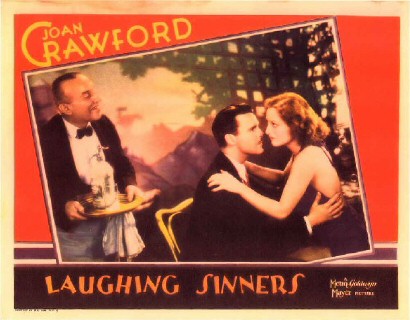
In 1931, a legendary film partnership began. Joan Crawford and Clark Gable appeared together for the first time in Laughing Sinners, a pre-code romance. We meet Ivy 'Bunny' Stevens (Crawford) in love - with Howard 'Howdy' Palmer (Neil Hamilton), a traveling salesman. It's quite clear that the two are lovers, and that Howdy has promised to marry Ivy (or Bunny, as he calls her). But while marriage IS on his mind, it's not marriage with her. He has decided to marry the boss' daughter, and coward that he is, he runs away, leaving her a note about his intentions. Some time later, Ivy tries to commit suicide, but is stopped by Carl Loomis (Clark Gable). Carl, a Salvation Army worker, encourages her to leave her current life, and become a part of his world. Giving to others, he feels, is what helped him to recover from the pains of a world that nearly destroyed him. Within a short time, Ivy too has become part of the Salvation Army. But then Howdy returns. That this film is from the pre-code era is instantly apparent. Ivy and Howdy are obviously having an affair; and a one-night stand is neither condoned nor condemned. And all that is required for forgiveness to happen is honesty on the part of the parties involved, and a true attempt at repentance. Because of Gable's forthrightness, Carl is shown as sympathetic and forgiving -
not preachy. He truly believes you can always
restart your life, and his talks center on living life squarely. God is not brought into the equation. Relatively speaking, the part of Carl is a small one, and we would have liked to have seen more of him. Gable gets third billing in the film - behind Neil Hamilton, and Crawford (whose name is above the title). By the time he films Sporting Blood that same year, he has begun to be listed first; by the following year, his name is routinely above the title.
The Salvation Army is portrayed
positively; and again, there is little emphasis on the religious aspects of the
organization. Rather, it is shown as a means of helping people get
through difficult times in their lives. The Great Depression, which was
still severely impacting the lives of Americans in 1931 is a major focus
of the film. Helping your fellow man is the means of both ending the Depression, and finding inner salvation.
As always, much of our conversation focused on Joan Crawford. She is so exquisitely beautiful in
this film, and her portrayal of Ivy is spot on. Crawford manages to touch gently on the dilemma faced by her character, and to make her likeable and sympathetic. Though her reformation requires that Ivy quit her job, she is never condemned for working in what appears to be a speakeasy.
The portrait painted of the traveling salesmen in the film, however,
shows them as carousing boozers. Again, the pre-code aspects of the film are obvious - the purchase of alcohol is still illegal in 1931, yet the salesmen buy it with easy. And since they seem to travel in bunches,
they egg one another into bad behavior. Laughing Sinners has a short, but tightly written script, based on Kenyon
Nicholson's play, Torch Song, which opened on Broadway on 27 August 1930. Guy Kibbee here reprises the role of Cass Wheeler which he originated in that
production, the only member of the cast to come over to the film (and Mayo Methot, who would become the wife of Humphrey Bogart, starred as Ivy). Interestingly, Johnny Mack Brown was originally cast as Carl, but bad previews
caused them to reshoot the part with Gable (for more information, see this TCM article).
For those of you who read Entertainment Weekly, you might have had the pleasure recently to read an excerpt of Mark Harris' new book Five Came Back: A Story of Hollywood and the Second World War. The book focuses on five directors: John Ford, Frank Capra, George Stevens, John Huston, and William Wyler, all of whom served in the military during WWII, and all of whom were involved in film-making within the armed services. Their war experiences, not surprisingly, colored their post-war films, and this book looks in detail at their work during and after the war. In conjunction with the book's release, AFI Silver featured a screening of the 1953 Shane, one of director George Steven's post-war films. Shane features an all-star cast: Alan Ladd as the title character, a gunfighter who is trying to escape his past; Van Heflin as Joe Starrett, Jean Arthur as his wife Marian Starrett, and Brandon de Wilde as Joey Starrett, a family trying to create a home on the frontier; and Jack Palance (here listed as Walter Jack Palance) as Jack Wilson, the gunfighter who is trying to drive them off their land. It's a fairly simple film: the Starett family is trying to build a farm on the prairie, much to the disgust of Rufus Ryker (Emile Meyer) a cattleman who claims rights to the whole valley. The lives of the Staretts and all the settlers have been made miserable as Ryker attempts to run them off. Enter the loner, Shane, who attempts to restart his life by working for Joe as a handyman. But given the environment, Shane soon finds that the only way he can help the family he has come to love is to return to his old occupation.
Interestingly, Ladd and Heflin were not the first choices for Shane and Joe. Montgomery Clift and William Holden were the first choice of director Stevens
for the roles of Shane and Starrett. When they were unavailable,
Stevens selected Ladd and Heflin who were under contract to Paramount. This article from TCM discusses some of the studio's attitudes towards the film.
Stevens was able to coax Jean Arthur (with whom he had worked on The More the Merrier) out of retirement for this, her final film role. Ms. Arthur is quite wonderful as Marian, a strong woman who loves her husband, but who is also attracted to the stranger in their midst. The scene in which she tries to decide what dress to wear - all but her wedding dress are work clothes - as Shane talks to Joey outside, is gently amusing and poignant.
Shane is shot in Technicolor, and while it's not a widescreen film, it has an exquisite use of color and vistas. The film emphasizes the size of the country through the use of widescreen shots. This serves to elaborate on the greed of Ryker, who desires so much land in an area that is so vast it surely could hold a few more people. Yet Ryker is given time to explain his need for the land. In fact, all of the characters are allowed an opportunity to explain their feelings about the range dispute, leaving us, the audience, to decide who is in the right.
And there are
quite a few characters: Elisha Cook, Jr., as Stonewall Torrey, a former
Confederate soldier with a bad temper and a deep thirst; Ben Johnson as
Chris Calloway, a ranch hand for Ryker who starts the film as Shane's
adversary, but who ends as his friend; Edgar Buchanan as Fred Lewis,
another of the settlers who fears the effects of Ryker's wrath. We also
have two familiar female faces in this group: Nancy Culp (Mrs. Howells)
and Ellen Corby (Liz Torrey) have brief moments as settlers' wives.
Ultimately,
though, Shane is a love story between a grown man and a little boy, and
Brandon de Wilde as the hero-worshiping Joey turns in a wonderful
performance. There is a real rapport between him and Ladd, and their
chemistry gives the film its strength. Sadly, after a career in
which he appeared in films such as The Member of the Wedding, All Fall Down, and Hud, de Wilde died in a traffic accident at the age of 30.
We leave you with a clip from Shane, in which the title character demonstrates the proper use of a revolver to young Joey. One thing to notice is the loudness of the gunfire - director Stevens purposely made the gunshots extra loud: "a gun is a tool," Shane tells us. But in a sense, it is a tool that destroys lives.
Perhaps the most interesting film to examine Hollywood is The Bad and the Beautiful (1952). Kirk Douglas plays Jonathan Shields, a would-be studio executive, who is broke and has successfully alienated everyone who might possibly have assisted him in a comeback. Jonathan is brilliant, he is inspirational, but he is also the biggest creep you could ever have the misfortune to meet. As Harry Pebbel (Walter Pidgeon) asks former friends Georgia Lorrison (Lana Turner), Fred Amiel (Barry Sullivan), and James Lee Bartlow (Dick Powell) to consider being part of Jonathan's next production, we are treated to three mini-movies, which reveal their particular relationships with Jonathan. Told in flashback, we already know that Jonathan has world has collapsed. But what we don't know is why these three renowned people - an Oscar winning director, a highly praised leading lady, and a Pulitzer Prize winning author - despise Jonathan. Slowly, we learn that Jonathan is completely obsessed with his own vision, and he will use his friends' strengths - and weaknesses - to get what he wants. But we also discover that each of the three became who they are because of Jonathan. Fred is a would-be director unable to get a job. He is meek, unassuming, and almost passive. Jonathan even takes the initiative to propose marriage to Fred's girl FOR Fred. But once Jonathan steals Fred's pet project, Fred learns to fight for what he wants. He becomes a power in Hollywood, and a success in his personal life.
Georgia, the daughter of a famed Shakespearean actor - and noted
drunk - is herself a drunk, who thinks nothing of sleeping around to
amuse herself. She is, by her own confession, a lousy actress, and she
has no ambitions. She both hates and idolizes her dead father, and has
hidden herself away from even the possibility of success, until Jonathan
enters her life. James Lee is a college professor in
Virginia, living quietly with his amorous wife Rosemary (Gloria
Grahame). It has taken him seven years to complete his first book,
primarily because Rosemary won't let him work. This story is perhaps the
most hard to deal with of the three. In order to allow James Lee time to work, Jonathan involves Rosemary with
film Lothario Victor 'Gaucho' Ribero (Gilbert Rowland), leading to both
their deaths. Left to himself, James Lee becomes a successful writer, but at what cost? Is the death of Rosemary worth the success he achieves? Or, is love and companionship more important than success?
Director Vincente Minnelli carefully weaves in nods to real Hollywood in this fictional tale. It's very apparent that the unseen George Lorrison (voiced by Louis Calhern) is modeled on John Barrymore; and that Georgia is loosely based on Diana Barrymore. Also, the filming of a horror film involving cat men is a nod to the 1942 film Cat People. But also alluded to, according to this article from SUNY Albany are such notable filmmakers as David O. Selznick, Alfred Hitchcock, Josef von Sternberg, Erich von Stroheim, Val Lewton, and William Faulkner. TCM provides a great deal of information on this film, including the fact that Clark Gable was asked to play Jonathan (he turned it down). Certainly, it would have been a very different role - Gable was much older (perhaps too old to play the younger Jonathan), and was also too likeable. Is it possible to loathe Clark Gable? This is a film with an amazing cast, both of leads and of extras. Kirk Douglas is electrifying as Jonathan. He conveys the small things as well as the big ones - his dislike, but love for his father; his admiration for Georgia's father; his fear of loving and being loved. Barry Sullivan, an actor who is usually not high on my list, is excellent as well. And Gloria Grahame as the modern day Scarlett O'Hara, Rosemary Bartlow, is stunning. (Her line, "You have a dirty mind, James Lee, I'm happy to say" is priceless.) Did Rosemary cheat on her husband? We'll never know, because Grahame paints such a beautiful, multidimensional portrait. And watch for bit parts from people like Barbara Billingsley and Ned Glass. This "Behind the Camera" from TCM discusses Glass' role in the film; Glass was a victim of the Hollywood Blacklist, and this film began his problems. Finally, also from TCM, a look at the critical reception of the film in their Critic's Corner.The film won five Oscars (from six nominations), as well as receiving accolades from the major critics. Before we go, a clip from the film in which Ned Glass as the costumer for "Doom of the Cat Men" demonstrates how NOT to dress a monster: