Wednesday, December 10, 2014

Reginald Hates Christmas

TCM hosted another Fantom Event this weekend - a double feature of two excellent Christmas films.  I'll be posting about both of them, starting with the 1938 A Christmas Carol, starring Reginald Owen as Ebenezer Scrooge.  A later post will deal with the second feature on the double bill.

In the spirit of total honesty, I'm going to admit right off that my favorite Christmas Carol is the Alistair Sim version from 1951.  My husband is a fan of The Muppet Christmas Carol (Michael Caine as Scrooge).  And I have a fondness for Mr. Magoo's Christmas Carol as well (I love the music).  But this version, with Gene Lockhart as Bob Cratchit, and real life wife Kathleen Lockhart as Mrs. Cratchit is excellent (oh, and there is also young daughter June in an unbilled appearance as Belinda Cratchit).  It does alter the book in many respects.  We get much more exposure to Scrooge's nephew, Fred (Barry McKay) and fiance Bess (Lynne Carver) than in the book.  That's not a bad thing, but does skew the story a bit.  We also have an incident in which Scrooge fires Bob Cratchit on Christmas Eve (for hitting him with a snowball).  THAT is a big change from the book, and very much changes the dynamic of the story.  While we gain a more preoccupied Bob, we lose so much of his Christmas spirit - remember that, in the book, to the dismay of Mrs. Cratchit, Bob insists on toasting "Mr. Scrooge, the founder of the feast" in the Christmas Present visit.  This Bob has no reason to toast Scrooge - and does not.  To my mind, the elimination of this brief dialogue is unfortunate, because, in one sentence, you can appreciate the genuine goodness of Bob Cratchit.
That being said, seeing A Christmas Carol in a theatre is a moving experience.  Reginald Owen plays Scrooge as a man looking for redemption.  Certainly, it is a short film (only 69 minutes.  Both the Alistair Sim version and the Muppet version are 85 minutes), so Owen doesn't have a whole lot of time to accept his future, but he is believable as someone who faces his destiny and resolves to be a better person.

Owen was not the first choice for the role.  For years, it had been performed on radio by Lionel Barrymore, and MGM was eager to have him recreate the role on screen.  However, Barrymore broke his hip on the set of Saratoga, and was unable to participate in the film.  Always a gracious man, Barrymore consented to do the trailer for the film (as this TCM article points out, in the 1930's, Barrymore WAS the character of Scrooge to the general public), and handed over the radio broadcast for 1938 to Reginald Owen, so there would be no unfair comparison.  Though bitterly disappointed that he would be unable to enact the part, Barrymore suggested Owen for the role, and supported his substitute as much as was possible.  Interested in hearing Mr. Barrymore's interpretation? Old Time Radio has a recording of the Campbell Playhouse production, hosted by Orson Welles.
I'll end with the beginning of the Scrooge's journey towards redemption.  Pictured above is Leo G. Carroll as the Ghost of Jacob Marley.  I felt that Carroll played to the ambiguity of the character - Marley, a selfish and grasping man in his lifetime, reaches out to his old partner to try and help him to avoid Marley's fate.  Will Marley receive some heavenly brownie points for this effort? It's not clear from the dialogue between the two, but Carroll's is on a man more concerned with his old friend than with any credit he will garner.  See if you agree.

Here's the trailer, with commentary from Lionel Barrymore, himself.

Monday, December 1, 2014

Lauren Has Designs on Gregory

The theme of marrying in haste and repenting at leisure is again explored, this time in Designing Woman (1957), a romantic comedy starring Gregory Peck and Lauren Bacall.  Peck is Mike Hagen, a sportswriter who is on assignment in California.  He's been out drinking, and awakens hung over and unable to recall whether he filed an important story.  Later that day, he re-meets Marilla Brown (Bacall), with whom he spent his night of drinking.  She, however, stayed sober, helped him to write his story (and filed it), AND has been carefully holding the $700 he gave her in his stupor.  They spend a romantic two weeks together, and end their vacation by marrying.  Mike is blissfully unaware of pretty much anything about Marilla, but on the plane ride home, after she excuses herself and returns in a high-fashion dress, he begins a learning experience.  Marilla is a highly respected, and highly paid, fashion designer.  Mike's shabby apartment would fit into Marilla's bedroom, and Marilla's friends are NOT the kind of people with whom Mike associates.  Thus, their newlywed bliss begins to deteriorate as each is forced to inhabit the world of the other.
Some interesting background information on Designing Woman is available from this TCM article.
Originally, Grace Kelly and James Stewart were slated for the leads, but then Grace got married, and Jimmy opted out (He had really wanted to work with Kelly; after the film's release, he said he was sorry he had turned down the role). Bacall consented to do the role, despite that fact that her husband, Humphrey Bogart, was dying.  Bogart encouraged her take it; he died four months before the film's release.  Gregory Peck commented on her professionalism during this trying period in his tribute to Ms. Bacall.

The story for the film came from Helen Rose, the costumer for the production.  The wardrobe here is outstanding.  Bacall's quick change in the plane from tourist to professional is one noteworthy example of Ms. Rose's talent.  The costume defines the character for the audience - Marilla's flair skirt and casual blouse change to a tailored dress and matching hat.  Another example is her costume for the scene in which she meets Mike at the fights.  Her professional outfit immediately places her as a fish out of water in this extremely funny episode.  One of my group recalls seeing pieces of Ms. Rose's personal wardrobe, which were donated to the Fashion Institute of Technology in New York City.

Another thing to notice in the film is the amazing set decoration; the contrast between Mike and Marilla's apartments quickly establish the conflict that is to come.  And Marilla's apartment is a showpiece - down to exquisite door knobs (with star decorations on them).
A few words on the always fantastic Gregory Peck.  In Gregory Peck: A Biography, by Gary Fishgall,  the author relates that after seeing Peck's reaction to having a plate of ravioli dumped in his lap, George Burns - no slouch when it came to reacting to the ridiculous - was "in stitches".  Peck's responsed that it was "worth as much as the Academy Award" to have made Burns laugh. 

Besides Peck and Lauren Bacall, the film has an excellent supporting cast. Dolores Gray (Lori Shannon) was familiar to some of us from her appearance as the television personality Madeline Bradville in It's Always Fair Weather.  But Ms. Grey had a very limited film and television career - only 10 credits appear in IMDB, but two of her films are noteworthy: Sylvia (the Rosalind Russell role) in The Opposite Sex and Lalume in the 1955 version of Kismet.  However, Ms. Grey had an exceptional career on Broadway, winning the Tony for her appearance in Carnival in Flanders (she also has the record for winning a Tony a play with the shortest run - 6 performances!).  She gives us a memorable character in Lori, one that can stand toe-to-toe with actors of the caliber of Bacall and Peck.

Jack Cole, who plays choreographer Randy Owens was perfect.  Without giving too much away (slight spoiler here), the image of Randy taking down a cadre of villains, including Chuck Connors (as gangster Johnny O), who is twice his size, is an absolutely perfect touch.  It was one of my favorite scenes in the film.

Many TV favorites are featured in the film, including the aforementioned Connors, Edward Platt, the Chief of CONTROL from Get Smart as gangster Martin J. Daylor, Richard Deacon (Mel Cooley from The Dick Van Dyke Show) as a newspaper reporter, and Dean Jones in a small role as an assistant stage manager.

The film employs narration from Mike and Marilla to tell much of the story.  It's a interesting technique, and works well.  We leave you with this clip from the film, in which Bacall and Peck have a row:

Friday, November 28, 2014

Ms. Blondell's Sorta Engaged

We were in the mood for a comedy this week, so we selected Kansas City Princess (1934), starring Joan Blondell as Rosie Sturges and Glenda Farrell as her best friend, Marie Callahan.  Though technically this film was released after the Code was being enforced, it has a lot of the earmarks of a pre-code film.  For one thing, our two heroines are clearly on the make for rich husbands, at whatever cost, and they are usually up to hijinks that hint at  the risque.  The movie was filmed in the pre-code era, and originally set for a July release (making it on the borderline of Code enforcement), but Joan Blondell was pregnant (with son Norman S. Powell - the biological child of her first husband, George Barnes, but adopted son of second husband Dick Powell), so the studio opted to wait to release the film until October, after her child's birth.  This TCM article gives a quick overview of the film's history.

The plot is fairly simple.  Rosie is seeing petty gangster Dynamite Carson (Robert Armstrong), much to the disgust of Marie, who thinks Rosie can get a more wealthy husband.  Dynamite presents Rosie with an engagement ring, but Rosie isn't quite sure (thanks to Marie) that she WANTS to be married to Dynamite.  So, she goes out on a date with Jimmy the Dude (Gordon Westcott), who appears to be wealthy, but, it turns out, is an even more petty thief than Dynamite.  Jimmy proceeds to steal Rosie's engagement ring, which forces Rosie and Marie to skip town, rather than tell Dynamite how the ring was stolen.  The girls disguise themselves as Outdoor Girls of America (shades of The Major and the Minor!) to board the train, then manage to get two men to pay their boat fare to Paris, after they get "stranded" on the ship.  However, Dynamite is in hot pursuit, having discovered his ring in Jimmy's possession.

In one of the three films in which they appeared together, Glenda Farrell and Joan Blondell make a fun team.  Their chemistry is good, and both can talk at the speed of light - Farrell especially is adept at the rapid dialogue, as noted in the article above.  We were amused at the change in mores from the 1930s - our leads are manicurists, and have opted for that occupation because they are more likely to meet wealthy men (something that we are not as used to in the 21st century.  The nail salon has become the haven for women, and not even wealthy women).  We've noticed this before, primarily in Hands Across the Table, but it is still an interesting cultural phenomena.

Robert Armstrong's Dynamite is not the brightest bulb in the pack.  It never occurs to him that Jimmy stole the ring from Rosie (and he lets Jimmy keep it!).  He blithely assumes Rosie is engaged to him (he never really ASKS her to marry him - he just presents her with a ring, which he shoves on her finger).  The biggest flaw in the character is that he just isn't really all that scary; he's more stupid and obsessed and tenacious.  One rather think that the much smarter Rosie could deflect his interest without a great deal of effort, if she wanted to.
Before we go, a few words on two of the supporting players.  We have Hugh Herbert as Junior Ashcraft, a benign, albeit wealthy idiot who serves as a means to get Marie a wealthy husband.  At least Herbert wasn't clapping his hands all the time (as you can tell, I'm not a fan).  The other is Osgood Perkins as detective Marcel Duryea.  We had never seen Mr. Perkins before, so it was interesting to finally see the father of actor Anthony Perkins.  He's good here, though a bit slimy (but he is supposed to be offputting).  Perhaps we will get to see him again, though he had a very short film career - appearing in only 21 films before he died of a heart attack at age 37. 

We leave you with a scene from the film.  Gotta love the Pre-codes!
 

Thursday, November 20, 2014

Ray is Haunted

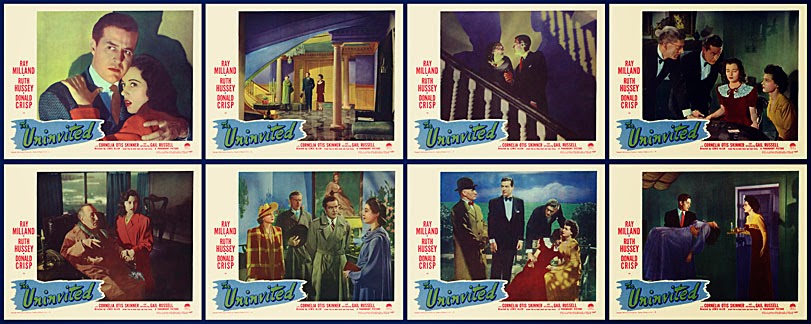
This week, we revisited one of my favorite movies, the suspenseful The Uninvited (1944). Ray Milland stars as Roderick Fitzgerald, a music critic for a London newspaper who is vacationing on the Cornwall coast with his sister Pamela (Ruth Hussey).  Rick and Pam are NOT rich.  They have enough money to get by, and some small savings, but on this fateful day, they encounter a wonderful old house that apparently has not been inhabited for some time.  The house reminds the siblings of their childhood home, the view and seaside location are breathtaking; the Fitzgeralds decide immediately to pool their savings and try to buy the house.

To their surprise and delight, Rick and Pamela find that the owner of Windward House, Commander Beech (Donald Crisp), is eager to sell the house at a price they can afford.  However, it is over the loud protests of his young granddaughter,  Stella Meredith (Gail Russell).  The brother and sister take possession of their new home and Rick finds himself becoming involved with the "sleeping beauty" quality that is Stella Meredith.  But before he can move in, Rick must return to London to settle affairs with his employer.  When he returns, he finds Pamela's dog, Bobby, has run away, and Pamela seems tense and withdrawn.  That evening, Rick's first in Windward House, all becomes clear.  The sound of a woman sobbing reverberates through the house.  Only no one is there.

The fabulous thing about this film is that it never denies the existence of ghosts.  It doesn't end by having all the fantastic occurrences explained away by natural phenomena.  The house is haunted; there are ghosts, and while ghosts can be either good or evil, they remain on earth for a reason. And that goodness or evil is a reflection of their human personality, not something that came after death.  It is up to the mortals to determine WHY the ghosts are in the house and try to satisfy them, so both ghost and mortal can at last have peace.  This TCM article goes into more detail on the unique nature of this film.
As the article mentioned above states, by today's standards, this is NOT a scary film - no one gets killed in some particularly gory manner, nor are there long chase scenes by a masked stalker with a chainsaw.  But what there is is a delightfully eerie feeling - enough to put you on edge and keep you there.  Much of this is thanks to the acting, especially the remarkably talented Ray Milland and Gail Russell.  Milland is able to give Rick a controlled panic - he's just invested his life savings in a house that may be uninhabitable, and the girl he loves is dangerously attracted to a house that seems to want to harm her.  And so as Rick, Pamela, and Dr. Scott (Alan Napier) begin to investigate just WHAT causes spirits to stay at Windward House, and why they would want to harm Stella, Milland remains the focal point for the audience.  He is our anchor to reality and our connection to the supernatural; we trust the ghosts are real because HE believes it.

Which brings us to Gail Russell.  Much has been written about her beauty and her sad, short life.  An alcoholic, originating from her severe stage fright (and probably started while filming The Uninvited), she ended up dead at age 36 from malnutrition and liver disease.  (This Los Angeles Times history outlines Ms. Russell's unfortunate life).  But her history should not detract from her performance.  Her Stella is delicate, but determined; innocent yet wise in many things.  She is the glue that binds Rick to Windward, she is the song he composes.  Who can hear "Stella by Starlight" and NOT see Gail Russell's lovely face rise as the inspiration?  She gives Stella a heart that makes you want her to finally live in the house she loves, and find the man of her dreams.  In some senses, she is the soul of The Uninvited.

If Stella is goodness incarnate, then Miss Holloway, as portrayed by Cornelia Otis Skinner is the human link to pure evil.  The dear friend of Stella's mother, Mary Meredith, Miss Holloway hates Mary's daughter with the same passion that she adores Mary.  As the TCM article above mentioned, there is a lot in common between Miss Holloway and Rebecca's Mrs. Danvers, not the least of which is both of their overtly sexual obsession with a long-dead intimate.  Ms. Skinner, a noted stage actress and author, had a very limited screen career - only four films (one silent) and several appearances on television. She's wonderfully spooky here, letting the viewer glimpse the madness that is underneath her calm exterior.

There is another rarely seen actress, Dorothy Stickney as Miss Bird, a resident at the Mary Meredith home.  Though Miss Bird is supposed to be the one who is sick, she seems a lot saner than Miss Holloway!  We'd seen another one of Ms. Stickney's rare film appearances - she appeared as Henry Fonda's obnoxious mother in I Met My Love Again.  Ms Stickney had a very distinct voice, which led to her portraying a number of eccentrics on film and on stage.  She had a long career on Broadway, from her debut in 1926 in The Squall to the mid-1970s, when she appeared in Pippin (assuming the role of Pippin's grandmother after Irene Ryan's sudden death).  Of her many stage roles, two are worth mention here:  in 1928, she played Mollie Malloy in The Front Page and, beginning in 1939, she appeared as Lavinia in the original production of Life with Father.  She was, in fact, in that play for its entire run (til 1947), following it up with a short run, again as Lavinia, in Life with Mother.  Ms. Stickney died in 1998, just shy of her 102nd birthday.
The film was given a well-deserved cinematography nomination by the Academy of Motion Picture Arts and Sciences (it lost to Laura), but interestingly, the song "Stella by Starlight" was not even nominated, nor was the film's score. The songs that were nominated include some standards like "The Trolley Song" (Meet Me in St. Louis), "Long Ago and Far Away" (Cover Girl), "I'll Walk Alone" (Follow the Boys), and (the winner) "Swingin' on a Star" (Going My Way).  Regardless, "Stella by Starlight" became a popular and jazz favorite, performed by such artists as Frank Sinatra, Ella Fitzgerald, Sarah Vaughan, Ray Charles, and Miles Davis.

Though it appears that the NY Times' Bosley Crowther was not paying attention during his viewing of the film in 1944, we know you will enjoy it.  We'll leave you with a trailer from this wonderful fillm.

Monday, November 10, 2014

Olivia Loves a Thief

TA. J. Raffles (David Niven) is a young man of society - a well-known cricket player and man about town. Though Raffles has no real income, he lives quite well.  He supports himself with his hobby - in his spare time, he is the notorious Amateur Cracksman, a thief who has been bedeviling the local police.  Thus begins the fourth remake of Raffles (1939).

The film had already been made in 1917 (as Raffles, the Amateur Cracksman, with John Barrymore), in 1925 (with House Peters) and in 1930 (with Ronald Colman).  We were lucky enough to see some commentary from Robert Osborne, and he mentioned that this version was an almost scene by scene recreation of the Colman film.  Director Sam Wood (who had just come off Gone With the Wind) was too tired to waste effort on a new version, so he just cribbed from the Colman version.  This TCM article goes into a bit more detail.  We hope, at some later date, to view the 1930 Colman film and compare those two films.

Also fresh from Gone With the Wind was Olivia de Havilland, who was assigned to play Gwen Manders, Raffles love interest.  Ms. de Havilland had little interest in the role - it was mere window dressing to Niven's more rakish part (Cary Grant actually pursued the role of Raffles - he even offered to lower his normal salary).  Her disgust at being forced into roles that she viewed as inferior was the impetus for her eventual suit against the studio system.  For more information on this story - and it should be noted that Ms. de Havilland was a leader at great cost to herself in this protest - see this interview at the Academy of Achievement. 
So, while Olivia doesn't have a whole lot to do here (except be intelligently gorgeous, which is also quite a skill.)  Her Gwen is no dummy, and Ms. de Havilland can show you with just the merest glint in the eye what is going in within Gwen's head), David Niven shines.  He is quite dashing as A.J.  Our group found the film quite reminiscent of To Catch a Thief, and were fascinated by Cary Grant's interest in Raffles.  It seemed to us that, while it took nearly 20 years, Mr. Grant DID finally get to play The Amateur Cracksman. 

Many films from the period portray the police as complete dolts.  Not Raffles.  The police inspector MacKenzie, played by Dudley Digges, is a worthy adversary to Raffles, and someone that Raffles respects.  In fact, it is a mutual admiration society - MacKenzie also admires The Amateur Cracksman's skill and daring.  Nevertheless, MacKenzie is determined to put him behind bars. 

There is an attempt on the part of the screenwriter to make Raffles a more attractive - and admirable - character.  At least twice we see him steal in order to help someone else.  In the first scene, he snatches a piece of art, then secretly presents it to a retired (and hard up) actress, so she can collect the reward. This bit of Robin Hood in the character is surely meant to placate the code - we can't quite condemn him when the only thefts we see are those that help a destitute old lady and his future brother-in-law, Bunny Manders (Douglas Watson).
The screenplay is very well done, and there are some well-crafted scenes.  In one instance, Raffles needs to get down to the first floor of Lady Melrose's (Dame May Whitty) home.  However, he knows Inspector MacKenzie is hovering around his door.  His solution, to pretend to put his shoes outside the room, is done in total silence.  It's an effectively done sequence, and David Niven is quite excellent in his execution.  Also fun was Raffles attempt to stash a stolen bracelet in a humidor. Only he doesn't realize that Inspector MacKenzie is a pipe smoker.   And the Inspector has forgotten his tobacco. Finally, there is a wonderful bit where Raffles realizes another thief is in the house. Niven's relish at getting the best of his competition is delightful. 

All in all, a fun film well worth a viewing. We leave you with a clip from the beginning  of Raffles:


Monday, November 3, 2014

Fay's a Lawyer

Sometimes watching a film so firmly set in its own time can be almost painful for a modern audience.  Such is the case with Ann Carver's Profession (1933).  Fay Wray plays Ann Carver, who has married her college sweetheart, "Lightning" Bill Graham (Gene Raymond) after both have worked their way through advance degrees - he as an architect, she as a lawyer.  Though Bill was a football hero in college, the real world places him into an architectural firm, where he gets to do the scutwork for very little money.  Ann has been unable to even find a job.  She's frustrated and Bill is eager to help her find a position.  So, when an evening arises in which he can sing his wife's praises to the head of a law firm, he does so, and Ann takes it from there, providing some advice that results in the firm's winning an important case.  Ann is on her way.

It's at this point that film becomes annoying.  There is no middle of the road for Ann.  As a successful lawyer she is selfish, rude, smug, and an all-around heel.  She becomes the stereotypical career woman - a man-eating viper who cares for nothing but her success.  SHE purchases a large house.  SHE hires many servants (why does a young married couple need a maid, cook, and butler anyway?) - Bill is not consulted.  After all, SHE controls the purse strings.  When she is forced away on business, Bill can't pay the staff - he has no access to HER funds.  All in all, he is humiliated in every way, and Ann, of course, is oblivious to his needs.  HER job comes first, especially since she is the big wage earner.

The biggest problem with the character of Ann is that she is so exaggerated. Her shift from frustrated housewife to power lawyer is dramatic and unrealistic.  This basically nice woman becomes a harridan for no real reason,other than absolute power corrupting absolutely.  It doesn't help that her rise to fame is so unrealistic - within a few weeks of being hired, she is a headline-making, major player in her law firm.   
Of course, this is a precode film, so we have a scene with Ann and Bill snuggling in their big double bed.  There is also Bill's "relationship" with Carole Rogers (Claire Dodd).  The consensus among our group was that there was a brief fling between the two;  however, Bill is ultimately disgusted with Carole's drunkenness and lewdness.  In spite of the affair, it's still hard to work up much sympathy for Ann.  She treats Bill as an appendage - someone to bring her to important work-related dinners - not as a husband.  Appearance is all that matters to her, and when Bill decides a career change will bring him more money, Ann is horrified - what will people think of HER with a "crooner" as a husband? 

We suspect not a lot of attention was paid to Ann Carver's Profession, as it was released the same year as another film starring Ms. Wray - King Kong.  She had already ventured into the land of horror that year (with The Vampire Bat and Mystery of the Wax Museum), but with the popularity of Kong, Ms. Wray became a staple in the genre, and was often called The Queen of Scream. 

Regardless, she had a long career - she appeared in films and on television as late as 1980.  Interestingly, she would marry the screenwriter for Ann Carver's Profession, Robert Riskin, in 1942.  They had two children and were together until his death in 1955.  Fay Wray died in 2004, at the age of 96.  

We'll close with a clip from the 1998 Oscars with Billy Crystal. A tribute to King Kong was part of the entertainment that evening, and Mr. Crystal surprised Fay Wray by introducing her from the audience.  

Oh, and Ruthelma Stevens was barely findable as a party guest.  A shame really...

Monday, October 27, 2014

Adolphe's on Vacation

New York City District Attorney Thatcher Colt (Adolphe Menjou) is tired.  He needs a vacation badly, and the only way to get one is to go away and not tell anyone his destination.  So, he throws a dart at a map of NY State, and settles on a small upstate town.  He arrives to find the circus is in town, and with it the mystery of murder attempts on the life of star aerialist Josie La Tour (Greta Nissen).  Thus, The Circus Queen Murder (1933) brings Thatcher and his secretary Miss Kelly (Ruthelma Stevens) very far from a restful countryside.

The Night Club Lady was made the previous year, and was intended to be the first in a series of three movies about DA Thatcher Colt.  However, Circus Queen Murder was the only other one that was made.  It's not really clear why, though perhaps the enforcement of the Production Code played a part in it.  Eventually, Thatcher Colt returned in 1942's The Panther's Claw (starring Sidney Blackmer).  This TCM Article goes into greater detail about the films.
None of us was familiar with Ruthelma Stevens (pictured above), who played Miss Kelly, Colt's secretary, confidant, and more-or-less love interest (he can't go on vacation without her...)  She's excellent in the film; in fact, she is the most appealing part OF the film.  She is a strong actress, with an interesting voice and appealing, intelligent face.  She appeared mostly in B films and in small parts in major films (like The Fountainhead and The Scarlet Empress), as well as on Broadway.  She died at age 84 in NYC.  Though Ms. Stevens is the person you most remember, it is not her that is pictured on the poster - that honor goes to Greta Nissen.   The poster makes it appear that Thatcher Colt is involved with Ms. Nissen, which he most definitely is not.

Another notable actor in the film is Donald Cook, who is best known as James Cagney's brother Mike in The Public Enemy. Featured here as Josie's love interest Sebastian, the character comes across as a gentleman, who is gutsy enough to risk his own life to protect his lover.  And though Josie is married, it's really hard to condemn her for loving Sebastian.  Her husband Flandrin (Dwight Frye) is an insane stalker.  (Of course, this IS a precode film...)  We've seen Cook before as one of Barbara Stanwyck's lovers in Baby Face; he's not the strongest actor ever, and while he is good, he is not the character you will best remember from the film.  It's a well known fact, that he was originally cast in the role of Tom Powers, in The Public Enemy, however Cagney so completely blew him off the screen that the parts were reversed.  Though Cook's film career did not go much beyond the 1940s (he made a few film in the 50s),  he had a substantial career on Broadway, appearing in 20 plays, most notably in The Moon is Blue.  He died in 1961, at age 60.

There were several bits in the film that we found quite intriguing.  First was the use of a bulletproof vest!  Though we were unaware of it, bulletproof vests were being developed as early as 1561.  Also, the film establishes quite early that Miss Kelly is quite proficient at reading lips, a talent that will be important to the film action.  Unfortunately, the one bad aspect of the movie was the tendency to telegraph quite early later action: for example, the knife thrower has the vest to protect his target, so we are waiting for it to be used.  So too the film's title also gives away too much information.

The one aspect of in the film that was a bit off-putting were the circus cannibals.  It turns out, they were a much larger feature in the book on which this film is based - in fact, their chief helps Colt investigate the threats against Josie.  We felt they should either have been eliminated or put to better use.   

All in all, though, we enjoyed the film.  And we enjoyed Ms. Stevens enough that we'll be viewing another of her films next time.

Wednesday, October 22, 2014

Kay Flies

Kay Francis takes to the air as Janet Steele in Women in the Wind (1939), a film that looks at flying from a woman's point of view.  Janet Steele has been nursing her brother, Bill (Charles Anthony Hughes), an aviator who was injured in an air accident, and requires expensive surgery to save his life.  Janet, a flyer herself, decides to enter an air race to win the funds necessaryfor Bill's surgery.  She approaches Ace Boreman (William Gargan), an arrogant ladies' man (and friend of her brother's), to enlist his support (she needs a plane!).  Of course, they fall in love.  But there is a wrinkle.  It turns out that Ace's Mexican divorce from his wife, Frieda (Sheila Bromley) is not legal in the United States.  And SHE wants his plane as well.

Obviously, we love Kay Francis, and she is (as always) just fine in this picture.  As we've mentioned before, Ms. Francis was tarred with that Box Office Poison list that also affected Katharine Hepburn, Joan Crawford, and Norma Shearer.  Warner Brothers had tried to buy Ms. Francis out of her contract; when she refused they stuck her in a bunch of unappealing roles.  Women in the Wind was her last film under that WB contract.  (This TCM article goes into greater detail).  But this film is not really all that bad for a B picture - what we lose are the glorious costumes that usually grace Ms. Francis' films.  While Orry-Kelly is listed as providing the gowns, Ms. Francis spends most in work clothing, which very much become her.  And Eve Arden (as Kit Campbell) looks fantastic in the riding pants that she sports for a good part of the film.
This is not a complicated or deep film, but it has the feel of being about ordinary people in extraordinary situations.  The characters (especially the women) are so precisely drawn, it makes the movie better than it should have been.  You end up liking many of the characters, and even those that were not likeable are interesting enough that you want to see them again.  Much of this, of course, is the acting.  With strong character actors like Eve Arden, Eddie Foy, Jr (as Denny Corson), and  Victor Jory (as Doc), the ordinary dialog sparkles.  

We especially liked the way the film portrayed the relationship between Janet and Kit; in fact, for the most part, the picture gives us a glowing view of sportsmanship in the aviation race, both among men and women.  There is, of course, the rotten apple of Frieda, but even she comes through in the end.

One odd bit of film editing occurs mid-film.  A mechanic has tinkered with Janet's plane, causing it to leak gas.  This forces Janet to land in the middle of a field, and try to obtain some gas from a local farmer.  As the plane leaks, the editor keeps cutting to the leaking part.  Then, after Janet gets gas and takes to the air a second time, there is a quick cut to the damaged part.  It doesn't seem to be leaking, but still, our immediate reaction was "oh, no, it's going to leak again".  But, the it doesn't.  And Janet's subsequent problems are totally unrelated to her gas line.  And we can't leave out another continuity error.  When Kit's plane crashes, she comes out of it all neat and clean and uninjured, despite the fact that we see the plane burst into flames.  Ms Arden said in her autobiography that, much to her dismay, "the audience howled" at what was supposed to be her big dramatic scene.

One interesting bit of background (from the article cited above) - the character of Denny Corson was based on Douglas "Wrong Way" Corrigan, a flyer who was SUPPOSED to fly from New York City to Long Beach, California, but instead flew to Ireland.  He had asked for permission to fly to Ireland, but it was denied, so he "made a mistake" and went in the wrong direction.  Though Corrigan never admitted to purposefully going against orders, most historians believe he wasn't such an awful pilot that he couldn't see the difference between water and land.

We leave you with a trailer from the film:

Thursday, October 16, 2014

Grace Sings to Franchot

Grace Moore was a Broadway performer and Metropolitan Opera star long before she began to make films.  She has been credited with popularizing opera on screen, and was important enough to the film community that she was given equal billing to Maurice Chevalier (which he did NOT endorse.  In fact, it drove him from Hollywood), and was often given over-the-title billing as MISS Grace Moore.  Any film featuring Miss Moore is bound to contain many songs, and at least one operatic number.  Thus, The King Steps Out (1936) gives us Miss Moore (as Elizabeth/Cissy) singing her heart out to Franchot Tone (Emperor Franz Josef)

The plot is fairly simple.  Cissy, the daughter of Maximilian, Duke of Bavaria (Walter Connolly) is a free spirit who would rather be out in the woods than in the palace.  Her older sister Helena (Frieda Inescort) is in love with Captain Palfi (Victor Jory).  But with 6 daughters to marry off, the Duchess Louise (Nana Bryant) and her sister the Empress Sophia (Elisabeth Risdon) have agreed to a match between Helena and Sophia's son, Franz Josef, much to Cissy's disgust.  So, Cissy follows her mother and sister - with her father in tow - to try and stop the wedding.  Of course, given her predilection for peasant clothing, the Emperor mistakes her for a seamstress, and Cissy is not inclined to disoblige him of his error.

While this is not a great film, it is amusing.  It has a pleasant (though unsurprising script), with songs thrown in helter skelter to maximize Miss Moore's talents.  Loosely based on the the true story of Emperor Franz Joseph, who ended up marrying the younger sister of his intended, it feels like Pride and Prejudice meets The Merry Widow.  The film did well financially (though reviews were tepid) - this TCM article will give you more information about the film's history, and the director, Josef von Sternberg.

 
The biggest complaint we had about the film was that the scenes at the fair went on a little too long.  However, we were all quite taken with the gypsy woman (Eve Southern, an actress whose career extended back to the silent era), who is the smartest person in the film.  She is the only one who  recognizes the Emperor and who realizes that Cissy is in love with him.  Southern's breezy portrayal makes the character a memorable one, 

Grace Moore is approximately 38 in the film (she looks about 30) and is supposed to be playing a 20 year old.  She PLAYS it young, but you aren't deceived for a moment - she's actually several years older than her co-star, Tone.  She's not a bad actress, but she's here because of her magnificent soprano voice - it is that voice which sold the film.  It's interesting that the "ordinary" people, not the intellectuals, are the ones that would have brought in those film revenues.  (Today's producers would hide under a bed rather than risk money on an opera star.)  Miss Moore would only appear on the screen til 1939, but she continued to perform - for the USO during WWII, and for various opera companies.  She died in a plane crash in 1947.
Also in the cast, playing the older sister Helena, is Frieda Inescort.  While Helena at first seems the victim of much woe, she turns out to be quite the witch - she dumps her boyfriend because Franz Josef is cute, is quite nasty to her sister, and really is only interested in Franz Josef because he IS the emperor.  We rather hoped that Captain Palfi caught onto the fact that Helena was no great catch.  Of course, we've seen Ms. Inescort before - she spent much of her career as the second lead or the other woman in films - her aristocratic good looks played against her being a "regular" person.  She did not have an easy life, though. In the 1930's, she was diagnosed with multiple sclerosis.  After her husband's suicide in 1961 (they had been together since 1926), her condition worsened.  However, she used her fame to bring the illness to the public's attention, collecting money for the Multiple Sclerosis Society (from her wheelchair).  She died in 1976, at age 74.  
 
Quick nods to Franchot Tone, who is enjoyable as the Emperor, even if his curly wig is a bit off-putting (he wears a hat quite often, so that helped), and to Elisabeth Risdon as the mother-in-law from hell.  Even without talking, Risdon can give a look that would scare any perspective daughter-in-law.  Take a look for uncredited William Hopper as a soldier and young Gwen Verdon in the ballet troupe. 

 As we go, listen to Grace, as she sings to Franchot.


Monday, October 6, 2014

Scarlett Loves WHO?

Gone with the Wind on a big screen - can it get any better than that?  Thanks to TCM and Fantom Events, we got the opportunity to see this magnificent movie where it deserves to be seen, in a theatre, on a huge screen, surrounded by fellow devotees of Ms. O'Hara (Hamilton-Kennedy-Butler) and Captain Rhett Butler.  We've had a prior discussion about the film, in the context of Olivia de Havilland's superb depiction of Melanie Hamilton Wilkes, but it's impossible to talk too much about Gone With the Wind.  Every time you see it, you see something new.  (By the way, my favorite of her many glorious dresses is to the left).

Let's get one thing out of the way.  I love this film (surprise!), but I'm always waiting for the alternate reel wherein Rhett finally figures Scarlett out and doesn't leave.  Sure, we'd lose some great lines, but Rhett frustrates me a lot.  He knows from the get-go that Scarlett is stubborn, that she has a crush on Ashley, and that she doesn't think she loves him.  But at the first sign of moon-face from her, he gets mad.  It also doesn't help that the motivating factor is her weight gain (after all, he was the one that told her "If you don't stop being such a glutton, you'll get as fat as Mammy. Then I'll divorce you.").  In fact, in the novel by Margaret Mitchell, she's already had three children - can one blame her for wanting to stop being a baby-making machine (the poor woman gets pregnant if a man LOOKS at her)?  

The problem is, I like Rhett so much, I just always think he should know better.  It also struck me this time that, by the end of the film, what he wants most is to become Ashley - "I want peace. I want to see if somewhere there isn't something left in life of charm and grace..."  The very thing he always ridiculed about Ashley is the life that he himself desires.  But, Rhett is a continual source of self-contradiction - he loathes the war, but runs off to fight as the cause is lost; he laughs at polite society, but struggles to join it when his daughter is born, and he claims no ability to love, yet loves Scarlett with a depth it is hard to fathom.
There are a lot of people who don't like Ms. O'Hara, but I'm one of the ones who does like and rather admire her.  Scarlett is someone I want on my side.   I know that, if the chips are down, and I'm one of her "folk", I'll be protected.  Think about her relationship with Melanie: Scarlett claims to disdain Melanie, to want her gone, so there will be a clear path to Ashley.  Yet, she puts herself in danger to protect Melanie when she could easily leave Atlanta in advance of the invasion.  With cannon-fire surrounding her, and no one to support her, Scarlett stays to safely deliver Melanie's baby, then transports Melanie and baby Beau (and Prissy, who anyone else would have left behind) to Tara, where Scarlett becomes responsible for their care and feeding - when there is no food for anyone.  And, when they do have some food, and Melanie is handing it out to every soldier that comes by, Scarlett chides Melanie, but there is no animosity in her comment.  She says it for effect.  Scarlett knows very well that Melanie will not stop.  Let's not forget Scarlett is 19 years old when she is forced to assume responsibility for Tara, and she and Melanie are afraid that Ashley is dead. Certainly, Scarlett is a lot harder in the novel; the film does clean her up a bit.  But all in all, she handles her responsibilities pretty well for a teenager.  Visit A Person in the Dark for yet another fan of the magnificent Ms. O'Hara!
I had a rather amusing realization this viewing (the big screen helped a lot).  Olivia de Havilland knows how to crochet!  In the scene where Melanie, India, Mrs. Meade and Scarlett are waiting for the return of their men from a "political meeting" (translation - a raid on Shanty Town that will have very bad results), Scarlett is embroidering, India is knitting, and Mrs. Meade and Melanie crochet.  First off, the distribution is interesting.   Scarlett is the only one performing a purely decorative craft - there's not much practical use for crewel work except to ornament a home.  While the other three ladies work on projects that are practical.  But while it's not clear if Alicia Rhett and Leona Roberts know what they are doing, Ms. de Havilland clearly does.  In fact, her crocheting speeds as she becomes anxious - the true sign of an experienced handcrafter - the craft acts as a stress reliever.

Obviously, there is a lot of information available on this film.  One interesting take is Gavin Lambert's The Atlantic article "The Making of Gone With the Wind."  We learn that Gable was terrified to break down in front of Melanie, and even threatened to walk off the set rather than cry.  But his respect for Victor Fleming won the day, giving us perhaps the most remarkable scene of a wonderful career.  We also learn that, since only 1,500 extras were available to film the railroad station scene, 1,000 dummies were interspersed among the extras to portray the vastness of the war's damage.   My husband was particularly looking forward to this scene.  It is a stirring moment, displaying all that is now lost, and the endless suffering caused by a pointless war.  Done with the special effects capabilities of 1939, it is nonetheless a breathtaking scene

We leave you with two clips this time - first, the railroad station scene...

And since imitation is the sincerest form of flattery, here is Carol Burnett's over-the-top homage to Ms. Scarlett Went with the Wind. 

Next time, back to our regular discussion.