Gilda Karlson (Dorothy Mackaill) has hit rock bottom. In order to survive after losing her job, she sees no other options but to work as a prostitute. She has basically accepted her fate; but when she arrives at an appointment and finds the client is Piet Van Saal (Ralf Harolde), the man who raped her, fired her from her job in his company, and then prevented her from finding another job, resignation flies out the window. She informs him that he is the only man on earth to whom she is off-limits; when he tries to again molest her, she hits him with a vase, and runs. The room catches fire, apparently killing Piet. With Gilda now on the lam for the murder of Piet, she is taken by her seaman boyfriend, Carl Erickson (Donald Cook) to a Caribbean island where she cannot be extradited. Though initially devastated by the revelation that Gilda is a hooker, Carl (who has just returned from sea duty to see her) still wants to marry her, but he asks her to promise to remain true to him while he finishes out his service on his current trip - a promise easier said than done on this island where women are at a premium. Gilda quickly discovers that she is Safe in Hell (1931). Without giving away the ending, this is not the happiest movie on the planet. Gilda's life IS hell, and life on this little island doesn't make it any better. For the most part, the members of my review panel did not enjoy the film, though I myself do like it. It's a tough movie, but the performance of Dorothy Mackaill makes it a standout for me. Gilda doesn't always make the best choices, but her strength and determination make her a character worth watching.
The part of the script that my group found most difficult to accept was Carl's
decision to bring her to this abysmal environment. First, she has to endure three days in a box in the hold of a ship, then she ends up on an island full of very nasty men. Yes, the island has
no extradition treaty with the U.S., but since Carl plans on bringing her
home once the furor dies down, one would think he could find a safer
place to stash her. This is, after all, not the age of the Internet -
drop her in a big city somewhere, give her money to live, change her
name and appearance a bit, and she can get lost for a good long time. Is Carl (as suggested by my colleague at Pre-code.com) punishing her for her actions or protecting her? Given the outcome of the film, it's hard to determine what his motivation could be. Perhaps what makes this film a film worth watching (besides Ms. Mackaill's exemplary performance) are the portrayals of Leonie (Nina Mae McKinney) and Newcastle (Clarence Muse), the only really good people in the film. This is notable because both Mr. Muse and Ms. McKinney are black. But, we are not treated to servile idiots. Both Leonie and Newcastle are intelligent and well-spoken. (This TCM article comments that the original script had the character doing the usual southern black dialect, but it seems director William Wellman changed it). Leonie and Newcastle work in this horrid environment, but they have not absorbed it. Their affection for Gilda is evident, as is hers for them. Ms. McKinney, who has a lovely singing voice, gets to do one song, the clip below features just that part of her sensitive performance:
Safe in Hell is reminiscent of several other precode films: Suzy, The Unholy Garden, and Mandalay all spring to mind - featuring a woman on the run and some very disreputable men. In fact, a New York Times review from 1931 (by critic Mordaunt Hall) specifically comments on the similarity to The Unholy Garden,and Mr. Hall was not keen on this film. But, what is equally interesting is this 2012 New York Times article on Ms.Mackaill, which presents a glowing discussion of Safe in Hell. Obviously, nearly 80 years makes a big different in attitudes.
It's a shame that Dorothy Mackaill had such a brief career. She started in silent films (she had two Broadway appearances around the same time - appearing in one of Florenz Ziegfeld shows in 1921). She was a WAMPAS Baby Star in 1924, and apparently made the transition to sound smoothly - in 1931, she appeared in 6 films. But by 1934, her star was starting to wain. She made two pictures that year, and then nothing until 1937 (last week's Bulldog Drummond at Bay). With that, she retired to care for her mother. In 1947, she married Harold Patterson, an orchid grower in Hawaii (they divorced the following year). She made Hawaii her home, living at the Royal Hawaiian Hotel (sometimes called "The Pink Palace") for the rest of her life. In the 1970s, she appeared in two episodes of Hawaii Five-O - it was after all, filmed in her home town! When she died, her ashes were scattered off her beloved Waikiki Beach. She was 87 (Here is her obituary from the LA Times).
According to this articles from AFI, a number of different people were considered for this film, including Barbara Stanwyck and Lillian Bond as Gilda, David Manners as Carl, and Boris Karloff, with Michael Curtiz originally slated to direct. This would have been the time period in which Ten Cents a Dance and Night Nurse were released, so perhaps it was better for Stanwyck not to have been given the role of yet another woman with an "image problem."
We'll close with Dorothy's arrival in hell. I'd also like to recommend reviews from two of my fellow bloggers at Immortal Ephemera and Pre-code.com. Both have spoilers, but are excellent analyses of this difficult film. Next time, we'll discuss a comedy with another of our favorite actresses, Olivia de Havilland.
We follow one of our favorite actors with a favorite actress, the lovely Dorothy Mackaill in Bulldog Drummond at Bay (1937). Ms. Mackaill plays Doris Thompson, a rather shady young lady who seems to be menacing the hero of the piece, Hugh "Bulldog" Drummond, this time played by John Lodge. When a vacationing Drummond sees two men loading a dead body into a car trunk, he becomes enmeshed in a plot which includes stolen jewels, a mysterious lady, and intrigue. In a sense, the plot of this Bulldog Drummond adventure seems very reminiscent of the one we watched last week. However, our reactions to the films were very different. Where the 1929 film crackled, this one rather drones along. Part of the problem - in fact, the biggest part - is that John Lodge is no Ronald Colman. He's quite handsome, and he is an okay actor, but he just doesn't have any spark. Quite frankly, Dorothy Mackaill steals the film right from under him. It really should have been entitled Doris Thompson NOT at Bay. (This, by the way, was Ms. Mackaill's final film). Though the title of this film was reused in 1947 (with Ron Randall in the title role), the plots seem to be quite different.
John Lodge did not have a long film career. Discovered by a talent scout while in California visiting his wife (who was dubbing a Greta Garbo film into Italian), between 1933 and 1940, he appeared in 21 films, the most notable being Little Women (1933), as Laurie's tutor, John; The Little Colonel (1935) in which he played Shirley Temple's Confederate officer father; and The Scarlet Empress (1934), as Marlene Dietrich's lover. He journeyed to France for his last film, Max Ophuls' Sarajevo, then went to New York to appear on Broadway in Night of Love and Watch on the Rhine. But, by 1943, he was in the Navy, where he achieved the rank of Lieutenant Commander and was decorated with the rank of
Chevalier in the French Legion of Honor and with the Croix de Guerre
with Palm. When he returned to civilian life, he and his wife settled in Westport, Connecticut, where Mr. Lodge took up the family business - the grandson of Senator Henry Cabot Lodge, he ran for a seat in the U.S. Congress and won. He later would serve as governor of Connecticut, and eventually would become ambassador to Spain, Argentina, and Switzerland. (His wife, Francesca,was a founding member of the American Shakespeare Festival in Stratford, Connecticut.) He died in 1985, at the age of 82, survived by his two daughters and his wife of 53 year. The Connecticut Turnpike was named in his honor after his death.
Victor Jory (Gregoroff) is. not surprisingly, the villain of the piece. Jory spent most of his career playing the baddie - Jonas Wilkerson in Gone with the Wind (1939), Injun Joe in The Adventures of Tom Sawyer, Yancey in Dodge City, (1939) are just a few of his films, but it was a substantial career. Mr. Jory began working at the beginning of sound - his first film was in 1930 - and continued working in film, television, radio until 1980, two years before his death. With a remarkable, unique speaking voice, he was a natural to take up animated films, and in fact his recording of Tubby the Tuba (he served as the narrator to the song, which was designed to introduce children to the parts of an orchestra) was nominated for an Oscar for Best Animated Short Subject in 1947, and was inducted into the National Recording Registry in 2005. In the 1940s, he moved to New York, where he appeared in 8 Broadway plays. In his later years, he segued easily into television, becoming a staple (usually as the villain) on many television series (including I Spy, Bonanza, and Burke's Law, to touch the tip of the iceberg). His own series, Manhunt, was on for two years. Married for 50 years to his wife, Jean, he was 80 when he died of a heart attack. This obituary in the Los Angeles Times will give you a fuller picture of his impressive career. We'll leave you with this scene of the arrival of Dorothy Mackaill to the Drummond hide-away. Next week, we'll return with another of her films.
Former British army Captain Hugh "Bulldog" Drummond (Ronald Colman) is finding civilian life to be a bore, so he puts an advertisement in the Times as a lark - advertising his services in exchange for some adventure. Though most of the replies are nonsensical, one - from Phyllis Benton (Joan Bennett) is not. She is in extreme danger and needs his help. Intrigued, Drummond heads out to meet her - where he finds the adventure he seeks. So begins Bulldog Drummond (1929), a very early sound film, and the first talkie featuring Ronald Colman. Films from the beginning of the talking film era can be both a blessing and a curse to the modern audience. It's fascinating to watch the birth of a new technology, but the birth pangs - the unease with the technology, the problems with its limitation, the insecurities of the performers as they try to adapt to a new style of acting - are equally frustrating in an age where CGI makes special effects hyper-realistic. But these early films often provide a surprise and in this one, the surprise is Ronald Colman, in his first sound film.
According to this TCM article, "by late 1928, producer Sam Goldwyn was searching for a suitable property
for Ronald Colman to transition from silent films to talkies." The natural choice seemed to be a romance, but Goldwyn decided instead on a mystery film, and was he ever correct!.
Colman is so natural, and so comfortable with sound that he immediately takes command of the film. While the rest of the actors (especially Lawrence Grant as one of our villains, Dr. Lakington - he all but twirls his mustache!) appear to have some problems making the transition, Colman is never ill at ease. One wonders what it was like for the viewers, familiar with Colman in silents, first hearing that glorious voice. Certainly, Goldwyn must have suspected he had a goldmine on his hands! Colman gives Drummond a joie de vivre that permeates the film, and keeps you wanting to watch it. The character of Bulldog Drummond was not unfamiliar to the screen.
While this was the first talking film about his exploits, there had
previously been two silent films - Bulldog Drummond (1922, a US production with Carlyle Blackwell in the title role) and The Third Round (from
the UK in 1925, with Jack Buchanan as Drummond). Nor would this
rendition be the last. Ronald Colman would return as Drummond in 1934's
Bulldog Drummond Strikes Back, but in the meantime, two other films would be released with Kenneth MacKenna (Temple Tower, US, 1930) and Ralph Richardson (The Return of Bulldog Drummond,
UK, 1934). In all, there was a total of 23 films featuring the character of Bulldog
Drummond released between 1922 and 1969. Among the actors who
appeared as the character were Ray Milland, Tom Conway, John Howard, and
Walter Pidgeon. The character also was featured on television and
radio adaptations. (TheAFI Catalog also discusses the history of the film series).
The series of films is based on the popular
novels of H. C. McNeile (aka "Sapper"), who wrote 10 novels between 1920
and 1937. Sapper was inspired by Sherlock Holmes, Richard Hannay, and
The Scarlet Pimpernel in his creation of the character of the gentleman
adventurer. After McNeile's death, the series continued with 7 novels
written by Gerard Fairlie (from 1939-1954). More novels followed in
1967 and 1969, both authored by Henry Raymond. Later iterations using
the character included short stories and graphic novels. Our two female leads - Joan Bennett as Phyllis and Lilyan Tashman as
Erma display different levels of comfort with sound. Bennett, at age
19, and also appearing in her first talkie, seems strained, though she
gives Phyllis a spunky-ness that is appealing - watching her rescue
Drummond was a real treat! Her unease with the new medium would, of
course, quickly pass - she would ultimately appear in 98 film and
television appearances. She began her career as a blonde - it wasn't
until her character in Trade Winds (1938) needed a disguise that
she went to brunette tresses. The look was so attractive, and opened up
such a range of roles (like that greedy Kitty March in Scarlet Street) that she retained the dark locks til the end of her career.
Lilyan Tashman, on the other hand, seems more relaxed with sound. An interesting actress, the bulk of her career was in silent films. She was transitioning nicely, when she was diagnosed with cancer. She died in the hospital, following surgery. She was 37 years old. Bulldog Drummond was extremely well received, as evidenced by these reviews from the New York Times and Variety. The film also received two Oscar nominations: for Art Director James Cameron Menzies and Ronald Colman as best actor (he lost to George Arliss in Disraeli. Technically, both Arliss and Colman were nominated for two appearances that year. Colman was also cited for Condemned). We were lucky enough to see an introduction by author James Curtis. He credits Menzies and his use of
storyboards for the fluidity of the film, as well as the use of sound effects which give the film
movement and sound simultaneously, something films of this period generally lack. We wholeheartedly recommend this film, especially if you are a Colman fan - he is a delight! Next week, we'll look at another Drummond film, with one of our favorite actresses, Dorothy MacKaill.
In A Notorious Affair (1930), Patricia Hanley (Billie Dove) defies her father, Sir Thomas Hanley (Montagu Love), and jilts her fiance Dr. Alan Pomeroy (Kenneth Thompson), when she elopes with struggling violinist Paul Gherardi (Basil Rathbone). Patricia happily gives up her privileged life to share Paul's poverty, and ultimately his success. But with that success comes temptation, and Paul becomes involved with the sexually predatory Countess Olga Balakireff (Kay Francis), creating a scandal that involves both Paul and his betrayed wife. Adapted from the play Fame (written by Audrey and Waverly Carter), the original play may have starred Gerald de Maurier (father of author Daphne. This AFI Catalog talks briefly of the play's history). Like many films of the early sound era, this movie suffers from the stagnation of the static camera and microphone. Scenes that, a year or two later, would be full of movement and energy just sit there because the sound equipment forces the actors to stay stock still. As a result, the film and the actors seem stiff and un-engaged. All three of the leads, Francis, Rathbone, and Dove, had theatrical backgrounds. Basil Rathbone was a veteran of both the London and Broadway stage, but was relatively new to film (he'd done 7 silent films and 3 talking films prior to A Notorious Affair). Kay Francis had appeared in 4 Broadway plays, as well as 6 films. Billie Dove, however, had made her career as a Ziegfeld Girl (billed as The American Beauty), not as an actress, though she had already appeared in many silent films and several talkies. (A TCM article about the film discusses the actors' backgrounds).
In spite of Basil Rathbone prior appearances in talkies, he seems rather uncomfortable in this film. As we are used seeing him in roles in which he dominates the screen (a particular favorite is his turn as the roué in Confession, with his co-star here, Kay Francis), this Basil was a bit off-putting. We talked about him in some detail in our discussion of his fantastic performance in The Mark of Zorro. But if anyone owns this movie it is Kay Francis. Olga is quite the seductress, and with a sexual appetite that knows no bounds. Ms. Francis' ability to telegraph her thoughts with only her eyes serve her in good stead here. Watch her when she sees a stableboy entering a barn; we know exactly what is about to happen as she quietly enters the barn and shuts the door behind her. Likewise, the look on her face when she first sees Paul - it's as though she is looking at a steak after a 30 day fast. But Olga bores just as quickly as she hungers, and her relationship with Paul mirrors her tet-a-tet with the kennel man - once fed, she's done. The New York Times review had it right when they say that "Kay Francis...as the scheming countess, puts Miss Dove somewhat in the shade."
While we can't wholeheartedly recommend A Notorious Affair as a film, for anyone who is a fan of Kay Francis, this is essential viewing. Not only are you able to see her before she becomes the Warner Brothers cornerstone, you get to see her playing the kind character that wouldn't come her way for a number of years.
In celebration of National Classic Movie Day, and as part of the Classic Film and TV Cafe's blogathon, I'm going to venture on choosing the five (!!) movies I want with me when I'm stuck on a desert island. For someone with over 1,000 DVDs in her library, this is no easy task, but I'm going to give it a try with the caveat that the five I pick today may not be the same five I pick tomorrow! I know that when forced to choose, I'm going to want to mix up the genres a bit, so I'm not watching the same kind of film over and over,. Let's start with a musical, and my selection here is without equivocation. Whenever Singin' in the Rain is on, I have to watch the whole thing. I start out saying "I'll just watch this scene", and the next thing I know, the movie is over and I've re-watched it again. I actually do that with a lot of movies, which is probably not a surprise to anyone reading this. Regardless, Singin' in the Rain is special. With great music, wonderful dancing (Donald O'Connor doing "Make 'em Laugh" is an especial favorite), and terrific actors (Jean Hagen as Lola Lamont - she is perfection!) it has everything. It also serves as an introduction to the beginning of talkies. It's a film to which I frequently refer people, especially when they are puzzled as to why films look like they do in 1929 and 1930. Plus, it's a film that you will finish with a smile on your face and a song in your heart.
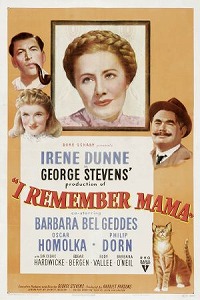
If you've never see I Remember Mama, you are missing a wonderful film. My pick for drama has several competitors (mainly A Tree Grows in Brooklyn, Johnny Belinda and The Enchanted Cottage), but for this week, I'm going with Irene Dunne in one of her last films. As the titular Mama, Dunne is perfect as Marta Hansen. Sure, Mama at time seems without fault, but it's hard to care or even notice as Dunne is so unbelievingly convincing as this warm and loving wife and mother. Narrated by the family's oldest daughter, Katrin (played beautifully by Barbara Bel Geddes), the story is a series of incidents in the life of the Hansen family over a number of years, which makes it perfect desert island viewing. Each "story" can be watched as part of the whole progression of the film, or as an independent short story. Especially poignant is an incident that revolves around the illness of the youngest daughter, Dagmar (June Hedin), and the inability of Mama to see her ailing child after surgery (hospital rules forbid any visitors for 24 hours post surgery. Wow, have things changed with time!) Dunne's heartbreak and guilt (she'd promised the child she would be there when she woke) in this segment reaches out from the screen and tears your heart. Ultimately, it is the strength of the family and the care that the immigrant mother and father show to their children as they try to avoid "go[ing] to the bank" that you will remember.
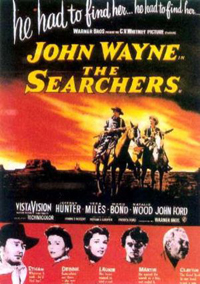
There are some really great westerns, and I have to admit that I had trouble deciding on just one. It came down to two: The Searchers and Westward the Women (add to the mix, a friend suggested Shane and The Big Country. Yes, my friends make my life harder). Ultimately, I chose The Searchers since it is again one of those movies I fall into each time I see it. John Wayne is exceptional as Ethan Edwards, a man driven to almost insanity by his hatred of Native Americans. When Ethan's niece, Debbie, is captured by a group of Indians who murdered the rest of her family, Ethan and Martin Pawley, a young man of mixed heritage who was raised by Debbie's parents, go on a quest to recover Debbie from her captors. But as the years pass and Debbie goes from childhood to young adulthood, it becomes clear to Martin that he must continue on the journey, no matter the cost. For, if he abandons it, Ethan will surely murder the young woman he now sees as a squaw. The story is intense, with Wayne creating a character that is impossible to like, but with whom the viewer feels a bond. Also notable are Jeffrey Hunter as Martin and Ward Bond as the Reverend Clayton, both characters that act as counterpoint to Wayne's driven loner. Finally, there are the magnificent vistas of Monument Valley, which director John Ford uses to tell his tale. It's a film with so many layers that, with each viewing, you'll see something new.
There are a number of comedies, especially romantic comedies which come to mind when asked to pick a desert-island selection: Victoria, Victoria, The Major and the Minor, Roman Holiday are just the tip of the iceberg. But I decided to select Bachelor Mother, starring Ginger Rogers as Polly Parrish, the temporary employee of Merlin and Son Department Store. When her job is about to come to an end, Polly goes out on her lunch break to find another job. She sees a woman abandoning a baby at a foundling home. Fearful the baby will roll from the stoop, Polly rushes in - and is mistaken for the baby's mother by the staff. As a result, Polly finds herself saddled with a baby, as well as a suitor, in the form of David Merlin, the "and Son" of the department store. The film is funny and sweet, the baby is adorable, and our romantic couple have a great chemistry. But what I love about this film are the attitudes of everyone towards this seemingly unwed mother. Sure, we, the audience, know that Polly is a "good girl", but the other characters don't, and uniformly they treat her with kindness and compassion. I especially love Polly's landlady Mrs Weiss (played to perfection by Ferike Boros), who, rather than condemn the girl, goes and gets her adult son's baby things and becomes Polly's go-to baby sitter! In an era where unwed mothers didn't exist, or were punished (usually by death) at movie's end, Bachelor Mother gives us a picture of a society that embraces the mistakes of a young woman, and ends by creating a happy family, all without violating the Code.
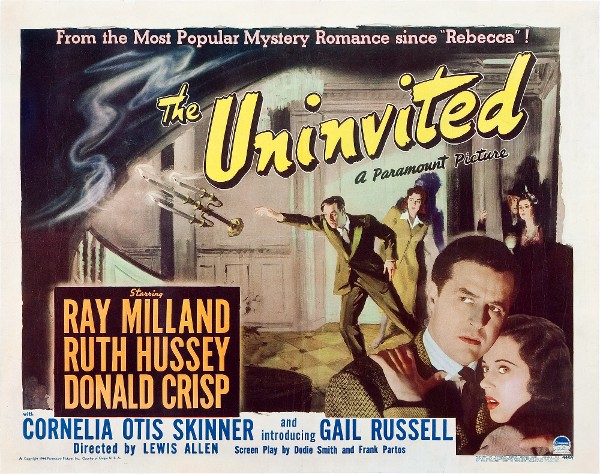
I'm not a huge horror fan, but I love suspenseful films. The Spiral Staircase is one film that I considered for this category, but really there was no contest in the ultimate winner: The Uninvited. It really does have everything - a phenomenal story, great cast, two ghosts, a really mysterious house, and a haunting musical score. (In an earlier blog entry, above, you'll find a link to a You-Tube video of the magnificent theme, Stella By Starlight). One of the problems with suspense films is that, once you know the answer, you don't always enjoy rewatching the film. ButThe Uninvited still is a pleasure even when you know what is coming. Much like Laura, it's the acting, and the relationships of the characters that keep you returning to this film. Ray Milland is exceptional as Rick, the new owner of Windwood House, as is Ruth Hussey as his sister Pam. But the person who steals the film from under everyone else is the ethereal Gail Russell, playing Stella Meredith, the object of Rick's love and the focus of the beings that haunt the house. The Uninvited is a movie that will make you believe in ghosts.
As I said, this is a list that could change at a moment's notice, and you'll notice that the list lacks a few films that one might expect to see on a desert island list. So, let's give a nod to To Kill a Mockingbird, Gone with the Wind, The Best Years of Our Lives,The Thin Man, Casablanca, just a few in a list of "essentials" that film fans love. These are wonderful; I own them, I would never give them up. I rewatch them regularly, but you all KNOW about these films. With my list, I hope I may have brought up a few films that might not have made your own "essentials" queue.
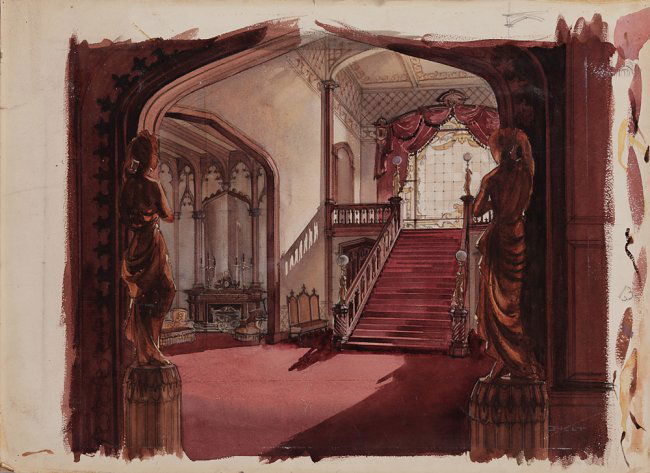
Though I've already posted on Gone with the Wind several times, I'm again going to discuss it, this time in relation to a interesting program held at AFI Silver (in partnership with Smithsonian Associates), which was part of a series entitled William Cameron Menzies: Inventing Production Design. James Curtis, the author of William Cameron Menzies: The Shape of Films to Come, spoke about Menzies contributions to filmmaking in general, and specifically about his impact on the film that would become Gone with the Wind. Using examples from Menzies' surviving art work (a sketchbook was miraculously saved from the attic of his home before the building was razed), Mr. Curtis discussed the contribution of Menzies' amazing eye in creating the look and feel of the film. Gone with the Wind was always going to be a Technicolor film; this gave Menzies the opportunity to use color in the telling of the story. Mr. Curtis pointed out the pastel hues of the early scenes - think of Scarlett entertaining her beaus on the steps of Tara, compared to the deep reds and oranges of the escape from Atlanta. The sketches tell the story of Menzies vision of the film.
Today, we see the term "production designer" on all films, but Menzies was the first person to have that title; in fact, it was created to describe his unique contribution to filmmaking. He won the first awarded Oscar in Art Design for his work in The Dove and Tempest (both in 1929) and was given a special Oscar for Production Design in 1939 for Gone with the Wind. Of course, there WAS no Production Design award at that point - the Oscar in that category was only renamed (from Art Direction) in 2012. In 2016, the Art Director's Guild instituted an award named after William Cameron Menzies. The first awardee was Robert Osborne, "for his work in championing classic motion pictures." Menzies would eventually go on to try his hand at film direction - Things to Come (1936) and Invaders from Mars (1953) are the two that are most highly regarded. But his credits in this area cannot surpass his credits in production design. With films like Kings Row (1942), Our Town (1940) and Made for Each Other (1939), he created a vocabulary of images.
Barbara Stanwyck's final role on the big screen was in a William Castle horror/suspense film entitled The Night Walker (1964). Its major claim to fame (besides being Stanwyck's last go at movies) was that it reunited her with her former co-star - and former husband -Robert Taylor. Stanwyck plays Irene Trent. Married, unhappily to jealous tyrant Howard Trent (Hayden Rorke), Irene's sleep is plagued by dreams of a fantasy lover (Lloyd Bochner). When Howard is killed in a freak accident in his laboratory, Irene's not heartbroken, and happily leaves their damaged home in the hope of escaping from the stressful dreams. But the dreams begin to escalate in intensity; terrified she is going mad, Irene goes to her husband's attorney,Barry Morland (Robert Taylor) for help. On some levels, one wonders what would prompt Ms. Stanwyck to appear in this rather ludicrous story. Though hired first, she ends up billed under her ex-husband, Robert Taylor. According to this article in the Florence Times, from May 9, 1964, Stanwyck was willing to appear with her ex, if he and his wife (German actress Ursula Thiess) agreed. Taylor said it was fine with him, but when asked, the current Mrs. Taylor allegedly said "not necessarily."
While Stanwyck gets second billing, it is clearly her film. Even with an outlandish plot, special effects that are laughable, and an ending that makes you want to go "Huh?", Stanwyck is still excellent. In an age when older actresses were having to become laughingstocks in the Grand-Guignol style (think What Ever Happened to Baby Jane), Stanwyck is still elegant, and even regal. Her beauty was even more striking as she aged (my father - a huge fan - always said she got better looking every year), and at age 57 she looks like a youth when compared to much less well-preserved (and 4 years younger) Robert Taylor. (The book Barbara Stanwyck: Miracle Woman by Dan Callahan also comments on the physical differences between the stars. Be aware - there are spoilers).
Interestingly, Joan Crawford is alleged to have been William Castle's first choice for Irene. She declined, perhaps because she was at that point committed to Hush, Hush Sweet Charlotte, a role that was ultimately given to Olivia de Havilland when Crawford became ill (or, perhaps just couldn't stand the thought of working againwith her rival, Bette Davis).
Possibly the biggest problem with the story is the lack of continuity. Howard Trent is horribly jealous. Why? He has a laboratory in the attic. What is he doing there? Irene owns a beauty salon, which she owned before she met Howard. Why did they marry? Why is Howard blind? The questions go on and on, but we get no answers. We're supposed to wonder why Irene is having these odd dreams, but given her rather strange marriage, it's no wonder that she is dreaming of a handsome man who adores her. And if you listen carefully, you actually can figure out WHY "The Dream" is someone who actually exists. It's quite probable that Irene met him at some point.
It was very pleasant to see Hayden Rorke in a film role - he actually had a very lengthy film career in character parts before he became so very familiar to us all as the much put-upon Dr. Bellows on I Dream of Jeannie. While this was not his last film role, he primarily did television after this movie. He'd started film acting in 1943; prior to that, he'd appeared on Broadway in 6 plays (including The Philadelphia Story, with Katharine Hepburn - he played Mac, the night watchman). He continued working until 1985, and died in 1987, age 76. He was survived by his partner, Justus Addiss. Also in the cast, in tiny parts, are Jess Barker (who we saw in Good Luck, Mr. Yates) and Rochelle Hudson (probably best known as Shirley Temple's older sister in Curly Top). Blink, and you'll miss Ms. Hudson as Hilda, the manager of Irene's beauty shop. Barker at least gets a few minutes screen time as Mr. Malone, the inspector of the damaged house, at the beginning of the film.A shame really, that they didn't get more to do.
As Bosley Crowther in his New York Times review states, "the whole thing would not be worth reporting if it didn't have Barbara Stanwyck in the role of the somnambulistic sufferer and Robert Taylor as her husband's lawyer who tries to help." Small wonder that Ms. Stanwyck eschewed further big screen roles in favor of television. Her next role would see her in the part of the inimitable Victoria Barkley, with star billing as
MISS Barbara Stanwyck for the four-year run of The Big Valley. That role would earn her four Emmy nominations, and two wins. She also would win another Emmy in 1983 for her performance as Mary Carson in The Thorn Birds. (Obviously, the Emmy voters were a lot smarter than the Oscar voters!) We'll leave you with this trailer from the film.
In the second year of her film career, Kay Francis appeared in 10 films. For the Defense (1930) features her in the third of the 6 films in which she appeared with William Powell. Powell plays attorney William B. Foster, a successful, albeit often unethical attorney who will do almost anything to get his client freed. He loves actress Irene Manners (Ms. Francis), but is unwilling to marry her - he's not the marrying kind, and is perfectly satisfied with their current relationship. She, however, is ready for marriage, and is being wooed by Jack Defoe (Scott Kolk), who is eager to wed her. Irene is ambivalent - she loves Bill, but the relationship is going nowhere; Jack loves her, but she she has no strong feelings about him. Sensing her indecision, Jack drinks too much; Irene insists on driving him home. On their trip, Jack again tries to embrace her; as a result, she inadvertently swerves, hitting and killing a man in the road. Jack insists that she leave the scene; he takes the blame for the accident, and ends up on trial for manslaughter - with Bill as his defense attorney. This was Kay Francis' first real chance at a leading role; she seems at ease and quite natural in the part. Though not given the wardrobe that would later enhance most of her films, her costumes are not shabby, thanks to the excellent (and uncredited) work of Travis Banton. Even her hairdo is different here; she wears it extremely short, and slicked back (you can see it below). It's very severe, but is also becoming. As the only woman in the cast (even the jury members are all men), Ms. Francis stands out, and makes the most of what could have been a fairly small role.
The character of William Foster is based on a real life character - William J. Fallon, "The Great Mouthpiece", who
defended, among other, Nicky Arnstein (Fanny Brice's husband) and Arnold Rothstein (the model for Meyer Wolfsheim in The Great Gatsby). Of the 120 defendants accused of murder that Fallon defended, none was convicted. This article from The New York Press goes into detail on the life and times of the notorious Bill Fallon. In 1932, Warren
William would play another character, loosely based on Fallon in The Mouthpiece; the character of Billy Flynn is certainly a direct descendant of the lawyers patterned after Fallon. William Powell is quite good as Foster. Just two years from silent films, Powell knows how to use the camera both with speech - and without it. The sound cameras in 1930 were very limited and director John Cromwell does a lot to compensate for the problems, such as using rear screen projection to give the feeling of a busy city street (This TCM article goes into more detail on some of the techniques used to give the film movement). Especially impressive is a scene of Powell, late in the film, walking down a long corridor. There isn't a sound, but Powell and Cromwell make the walk seem like forever. (Check out this review of the film on Pre-code.com for more on the film's impressive use of silence.)
Powell's career began on Vaudeville and Broadway. He appeared in 4 Broadway plays (as William H. Powell - his name was William Horatio Powell) between 1918 and 1922, when he left New York for Hollywood. He worked steadily during the silent period - his greatest success being in Emil Janning's The Last Command. With his prior stage experience and wonderful speaking voice,he was ready for his first talkie in 1928, when he starred in Interference. But it was The Canary Murder Case the following year that really solidified his position in films. Originally conceived of as a silent, the film was reworked, and Powell cast (for the first of 5 appearances) as detective Philo Vance. The year after his final appearance as Vance, Powell was cast in the part for which he is best remembered - Nick Charles in The Thin Man (1934). He had just recently (in Manhattan Melodrama) appeared with co-star Myra Loy; their chemistry resulted in 14 films together. Though his marriage to Carole Lombard only lasted two years, they remained friends and in fact appeared in My Man Godfrey (1936) three years after their divorce. Shortly after the death of his fiance, Jean Harlow, Powell was diagnosed with cancer. After a two-year battle, the disease went into remission and Powell resumed his career. He worked steadily until his retirement in 1955, immediately after his appearance in Mr. Roberts. Married to actress Diana Lewis for 44 years, he died 30 years after his retirement, at age 91.
We'll close with this scene of Bill and Irene at a night club. We'll be leaving the pre-code period for a Barbara Stanwyck film from the 1960s.
Last week, we watched Kay Francis appear as a pre-code physician in Mary Stevens, M.D. This week, we viewedDr. Monica (1934), released the next year, but in many ways, a much more restricted film. While technically a pre-code film (Dr. Monica was released June 21, 1934 - the code didn't officially start being enforced until July 1st), for all intents and purposes, this film is forced to abide by some aspects of the Production code, not the least of which is the punishment of a woman who has carried on an affair with a married man. Dr. Monica Braden (Ms. Francis) is a successful obstetrician, married to writer John Braden (Warren William). The only thing that seems to mar the happiness of their marriage is Monica's inability to have a child. Or so it seems to Monica - unbeknownst to her, John has been carrying on an affair with aviatrix Mary Hathaway (Jean Muir). When John leaves for Europe, he and Mary call a halt to their relationship; what he doesn't know - and won't discover - is that Mary is pregnant.
Though the character of Mary is ultimately punished for her mistake (not so the erring husband), many aspects of the film fall into the pre-code conventions. There is the out-of-wedlock pregnancy, a brief discussion of abortion, and finally, our female leads. The film presents us with three women, all of whom are career women - our heroine, a successful physician; Mary, though wealthy, a trained flyer with her own plane; and Anna Littlefield (Verree Teasdale), a gifted architect. Several sources, including this TCM article note that Joseph Breen, the head of the Production Code Administration, despised this film as being about "a lesbian, a nymphomanic and a prostitute." We figured that Anna was the lesbian, given that she isn't married, doesn't have a man in her life, and has a successful career, and that Mary was the prostitute (though she certainly wasn't doing it for money. She has far more money that John will ever have. Monica is the major breadwinner in that family). But we weren't clear on who the nymphomanic was - Monica? Because she wants a child? We are at a loss, and we're not suggesting a seance to ask Breen what on earth he was thinking!
The New York Times review was far more sympathetic to the film, with positive reviews for the three ladies, especially Jean Muir, and even some kind words for Warren Williams (in what they truthfully call a "thankless role).
We were especially impressed with Verree Teasdale's performance - she gives the character of Anna a gravitas that is essential for the person who serves as Monica's moral compass. She is Monica's confidant, but she is also the one that makes certain Monica ultimately fulfills her duties as a physician, even when outside circumstances make her unwilling to act ethically.
Ms. Teasdale began her career on Broadway, appearing in 13 plays between 1924 and 1932. She started in films, in 1929, appearing in Syncopation that year. In her 30 films, she was primarily the second lead or nasty society wife; she also played Hippolyta in the 1935 A Midsummer Night's Dream. That same year, she married actor Adolphe Menjou - they had one child. Though they did not appear in films together, in the 1940's and 1950s, they hosted a radio show. She and Menjou remained together until his death in 1963. She died in 1987, at the age of 83.
According to the AFI Catalog, the Hollywood Reporter stated that Barbara Stanwyck and Joel McCrea were considered for the leads, casting that would have resulted in a very different movie. Stanwyck would finally get to play a doctor in the 1940s (You Belong to Me, 1941); Ms. Francis would play a physician once more, in 1939s gangster film, King of the Underworld, giving her the record, as far as I can find, of an actress playing a doctor. We'll end today's posting with a trailer from the film.
As I've mentioned before in this blog, I have a personal fondness for films about women doctors, so I was very pleased that the film my group selected for this week is Mary Stevens, M.D. (1933). Kay Francis is Mary Stevens. We meet her as she and her best friend, Don Andrews (Lyle Talbot) conclude their internships and open an office together,with Mary's devoted friend - and nurse Glenda (Glenda Farrell) in tow. It's rough going at first - Mary, as a woman, finds it hard to recruit patients. But, just as things start to improve, Don decides that he'll be better off married to Lois Rising (Thelma Todd), the daughter of a powerful politician. And, while Mary now has a thriving practice, she loves Don and he is now, seemingly, out of reach. The pre-code elements in this film are fairly simple: Don and Mary have an adulterous relationship, and Mary has a baby out of wedlock. There's even a brief hint at abortion (Mary refuses to "do something" about her pregnancy, since she'd recently advised a patient to "go through with the thing" and now she is "going to live up to [her] own advice!" My fellow blogger at Pre-code.com also provides a nice overview of the film (though be warned - there are spoilers). But Mary's integrity as a physician and as a human being are never in question. She is a good, dedicated doctor, who just happens to fall in love with a very wrong man.
We loved Kay Francis as Mary Stevens. Sure, she's got nicer clothing than any struggling physician should have. Regardless, she presents a picture of a woman who is competent and who KNOWS she is competent. Despite her love for Don, she won't brook medical sloppiness, and when she realizes that his drinking is destroying his ability as a doctor, she breaks all ties with him. Lyle Talbot also does a good job in portraying someone with real ethical issues. Talbot has the ability to switch from likeable to reprehensible with very little effort, a real asset with Don. And he needs to do it in such a way that the audience will root for him when Mary and he meet years later. We talked about Mr. Talbot at length in our review of A Lost Lady. He is equally good here, but in a very different part.
Poor Glenda Farrell gets very little to do here, except be supportive to Kay. She is seldom out of her nurse's uniform, and doesn't even have a last name. But she makes the most with what she is given, making Nurse Glenda memorable. With 116 film and television credits, Glenda Farrell's career extended from an uncredited role in 1928 to 1970. She excelled at comedy, and could do zany and/or dumb characters with her eyes closed. Frequently paired with Joan Blondell (they would do 9 films together), Ms. Farrell really broke out when she first appeared as intrepid reporter Torchy Blane in Smart Blonde (1937). She would play the part 6 more times Lola Lane played Torchy once in 1938's Torchy Blane in Panama when Warner Brothers decided they wanted a new Torchy - it didn't work out, and Ms. Farrell appeared again in the role. Jane Wyman would conclude the film series with Torchy Blane...Playing with Dynamite (1939) when Ms. Farrell left Warners to head back to New York and Broadway. Between 1929 and 1970, Ms. Farrell appeared in 12 Broadway plays, including Forty Carats (her part went to Binnie Barnes in the film version), as well as appearances in many television shows. While appearing in the Broadway play Separate Rooms (1941), Ms. Farrell met Dr. Henry Ross (he was treating her sprained ankle at the time). They married, and were together until her death of lung cancer in 1971.
Another actress with a minuscule part is Thelma Todd, who only has a few scenes as Don Andrews' wife Lois. We see her briefly prior to their marriage, then again when Lois' father forbids her from divorcing him. Todd had started her career in silent films, but talkies gave her the opportunity to show off her comedic talents, often teamed with ZaSu Pitts in a series of short films about two hapless women (patterned after Laurel and Hardy) named Thelma and ZaSu (surprise!). But Todd is perhaps known because of her mysterious death at age 29; she was found in her car, dead, in what the coroner called a suicide from carbon monoxide poisoning. The truth behind her death has been debated for decades. Did she die at her own hand, or was she the victim of a murder? In 2012, William Donati published The Life and Death of Thelma Todd, which revisited the investigation.
Two major incidents happen towards the end of the film that bear some mention. Dr. Stevens is called in to treat a child with infantile paralysis. She needs a serum. Really? Infantile paralysis - or polio - was not treatable in the 1930s, and the only "serum" currently available are the polio vaccines, discovered by Jonas Salk and by Albert Sabin in the 1950s. The other incident revolves around Mary's depression at the end of the film. As Don tries to bring her back to herself, it is her career that he uses as a motivator, not their pending marriage. That, combined with a final scene that is described in this TCM article are, for me, the most interesting aspects of this film on the role of women in medicine.
This New York Times review points out the excellent work of Una O'Connor in her small part as the mother of two sick children. All in all, it's a positive review, and we agree and highly recommend it. We leave you with a trailer.
Next week, we'll look at another Kay Francis film in which she portrays a doctor.