This week's film is a little-known Myrna Loy film from 1929 - The Great Divide,
in which she plays Manuella, the maid of Steven Ghent (Ian Keith).
Yes, Ms. Loy is a Mexican (with appropriately darkened skin), and she is
supposed to be VERY young (I believe 16), but she is quite enamored of
Steve. He, however, sees her as a child, and laughs off her advances.
Then, he meets Ruth Jordan {Dorothy Mackaill) and falls
head-over-heels. Only problem is, she is not interested in him. Since
she is a brat, and the daughter of a good friend (who is dead), he
decides to teach her some manners, so he kidnaps her, and brings her to
his hacienda. Where, of course, she meets our little Manuella. And here is Manuella BEFORE Ruth arrives, trying her best to seduce Steve:
Given
that this film was made in 1929, there is a certain static-ness to the
proceedings, and Keith is a bit stiff, but Loy and Mackaill (who we all
like very much. See our blog post aboutLove Affair) are lots
of fun, especially when sniping at one another.
This isn't a great
movie, but getting to see Loy in her exotic period is a enjoyable.
When you think that this is the future Nora Charles and Milly
Stephenson, one is even more impressed by her fabulous range as an
actress.
In 1938's My Bill, Kay Francis plays Mary Colbrook, the
widowed mother of four children. 3 of her little darlings are rude,
selfish, graspy creeps. But then there is Bill (played by Dickie
Moore), who for some unexplained reason calls his mother "Sweetheart",
and who is the only sensible member of this family. Though Kay was left
some money on her husband's death, she has wasted every cent of it
providing the selfish bunch with piano lessons and new dresses. Now,
she's broke. So the obnoxious 3 leave her (after she squanders more
money on cabs and flowers); Bill remains, begins a paper route, and
takes on the job of "Man of the Family" to support his mother.
I
think it would be fair to call this an odd movie. It's based on a play
(from 1928), but really the biggest problem is the character of Mary.
By the end, we get a lot more back-story (which does make her story more
interesting), but she is such a scatterbrain that one wonders how she
has survived as long as she has. Bill, however, is a stand-up young man,
and Dickie Moore plays him with verve. Bonita Granville, Anita Louise
and Bobby Jordan as the other three nightmarish offspring bring
obnoxious to new heights. And Elizabeth Risdon as Aunt Caroline confirms
they are from the correct gene pool.
This film came out the same
year that Kay got labeled "Box Office Poison" (along with Katharine
Hepburn and Marlene Dietrich); it's obvious it was less her and more
some of the parts she was being given. She does the best she can, but
in a sense, this IS Dickie Moore's movie. And he kinda runs with it.
1934's British Agent is our film this week. The wonderful
Leslie Howard is Stephen Locke, an English diplomat serving in Russia as
Lenin takes control of the government. The British, after the rise of
Lenin, leave Locke as provisional staff, evacuating their more important
diplomats (as do the French, Italian, and American governments). Locke
is committed to his country, and does the best he can under adverse
circumstances. He also meets and falls in love with Elena Moura
(Kay Francis), a Communist working with Lenin's government. Though she
loves Stephen, she too loves her country and informs her government
about Stephen's plan.
This is a fascinating film,
with a great cast (and some wonderful supporting players, such as Cesar
Romero as Tito Del Val the Italian provisional representative. The film
with keep you wondering just what is going to happen next, and Ms.
Francis is wonderful as the conflicted Elena. She and Howard are quite
good together. though I believe this is the only time they appeared
together on film (though they did the radio show Screen Guild Theatre together in 1939 (Never Of This World).
It's
also interesting to see this somewhat sympathetic view of Lenin in
1939. This surely is NOT a pro-Communist film, but, as you will see at
the end, Lenin is vindicated. So, anti-Communist - perhaps, but with a
bit of a balance. Here's a trailer for this excellent movie:
The House on 56th Street (1933) is a fascinating film. In it, Kay Francis is showgirl Peggy Martin, who has two men very interested in her: Monte Van Tyle (Gene Raymond), the scion of a wealthy family, and Lindon
Fiske (John Halliday), who has been involved with Peggy for some time.
Peggy falls in love with Monte; Since Lindon is quite clear that he is
"not the marrying kind", it is an easy choice for Peggy. So, despite
Monte's mother's objections, the couple wed and are quickly blessed with
a daughter. Years go by, with Peggy and Monte living happily - even
Mama Van Tyle (Nella Walker) has gotten used to her daughter-in-law.
Then, at a party, Peggy meets Lindon again. She is concerned at his
appearance, as Monte knows nothing about him. Add to this, Lindon does
not look well. Kay is concerned, and her concern is her downfall in
this drama.
Rather than give too much away, we'll
stop with the plot there, even though it forbids us doing more than
mention two important characters: Bill Blaine (Ricardo Cortez) and
Eleanor (Margaret Lindsay). The two are pivotal to the plot, and are
wonderful. Both show up in the latter half of the film. To say more
would be to ruin this wonderful picture for you.
Kay
Francis has to age over 20 years in this film. The motif that the
director, Robert Flory, uses to demonstrate the passage of time is
subtle but effective - we see Peggy playing solitare, as newspapers
flash up important events of the day.
The film is
also interesting in that it discusses with some seriousness the problems
of compulsive gambling. In 1949 Barbara Stanwyck would powerfully
portray a woman with a severe gambling problem. This precursor to The Lady Gambles is no less impressive, as it discusses an issue few other films were willing to examine.
When you get to the end of this film, you will understand WHY the code began to be an issue. We suggest you give it a try.
Released the year before the end of World War II, The Impatient Years
examines a topic in a comedic manner that, after the war would be
looked at in a more serious vein. Andy Anderson (Lee Bowman) is home on
medical leave, returning to the home of his wife of one week (plus
about 18 months). He finds Janie (Jean Arthur), busy running her home,
with her boarder (Henry Fairchild played by Phil Brown), her father
(William Smith, played by the always wonderful Charles Coburn), and her
not quite one-year old son! She exists on a very rigid schedule, one
which her husband will not respect. Within a day, the hastily wed
couple are ready to divorce with equal speed, much to the disgust of Mr.
Smith. So, he recommends to the Judge (Edgar Buchanan) that he prevent
the couple from divorcing until they can figure out WHY they married in
the first place.
By 1946, The Best Years of Our Lives would look at the impact of the hasty wartime marriage on the returning vet. And while The Impatient Years
certainly IS a comedy, there is a core of seriousness under the humor.
Both the Judge and Mr. Smith understand that the war is forcing
decisions to be made to quickly. They insist that our couple stop BEING
impatient and try to rediscover their lost love for one another.
It
should be added that neither Andy nor Janie is totally in the wrong.
He, back from combat, wants peace, wants to do what HE wants to do.
She, responsible for a house and small child, needs a schedule to get
everything done. Neither can understand the other's needs. Neither
even tries. And thereby hangs the serious heart of the film.
Both
Jean Arthur and Lee Bowman are excellent, and Charles Coburn, as
always, shines as a loving father (who, in fact, is just meeting his
son-in-law). We also have comic performances from Charlie Grapwin (as a
bellman) and Grant Mitchell (as a hotel clerk). Sure, the film can be a
tad silly, but at heart, it is a lovely story about two people who need
fight their own way out of the War.
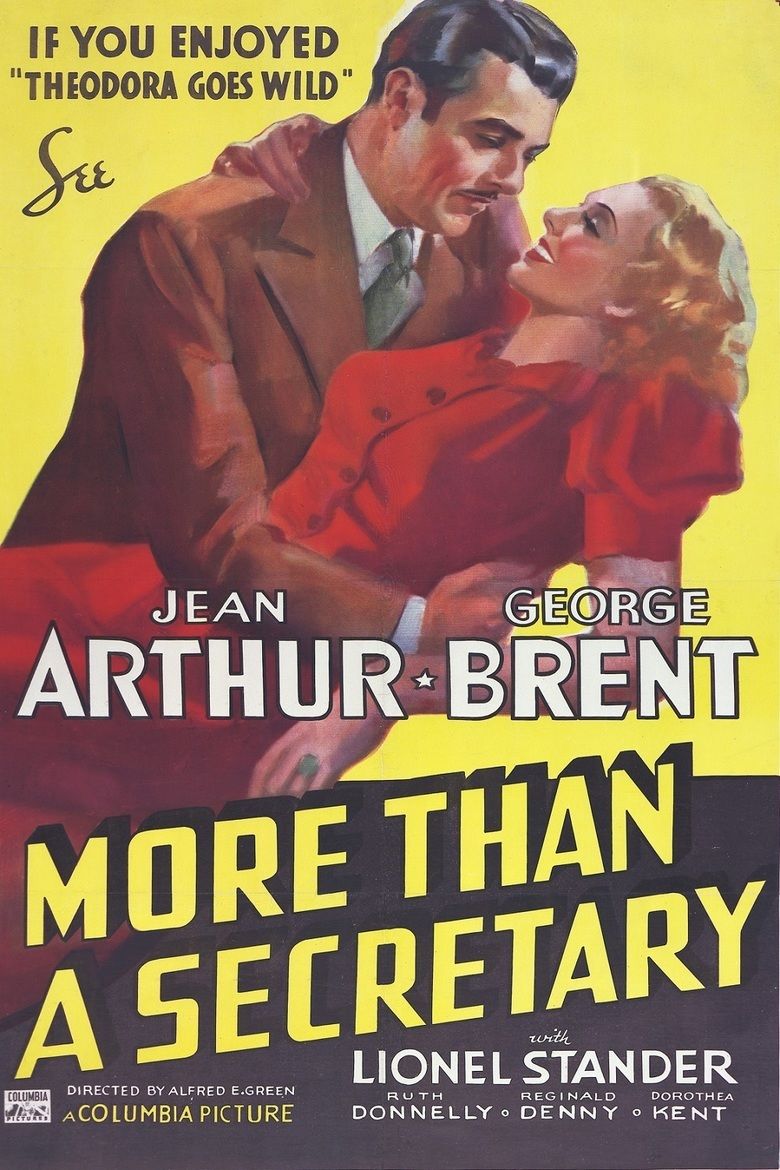
Carol Baldwin (Jean Arthur) and Helen Davis (Ruth Donnelly) run
a secretarial school. Unfortunately, most of their students seem to be
of the same caliber as their current student Maizie West (Dorothea
Kent) - no brains, but plenty of looks and a plan to make time with the
boss. Thus begins More Than a Secretary (1936), in which Jean Arthur
ends up working AS a secretary when the man who hired (and fired) one of
her students complains. The gentleman in question is publisher Fred
Gilbert (George Brent). His publication, "Body and Brains", is a
body-building magazine which regularly uses the face of an attractive
model on the body of the exceptionally well-built (and particularly
unattractive) Ernest (Lionel Stander). Of course, the magazine is NOT
doing well. It takes our Jean to put it on the right track. This
is a very cute movie, thanks to the interplay between Brent (who is
always wonderful) and Arthur (ditto). Her Carol, at the start, is
somewhat reminiscent of a character she will revisit in 1948 - Phoebe
Frost in A Foreign Affair. But she quickly discovers her outer
beauty, and becomes the perfect secretary. Beauty and brains in the
same office! Amazing! And Brent manages to make Fred a bit of a dweeb,
but still let you know why Carol is attracted to him. The scene where
he takes her out to a tofu dinner (!!!) is quite humorous.
It is
fun to see Lionel Stander as well. His Ernest longs for the day when
his face adorns his own body on the magazine - alas, it seems it is not
to be. Many of us remember Mr. Stander from Mr. Deeds Goes to Town and A Star is Born (as well as in Hart to Hart). It is sad that his career in this country was abbreviated during the 50s and 60s thanks to the McCarthy hearings.
A
few words are due, as well, for Dorothea Kent (as Maizie). She is a
hoot. You can't help but like the opportunistic creature! One
sympathizes with Carol's frustration, but I, for one, looked forward to
her return.
We'll close with the moment in which Carol finally loses it with Maizie. See you soon!
Tonight, we join the lovely Jean Arthur for the first in a series of films that feature her in the lead. Adventure in Manhattan (1936) has Jean starring as Claire
Peyton, and beyond that, there is little I can tell you, as there are
spoilers aplenty if I do. Joining Jean is Joel McCrea as George
Melville, a reporter noted for his unerring ability to predict crimes
before they happen. When a famous gem is stolen, George predicts the
next robbery, and surmises that the robberies are the work of Belaire, a thief long believed to be dead. By everyone, of course, except George.
It is interesting that this film is included on the Jean Arthur Comedy Collection,
as it is really hard to class it AS a comedy (unless you view comedy in
the more Elizabethan-theatrical vein). Our first encounter with Claire
is far from comedic, and very few of the incidents that occur will make
you laugh. Perhaps the only funny lines are at the end (and even then,
for those of us who had been carefully watching, they were much more
serious than we believed the authors actually intended.) This is
certainly a film that will keep you guessing til the very end, but I
would be interested to know if anyone else really believed this to be a
"comedy."
A lot of talent is involved in this
under-viewed movie. First, of course, is Ms. Arthur, who really is the
consumate actress. Joel McCrea, usually the boy-next-door, is
rather arrogant as George, and well he should be, because George DOES
think a lot of himself. We also have such excellent character actors as
Thomas Mitchell (as George's editor, Phil Bane) and Reginald Owen as Blackton Gregory. An interesting and gifted cast, in a very different, and at times puzzling movie.
This week, we visit one movie that was part of a greater series. The Lone Wolf Spy Hunt
(1939) was just one in a series of films about reformed thief Michael
Lanyard. The series started in the silent era, and continued into the
late 1940's. Among the actors to play Lanyard were Melvyn Douglas,
Francis Lederer, and Warren William, who plays Lanyard in our film - his
first in a series of 9 films.
The plot is somewhat convoluted.
Lanyard is being set up by a spy ring, led by Rita Hayworth (as Karen),
who want to force him to steal government plans. The delight here is
less the plot and more the byplay between William and Ida Lupino (as
Lanyard's love interest Val Carson) and between William and Virginia Weidler (as Lanyard's daughter Patricia - the only Lone Wolf
movie in which he HAS a daughter).
The two women are a riot. Val
stalks Michael, trying to get him to make more an emotional commitment
to her. At the same time, he is dealing with his rather precocious
child. A would-be detective herself, she is thrilled to receive a gift
of handcuffs (which she uses to force their butler, Jameson (Leonard
Carey) to actually "die" when she "shoots" him).
You may not remember the actual plot of this film, but you will laugh a lot.
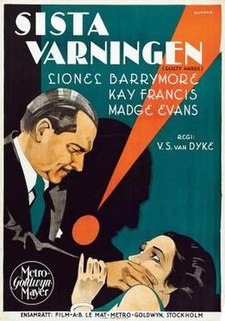
This week, we looked at a very underrated PreCode film from 1931. Guilty Hands stars Lionel Barrymore as Richard Grant, a lawyer who discovers that his beloved daughter is engaged to Gordon
Rich (Alan Mowbray), a client with a horrible reputation as a womanizer
and abuser (Rich probably murdered his last fiance). Grant tells Rich
that if Rich continues with his plan to marry Barbara Grant (Madge
Evans), Grant will kill him AND will get away with it. He will make
sure it is the "perfect murder".
It's not giving
too much away to reveal that Grant DOES kill Rich. But from there, we
will leave you in some amount of suspense. Kay Francis is wonderful
here as Rich's mistress, Marjorie West (this is a pre-code,
after all), who loves him in spite of his engagement to Barbara (and
fully intends to keep on seeing him after his marriage). When Rich
dies, Marjorie begins investigating his death. With some interesting
results.
Lionel Barrymore is fantastic. He is
sympathetic, and at the same time, sinister. You want to root for him,
but he is, after all, a murderer. Yet he did it for a good reason.
leading the audience to feel ambivalent about the conclusion. It is
also a plot that keeps you guessing, right to the very end. Will
Richard be caught? SHOULD he be caught? It's also fun to see Ms.
Francis' Marjorie take command as an amateur detective. Agatha Christie
was just beginning to write Miss Marple in 1926 (but only as a short
story in a magazine. She would not appear in book form til 1932). One
would need to go back, we suspect, to Wilkie Collins (The Lady and the Law, as well as The Woman in White) for an earlier female detective, so Guilty Hands heroine is quite a novel idea.
If you can see this picture, do so. It is worth your time. We think you will be surprised and will LOVE the ending. We'll leave you with a scene from early in the film:
I Loved a Woman from 1933 features Edward G. Robinson as John
Hayden, a would-be artist, living on his father's money in Paris, until
his father's death. He returns to America (Chicago, to be specific),
and at the encouragement of the lovely Martha Lane (Genevieve Tobin), he
assumes the responsibilities of running the company. Once in business,
John is no more a romantic artist, but a hard-headed, in fact cruel and
dishonest, businessman. As his marriage to Martha disintegrates (she pretty much married him for his money and power), he becomes romantically involved with Laura McDonald (Kay Francis), and the two begin a long-term affair. Meanwhile, John continues his ruthless business ways . Edward G. Robinson is quite convincing here. Heis
interesting as the romantic lead, for a change, but he is also, as we
all know from his gangster work during this period, perfectly
comfortable playing a not-very-nice guy. As always, Kay Francis is
great. Her Laura loves John, but this is a Pre-Code movie, so her life
style is, shall we say, rather risque. And again, being that this is a
Pre-Code film, our characters get away with things that, in another
year, would result in their deaths or imprisonment.
Probably
this film is more interesting as a Kay Francis film than as a venue for
Robinson. Not that he is bad, but his character is just not really as
interesting as it could have been. He is so callous in so many ways,
that it is hard to sympathize with him. But there are scenes with
Francis that are fun and interesting, so it is certainly worth a look. And just to get you started, here is the trailer: