Our Blushing Brides (1930) introduces us to three roommates and colleagues in a local department store: Jerry March (Joan Crawford), a no-nonsense young woman, focused on her career, who doesn't have a whole lot of regard for men; Franky Daniels (Dorothy Sebastian), a lazy person, looking for a husband - any husband; and Connie Blair (Anita Page), a fairly naive girl who is deeply in love with the boss (David Jardine, played by Raymond Hackett), and who sees him as her ticket to a life of ease and happiness. After a date with Marty Sanderson (John Miljan), Franky, in a drunken stupor, elopes with him. It doesn't hurt that he appears to be quite wealthy. Then, Connie moves into an apartment that David has rented for her - without benefit of marriage. But Connie is sure they will wed, as soon as David convinces his father of their deep love. Jerry meets Tony Jardine (Robert Montgomery), David's older brother, who woos her. But when she realizes he is interested only in a quick visit to his bachelor pad treehouse (yes, you read that right - a treehouse), she walks out. We were really impressed by the art design in this film. The settings are attractive, but appropriate to each economic level. The apartment Jerry shares with Connie and Franky is slightly more upscale than the one she ends up in when she is alone, and appropriately so. But the designers still make the apartments places that young women would live, not just sets. The one exception to this was Tony's treehouse - it is just much too large on the inside to fit the dimensions outside. Perhaps Tony knows how to cast an Undetectable Extension Charm (a la Harry Potter).
Jerry works in the store not only as a model, but as a salesperson. One of our group recalled that her mother told her of a store practice in which salespeople did try on clothing for their preferred
customers. We felt that the film gave us a little insight into the business world of the 1930s. The emphasis on clothing in the film also provides a display of some lovely dresses of the period (all far more expensive than the average woman would be able to afford), but the fashion shows finally got a bit
over the top. In the last one, it looked like they were channeling Busby Berkeley. As
always, Robert Montgomery is a pleasure to watch. He makes Tony
attractive, though he is not afraid to show him as a bit of a cad. But he also allows us to see Tony
grow as a person. We found the male characters in general to be interesting. They run the gamut from coward to thief to someone who grows into a good guy. We were very impressed both with Joan Crawford, as well as with her character. Jerry
is a good person, very devoted and loyal to her friends. When she sees David in a movie theatre with his fiance, Evelyn Woodforth (Martha Sleeper), Jerry goes to Connie to be a support, but cannot bring herself to tell her of what she witnessed. The beauty of this section is Crawford's reactions. Without speaking a word, we see all the emotions running through her head - Crawford's silent film training is evident. Jerry's loyalty to her friends is also admirable because of the obvious differences between her, Connie and Franky. Quite honestly, Jerry is a lot smarter and more ambitious than either of them - Connie, especially comes across as a complete dolt. Yet, Jerry sticks with them, even when their stupidity has gotten both of them into untenable situations.
We have a wealth of interesting performances here. Hedda Hopper is back for a brief bit as Mrs. Weaver,
a woman who is quite unpleasant. We also have Edward Brophy as Joe Munsey for some comic relief. Brophy's long career extended from 1920 until 1961. He died in 1960, at age 65, during production of his final film, Two Road Together.
Anita Page also had an interesting career. She appeared in many films from 1925 until 1936. Then, after a long break, she appeared in a few more movies, first in 1961,
then again in 1996. She died in 2008, at age 98; her final film was released in 2010. Dorothy Sebastian acted until 1948, dying in 1957 (age 53) after a long bout with cancer. Interestingly, Crawford and Paige had already starred in the silent films Our Dancing Daughters (1928) and Our Modern Maidens (1929), MGM's "jazz age" trilogy (. Sebastian joined them in Our Modern Maidens. This TCM article gives a bit more detail on the film and the trilogy. The opening scene immediately places us into the world of the film,
and introduces us to our heroines and their various personalities. We
see the girls clocking into work and listen to their discussions of
their jobs and men. Though the final scene in the film is a bit jarring
in its abruptness, all in all, this is a well-paced film. We should mention, however, that the title is more ironic than a reflection of the story. Before we go, here is an introduction to Jerry and Tony:
Gary Cooper stars in the title role as Casanova Brown (1944), a man who discovers that his one-day marriage to Isabel Drury (Teresa Wright) has resulted in a daughter - a child she is planning to give up for adoption. Upon returning from a trip, Cas Brown rushes to the home of Madge Ferris (Anita Louis), intent upon asking for her hand in marriage. Her father (Frank Morgan) is determined to circumvent him - Mr. Ferris is not keen on marriage, having been unhappily with Madge's mother for over 20 years. When Cas receives a note from a Chicago maternity hospital, Mr. Ferris' curiosity forces Cas to reveal that he was briefly married about 9 months before. His bride's family took an immediate dislike to him, and when he carelessly allows a cigarette he is hiding (Mrs. Drury, played by Patricia Collinge, despises "cigarette fiends") to set fire to the house, his goose is proverbially cooked. He leaves in disgrace, and without his wife. The marriage is quickly annulled. Though Mr. Ferris discourages it, Cas travels to Chicago to investigate the mysterious letter, only to find out that his former bride has a baby girl she has decided to give up. A horrified Cas cooks up a scheme to take possession of the infant. As films go, this one has a fairly absurd plot, with scenes that go on for much too long. Much of the film is over the top. The scene in which the Drury's home becomes an inferno is played for laughs (watching a beautiful home and all its contents become an inferno is funny?). And then, there
is the section where Cas arrives at the maternity hospital: men assume CAS
is pregnant (huh?) and Cas blithely allows a complete physical to be
performed without ANY questions. We wondered on what planet anyone
would accede to multiple blood tests, physicals, and x-rays with nary a
question? In an age of escalating health care costs and uninsurance
woes, this just doesn't age well. Also
ludicrous is Cooper's ability to merely don scrubs in order to sneak his
daughter out of the newborn nursery. He's a man in scrubs - naturally,
he is a doctor... (?!)
The film plays the Drurys as a farcical couple; Mrs. Drury's penchant for astrology is annoying. Assumedly, a 1940's audience would find her aversion to cigarettes to be odd as well (though as non-smokers in the 21st Century, we applaud her for that). Luckily, we don't have to put up with her all that long; she is only in the one, extended scene. Quite frankly, Patricia Collinge is totally wasted.
We also found it distasteful that the hospital literally sneaks in the news that baby Drury (the name on the bassinet) is being put up for adoption. The rights of the father (and we know that the doctor and staff are well aware that Isabel and Cas were married at one point) are completely ignored. Cas' panic at the loss of his daughter is understandable. And Cooper, with his wide, lovely eyes and amiable demeanor makes Cas' predicament all the more sympathetic. He is one of the reasons that the film ends up being somewhat enjoyable. The other is his reunion with Teresa
Wright. They are an enjoyable couple (just watch them together in Pride of the Yankees). One just wishes they had a bit more to work with. We found it fascinating that the film was nominated for
three academy awards: music, art direction, and sound recording.
The competition in Dramatic or Comedy Score category, which had 19 nominations included Max Steiner (for Since You Went Away and
The Adventures of Mark Twain), Miklos Rozsa (Double Indemnity, Women of
the Town), and Alfred Newman (Wilson). Since You Went Away took the prize. Art Direction had 7 nominations (including Gaslight and Laura. Gaslight won). Sound had 10 nominations, with Wilson taking the prize from Kismet, Double Indemnity and Cover Girl). Though filmed right in the middle of World War II, Casanova Brown makes no mention of the War. Perhaps it was considered escapist fare, but we found it strange that the War was so completely ignored. It was also the first feature of Independent Pictures. For more information on Independent Pictures, see this TCM Article on Casanova Brown. Though several worthy supporting players grace this film, with the exception of Frank Morgan, most have little to do. We already mentioned Patricia Collinge; Anita
Louise is similarly wasted. She really appears as a pretty face with no job but look lovely (which she does do quite well). The always amusing Mary Treen gets a bit more screen time as
the nurse, Miss Clark, and while she is amusing, this clearly is Cooper's film. He is in nearly every scene, and when he is in the scene, the film focuses on him. And of course, Frank Morgan is a delight as a character who, in close analysis, one would find despicable in real life. Finally, a quick mention of Jill Esmond as Dr. Martha Zernerke. It's always fun for me to find a film with a woman doctor. Interestingly, Zernerke's sex is not dwelt upon; she is portrayed as competent, and ultimately sympathetic. Her sex has no impact on her ability to do her job. Esmond, by the way, was Laurence Olivier's first wife and the mother of his eldest son, Tarquin. In closing, we leave you with Cooper arriving at a clinic for testing.
Marlene Dietrich plays a stage actress who falls in love with a baby and runs off with him in The Lady is Willing (1942). Elizabeth 'Liza' Madden (Dietrich) is walking home from the theatre one evening when she happens upon an altercation. A baby has been found abandoned in a building and the neighborhood is in a tizzy. A police officer hands Liza the baby, and it is love at first sight. So, since the baby has no parents to speak of, Liza simply takes him home, and begins the role of Mom. Of course, Liza quickly discovers that it's not that easy for a single woman to adopt a baby, much less a woman who is up to her ears in debt. You see, Liza has a lovely apartment, wonderful clothing, and lots of debts. She has a tendency to financially support relatives and friends - or dead-beats, as her assistant, Buddy (Aline MacMahon), calls them. So, Liza must marry, and marry fast or little Corey (David James) will be taken from her. She approaches Dr. Corey McBain (Fred MacMurray) to take on the dad role (Yes, there is a reason for the fact that Dr. and baby have the same name). In exchange, he can switch from his specialty of pediatrics to what he really loves, research. Of course, it will be a marriage in name only, and of course, Corey and Liza will begin to want a more lasting relationship. This is a cute film; while not great literature, it was fun to see Marlene Dietrich doing a comedy. Being, Dietrich, she is still intense, but she also makes the character likeable, if not a trifle naive. And while Liza is not the brightest bulb in the pack (for example, she has a lot of trouble understanding Mr. Micawber's basic rule for financial happiness: “Annual income twenty pounds, annual expenditure nineteen six, result happiness. Annual income twenty pounds, annual expenditure twenty pound ought and six, result misery."), she has a kind and loyal heart. Naturally, she also has a magnificent apartment (thanks to production designer Lionel Banks) and spectacular gowns (by Irene). Amusingly, when she needs another apartment, she is easily able to get the one next door. As New Yorkers, we found that quite funny (though, I have to admit, it was a lot easier to find housing in NYC in 1942 than it is today). A bit of trivia about the clothing: In this TCM article,
we learn that Dietrich injured her ankle very early in the production
and was required to wear a cast. She twisted her ankle attempting to
protect the little David James, whom she was holding at the time. Thus,
for most of the film, she is wearing long evening gowns or slacks.
There is a brief glimpse of the magnificent Dietrich legs, but nothing
more than that. But it is a small price to pay to see some of the
clothing she gets to model. This brief YouTube Video gives you a picture
of the fall that caused the injury and the resulting cast:
Fred MacMurray is also very good as the pediatrician who dislikes children. Corey McBain is
initially hard to figure out. He's cold and somewhat aloof, but
once we meet his ex-wife, Frances (Arline Judge),
and find out that his deeper ambition is to be a researcher, his
alienation is much more understandable. His soberness acts as a lovely
contrast to Dietrich's exuberance. But, for us, the standout performance in the film is Aline MacMahon. She is always so good, sharp but affectionate. Her regard for Liza is obvious, but not forced or phony. As usual, MacMahon gets some
of the best lines in the film, and even without words, she is a riot (watch the clip from the film below to get a look her some of her excellent silent moments. The film is filled with excellent character moments. Charles
Lane as ambulance-chasing lawyer K. K. Miller is at his abrasive best. Elizabeth Risdon as the child services worker Mrs. Cummings brings some interesting perspectives to what could be just an old-maid villain. A married, working woman with children, Mrs. Cummings is a caring professional, who understands the yearning for a baby. We found it Interesting that she is
"permitted" to work in an era when married women, especially were often banned from jobs. (Though released in 1942, The Lady is Willing was actually filmed in 1941, prior to U.S. involvement in World War II.)
The film also has some aspects that fly in the face of censorship. When Lawyer Miller arrives with a couple who claim to be baby Corey's parents, Dr. McBain proposes a blood test to determine parentage. Or, he queries, is the wife afraid that the test will prove her husband is not the father! Liza's Broadway co-star, Victor, seems to be interested in her, but when McBain comments on Victor's bestowing a kiss on Liza, she remarks that "he kisses everyone". Could Victor be gay? We should add that we were impressed with Victor (Roger Clark), who proves to be a true friend to Liza in the end. The one drawback to the story was the sub-plot of McBain's ex-wife. The storyline is contrived and the film would have been much stronger without her. She felt like she stepped in from another movie; she never quite fit the picture we had of McBain, and her impact could have been compensated for in a more imaginative way. We refer you back to the TCM article listed above for a story about Dietrich making a play for MacMurray during the filming (he wasn't interested). The article also contains a summary of a rather scathing review from The New York Times. We felt that Mr. Crowther was not seeing the same film we were. Variety, on the other hand, enjoyed it, as did our group. We hope you have the opportunity to judge for yourself.
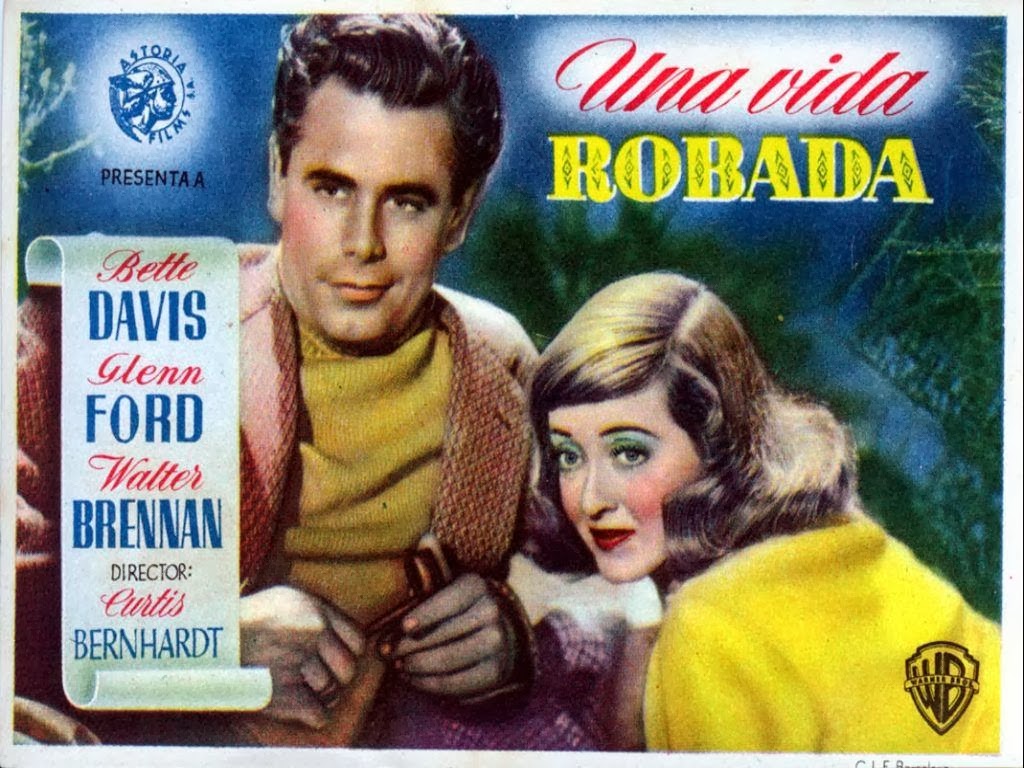
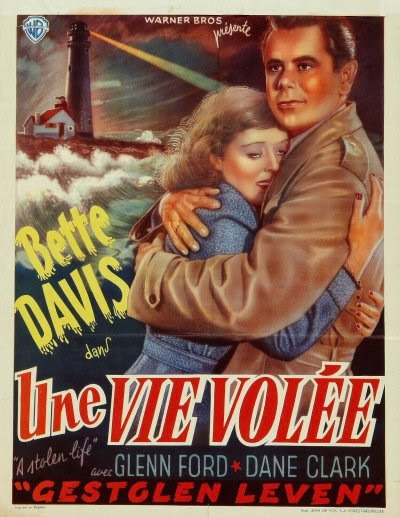
Two times the Bette Davis equals two times the passion in 1946's A Stolen Life. The inimitable Ms. Davis plays sisters Katherine and
Patricia Bosworth, twins who are identical in appearance, if not in temperment. We meet would-be artist Kate, on her way to an island off the Massachusetts coast. Having missed her connection, Kate asks for a lift from Bill Emerson (Glenn Ford). She is immediately attracted to Bill, a solitary man who loves the quiet island, and who has no real ambitions to live any other life but the one he already has. They seem an ideal pair until Pat Bosworth enters the picture. Once Pat realizes that Bill is attracted to Kate, she goes after him with a vengeance. The result, Bill marries Pat, leaving Kate bereft. We were all VERY impressed with Bette Davis in this dual role. She plays the two characters so that the sisters are subtly different. Patricia is perhaps more the Davis we are used to in films like Jezebel and The Letter - assertive, domineering, in-charge; Kate is more retiring and inward, more like the character Davis played in Now Voyager. It's easy to tell the sisters apart when they are separated, but Davis is able to make them different as they converse with one another. She never seems to lose focus of who she is portraying. And while the costuming by Orry-Kelly gives us slight clues, those differences
are also subtle, letting Davis do the work through her acting.
While Glenn Ford is very good as Bill, he does come across as a bit of a twit. It's clear that his attraction to Patricia is purely sexual. He states that he likes Kate, but that there was never a spark between them like there is between him and Pat. Yet, it's clear that Pat is his total opposite - where he is unambitious and wants a simple, country life, she is all about the city and excitement. Why Pat would want to do more than have a brief fling with him is a big question here. It's clear that she is gone off with her sister's beaus before. Does she want to marry Bill only because it is clear that Kate is finally in love? One wonders if Pat is interested in keeping her sister uninvolved (and therefore, closer to her) than in stealing her sister's great love. By marrying Bill, we know that Kate will never involved herself with him again leaving the sisters' relationship status quo.
The only character that is wasted in the film is Dane Clark as the artist Karnock. At first, it seems he might be the person who will make Kate forget Bill, but he is so eminently disagreeable, that it's hard to warm to him. Only in one scene, where he encounters Kate posing as Pat, are we allowed to find him even the slightest bit likeable. Unfortunately, the character never goes anywhere, and we were left wondering what the film would have been like if he had actually become involved with Pat.
On the other hand, Charles Ruggles gives a well-rounded performance as Kate and Pat's guardian, Freddie Linley. Though he says very little, his understanding of the sisters is obvious. He affection for Kate is also apparent. In the end, we discover he really is the only one who truly "knows" them. A quick nod also to Walter Brennan doing what he does best - being irascible; no one really does it better!
Bette Davis was a producer on the film, as is discussed in this TCM Article, and she had say in the casting. Dennis Morgan was originally considered for the part of Bill, but Davis would not have him in the part. The studio then suggested Robert Alda, and while she accepted Alda, she really wanted Glenn Ford. However, Jack Warner didn't want to pay the money for a loan-out from Columbia, until Davis was able to show him a screen test of Ford in the part. The film is actually a remake of a 1939 German film, starring Elisabeth Bergner (perhaps best known in the US for her role as Rosalind in the 1936 As You Like It).
Though A Stolen Life was not really admired by The New York TImes when it was released, we think it is a movie that has aged remarkably well. In this age of digital special effects, you will be amazed at what was possible in a 1940's film. You will totally believe that the twins are talking with one another. To give you a taste of what's in store, here is Bette talking to Bette:
We return for a visit with an old friend - Olivia de Havilland in Hold Back the Dawn (1941). This is an absolutely wonderful film, romantic and engaging. Sure, it's a melodrama, but in the best sense of the word, with characters that grow and keep you engaged in their stories. It also continues to be a timely story - that of immigration and the desire for people to find a home in the United States.
The film is narrated by Georges Iscovescu (Charles Boyer), who is on the run and trying desperately to get some money. He sneaks into the Paramount lot, to tell his story to Hollywood director, Mr. Saxon (played by Hold Back the Dawn's actual director, Mitchell Leisen). The war in Europe is raging, and Georges has escaped Europe to Mexico, intent on settling in the U.S. However, the U.S. immigration quota for Romania (Georges' place of birth) has already been exhausted, and there is a long waiting list. Georges finds himself stuck in a seedy little bordertown hotel, with other hopeful immigrants, waiting from five to eight years for a spot to open up. The arrival of Anita Dixon Shaughnessy (Paulette Goddard), Georges former dancing partner and lover, presents another option: marry an unknowing American and get a green card as the spouse of a U.S. citizen. Once in the country, divorce the duped spouse, and go off with Anita. Georges sets his sights on Emmy Brown (Olivia de Havilland), a shy schoolteacher in Mexico for the day.
The film contains some absolutely outstanding performances. Charles Boyer is wonderful as a cad who gradually changes into a decent person (and in some sense, much against his will). As he begins to fall in love with Emmy, we can see his inner battle between his growing feelings for her and his desire to resume his wayward life. As Emmy, Olivia de Havilland is sweet and generous, but with an inner core of strength that becomes apparent towards the film's end. Her conversation with Anita, and her comment that she is "from a small town. We don't have any of those fine
hotels. We eat at the drugstore... But we leave a tip just the same" is both biting and assertive. Finally, Paulette Goddard gives us an Anita who is grasping, passionate, and self-serving, but is also an absolute riot. That our immigration officer, Mr. Hammock (played with verve by Walter Abel) is also attracted and amused.
This film features a number of memorable performances by the supporting cast. Of special note is Rosemary deCamp as Berta Kurz. Patiently waiting to get into the US, the pregnant Berta is all the more sympathetic because of her desire to make a better life for her child. Without giving too much away, her actions to make sure that her child will have a secure future will have you rooting her her. Hold Back the Dawn was released in September of 1941, just before the war in the U.S. starts, but after the war in Europe has forced thousands of refugees to flee the Nazis. Though never stated, it seems obvious that Berta and her husband are Jews, fleeing the holocaust. It's interesting that the film never discusses WHAT the characters are running away from, yet you cheer for them all the same.
Costuming for the film is done by Edith Head; here she creates a variety of costumes, with bold, elaborate clothing for Anita, and simpler, more everyday garb for Emmy. The costuming tells us a great deal about the characters, adding even more dimenions to the characterizations.
Watch for the scene where Georges is escaping
from the police. It's quite well done, but has some humorous moments.
Also, George's encounter with an American woman at the bullfight is also quite
funny. Watch their faces as her marital status becomes apparent.
Finally, the lovely scene in which Emmy names some olives that Georges
shook from a tree (you have to see the film to find out why) is gentle
and romantic.
The film is based on an autobiographic story by Ketti Frings, with a script by Billy Wilder and Charles Bracken. This TCM article
discusses some of the story and script changes, causing some annoyance
to all of the authors. Despite the changes, this is still a remarkable
script. Robert Osborne, in an introduction to the film on TCM noted that deHavilland was in the unenviable position at her home studio of Warner Brothers of having to go outside the studio to find good roles. Here, she goes to Paramount, and ends up with an Oscar nomination. It is worth noting that, at Oscar time, Olivia DeHavilland was pitted against her sister Joan Fontaine (for the film Suspicion), the first time siblings had competed for the same award. Joan, of course, won, beginning rumors of a feud between the sisters. This Hollywood Reporterarticle looks at the story behind the feud.
As we leave you, here is a brief scene of Georges romances Emmy in pursuit of a green card:
A young couple has just married; they are deeply in love, and exuberant after their wedding. They arrive at an inn, where the proprietress, Mrs. Truesdale (ZaSu Pitts) has obviously dealt with the young man before - she won't let him in until she sees a marriage license! Flash forward a few months, and the couple are quarreling: being married is interfering with his writing, and then he discovers he is about to the a father. Flash forward another three years: our "hero" is frustrated with the duties of fatherhood, and the need to prostitute his "art" in order to pay the bills. After yet another quarrel with his wife, he leaves, never to return. Westward Passage (1932) stars Ann Harding as young wife Olivia Van Tyne Allen later Ottendorf) and Laurence Olivier as her husband, Nicholas Allen. It is unlikely that you will ever meet as unattractive a "hero" as Nick Allen. He is a selfish boor, a horrible father, and a verbally abusive husband. Why Olivia would want to be married to this man is beyond us. When he meets his ex-wife 6 years after their divorce, he has to be reminded that he has a child (he can't even remember how old she is), and he would prefer to ship the little girl off to boarding school than actually deal with her. Quite frankly, Nick doesn't have even one redeeming feature. He knows nothing about compromise, and he remains unchanged throughout the film. The only time we had even the tiniest bit of sympathy for him was when Olivia's friend spills tea all over his newly typed manuscript. Her callous disregard for his work and livelihood gave him at least ten seconds worth of appeal. In the past few weeks, we've watched two movies with Asian characters, and in our discussion of Son of the Gods we discussed the "cringeworthy" nature of some of the Western attitudes portrayed in those films. Here, Nick has a Chinese butler. Nick's discussions with Olivia about Chung make those other films tame. Both of their comments are so racially charged as to make one want to blush.
Olivier's portrayal of Nick paints a very unappealing man. We were puzzled as to why the author thought the audience would root for this cad. And Olivier's makeup in this film is quite odd and distracting - he's wearing more eye-makeup than Ann Harding; one ends up looking at his eyeliner rather than him. As
to Ann Harding's Olivia, she is incomprehensible. Olivia has remarried
Harry Ottendorf (Irving Pichel), a good husband and a loving father to a
child who is not his own. Yet, she obviously prefers Nick. Why? Who
know. A
quick nod to that nine-year-old version of the young Olivia, played
here by Bonita Granville. She is quite good and appealing, as is the
child that plays little Olivia at age 2. We also have near cameos by
Zasu Pitts, as an innkeeper who never seems to want residents at her
inn, and by Edgar Kennedy.
According to this TCM article, the film lost a chunk of money. Yet it got a quite good review in the New York Times, which compared it favorably to Coward's Private Lives. Also, it seems that this, Olivier's second US film, convinced Greta Garbo to request him as her leading man in Queen Christina, a somewhat notorious action that resulted in Garbo later asking that he be fired, and her former lover John Gilbert hired in his stead. Seems Garbo felt she and Olivier had no chemistry. As a result of these two films, Olivier goes back to the London stage, and it is quite a while before he can be attracted to appear in another Hollywood film.
We can't really recommend this one, unless you want to see Laurence Olivier before he was a big star. Next week, we'll venture forward, to the 1940's.
Son of the Gods (1930) stars Richard Barthelmess as Sam Lee, an amiable college student, with a good supply of disposable cash. Sam plays polo, and is frequently requested to fund his classmates when they run out of money. One evening, he is approached by Kicker (Frank Albertson); he and Bathurst (Claude King) have a double date planned, only a third girl arrived with their dates, and now they have insufficient funds. Would Sam loan Kicker a few dollars? Better still, would Sam join them, and squire the extra lady? Though at first reluctant, Sam agrees. All is well on the drive over; the girls like Sam, and he is shy, but friendly. When the group arrives at the restaurant, the young ladies retreat to the powder room to fix their faces. A few minutes later, a restroom attendant asks Kicker to come to the ladies' room. The women are in a furor - how DARE he inflict that CHINAMAN on them! Sam might ask them to dance! It is repulsive, and they want to leave NOW. The young men refuse to bring them home, but finally agree to get them a cab. And then they have to tell Sam. He's not surprised; he's been through this before. Though it is hard to fathom why no one questions Sam Lee's parentage (he certainly does not have physical features that would lead one to believe he is of Asian descent), it is equally hard to believe that Sam's race is so important. And, while Sam is Asian in all but color, he is also generous, kind, loving nature, and noble of spirit. Yet, he is abused by every woman he meets (save one) and is literally flogged because he is of another race. The single exception to this is Eileen (Mildren Van Dorn), who acts as secretary to Lee Ying (E. Alyn Warren), Sam's father, and who regards Sam as a brother.
As Robert Osborne said in his commentary on TCM, some moments in the film are "cringe-worthy". The reaction of Allana Wagner, played with vehemence by Constance Bennett, is certainly offensive to modern audience, but it is also apparent that it is intended to be repugnant to the audience of 1930. Of course, it's clear that we are supposed to feel for Sam BECAUSE he is pure of spirit, not a "coolie" This TCM Article discusses the attitudes present in the film in more detail.
We were particularly impressed with Richard Barthlemess in this film. His conversations in Chinese were quite convincing, and he is able to make Sam likeable without becoming saintly. Barthlemess had already played an Asian man in Broken Blossoms (1919); in that film, he was in full Asian makeup, and had a more tragic end. Also quite good was Mildred Van Dorn; while her Irish accent comes and goes, she is able to make Eileen an appealing character. Van Dorn only appeared in 15 films (between 1929 and 1934), 8 of which are shorts. She died in 2004 at the age of 93. We also have a brief appearance by Dickie Moore as Young Sam. Though we generally like Constance Bennett, she is rather histrionic in this part. We're not really supposed to like Allana, but Bennett's over-the-top performance is a bit hard to take. Next time, we'll be back with another film from the 1930's.
A young woman arrives in China to marry her childhood sweetheart, only to become swept up in a civil war. Barbara Stanwyck stars as Megan Davis, who arrived in China with high hopes of a new and happy life, but instead is introduced to the Bitter Tea of General Yen (1933), a grim, but very well done precode film. The film emphasizes the extreme class differences and violence that are associated with China. General Yen (Nils Asther) mows down a rickshaw boy with his car, and the local missionaries decry the "savages" that populate China. We are quickly made aware that there is no understanding between the European community and the Chinese, or between the peasants and their rulers. Yet the Europeans are busily attempting to convert the Chinese to their religion, and the rulers think nothing of killing prisoners. Bob Strike, the missionary Megan has come to wed - he has been living in China for years, yet can't speak or read the language. How can he be working with the Chinese people if he can't speak to them? He, of course, assumes that they will learn HIS language. That assumption proves both ignorant and dangerous, as it sets him up for ridicule (and endangers himself and his fiance), when he accepts a "pass" that he cannot read from General Yen that is nothing but an insult.
Strike is a very unappealing character. Though he has not seen his betrothed in three years, he cannot spare time to meet her at the station when she arrives. When she arrives at his home for her wedding, he still has not arrived. And when he does come, it is to tell her the wedding must be delayed, as he has to go out to a mission office to retrieve some orphans, who have been caught by the civil war. Is Strike a good man? Perhaps, but he is one of these individuals who loves mankind, yet has no regard for the individual. He is, in many ways, as careless of the individual as General Yen. They serve as interesting foils; one supposedly good and caring, the other cruel and selfish. But in the long-run, they are not much different.
Megan, on the other hand, is more open to the Chinese
culture. She is horrified at the death around her - she tries to get
help for her injured rickshaw man, she is eager to go with Bob to save
the orphans, despite the danger. She tries to stop the executions that
Yen has ordered, and she intervenes with Yen for the life of Ma-Li.
While she is ignorant of Chinese life, she seems to want to learn more.
Though she has come to China to work as a Christian missionary, Megan is willing to bring Ma-Li to the Buddhist Temple, and
doesn't try to convert her.
Megan is not only frightened of her attraction to China, but also of her growing feelings for General Yen - he is a man with an air of danger around him, and she certainly has reason to fear rape and/or murder at his hands. However, she also becomes fascinated by him, and in a sense, why not - Yen is an attractive, intelligent man. And he is a man who shows his attraction and interest in her. He listens to her. If Megan and Bob were to marry, would the
marriage last? It seems unlikely. Of course, as with so many early Hollywood films, Yen is played by a Caucasian. The makeup job is well done as these things go; the DVD of the film contains a short promo film which demonstrates a "before and after" of actor Asther in makeup. It's quite fascinating.
We have two wonderful Asian actors in the cast. Toshia Mori plays Ma-Li, and is interesting and attractive as a woman who is as dangerous as Yen. Mori did not have an especially long career (her final film was in 1937), but was the only non-white actor to be honored as a WAMPAS Baby Star. One assumes that the mores of Hollywood, which forbade Asian women from getting any good roles led to her eventual defection from Hollywood. She died (in the Bronx) in 1995, at age 83. The always wonderful (and shamefully underused) Richard Loo appears in a small part as Ma-Li's lover, Captain Li. Loo managed to have an especially long and rich Hollywood career, becoming the go-to villain during the second World War, and continuing with a long television career through 1981. General Yen is only his third film, so it is a genuine pleasure to see him as a young man. He died in 1983, at age 80.
Walter Connolly, as always, is excellent as the unapologetic scoundrel, Jones. Though we know that he is as callous and unfeeling towards the peasants as Yen, Connolly is able to create an attractive character. Perhaps his general disregard of everyone (including the missionaries) makes him more interesting. Though now highly regarded by fans of pre-code cinema, General Yen did not do well when it opened. This TCM article discusses some of the problems that it faced - primarily the audience's shock at a white woman having deep feelings for an Asian man. This is Stanwyck's fourth appearance in a Frank Capra directed film; their work together is always exceptional. A quick nod is also due to costumers Robert Kalloch and Edward Stevenson. We leave you with an early scene from the film:
AFI Silver recently screened The Searchers (1956). Glenn Frankel, the author of The Searchers: The Making of an American Legend, was also there, to comment on the film and answer questions. It was a fascinating talk. Though we previously posted on this film, the opportunity to see it on a big screen, and the commentary by Mr. Frankel invites a revisit to perhaps best of all Westerns. The book, which is reviewed here (NY Times Review), looks not only at the film, but at the historical inspirations for it. In this Interview with author from CNN, the story of Cynthia Ann Parker, and her abduction by the Comanches is discussed. Like Debbie (Natalie Wood), Cynthia Ann (or Naduah, as the Comanches named her) was abducted at about age 11. She lived with the Comanche for 25 years, bearing 3 children. One of her sons was Quanah Parker, the last chief of the Quahada Comanche. (For more information on Naduah and Quanah Parker, visit the Texas State Historical Association) Though given opportunities to leave the Comanche, Naduah refused; she loved her husband and children. Eventually recaptured, Naduah was unable to return to her family, dying at age 45. Ethan Edwards' fears that Debbie is now fully Comanche is a reflection of historical facts. Ford emphasizes the importance of Ethan's fears when he encounters a group of recaptured white women and children. Forced again into a new world, two of the prisoners appear insane - a woman who apparently has lost her child, and a teenage girl. A third girl is terrified and weeping inconsolably. Edwards' face reflects his horror, but of what? Is it his fear that this is what will remain of Debbie when she returns, or disgust at the "savages" these supposedly civilized females have become? You can draw your own conclusions, but it seems that this might be the instant when Ethan contemplates killing Debbie.
Finally, a word on seeing The Searchers in a theatre. Nothing can prepare you for the grandeur of the scenery when seen in its proper environment. The people are dwarfed by the expanse of the valley. They appear as ants, stretching across an unending vista of stone and sand. Monument Valley shows us that no one, not the settlers, not the Comanche, can change the Valley. The Comanche have learned to live with the land. The settlers come to "tame" it. They never will. One look at the sky and land, and you realize the lunacy of even trying. I close with a trailer from the film, which gives a good idea of the vistas, and of Ford's vision of the West:
Tonight and Every Night (1945) is the story of a small London theatre, the Music Box, which was able to continue performing every night during World War II, despite the constant bombings that plagued the city. The film opens late in the war, with the arrival of a "Life" magazine reporter, who is doing a story on this remarkable achievement. As he interviews performer Rosalind Bruce (Rita Hayworth), an American who was there from the beginning, we flash back to her recollections of the start of the war.
The music and dance in this film are the stage shows that our cast, Rosalind, Judy Kane (Janet Blair), Tommy Lawson (Mark Platt) and their colleagues put on at the theatre. The songs aren't "book songs" - they don't advance the action of the story at all, which is unfortunate, as we would have liked a little more backstory concerning our performers. Why are both Rosalind and Judy in England? And what about Tommy? We know he worked in a store, but we would have liked to have learned more. We also are given a love triangle: Judy loves Tommy, Tommy loves Rosalind, and Rosalind loves RAF Pilot Paul Lundy (Lee Bowman), and a story of friendship: the relationship between Judy and Rosalind is one of true loyalty to each other. But, at times, we yearned for more depth about our characters, and it just wasn't forthcoming.
The story line
is actually factually based. The Windmill Theatre (which still exists)
in London had the motto "We Never Closed", as it remained open
throughout World War II. The full story of the Windmill was told in the
2005 film Mrs. Henderson Presents, starring Judi Dench. Our version of the story was based on a play about the Windmill called Heart of the City (the name of the theatre was changed due to copyright issues). This article on the TCM Website will provide a bit more information about the history of Tonight and Every Night.
There are some particularly good numbers in this film. We were particularly taken with Janet Blair's rendition of the title song. Staged as Judy summons London residents from a filmed newsreel, the number is imaginative, and beautifully done. We especially liked the change from b&w to color as the performers emerge from "reel" to "real" life. Also amazing is Mark Platt's improvisational audition. Confessing that he dances at home to whatever is on the radio, theatre owner May "Tolly" Tolliver (Florence Bates) moves a radio dial to summon up a variety of different musical styles. Finally, Tommy performs an impressive dance to speech by Adolph Hitler! You can see that number in the clip below:
The film does a good job of painting a picture of life during the Blitz - the bravery of the performers in not only remaining in London, but performing despite extreme danger is made very clear. We learn of other theatres that are damaged or destroyed, and we are affected by the casualties of the bombing. Though the war was almost at an end when the film was released (January of 1945), filming probably occurred during the summer of 1944, as the Allied forces were invading the European mainland. Rita Hayworth's daughter Rebecca was born in December of 1944, and Hayworth was pregnant during film. Dance scenes were filmed immediately, before the pregnancy would show. Later scenes camouflaged her condition with loose fitting clothing and muffs. It's especially apparent in the "The Boy I Left Behind" number, where she wears long underwear, and the song "What Does an English Girl Think of a Yank". Rita's singing is dubbed again, but the dancing is all her. And, as always, she is magnificent.
In closing, here is the lovely Ms. Hayworth in "You Excite Me", widely touted as one of her best routines in any of her films: