Grace Moore was a Broadway performer and Metropolitan Opera star long
before she began to make films. She has been credited with popularizing
opera on screen, and was important enough to the film community that
she was given equal billing to Maurice Chevalier (which he did NOT
endorse. In fact, it drove him from Hollywood), and was often given
over-the-title billing as MISS Grace Moore. Any film featuring Miss
Moore is bound to contain many songs, and at least one operatic number.
Thus, The King Steps Out (1936) gives us Miss Moore (as Elizabeth/Cissy) singing her heart out to Franchot Tone (Emperor Franz Josef) The plot is fairly simple. Cissy, the daughter of Maximilian, Duke of Bavaria (Walter Connolly) is a free spirit who would rather be out in the woods than in the palace. Her older sister Helena (Frieda Inescort) is in love with Captain Palfi (Victor Jory). But with 6 daughters to marry off, the Duchess Louise (Nana Bryant) and her sister the Empress Sophia (Elisabeth Risdon) have agreed to a match between Helena and Sophia's son, Franz Josef, much to Cissy's disgust. So, Cissy follows her mother and sister - with her father in tow - to try and stop the wedding. Of course, given her predilection for peasant clothing, the Emperor mistakes her for a seamstress, and Cissy is not inclined to disoblige him of his error.
While this is not a great film, it is amusing. It has a pleasant (though unsurprising script), with songs thrown in helter skelter to maximize Miss Moore's talents. Loosely based on the the true story of Emperor Franz Joseph, who ended up marrying the younger sister of his intended, it feels like Pride and Prejudice meets The Merry Widow. The film did well financially (though reviews were tepid) - this TCM article will give you more information about the film's history, and the director, Josef von Sternberg.
The biggest complaint we had
about the film was that the scenes at the fair went on a little too
long. However, we were all quite taken with the gypsy woman (Eve Southern,
an actress whose career extended back to the silent era), who is the
smartest person in the film. She is the only one who recognizes the
Emperor and who realizes
that Cissy is in love with him. Southern's breezy portrayal makes the
character a memorable one,
Grace
Moore is approximately 38 in the film (she looks about 30) and is
supposed to be playing a 20 year old. She PLAYS it young, but you
aren't deceived for a moment - she's actually several years older than her co-star, Tone. She's not a bad actress, but she's here because of her magnificent soprano voice - it is that voice which sold the film. It's interesting that the "ordinary" people, not the intellectuals, are the ones that would have brought in those film revenues. (Today's producers would hide under a bed rather than risk money on an opera star.) Miss Moore would only appear on the screen til 1939, but she continued to perform - for the USO during WWII, and for various opera companies. She died in a plane crash in 1947.
Also in the cast, playing the older sister Helena, is
Frieda Inescort. While Helena at first seems the victim of much woe,
she turns out to be quite the witch - she dumps her boyfriend because
Franz Josef is cute, is quite nasty to her sister, and really is only
interested in Franz Josef because he IS the emperor. We rather hoped
that Captain Palfi caught onto the fact that Helena was no great catch.
Of course, we've seen Ms. Inescort before - she spent much of her career as the second lead or the other
woman in films - her aristocratic good looks played against her being a
"regular" person. She did not have an easy life, though. In the 1930's, she was diagnosed with multiple
sclerosis. After her husband's suicide in 1961 (they had been together
since 1926), her condition worsened. However, she used her fame to
bring the illness to the public's attention, collecting money for the
Multiple Sclerosis Society (from her wheelchair). She died in 1976, at
age 74. Quick nods to Franchot Tone, who is enjoyable
as the Emperor, even if his curly wig is a bit off-putting (he wears a
hat quite often, so that helped), and to Elisabeth Risdon as the
mother-in-law from hell. Even without talking, Risdon can give a look
that would scare any perspective daughter-in-law. Take a look for
uncredited William Hopper as a soldier and young Gwen Verdon in the
ballet troupe.
As we go, listen to Grace, as she sings to Franchot.
Gone with the Wind on a big screen - can it get any better than that? Thanks to TCM and Fantom Events, we got the opportunity to see this magnificent movie where it deserves to be seen, in a theatre, on a huge screen, surrounded by fellow devotees of Ms. O'Hara (Hamilton-Kennedy-Butler) and Captain Rhett Butler. We've had a prior discussion about the film, in the context of Olivia de Havilland's superb depiction of Melanie Hamilton Wilkes, but it's impossible to talk too much about Gone With the Wind. Every time you see it, you see something new. (By the way, my favorite of her many glorious dresses is to the left). Let's get one thing out of the way. I love this film (surprise!), but I'm always waiting for the alternate reel wherein Rhett finally figures Scarlett out and doesn't leave. Sure, we'd lose some great lines, but Rhett frustrates me a lot. He knows from the get-go that Scarlett is stubborn, that she has a crush on Ashley, and that she doesn't think she loves him. But at the first sign of moon-face from her, he gets mad. It also doesn't help that the motivating factor is her weight gain (after all, he was the one that told her "If you don't stop being such a glutton, you'll get asfat as Mammy. Then I'll divorce you."). In fact, in the novel by Margaret Mitchell, she's already had three children - can one blame her for wanting to stop being a baby-making machine (the poor woman gets pregnant if a man LOOKS at her)?
The problem is, I like Rhett so much, I just always think he should know better. It also struck me this time that, by the end of the film, what he wants most is to become Ashley - "I want peace. I want to see if somewhere there isn't something left in life of charm and grace..." The very thing he always ridiculed about Ashley is the life that he himself desires. But, Rhett is a continual source of self-contradiction - he loathes the war, but runs off to fight as the cause is lost; he laughs at polite society, but struggles to join it when his daughter is born, and he claims no ability to love, yet loves Scarlett with a depth it is hard to fathom.
There are a lot of people who don't like Ms. O'Hara, but I'm one of the ones who does like and rather admire her. Scarlett is someone I want on my side. I know that, if the chips are down, and I'm one of her "folk", I'll be protected. Think about her relationship with Melanie: Scarlett claims to disdain Melanie, to want her gone, so there will be a clear path to Ashley. Yet, she puts herself in danger to protect Melanie when she could easily leave Atlanta in advance of the invasion. With cannon-fire surrounding her, and no one to support her, Scarlett stays to safely deliver Melanie's baby, then transports Melanie and baby Beau (and Prissy, who anyone else would have left behind) to Tara, where Scarlett becomes responsible for their care and feeding - when there is no food for anyone. And, when they do have some food, and Melanie is handing it out to every soldier that comes by, Scarlett chides Melanie, but there is no animosity in her comment. She says it for effect. Scarlett knows very well that Melanie will not stop. Let's not forget Scarlett is 19 years old when she is forced to assume responsibility for Tara, and she and Melanie are afraid that Ashley is dead. Certainly, Scarlett is a lot harder in the novel; the film does clean her up a bit. But all in all, she handles her responsibilities pretty well for a teenager. Visit A Person in the Dark for yet another fan of the magnificent Ms. O'Hara!
I had a rather amusing realization this viewing (the big screen helped a lot). Olivia de Havilland knows how to crochet! In the scene where Melanie, India, Mrs. Meade and Scarlett are waiting for the return of their men from a "political meeting" (translation - a raid on Shanty Town that will have very bad results), Scarlett is embroidering, India is knitting, and Mrs. Meade and Melanie crochet. First off, the distribution is interesting. Scarlett is the only one performing a purely decorative craft - there's not much practical use for crewel work except to ornament a home. While the other three ladies work on projects that are practical. But while it's not clear if Alicia Rhett and Leona Roberts know what they are doing, Ms. de Havilland clearly does. In fact, her crocheting speeds as she becomes anxious - the true sign of an experienced handcrafter - the craft acts as a stress reliever. Obviously, there is a lot of information available on this film. One interesting take is Gavin Lambert's The Atlantic article "The Making of Gone With the Wind." We learn that Gable was terrified to break down in front of Melanie, and even threatened to walk off the set rather than cry. But his respect for Victor Fleming won the day, giving us perhaps the most remarkable scene of a wonderful career. We also learn that, since only 1,500 extras were available to film the railroad station scene, 1,000 dummies were interspersed among the extras to portray the vastness of the war's damage. My husband was particularly looking forward to this scene. It is a stirring moment, displaying all that is now lost, and the endless suffering caused by a pointless war. Done with the special effects capabilities of 1939, it is nonetheless a breathtaking scene We leave you with two clips this time - first, the railroad station scene...
And since imitation is the sincerest form of flattery, here is Carol Burnett's over-the-top homage to Ms. Scarlett Went with the Wind.
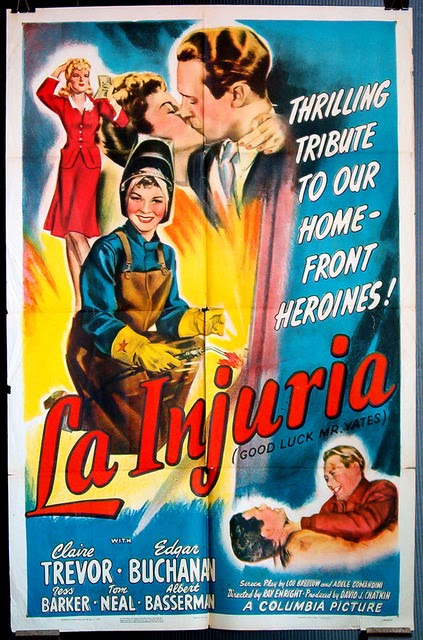
Our film for this week is a wartime B picture entitled Good Luck, Mr. Yates (1943), It stars Jess Barker as the titular Oliver Yates, an instructor in a Carlyle Military Academyl who has been, much to his disgust, exempted from military service as an essential employee (why a grade school teacher would be exempt from the draft is beyond me). Many of his students are hostile because he is not in the war, and Oliver is finally able to convince his boss that he must enlist. Only problem is, he has a perforated eardrum and is listed as 4F. Rather than return to the school, he gets a job at a shipbuilding facility, while he seeks treatment from German refugee Dr. Carl Hesser (Albert Basserman). Dr. Hesser can cure him in a few weeks, and he'll be able to join the army. Right...
To be upfront, two of our viewers found the film amusing, two of us loathed it (and I was one of the loathers). The film is all over the place, with no real focus, and much of it doesn't make a whole lot of sense. With a panoply of European characters (our German doctor, the Greek landlord, the Russian dockyard workers), all there to remind us of what we are fighting for, it tries to demonstrate the wonderful melting pot that is the United States. But all it succeeds in showing is that a mob is nasty no matter where you live.
And then there is our local "Rosie the Riveter", Claire Trevor as Ruth Jones, daugher of Oliver's shipyard boss, "Jonesy" Jones (Edgar Buchanan playing the only really good man in this movie). How Ms. Trevor got mixed up in this turkey is beyond our ken. She is such a good actress, and her success in Stagecoach is only a few years in the past. Around this period, she was appearing in a number of film noir like Crossroads and Murder My Sweet, frequently not in a starring role. Still, playing second fiddle to Jess Barker must have been a come down.
Jess Barker is banal as Oliver Yates, though one has to admit, he's not given a whole lot to work with. He's an attractive enough man, reminiscent of Richard Denning. But Barker had an abbreviated career, thanks to his own bad judgement. He was married to Susan Hayward for 10 years, and when she asked for a divorce, Barker created quite the public row. He insisted on a community property settlement (despite having signed a pre-nuptual agreement). When he was refused money, he filed for full custody of the twin sons. He lost that too. Then, two years later, he was implicated in a paternity suit, and was ordered to pay support for his daughter (conceived, it turned out, while he was still married to Hayward). He continued to act until 1977, but his reign as a potential leading man was long over. Another interesting aspect of this film is the marketing - it is (as you can see from the poster above), touted as a "thrilling tribute to our home-front heroines," with Claire Trevor getting top billing. Yet, there is very little about Ruth's war efforts. For better or worse, this IS Yates story.
We have an appearance by Scotty Beckett
as student Jimmy Dixon, and brief, uncredited appearances by Hugh Beaumont and John Hamilton. What we DON'T have are two segments that were cut from the film. Nan Wynn was supposed to sing as part of a lunchtime entertainment scene for the shipyard worker, but that was eliminated (here is a video of Ms. Wynn singing in Princess O'Rourke). Also cut were the Three Stooges doing their "Niagara Falls" routine. It seems the studio heads decided to save the routine and give it its own film: Gents Without Cents. Quite honestly, we considered THAT cut to be the one good thing about the film.
Next week, it back to the 1930s for a musical romance. Hopefully, we'll have more positive things to say!
Dangerous Blondes (1943) is a wartime film that pretty much ignores the war. Set in New York City, it stars Evelyn Keyes as Jane Craig and Allyn Joslyn as her husband, Barry, a mystery novel author. Barry is a bit of a show-off, and has recently bested the police team on a radio quiz show, making him not the most popular of men. So, when Jane's friend, Julie Taylor (Anita Louise) inadvertently gets Jane involved in a murder investigation, the interference of Barry does not win him any more friends with the local constabulary. The script has a lot of plot; with an 81 minute running time, the film goes by very fast. We found ourselves rerunning certain segments (the joys of DVR) to clarify plot points. Regardless, it's a fun film and not in the least boring. It's based on a story by Kelley Roos called If the Shroud Fits. Roos also wrote A Night to Remember (1942); we previously discussed the film version of that book. In Dangerous Blondes, Keyes and Joslyn are playing the same characters that Young and Aherne portrayed in A Night to Remember; again, the character's names from the book (Jeff and Haila Troy) have been changed. The following year, Keyes and Allyn would again play married amateur detectives in Strange Affair, though NOT the Troys (or the Craigs).
What makes the movie especially enjoyable is the relationship of Jane and Barry. Surely, this was an attempt to make another Thin Man type of film, and while Evelyn Keyes and Allyn Joslyn are no Myrna Loy and William Powell, they are very good (they are FAR more interesting characters than those in A Night to Remember). Jane Craig is a smart woman who loves her husband, and Barry is obviously deeply in love with her. Evelyn Keyes makes Jane attractive and not silly; her involvement in the murder investigation is mere coincidence. She is not the ambulance-chasing wife who MUST get in on her husband's action. And Allyn Joslyn is able to keep Barry personable even when he is being a bit of a twit. He too is accidentally involved, though Barry relishes the attention far more than Jane.
We have the usual married-couple banter, but it is affectionate and never over-the-top. We discover that Jane isn't really the best of cooks (though she is dealing with the difficulties in getting food - our only reference to World War II is Jane's brief comment on the amount of food one can buy with one's points). And we see Barry helping out around the house, which we all found to be a breath of fresh air. Imagine, a man doing housework and not being laughed at!
We found the costuming to be attractive; we were especially impressed, though, with the set design. Jane and Barry's apartment is so totally appropriate for their finances. It is the kind of apartment one would expect young marrieds to inhabit in 1943. It's not fancy, but it is clean and nicely furnished. It compliments the marriage that we are being shown.
The always funny William
Demarest plays a cop - Detective Gatling. It's established from almost the first scene that he is not very smart (he doesn't know who invented the first machine gun). Demarest, however, serves as a
good antagonist for Allyn Joslyn. He doesn't get a lot to do, but it is always a pleasure to see him.
Before we go, a quick nod to Minerva Urecal, who plays Jane and Barry's landlady in several scenes. You probably don't know the name, but you will know the face when you see her. With 276 film credits in film and TV (according to IMDB), she was always tiny parts, and often uncredited. She provides the first hint of trouble, and then she is pretty much gone. Ms. Urecal worked until her death of a heart attack at the age of 71 in 1966. Next week, we'll return with another World War II vintage film.
Vacations are over, and the Movie Night Group has reassembled for another Kay Francis movie. This time, we chose another film version of a novel: Little Men (1940), loosely based on the Louisa May Alcott book, which followed the life of Jo March Bhaer (Kay Francis) after the events of Little Women. And I do mean loosely. The novel was a somewhat episodic look at six months in the lives of the staff and students of the Plumfield School, which is run by Jo and her husband (Charles Esmond). The school has both male and female students, some of whom are relatives (Jo's sons, and sister Meg's daughter), as well as other boarding children. And that is pretty much where any similarity to the novel ends. Because this film (unlike the 1934 version which was much closer to the book) really is about the lives of Major Burdle (George Bancroft) - a medicine show salesman and con artist, his adopted son Dan (Jimmy Lydon), and Burdle's colleague - petty thief Willie the Fox (Jack Oakie). While Kay Francis' Jo is really a great effort on her part, she's about the only one in the film that is attractive. Professor Bhaer is a complete moron. The film wants us to believe he is an innocent, but he is, in fact, a complete doofus. Imagine giving your life savings to a complete stranger because you like his face! And this, when Professor Bhaer is already in debt because he is unable to approach the parents of the boarding students to collect the monies owed to him and his wife. Because of Bhaer's stupidity, his home and his school are endangered (in the book, Jo and Bhaer own Plumfield outright - it was left to Jo by Aunt March). Charles Esmond tries to make Bhaer appealing, but he doesn't have a whole lot to work with. Bhaer is beyond naive, and it is very difficult to get past his disregard for the safety of his family and students.
I suspect none of us would claim to be fans of Jack Oakie, but he is truly out-of-place in this story. His "comic relief" is not really funny, and his inclusion in the plot doesn't make a whole lot of sense. Without giving away the ending, his position as a deus-ex-machina is really silly. Our other lead, played by George Bancroft, is a con man and thief. The only appealing aspect of his character is his love for his adopted son. What Bancroft brings to the role is an obvious affection for the young man, and a desire that Dan have a better life than what Major Burdle can provide for him. We are so used to seeing Kay Francis in prestige pictures that this RKO film seems like a very low budget film. Francis, who was highly paid in the 1930s, was beginning to feel Warner Brothers disinterest in her, as the groomed younger (and lower paid) actresses like Bette Davis to replace her. This TCM article
goes into more detail about the persecution Francis faced: the studio even loaded her scripts with "r" words,
so her lisp was emphasized. Despite that, her Jo is a good, strong character. It's obvious though, that she is not the star - as you can see by the ad below, even a cow gets the same billing as Ms. Francis. We'll be back next week with a 1940s mystery film.
AFI Silver Theatre recently hosted a series of 70mm film extravaganzas. In part three of this series of films, the 1996 Hamlet, with screenplay and direction by Kenneth Branagh (who also took on the title role) was featured. As is noted on the AFI page, it's nearly impossible to see a 70mm film in a theatre any longer. Many of the prints are not available, and the hardware to project them is virtually extinct. I had seen this film when it opened on Christmas Day, 1996 in New York City at the Paris Theatre (on 58th Street, near 5th Avenue). As the film is a rendering of the complete play (all 4 hours and 10 minutes, with a 15 minute intermission), I was excited to see it again (sure, I own the DVD, but even my big screen TV doesn't do it justice). It is a major commitment, to be sure, but one I was thrilled to make again. Shakespeare, Hamlet, Branagh, a movie theatre - it doesn't get better than that! It should be noted that we attended this prior to Robin Williams untimely death. Mr. Williams' appearance as Osric is short, and might have only warrented a brief comment, but combined with the events of last week, an extra poignancy was brought to the role. That Branagh mixes American and British actors in this production has always been a delight for me (Branagh did the same thing in his excellent Much Ado About Nothing). Having Robin Williams in the part of a nonsensical fool brings a delightful humor to Osric. He plays up the silliness of the character, but also gives him a degree of pathos. So often noted for his remarkable comedy sense, we sometimes forget what a gifted dramatic actor Robin Williams is. I am of the opinion that he is an excellent Osric. I would have loved to have seen him tackle another Shakespeare role - perhaps Jacques in As You Like It, the Fool in King Lear, or Malvolio in Twelfth Night. Alas for the loss of such a gifted man; for the roles he will not play; but gratitude for the joy and revelation he brought to all our lives.
I did my master's degree in English literature; my specialization was Renassiance drama and Shakespeare. Thus, I did a lot of coursework surrounding the works of the Bard (and, just as an aside - Shakespeare wrote Shakespeare!). One of my instructors once said that he could never envision a Hamlet in which Hamlet and Ophelia were not lovers. Until I saw this film, I was not of the same opinion, but as enacted by Branagh and Kate Winslet, I now find it difficult to see the play any other way. Winslet's mad scene is especially cogent within the context - Ophelia's bawdy songs now have a great deal of meaning. One wonders if her madness is the loss of her father or her lover. And one other little thing. This Hamlet is set in the winter in Denmark. Not a flower to be seen; yet Gertrude still tells of Ophelia on the river bank playing with flowers. Were they the imaginary flowers she toys with in the scene with Laertes? Or did something more sinister happen to the madwoman? It's up to you to decide. The performances of Derek Jacobi as Claudius and Julie
Christie as his bride, Gertrude are wonderful. Casting Christie is quite
insightful - this is a Gertrude worth murdering for! And Jacobi is
remarkable in portraying the ambiguity of Claudius. He gives us a
character who initially does want the good regard of his new stepson.
Flashbacks within the film show us a family relationship prior to King
Hamlet's death that was convivial; thus Jacobi's Claudius is surprised at
the change in his nephew's attitude towards him.
Besides Robin Williams, other American actors in the cast include Jack Lemmon as Marcellus, Charlton Heston as the Player King, and Billy Crystal as the First Gravedigger. Mr. Lemmon doesn't have a lot to do in his part, but Heston and Crystal certainly do. Mr. Heston is extremely good doing the Hecuba speech - he is an actor one forgets has a deep history with Shakespeare. His Antony and Cleopatra is available on DVD; he in fact not only starred as Marc Antony, he was part of the writing team on the production and directed it. It is, in fact, an excellent version of the story. And Billy Crystal gives us a wry Gravedigger - humorous, but also quite intelligent and insightful.
Branagh is also includes in the film several actors who have themselves tackled the role of Hamlet. Derek Jacobi is well known for his rendition in the 1980 BBC version of Hamlet. We also have John Mills as Old Norway, who played Hamlet at the Old Vic in 1929, and John Gielgud, noted as one of the finest Hamlet's of his generation as Priam. Gielgud also directed another splendid Hamlet - Richard Burton - in his notable stage production (the Richard Burton Hamlet is available on home video). For those of you who would like to see more of some of these other performances, snippets of other Hamlets are available on YouTube, including Richard Burton, Laurence Olivier, John Gielgud.
It will be a couple of weeks before our next posting (several members of the group are off on vacations). In the meatime, we leave you with the remarkable Kenneth Branagh discussing his rendition of the "To Be or Not to Be" soliloquy. Don't let the length of this production dismay you. With superb acting, beautiful sets, and cinematography to die for, this is worthy of your time.
The setting is a small English village in the 1850s. A young man arrives by train late at night. No transportation is available, so he walks to his new residence, Limmeridge House, where he will be working as an art instructor. En route, he meets an odd young woman, dressed all in white, who disappears when a carriage approaches. Thus begins the mystery that is The Woman in White (1948), based on the novel of the same name by Wilkie Collins. As a huge fan of Wilkie Collins and of the novel, I have mixed feelings about this film, which changes so many aspects of the original story (later on, I'll detail some of those changes). My colleagues were not familiar with the book, nor with the 1997 BBC production (which appeared on PBS); as a result of our discussion, one member is planning to read the book, the other to take a look at the more recent adaptation. Since our discussion of the film did look at the book as well, readers should be warned that spoilers will be included. I usually try to avoid them; in this case, it would be impossible. By and large, the group felt that the movie was disjointed, and once information about the book was included, they all said they would have liked a film that more closely followed the novel. However, the change in the character of Laura Fairlie (Eleanor Parker) from namby pamby to someone who actually has a backbone, was a vast improvement. Wilkie Collins painted his main heroine as the helpless blonde female - she is gorgeous and gentle, and therefore does not have a brain in her head, or the ability to do much more than faint in the face of adversity. Eleanor Parker does a good job of portraying Laura, and of showing her attempted resistance of the dastardly Count Fosco. Her Anne Catherick is a bit more mannered, and resulted in a number of jokes about "identical cousins". In the novel, Anne and Laura are probably half-sisters.
Both book and film give us a strong, capable Marian Halcombe (Alexis Smith), here described as Laura's cousin; in the novel they too are half-sisters (Mr Fairlie was a busy man!) But Ms. Smith is a beautiful woman, and Marian really should not be. Walter Hartright (Gig Young) describes her thus in the novel:
The lady is ugly. . . . [her] complexion was almost swarthy, and the dark down on her
upper lip was almost a moustache. She had a large, firm, masculine
mouth and jaw; prominent, piercing, resolute brown eyes; and thick,
coal-black hair, growing unusually low down on her forehead.
However, Walter also says that Marian appears "bright, frank, and intelligent." And while Ms. Smith certainly appears "bright, frank, and intelligent," she is NOT ugly. So, it is no surprise that at the end of the film, Walter ends up with the lovely, smart Marian, while in the novel, he weds the gorgeous, vapid, helpless Laura. Alexis. Smith is excellent in the role; she projects an intelligence and engagement that is essential for the role to be successful.
Sydney Greenstreet as Count Alesandro Fosco, stays very close to the character as written in the book. He has the same rather overpowering charm, and the same sinister demeanor. His sincere admiration for Marian is also retained. We meet him almost immediately, and, of course, are immediately suspicious of his intentions. In the novel, we are not introduced to the character until after the marriage of Laura and Sir Percival Glyde. He is not married to Anne Catherick's mother (the Countess Fosco, as played by Agnes Moorehead), and it is Walter, not Marian, who forces him to confess his intentions.
All of these changes, and others, serve to diminish some of the power of the book, and it is unfortunate. The book is quite cinematic; like Dickens, his friend and sometime collaborator, Collins was a very visual writer, and his descriptions would lend themselves well to film. We spoke at some length about Gig Young. The actor had changed his name about 6 years prior to this film, from Byron Barr to Gig Young, adopting the name of his character in The Gay Sisters. This is the second film he made after returning from WWII, where he served in the Coast Guard. He had a long and very varied career. He was a talented comedic actor (in films like That Touch of Mink and Teacher's Pet), and a powerful dramatic actor, finally winning an Oscar in 1969 for They Shoot Horses, Don't They? His death, at his own hand, at the age of 65 (he also murdered his new wife) remains a mystery to this day. We leave you with an early scene, in which we get to meet several of the main characters:
James Warlock (Ronald Colman) has been happily married to Clemency (Kay Francis) for 7 years. He is eagerly anticipating their upcoming wedding anniversary, only to discover that she is going on an extended trip with her younger sister, Garla (Florine McKinney). It seems the madcap Garla has become involved with a man to whom her family objects, and their parents have requested that Clemency get her far away from temptation. When Jim's friend John Tring (Henry Stephenson) discovers that Jim is at loose ends, Tring invites him out to dinner; John also invites two young ladies to join them. Jim resists the attractions of Doris Lea (Phyllis Barry) at first, but when he meets her again, weeks later, he is lost. An affair, which will have disastrous results for all involved, begins. Cynara (1932) is told in flashback. In the film's first scene we learn that Clemency knows of Jim's infidelity and that Jim's successful law career has been destroyed. What follows is a chronicle of deceit and guilt, as Jim descends into a morass of lies and betrayals from which there is no return. It's hard to actually dislike Jim - yes, he cheats on his wife, but from the minute he meets Doris, he is honest with her: he tells her he is married, that he loves his wife, that their affair is temporary. But Doris, who has been down this road before (a key plot point at the end of the film), is desperate and unstable. Today, we would call her a stalker. Though Jim rebuffs her advances when they first meet, she actively pursues him. She is unable to compartmentalize her feelings about him; as a result, she loses her job, and ultimately destroys both of them.
Clemency, on the other hand, becomes a victim of her own
neglect. Though she genuinely loves her husband, she takes him for
granted. She leaves on the eve of their wedding anniversary, without
even a by-your-leave - Jim comes home to find her packing. She will be
gone for several months, yet she does not even consider discussing this
move with her husband (who is presumably paying for her trip!). One
doesn't dislike Clemency - she is a caring woman, but it seems that she
is oblivious to her husband's needs Colman is, as always, pitch perfect. He is a fantastic actor, with perhaps the most glorious voice in film. It's hard to believe that he started in silents (imagine that impressive voice unheard!) However, one suspects that, with the advent of sound, Samuel Goldman rubbed his hands with glee at the thought of Colman's transition to sound. (A TCM biography of Colman likens his voice to "crushed velvet"). Colman had started his career in the theatre, and in his later years, transitioned to appearances on radio and television, often appearing with his second wife, Benita Hume. He won an Oscar for his role in A Double Life. He died at age 67 (from acute emphysema) in 1958. Unfortunately, Kay Francis doesn't have a lot to do in this film. Clemency is in Italy for most of it, and when she returns, she merely gets to look pained. On the other hand, Phyllis Barry has quite a bit of screen time. Her casting is interesting - and telling - as she rather resembles Kay Francis. It only serves to emphasize that Jim seems to be seeking his arrant wife, rather than looking for a lover. Barry had a fairly long career, though mostly in very small parts. She died in 1954 of barbiturate poisoning. For more on Cynara and the careers of Colman and Francis, see this TCM article. The title Cynara is taken from a poem by Ernest Dowson. The poem, Non sum qualis eram bonae sub regno Cynarae (1894) contains the line "I have been faithful to thee, Cynara! in my fashion." It ALSO contains another famous movie title: Gone with the Wind. Another Dowson poem supplied the title of The Days of Wine and Roses. All in all, we found this an enjoyable film, and recommend it. It is a wonderful example of early Colman. We leave you with the opening of Cynara, in which we learn of Jim's downfall:
This week, we move to the period just before the start of World War II to discuss All Through the Night (1941), a very funny - and entertaining - film from Warner Brothers. 'Gloves' Donahue (Humphrey Bogart) is a promoter in New York City. Every day, 'Gloves' goes to his favorite restaurant for Miller's cheesecake. The restaurant is under orders to ONLY serve Miller's cheesecake. On one particular day, Papa Miller (Ludwig Stossel) has not made his usual delivery. Though Papa Miller assures 'Gloves' that all is well, later that day, - following a frantic phone call from his mother (Jane Darwell) - 'Gloves' discovers Papa Miller has been murdered. 'Gloves' - the prime suspect of the police - and his crew investigate the murder, and find not only the murderer, but a passel of Nazis who have infiltrated New York City.
This film has an amazing cast. Humphrey Bogart demonstrates his flare for comedy as 'Gloves' (whose given name is Alfred!), and is supported by actors like Frank McHugh (as newlywed Barney), William Demarest (as right-hand man Sunshine), and Jackie Gleason (as Starchy). His opposition is just as impressive. Peter Lorre as Pepi, our slimy villain was of particular interest. He is an actor who is always fascinating to watch; he is not a disappointment here. The wonderful Conrad Veidt is featured as Hall Ebbing, the ultimate Nazi; and Judith Anderson appears as Ebbing's comrade - she is just as menacing as she was in Rebecca. Add Kaaren Verne
as love interest Leda Hamilton and Phil Silvers
(as a waiter in the restaurant), and you have a powerhouse of actors. It's really it is the acting that make this film so enjoyable. It has a good script, but coming from the mouths of these folks, the dialogue shimmers.
The film was released on December 2nd, 1941 - just 5 days before the United States would enter World War II. Many of the studios tried to avoid any mention of the difficulties in Europe. Certainly, this was an economic issue (insulting the Nazi party would assure that the studio's films would not be shown in Germany). But censorship was an issue as well. The Hays office, which governed film standards under the Production Code, was very clear that films which "would arouse very bad feeling in Germany" were to be avoided (The New Yorker. "Hitler in Hollywood"). However, Warner Brothers had other ideas. As this article from the American Film Institute discusses, Warner Brothers release of Confessions of a Nazi Spy in 1939 (based on an FBI case in New York) was the first explicitly
anti-Nazi film made in America. It was produced in the face of numerous
domestic and international threats, and reversed the policy of the Hays
office.
This film follows in
that anti-Nazi vein, and features three actors who had a vested interest
in showing the dangers of the Nazi party. Conrad Veidt, whose wife was
a Jew, left Nazi Germany for the United Kingdom in 1933, relocating the U.S.
around 1940. Peter Lorre was in a similar situation. Though lauded by Nazi Minister of Propaganda Joseph Goebbel for his work in the film M,
Lorre and his wife (actress Celia Lovsky) fled to the United States in
1933. Kaaren Verne left Germany in 1938, also to get away from the
Nazis (Verne and Lorre would marry four years after this film, after
divorcing their respective spouses). Veidt, who donated huge sums of money to the British war effort, especially seemed to relish the chance to make the Nazis look bad. He is a marvelous actor, and it is a shame that his death of a heart attack in 1943 precluded his return to meatier roles.
The advertisements for the film make sure to emphasize that Bogart's 'Gloves' is a gangster. Take a look at the poster above. "The underworld's top trigger-guy..." That's 'Gloves'. Except that the film clearly tries to make him less a gangster and more a businessman. Sure, he orders all the local restaurants to only purchase cheesecake from Papa Miller (a cheesecake protection racket!), and he has a gun. But he is a nice guy who loves his mother. The script really wants to de-emphasize the shadiness of 'Gloves' line of work, so that the film can have a happy ending (the Code would not allow a real gangster to survive the ending, no matter how noble he was). But it's amusing that Warner Brothers is really trying to have their cheesecake and eat it too!
All Through the Night is obviously set in New York City. But as natives, we were very amused by the film's geography. The warehouse which 'Gloves' and crew go to investigate is on 733 E. 61st
Street, which would be in the middle of the East River. The art gallery is attached to it (around the corner, we are told), but later on we are told that the gallery is 3 blocks from 5th Avenue. Huh? If the warehouse is floating in the center of the East River, that's about 10 blocks from 5th Avenue.
This film was yet another role that Bogart got because George Raft wasn't interested. (Raft also refused to do The Maltese Falcon and High Sierra). Olivia de Havilland was at one point listed for the role of Leda. This TCM article discusses how Gleason and Silver got into the film. Though no characters were in the original script for the actors, Jack Warner told Vincent Sherman to find them parts. So he did!
We end our discussion for this week with a trailer featuring our remarkable character actors and our star:
As promised, we again return to Illicit, which we've reviewed on two separate occasions (to read those, please visit my reviews from last November - when I saw it in a theatre - and in January of 2013.) This time, we talked about the film in comparison to Ex-Lady, a remake of this 1931 film. The plots are very similar; a young woman, deeply in love with a young man, disdains marriage, but is finally convinced to wed the man, and finds her prophesy of unhappiness is coming true. In both films, we have past lovers who interfere with the marriage. But there are substantial differences, and those changes mpact the remake. Illicit makes quick reference to Anne Vincent (Stanwyck)'s reasons for disliking marriage - her parents were divorced. The only other parental figure we meet is Dick's father, who is a good and kind man. No spouse is ever mentioned for Mr. Ives, Sr. As a result, Anne's reluctance to wed is rather unspecific. Ex-Lady, however, gives us a clearer picture of Helen Bauer (Bette Davis)'s abhorrence to marriage. In one brief scene, we are shown the horrible marital example Helen has lived with her entire life - her domineering father, and her passive, obviously abused, mother. Given a graphic example of Helen's family relationship, it's little wonder she despises marriage. Also, unlike Anne, Helen is extremely career-focused and has a marketable skill. We have to assume that Anne is independently wealthy - we never actually see her doing anything.
On the other hand, the reason for the couple's separation is much clearer in Illicit. Dick and Anne are never with one another. They are always partying, and the intrusion of their exes is much more evident. Another big factor is Dick's obvious lack of a career or of any kind of ambition (other than carousing). In Ex-Lady, Don's jealousy of Helen's more successful career seems to starts the downward spiral (though Don was aware of her work ethic before their marriage).
While Ex-Lady is 12 minutes shorter, there is more depth to the characters. We never felt that we got enough screen time or development of Ricardo Cortez' Price in Illicit. Monroe Owsley, however, gets much more of a chance to flesh out the "other man, " Nick, who he portrays as a total swine; he's oily and rather
revolting. When Ricardo Cortez plays the same character, you don't like
him, but he's not quite as slimy, though he should be.
All in all, we love Stanwyck, we're not keen on Raymond, but Ex-Lady came out with a slightly higher thumbs up from the group. That extra bit of character development, and the strengthening of the lead female role made the film a lot more appealing. Here's a scene from Illicit.



FLjQ~~0_35.JPG)


