This week, we returned to the pre-code period, and early to an Bette Davis effort (back when she was blonde) with The Big Shakedown (1934). Bette plays Norma Nelson, a clerk in the neighborhood pharmacy run by her fiancé, chemist Jimmy Morrell (Charles Farrell). Jimmy is an easygoing sort, who runs his store more as a local gathering place than as a business. He's not able to afford for he and Norma to marry, and he is being threatened by a large pharmacy chain that wants to buy him out for peanuts. Enter Dutch Barnes (Richardo Cortez), a bootlegger who is finding it hard to pedal his wares now that Prohibition is over. Dutch has a brainstorm - hire Jimmy to pirate PearlyDent toothpaste; Dutch will then sell the identical, but more cheaply made product for less money. Norma is furious when Jimmy agrees to the scheme, but Jimmy doesn't see the problems (he's making it, after all. He's not SELLING it). Things get complicated, however, when Dutch decides to branch out, first into cosmetics, but then into pharmaceuticals. And by then, Jimmy can't get out. The strength of Bette Davis' personality is a real plus in this film. Charles Farrell's Jimmy is so lackluster that Davis dominant personality gives the film the power that it needs. In this TCM article, the reviewer laments that Davis as the good girl is wasted, but we think not. Without the character's innate integrity and willingness to stand up for
what is right, the picture would flounder. You believe that Davis is
able to disregard Jimmy AND the mobsters.
One of the wiser choices of the writers is to begin with a fairly inane crime (counterfeiting toothpaste), provide it with some humor (a group of fairly dumb gangsters - including Allen Jenkins - taste testing the product), but then build up to the true crimes: blackmarket drugs, murder, and the destruction of a company. Besides Davis, we're treated to two of our favorites - Glenda Farrell as Lilly Duran, Dutch's mistress, and Ricardo Cortez. Farrell here gets to play both the ditsy blonde and the wronged woman. Where at first you think that Lily is rather stupid, you quickly discover she's quite smart and observant. She's also the wrong person to cross, to her misfortune.
Cortez provides a villain who is smart, disarmingly charming, and deadly. He's seductive, a human cobra sucking in anyone who peers too deeply into his eyes. Dutch knows how to gauge people's weaknesses, but ultimately his reach exceeds his grasp. Our group has a fondness for Cortez, an actor who, unfortunately, is not well remembered today. Born Jacob Krantz in New York City, he started in silents, with studio executives billing him as a Latin lover (to get in on the Rudolph Valentino craze). While that worked before pictures spoke, sound was a give-away that Cortez, with his Lower East Side accent, was not a Latino. So, while his roles changed, his popularity did not. He played more character parts; often the villain, though sometimes a good guy (see Ten Cents a Dance; he's quite good!) He even played Perry Mason at one point (The Case of the Black Cat, 1936). He appeared in over 100 films, and directed 7. By the mid 1940s, he was finding parts hard to get, so he "retired" and became a successful stockbroker (though he did appear in two films in the 1950s, and even was in an episode of Bonanza! Cortez died in 1977 at the age of 76. That this is a pre-code film is apparent, even though it came out as the Code was going into closer effect. A murderer is left unpunished, and our lead character (while he does have to pay a price for his deeds) really doesn't suffer all that much in the long-run. Fellow blogger at Pre-code.com disliked the film; New York Times, however, rather liked it. While this is not great literature (and drug counterfeiting plotnotwithstanding, it surely is NOT The Third Man), we think it is worth a look. The trailer below will give you a taste.
This year's TCM Cruise presented a number of films with Tyrone Power (which is never a hardship for me); not surprisingly, I saw them all. The third night of the cruise featuredThe Razor's Edge (1946), based on W. Somerset Maugham's novel, and introduced by Alex Trebek and Robert Osborne, both huge fans of this excellent rendition. (For those of you who liked the Bill Murray remake, sorry - I didn't care for it, and neither did the evening's hosts). The story focuses on Larry Darrell (Power), He has physically survived the First World War, but is tormented by the death of a friend, who died saving Larry's life on the eve of the armistice. Why, Larry wonders, should he live, when this man is dead, and what can he do with his life to make up for that death? Larry's fiance, Isabel Bradley (Gene Tierney) is sympathetic, and agrees that Larry should travel for a while, to try and find the answers to his questions. But when, a year later, Larry is still determined to continue his quest, Isabel balks - she is not willing to live as an itinerant, with a husband who has no ambitions to anything but the life of a nomad. So, they separate, only to be reunited years later, when both their lives - and the lives of their friends and relatives - have drastically changed.
This is a complex film, following the lives of a number of central characters over a period of nearly 15 years, all of whom are in some way related to Larry and Isabel. The characters are real - with faults and flaws. We admire Larry, but would find him impossible to live with. We sympathize with Isabel, but gasp at her machinations. It's a film of greys - there are almost no black and whites. Elliot Templeton (Clifton Webb) is a prime example of a "grey" character. Wealthy, selfish, and somewhat arrogant, Elliot is also generous and intrinsically good. Late in the film, a priest characterizes Elliot as "a good man. His defects were on the surface, but he was generous of heart ...and kindly toward his fellow creatures." That he is basically good is reflected in the fact that our narrator, Maugham (Herbert Marshall), actually likes Elliot (also calling him "kind and generous"), even though he feels that Elliot " has no friends, only acquaintances." Elliot's wealth has allowed him to live his life in Europe, hobnobbing with the wealthy and noble, and to look with aghast at his much loved sister, Louisa (Lucile Watson), who has chosen to spend her life in the Midwest. But, when his niece and nephew-in-law lose all their money in the Stock Market crash, it is Elliot who takes them in, and supports them and their children until they can get on their feet. Webb paints a picture of a man whom you like in spite of yourself; he allows us to the see the inner Elliot.
Anne Baxter won her Academy Award for playing Sophie
MacDonald, a
loving wife and mother whose life is shattered after an
automobile accident. Other actresses were considered for the part
(Susan Hayward, Betty Grable, Judy Garland, Anabel Shaw, Nancy Guild,
and Bonita Granville, according to Ms. Baxter), but it is hard to
imagine anyone else doing it. The character of Sophie floats in and out
of the
story, as she does in the lives of the other characters. Sophie's alcoholism
becomes a major focus of the film, and it is Baxter's seering portrait
of Sophie's problem that more than likely cinched the award for her.
While we sympathize with Sophie, Baxter is careful to make her
unappealing in the latter half of the film - again, she is painted in
grey tones. And her alcoholism is not something that just appears
because of the accident - early on, Sophie tells us that her husband Bob
(Frank Latimore) doesn't like her to drink because of what it does to
her. Of course, Joseph Breen tried to get the alcoholism eliminated
from the film - Darrel Zanuck refused to take it out, as essential to
the story (for more on this and other casting issues see these AFI notes.)
Gene Tierney was not the first choice for Isabel. Both Joan Fontaine and
Olivia de Haviland were considered, as was Maureen O'Hara. In her autobiography, 'Tis Herself, Ms O'Hara recalls that the deal was all but completed. There was one proviso, however: producer Darrell Zanuck told her to keep quiet about her casting. She didn't - she told her friend Linda Darnell - who was in a relationship with Zanuck at that point, unbeknownst to Ms. O'Hara- and Zanuck fired her later that day for blabbing.Regardless of the fact she was not the first choice, Ms. Tierney
shines (she was nominated for an Oscar - losing to Joan Crawford in Mildred Pierce) as Isabel, and creates a character of dimension and layers. As hideous as some of
her actions are, even narrator Maugham cannot dislike her, nor in a
sense can we do more than shake our heads at her selfishness. According
to this TCM article,
Tyrone Power (newly back from his service in World War II), developed
on crush on her. She privately let him know that, though divorced from
Oleg Cassini, she was seeing someone else - future president John
Kennedy. Though Tierney loved JFK deeply, it was not too be. Kennedy
was already looking towards his future in politics, and men married to
divorcees just didn't get to be president in the 1940s.
Gray Maturin (John Payne) is the man who has loved Isabel for years,
and who ends up married to her when Isabel is unwilling to wait for
Larry. It's interesting that his name is "Gray", because he is perhaps
the only non-gray character in the film. Gray is, in fact, the only really "good"
person we meet. He loves Isabel unquestioningly and he likes Larry, even
though Larry is the competition. It is Gray who has to interact
with Sophie on the most critical day of her life - Payne gives us a man who is caring, but unable to do more than just sympathize. Payne works hard to
make Gray a complex, but not weak character; he mostly succeeds, as we care about Gray and understand how deeply honorable he is. One other character of note is that of Miss Keith (played by Elsa Lanchester). As the private secretary of the Princess Novemali, the part is tiny - at one point, we see her in the background of the action, but finally get to meet her at the film's end. Like Gray, she is someone who is deeply good. Though Lanchester only has this one brief scene with Tyrone Power, you will remember her. Her Miss Keith is a woman of integrity in a world of mere surface. In the discussion prior to the film, Robert Osborne cited one scene in the film that he thought one of the most beautiful on film. You can see it below, as Isabel tries to seduce Larry, to keep him from going away again. A magnificent setting, and two of filmdom's most attractive people - this scene does shine. We'll be returning to more films from the festival in coming weeks (along with our regular conversations).
All of the members of our group remember with fondness reading the book Anne of Green Gables by Lucy Maud Montgomery (in fact, I reread the story last year, and found it as wonderful as I had as a child). This week, we took a look at the 1934 film verson of the novel.
Siblings Marilla and Matthew Cuthbert (Helen Westley and O.P. Heggie), own a farm in Prince Edward Island, Canada. Neither are young and Marilla worries that the farm is too much for Matthew to manage alone. So, she decides to foster an orphan boy who can help with the work. They are both surprised when the orphan who arrives is a girl - Anne Shirley (played by Anne Shirley - she officially changed her screen name from Dawn O'Day with this film). Anne (Ann with an "E" as she insists) is a talkative and imaginative young thing, and Matthew is immediately taken with her. Though Marilla is at first resistant to the idea of a girl child, she too becomes fond of Anne, and Anne stays on to help Marilla in the house. The film recounts the "adventures" of Anne Shirley as she grows up on Green Gables. There are some differences between the book and the film, as is to be expected. The character of Mrs. Rachel Lynde merges with Diana's mother, Mrs. Barry (the Anne of the book has misunderstandings with both of them, so this is not an unlikely union. The part in this film was played by Sara Haden). The novel ends with Matthew's death, and Anne's return to Green Gables (and in the novel, Gilbert Bythe is studying to teach, as Anne does). Finally, in the book, there is no animosity between Marilla and the Bythe family. If there is one change to the book that irked me (this was my favorite book growing up), it was the film's alteration of Marilla. While sometimes stern, Marilla is the epitome of fairness. The film's Marilla, while generally an excellent role model for the growing child, has a tendency towards pettiness, which is just not necessary to carry the story forward. Anne's own antipathy for Gilbert (based on the incident portrayed in this film, where he calls her "Carrots") is really all that is needed. This TCM article quotes a very favorable New York Times review, which lauded the film's faithfulness to the novel, but points out that author Montgomery found the film "entirely different" from her conceptualization. Regardless, the film does one very important thing right - it captures the spirit of Anne Shirley.
Helen Westley started her film career the year of this film (by the end of 1934, she had 6 film credits to her name. With Anne of Green Gables opening for Thanksgiving, this was final film of that inaugural year.) By 1942, the year she died, she had appeared in 38 films, including Banjo on My Knee and Adam Had Four Sons (which we had previously discussed). Westley, who primarily played cantankerous old women on screen, had a notable stage career prior to and during her tenure in Hollywood. She appeared in 53 Broadway plays from 1915 through 1939 (including the stage version of The Primrose Path - the filmed version had Queenie Vassar in Ms. Westley's part.)
Dawn O'Day's new name was a publicity stunt concocted by RKO, but Ms. Shirley opted to continue with her new name as her career flourished. (See this article from the AFI article for more information). She would revisit the role of Anne Shirley in Anne of Windy Poplars (1940), but within 4 years of that film, Ms. Shirley retired, following her marriage to her second husband, Adrian Scott. (She had previously been married to John Payne; they had one child together). After the union with Scott ended, Ms. Shirley married again, this time to Charles Lederer, a marriage that lasted from 1949 until his death in 1976. Ms. Shirley died at the age of 75 in 1993.
Tom Brown's (Gilbert Blythe) career started in the silent era (when he was 11 years old) and continued, into talking films and television, until 1979. He was a regular on the long-running soap General Hospital (appearing as Al Weeks), and had a recurring part (Ed O'Connor) on Gunsmoke. He died in 1990.
A few small bits of trivia: both Bonita Granville and Ann Miller appear in small parts (as school girls. If you blink, you will miss them). More obvious is June Preston as the little Bluett child (she actually gets a mention in the credits!). She's not really remembered today as a film actress - she did a few Our Gang films in the 1930's, but is listed in all of her 15 films as some variation of "little girl". However, Preston had a second career as an adult: she was ainternationally known soprano with the Metropolitan Opera's touring company, later doing recitals in major venues all over the world.
We will leave you with this introduction to Anne Shirley, and also mention that PBS did a remarkable series on Anne of Green Gables and some of the subsequent books (that remained very true to Ms. Montgomery's novels), with Megan Follows as Anne (she is, in fact, nearly perfect in my humble view) and Colleen Dewhurst as Marilla. Regardless, this version is excellent, and Ms. Shirley is a joy as Anne. We highly recommend it.
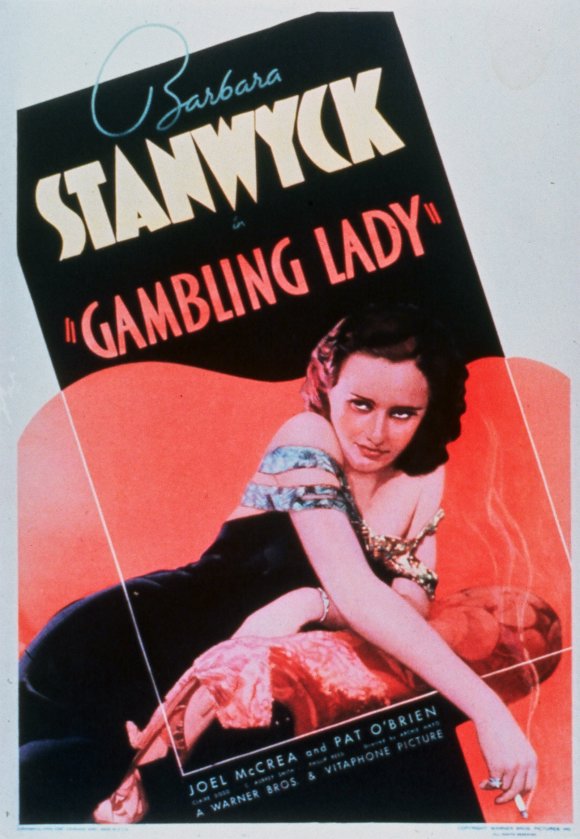
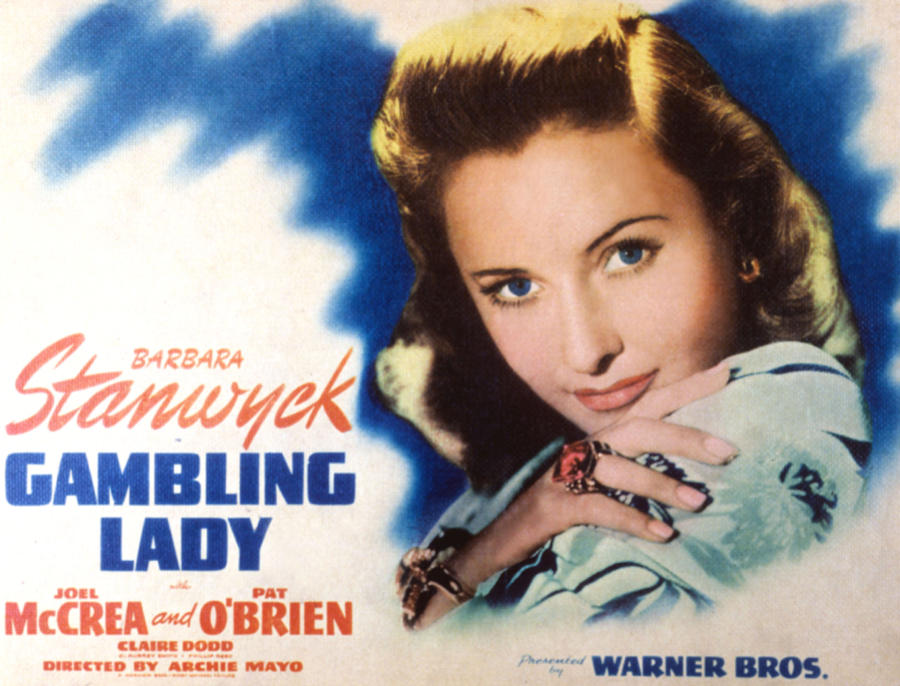
Gambling Lady (1934) is an engaging film, which stars Barbara Stanwyck as Jennifer "Lady" Lee. When her father, Mike (Robert Barrat) kills himself in despair over his debts to a gambling syndicate, Lady seeks employment in the one occupation she knows - gambling. Lady, like her father, is scrupulously honest, and takes a job with the syndicate on the proviso that they will run an honest game. When she discovers they have lied to her (and have placed someone into the game who is systematically cheating), she resigns and begins working on her own. While playing at a society party, she meets Garry Madison (Joel McCrea); they fall in love and he proposes marriage, to the concern of his father, Peter Madison (C. Aubrey Smith). But Peter, a gambler himself who knew and admired Mike Lee, comes to realize that Lady's love for Gerry is true, and consents to the marriage. However, the course of true love hits road bumps - the return of Garry's former girlfriend Sheila Aiken (Claire Dodd) and Garry's jealousy of Lady's friend Charlie Lang (Pat O'Brien). This is a good, fast-moving film, with a lot of story packed into 66 minutes. Stanwyck, as always, is excellent as Lady Lee, and her rapport with Joel McCrea (in their first of 6 films together) is evident. Particularly notable are two scenes: the first one has Lady playing cards with her rival Sheila, to Sheila's misfortune; the second immediately follows, and shows Garry and Lady frolicking in their bed as Garry tries to convince Lady to return Sheila's losses (this is, after all, a precode film). It's obvious in this second scene why Stanwyck and McCrea became a screen couple. When we viewed Banjo on My Knee several months ago (their second film together) we discussed their screen history. For more information on McCrea himself, please visit our blog post on Rockabye. The one criticism we have of his character in Gambling Lady is his jealousy towards Charlie - he should know his wife better. She is the soul of honesty; how could he even THINK that she would cheat on him?
We like Pat O'Brien, but he is somewhat wasted in the film - his screen time is small, and there are times when one wonders why Lady would pick Garry over Charlie (Garry can be quite petulant at times, while Charlie is always in Lady's corner). But, O'Brien has the acting chops to stand toe to toe with Stanwyck, and that is important here - we HAVE to understand Lady's loyalty to Charlie, even though he doesn't always play an honest game. And O'Brien has an inner integrity that makes his character almost admirable.
This is a film that is loaded with excellent character
portrayals. C. Aubrey Smith's Peter is one of them. A man of honor,
who loves his son and grows to love and even admire Lady, Smith gives us a memorable performance. A versatile actor, who could play
sweet (as he does here) or vile (see No More Orchids
for one of his more repugnant characters.) Smith began his living as a
professional cricketer, playing professionally from 1882-1890, and
highly regarded as a bowler. When he came to Hollywood, he continued to
play, forming the Hollywood Cricket Club, with fellow actors David
Niven, Laurence Olivier, Nigel Bruce, Leslie Howard, and Boris Karloff.
His acting career began in London - he, in fact, was the lead in The Prisoner of Zenda
(returning to the story in the 1937 film version, in which he played
the wise Colonel Zapt). He worked in silent films in England, then
ventured to Hollywood, where he became the unofficial head of the
"Hollywood Raj," or British film colony. In 1938 he was appointed a
Commander in the Order of the British Empire, and was knighted in 1944.
Married to Isabelle Wood from 1896 until his death in 1948, Smith was
an actor of note, appearing in such classics as The Four Feathers (1939), Wee Willie Winkie (1937), and Rebecca (1940). His final film, Little Women (1949) was released after his death from pneumonia.
Claire Dodd is also quite entertaining as the evil Sheila
Aiken; as mentioned above, her gambling scene with Stanwyck is one to
see - two pros matching wits (Stanwyck wins, but Dodd gives her a run
for her money). We discussed her career in some detail when we saw her
in Lawyer Man (1933). This New York Times review was quite complementary - and justifiably so - of Ms. Dodd in the film. Fellow blogger at Immortal Ephemera also singled out Ms. Dodd for praise. As discussed in this TCM article,
Stanwyck had some momentary trouble with director Archie Mayo when he
tried to pinch her. Not surprisingly, she handled the situation quickly
and firmly (and he didn't do it to her again). In 1949. Stanwyck would revisit the theme of gambling in The Lady Gambles, but the two films are in no way similar (the 1949 film is very much a social drama about gambling addiction). We'll leave you with the trailer from Gambling Lady, and a hearty recommendation to give it a try:
In my last post, I mentioned there would be a hiatus on the blog as one of the members was going on vacation. That member was me, and I was thrilled to spend 5 days onboard the Disney Magic on this year's Turner Classic Movies Cruise. Though I've cruised before, I'd never attended a themed event, nor have I had the opportunity to attend any of the TCM festivals. So, it was with a mix of anticipation and excitement that we arrived at the cruise. It was, I can honestly say, well beyond my wildest dreams. We had a ball, and if I have one regret, it's that I didn't have a time turner, so I could do EVERYTHING. The cruise is so chock-full of events, it's hard to pick just one in a given time period. For the most part, I attended as many of the interviews as I could squeeze in; but there was still time for films, and over the next few weeks, I'll intersperse our group watching with some comments on films that I viewed during the cruise.We'll start with our day one film - On the Waterfront (1954). Eva Marie Saint, a guest on the cruise, provided some comments, along with the always knowledgeable Robert Osborne.
Watching a film in a public venue is always a more magical experience; but it can also be a problematic one. One "viewer" of the film, we are sure, attended ONLY so he could issue a loud "BOO" when Elia Kazan's name appeared on the screen. I'm aware that Kazan notoriously "named names" during his examination by the HUAC (House UnAmerican Activities Committee), and while I deeply regret his actions, I also know I wasn't there (I wasn't even born yet), so I have no idea how I would have responded to the pressure placed on Mr. Kazan in 1952. Other people "named names" - Budd Schulberg, Sterling Hayden, and Lee J. Cobb for example; yet they are not vilified the way Kazan is (It could be said that there was no need to condemn Sterling Hayden - he condemned - and punished - himself for years because he was "a stoolie"). But Kazan has become the poster boy for those who need to find someone to blame for this shameful period in America. That someone would try to ruin this great film by "showing off" his superiority was the only down note to the screening.
One scene that was discussed during the comment section was the "Glove scene" (which I've attached below). Asked if the scene was scripted or improvised, Ms. Saint talked about the rehearsals between herself and Mr. Brando. In one of their sessions, she dropped the glove, and Mr. Brando began to play with it, much as he does here. When Mr. Kazan arrived to discuss the rehearsal process with them, they showed him this little improvised bit, and he said to include it in the filmed version.
Another scene discussed by Ms. Saint and Mr. Osborne was this, perhaps the most famous one from the film. The scene was supposed to have a back projection as the cab sped through the City, however, it couldn't be arranged, so instead, Venetian blinds were installed to shut off the back from view. Like Mr. Osborne, I've been looking for a cab with Venetian blinds my whole life (and never found one). This TCM article also discusses that scene. You can also see a clip from it below.
Before we go, a few factoids about On the Waterfront. In 1954, it won Oscars for Best Picture, Actor (Brando), Actress (Saint), Director (Kazan, who also won the Director's Guild Award), Screenplay (Schulberg), Cinematography (Boris Kaufmann), Black and White Art-Set Direction, and Editing). Karl Malden, Lee J. Cobb, AND Rod Steiger ALL received nominations for Best Supporting Actor (the award went to Edmond O'Brien for The Barefoot Contessa), and Leonard Bernstein was nominated for his score (with the award going to Dimitri Tiomkin for The High and the Mighty). The New York Times review called it "moviemaking of a rare and high order". It was #19 on the AFI's list of Greatest Films of All Time, and #3 on the "100 Years, 100 Quotes" list (for You don't understand! I coulda had class. I coulda been a contender. I could've been somebody, instead of a bum, which is what I am.") On the 25 Greatest Scores List, it placed #22, #23 on the list of the 50 Greatest Heroes, and #36 on the "Most Inspiring Films" list. In 1989, it was one of the first 25 films to be added to the National Film Registry.
If you've not seen On the Waterfront, you should, if only to see the birth of a new form of film acting. You'll also see performances that still shine, even after over 60 years.
We'll be back soon with more from the Cruise, and more from our weekly discussions.
We return to the films of Ronald Colman with the romantic comedy, My Life with Caroline (1941). Caroline Bliss Mason (Anna Lee) is very much a woman who, when she is not near the man she loves, loves the man she is near (with apologies to E.Y. Harburg). So, while she is on a trip to an Idaho ski lodge with her father (Charles Winninger), she announces that she has discovered her "true love" in Paco Del Valle (Gilbert Roland), a South American millionaire. Mr. Bliss, being no fool, cables Caroline's husband, publisher Anthony Mason (Ronald Colman), who immediately flies to meet his straying spouse in Idaho. Anthony been through this before - and as he waits to clear up Caroline's latest mess, he recalls the last time she found her "true love", and her relationship with artist Paul Martindale (Reginald Gardiner). Told in flashback, the film is primarily the story of Paul and Caroline and Anthony, as Caroline holds her lover off temporarily while she attempts to tell her husband that she loves another. Perhaps Caroline's one saving grace as a character is that it doesn't appear that she has cheated on her husband in the physical sense (though there is obviously an awful lot of cheating going on in her head). Normally, I wouldn't just refer immediately to a film review, but upon reading New York Times review. we were all struck by how on the mark it is:
"Things have come to a pretty pass, certainly, when Ronald Colman, that
old debonair dog, has to work to hold onto his lady as laboriously as he
does in RKO's My Life With Caroline. . . And such an unimportant fluff the lady is, too—such an
obvious nincompoop! Time was when Mr. Colman wouldn't have given her a
"how'dya do," let alone make himself silly for an hour and a quarter
chasing after her. Well, that only leads to this conclusion: either Mr.
Colman is slipping or his writers are".
Nincompoop is the perfect word for Caroline, and it is hard to envision why any man would put up with her nonsense. And WHY would one want to give up Ronald Colman for Reginald Gardiner, who is probably one of the prissiest human beings in film?
We can't really blame Ronald Colman, except for picking the film, as he is good as Anthony, with just the right amount of humor and tolerance for the part. Though not entirely a comedy, his talents in the arena were better served in Talk of the Town later that same year. That, far more than this, demonstrated his light touch. Here, he seems miscast; a better script would have helped. As discussed in this TCM article, Colman is just too sophisticated and too mature to be interested in such a flibbertigibbet as Caroline. Regardless, it was a film Colman and director Lewis Milestone very much wanted to do. Which brings us to Anna Lee. Though listed in the credits as being introduced to film, Ms. Lee had actually already appeared in 10 films (beginning her film career in 1932), though the roles were either minor or supporting parts. Later that same year, she would return to a second lead status, but this time in a film that would better utilize her talents - How Green Was My Valley, in which she played Bronwyn, the bride of oldest Morgan son. Lee, who was born Joan Boniface Winnifrith in Kent, England, had a long and successful career, segueing almost seamlessly from film to television, and ending her career playing Lila Quartermaine, first on the soap opera Port Charles, then playing the same character on General Hospital (performing from a wheelchair after an automobile accident paralyzed her from the waist down). She died in 2004, aged 91, the year after her a new production staff at General Hospital refused to renew her contract.
Which brings us to Reginald Gardiner - we wondered if, unlike Paco, Paul was under the delusion that Caroline was wealthy (or would get some kind of alimony from her husband. Fat chance, since she is this close to cheating on Anthony). We know from her father that any money that Caroline has is from her quite generous husband. It's rather hard to like Paul, and Gardiner, who really is a rather stuffy actor, doesn't make it any easier. In a sense, he is playing the same part he played in Christmas in Connecticut. He wasn't all that likable there either. Both Eva Gabor and Miriam Hopkins were considered for Caroline (see this article from the AFI Catalog); after Anna Lee was cast, she also received a long-term contract. The film, written by Milestone as Palm Beach Limited and based on a French farce, was the first outing for Colman's production company with Milestone and William Hawks, United Producers Corp.
While this isn't a film we would recommend, it has some interesting moments. And it does have Ronald Colman. We'll leave you with this scene from the beginning of the film.
I don't usually blog about 21st century films (though, I do go to see them!) - they just aren't old enough for me. But, I'm going to make an exception this week for Star Trek (2009). We were treated to a concert of the score, which the National Symphony Orchestra, under the direction of Emil de Cou, performed to the film. It was a genuine thrill. And, given there is an awful lot of flying going on, I decided this was an appropriate contribution to the CMBA "Planes, Trains, and Automobiles Blogathon". Let's start by confessing that I am a Trekker; I'm a Classic Trek girl, and in the Kirk vs. Picard content, Kirk wins - I suspect it is always your first Captain of the Enterprise that keeps your heart. But, I've seen every episode of every show, all the movies (and the animated series). I mourned Spock's death in The Wrath of Khan; rejoiced when he returned in The Search for Spock, and cried when Kirk died in Generations. The release of a new film, with a new Kirk caused some trepidation, but I eagerly saw this film in the theatres the first weekend it opened in 2009 (I was in Hawaii for a business trip, and was hunting for a theatre from the minute I arrived). At the time, I was concerned at a new actor taking on the role of my beloved James Tiberius Kirk, but Leonard Nimoy was appearing as Spock, and I had faith he would not appear in a film that trashed the long heritage of Gene Roddenberry. Ultimately, Chris Pine won me over. He's not the Kirk of the series - nor should he be, as this is a Kirk who's early life is much different than the character played by William Shatner. This Kirk's life was disrupted by a change in the time continuum - his life inexorably altered by the death of the father who should have been with him until adulthood. And though all of our favorite characters end up at Starfleet, their lives are all made drastically different by the intrusion of a Romulan ship from the future, which appears, wreaks havoc for a short time, then disappears for 25 years.
There is no question that it is hard to remake/redo/reboot (pick your favorite verb) a beloved series. Even when the original cast returns, can the magic in the bottle be found to again return the fans to the joy the felt with the original? The first Star Trek movie (Star Trek: The Motion Picture, 1979) was not an unqualified success, and it took several years for Star Trek: The Next Generation to find its feet. This film manages to succeed, and also to reference the iconic series that preceded it. One scene that still elicits applause from fans is Kirk's first view of the Enterprise. The scene references a similar scene in Star Trek: The Motion Picture: the ship hovers in space; it is moving and exciting, even though there is almost no movement. The ship symbolizes the missions that will follow, but also the missions that we recall from the Enterprise's "past" - the series and movies that have occurred on this iconic craft. These are, after all, the voyages of the Star Ship Enterprise, not of one particular character.
I'm particularly fond of Karl Urban as Dr. Leonard "Bones" McCoy. This film provides us with some backstory regarding their meeting, and retains some of the history that we learned in the original television show - that McCoy was somewhat older than the rest of the recruits, that he's not really taken with space travel, but has just gone through a messy divorce, and Star Fleet seems like his only alternative. DeForest Kelley, the original Bones, gave us a curmudgeon that Urban gleefully honors in his portrayal - it is an homage to Kelley; at the same time Urban provides his vision of the character. It was also a pleasure to me that Majel Barrett's voice was again used for the computer - Ms. Barrett has supplied a voice or appeared in nearly every Star Trek iteration, until her death in 2008. Also, the film finally provides Uhura (Zoe Saldana) with a given name. Fans chose the name Nyota many years ago (similarly, Sulu was called Hikaru - a name that was adopted officially in Star Trek VI: The Undiscovered Country, when Captain Sulu announces himself). The film also bring back to us the much beloved character of Spock, both as his young self (Zachary Quinto) and as the older Ambassador Spock (Leonard Nimoy). Both are excellent, playing a role that is essentially the same person, but are individuals whose lives have created two distinct personalities. Around the time the film came out, the two actors did an advertisement for a car that is absolutely hysterical, and can be found on YouTube. I started this post with a mention of the event which brought us to this particular screening. I'm going to close with this video production of the score of the film. There is nothing to compare with seeing a film on a big screen, except having a live orchestra playing the music as the film rolls by. And the majesty of space travel is well served in this filming of Gene Roddenberry's vision of the future.
This post represents my contribution to the Planes, Trains and Automobiles 2015 blogathon of the Classic Movie Blog Association.
Barbara Stanwyck returns as another literary heroine in A Lost Lady (1934). Marian Ormsby (Stanwyck) is happily celebrating her wedding - she's supposed to marry the next day - when her fiance, Ned Montgomery (Phillip Reed) is gunned down by the angry husband of a woman with whom Ned has been carrying on an affair. Stunned into a stupor, Marian is convinced to go away to recuperate. While out for a walk, she falls down an incline, breaking her leg. She's rescued by Daniel Forrester (Frank Morgan), a wealthy lawyer who is immediately fascinated by this lost lady. As she begins to heal from her physical and emotional wounds, he proposes marriage. Though she doesn't love him, she consents to be his wife, and finds happiness for a time in the safety of his love. But not for long - for other men are attracted to her: Neil Herbert (Lyle Talbot), Dan's protege and Frank Ellinger (Ricardo Cortez), an aviator who crashes - literally - into her life. The film is based on the novel by Willa Cather, though the link between this story and Cather's novel is thin at best. In their review of the film, the New York Times called the novel of A Lost Lady "a genuine American masterpiece," with a film that is "mediocre... by comparison". But according to A Life of Barbara Stanwyck: Steel True 1907-1940, other reviewers were not nearly so kind, and neither was Cather - who didn't want any further adaptations of her work. In fact, her will banned any further film adaptations of her works (along with publications of her letters. The ban on both was recently lifted by the Willa Cather Trust, as outlined in this New York Times report.) For someone who's work so focused on the American frontier, and the people who built it, seeing Cather's work made into a mere romantic triangle on rich people from the east must have been very hard for the author, and her fans, to stomach. While it is undeniably hard to successfully adapt a masterpiece of literature to the screen; script-wise, this adaptation doesn't even come close (and more to the point, doesn't really try). For more on Cather, visit Willa Cather: The Road is All from American Masters. If you go into the film acknowledging that it's not Cather's book, it
does have some enjoyable moments, mostly because of the excellent acting
of the four leads. Stanwyck is, as always, exceptional as Marian, a
woman who seems unable to select the right man. And Ricardo Cortez is
wonderful; he gives Frank Ellison a subtle shadiness that is perfect for
the character, and makes Frank a mirror image of the deceased Ned
Montgomery - both men who are more interested in conquest than in love.
Originally, the cast would have included Kay Francis and John Eldredge
(see this AFI article.
Eldredge's part is not specified. Probably, he was being considered
for one of the roles that eventually went to Cortez or Talbot).
Lyle Talbot is excellent as Neil, the honorable man who loves Marian from afar, because of his regard for Daniel. Talbot provides a moral compass in the film, both in his relationship with the Forresters, and in his dislike of the relationship between Marian and Frank. Talbot had a remarkably long and noteworthy career, beginning almost with talkies (he had a lovely voice, in my opinion), and continuing until 1987 (he died at age 94, in 1996). When film work - primarily as the lead in B movies - began to elude him, he transitioned gracefully to television, appearing on episodes of shows such as The George Burns and Gracie Allen Show (where he had a recurring part), Bonanza, and Newhart. His film career was notable: we've already seen him in She Had to Say Yes (1933), Mandalay (1934), and No More Orchids (1934). His life was recently detailed by his daughter, Margaret Talbot, in her book The Entertainer: Movies, Magic and My Father’s Twentieth Century. Finally, there is Frank Morgan who shines as Daniel Forrester. It's hard to make a character who is kind and gentle come across as anything but weak, but Morgan does it. He gives us a characterization that is pure in heart, but deep in his love for Marian and his desire to build a life with her. According to this TCM article, he was made up to look far older than his 44 years (though he never really looked young!) In a few more years, Morgan would be cast in the film that would probably gift him with eternal fame - The Wizard of Oz (1939), but he appeared in over 100 films, and was impressive in all of them. We will leave you with a trailer from the film, where you can glimpse some of the lovely gowns designed by Orry-Kelly. While not a great film, it's certainly worth your time for the excellent acting that is on display; for plot, read the book instead:
Marriage, and the difficulties of dealing with the in-laws, is the subject of The Mating Season (1951), a wonderful (and underrated) romantic comedy, which stars Gene Tierney and John Lund as newlyweds trying to deal with their respective mothers. When Maggie Carleton (Gene Tierney) meets Val McNulty (John Lund) after she nearly runs her car off a cliff, love is almost immediately in bloom, much to the consternation of Maggie's wealthy suitor Junior Kalinger (James Lorimer) and Val's secretary, Betsy (Jan Sterling). But, if the young couple thought life with Junior and Betsy were their only problems, they were mistaken, because in comes trouble in the form of his mother Ellen (Thelma Ritter) and HER mother Fran (Miriam Hopkins). Problem 1 - Fran is a horror, who thinks her son-in-law is far beneath her (and Maggie's) notice. Problem 2 - Maggie has mistaken Ellen for a housekeeper who was being sent over by an employment agency, and Ellen doesn't want her to know that she is Val's mother. So, when both mothers move move in - Ellen as housekeeper, and Fran by taking over the master bedroom, the marriage begins to feel its growing pains.
Though Gene Tierney and John Lund are the official stars of this film, the movie really belongs to Thelma Ritter as the down-to-earth Ellen. Though Miriam Hopkins thinks it is her movie (see this TCM article for Ms. Hopkins hijinks), there is no way even Hopkins, the ultimate scene stealer, can get the film back from Ritter. As with pretty much everything she does, when Ritter is on the screen, you are looking at HER. Do you recall Ms. Ritter in Miracle on 34th Street? She has two, very brief scenes, but you will always remember her as the harried mother in Macys. In 1951, she was nominated for her second Academy Award for her supporting role in The Mating Season; ultimately, she was nominated six times (and never won. Go figure). Ellen is the emotional core of the film, with Ritter providing a perfect foil to Hopkins meddling mother, as she carefully tries to maneuver past the dangers that come with two mothers-in-law in the same house. There are perhaps no scenes more telling than the pair that show each child with his/her mother. In one, we see Maggie and Fran in the master bedroom - where Fran has not only separated husband and wife, she has even gone so far as to steal Maggie's only pillow; this is followed by a conversation between Val and Ellen, in which Ellen's desire to sacrifice for her son and his wife is so very clear.
Ritter returned to acting in 1947 after a hiatus to raise her two children (she was married to her husband, Joseph Moran, for 42 years). Her first picture was Miracle on 34th Street (1947), in which she was not credited. By 1950, however, she had received her first Oscar nomination (for her work as Birdie in All About Eve), and was then nominated again the next four years in succession (for this film, With a Song in My Heart, and Pickup on South Street). In her 21 year screen career, she appeared in 44 films and television shows. In 1958, she returned to Broadway, and won a Tony for her role in New Girl in Town (a tie - with her co-star Gwen Verdon). Ms. Ritter died of a heart attack in 1969, at age 67.
Gene Tierney is also quite wonderful as Maggie. Badly played, Maggie could be a wimp, but Tierney gives her spunk and integrity. Her blossoming relationship with Ellen is warm and affectionate. And when Ellen's real position in the household is revealed, you sympathize with Maggie's fury for the deception that has robbed her of an even better relationship with her new mother.
Equally wonderful in as very small role is Larry Keating as George Kalinger, Sr. The wealthy head of Val's company, Mr. Kalinger, Sr. is impressed by both Val, and especially with Val's mother. How he got a son like Junior is a puzzle - and one Mr. Kalinger doesn't understand. The comfortable nature of his relationship with Ellen provides a lovely picture of mature love - placed in juxtaposition to our young lovers, we can almost see the future for Maggie and Val. Keating, who would eventually go on to a noted television career (as the original Harry Morton in The Burns and Allen Show, and as next-door neighbor Roger Addison in Mr. Ed), died in 1963.
John Lund, on the other hand, is rather banal. It's hard to understand why Maggie falls for him so quickly, as he often appears stiff and up-tight. It's not that Val isn't in a precarious position - it's just that, even when he is with Maggie and Ellen, Lund gives us a Val who doesn't ever seem to become comfortable. Interestingly, Lund himself was not really taken with his appearance on film. He is quoted as saying (IMDB): "Each picture has given me an inferiority complex. I've become face
conscious. Projection rooms are torture chambers to me, at this point.
When I saw the first day's rushes on To Each His Own (1946), I went home and started packing. I had thought I was smiling tenderly at Olivia de Havilland,
but, on screen, I looked as though I were ready to bite her ear off,
and I didn't have any eyes at all. After that, I refused to look at
myself, but I began enjoying the work." A competent actor, he might have been better off in character parts - and in fact, in his later years, he switched to radio, voicing the titular detective in Yours Truly, Johnny Dollar. But for the most part, his leading man looks shoved him into the romantic lead. But when he finally got to turn that model on its head - as the uptight George Kittredge in High Society (1956) - he was at his best.. Eventually, he left acting to become a successful businessman. He died in 1992, after a battle with heart disease, aged 81.
Filmed under the working title of A Relative Stranger (AFI Notes), the film was given okay reviews (though Bosley Crowther of the New York Times was not particularly amused). Regardless, this is a film that has aged remarkably well, and is just a delight from start to finish. We'll leave you with the trailer:
Barbara Stanwyck again plays a working woman reluctant to wed, though this time in a more comedic vein, in The Bride Walks Out (1936). Stanwyck plays Carolyn, a successful model (she's earning $50 a week in the middle of the Great Depression), who is in love with would-be engineer Michael Martin (Gene Raymond). Michael wants to marry immediately - and wants a stay-at-home wife to live on his $35 a week salary. He doesn't care that Carolyn loves working and appreciates the independence and the luxuries her job allows her. And while she is, at first determined to stay single, her love for Michael wins out, and she reluctantly marries him. Within a few months, she discovers that, even with scrimping, she is unable to make ends meet: they owe the grocer and their landlord, and cannot make the payments on the apartment full of furniture Michael bought on credit. Add to that, Carolyn just can't cook. The biggest problem with this film is that you wonder why is Caroline so in love with Michael. He's supposed to be intelligent - he has an engineer degree, but he hasn't enough common sense to spread on a cracker. He has no clue of what things cost; he buys new furniture that he cannot afford, when Carolyn has perfectly good furniture from her apartment. And WHY is he so unwilling to let her work? They could be socking away some money for a nice home, and to finance his professional ambitions before they have children. He claims that this is just the way it is in his family, but we never meet his family. (We wondered if seeing his family would have given us more insight into him). Besides - it's still the Depression - any income in this period is good income.
Gene Raymond plays Michael as someone who lives in the moment and cannot look
forward to the future, either financially or emotionally. He
marries Carolyn hoping to change her. He ignores their finances and
the debts he has incurred, yet over her objections, squanders $50 on a party. Yes, she is hiding some of the financial woes from him, but he isn't looking either. And when money starts to magically appear, it never occurs to him that their sudden financial security is not possible on his salary. He wasn't able to save very much when he lived alone on his salary, how he intends to support and save for two with only one person working is unbelievable. We need a triangle, so early on the film introduces Robert Young as Hugh McKenzie, a wealthy ne'er-do-well, who meets Carolyn and Michael in court, and falls head over heels for the new bride. As portrayed by Young, Hugh is the only character who grows within the course of the film - he begins as an incorrigible drunk, but with Carolyn's help, he matures into an unselfish individual who wants only what is best for Carolyn.
As an actor, Young had a remarkable and long career (he was, in fact, on loan from MGM for this role. See this brief article at the AFI database). His career started with a role in a short film in 1928 (uncredited), but he quickly had a nice role in The Sin of Madelon Claudet as Helen Hayes' adult son. He worked steadily throughout the 1930s and 1940s, appearing in such films as Journey for Margaret (1942), The Shining Hour (1938), The Enchanted Cottage (1945), and Crossfire (1948). As work in films disappeared in the 1950s, Young segued rather seamlessly to television, first as the titular head of the family in Father Knows Best (1954-1960) and then as the kindly general practitioner in Marcus Welby, MD (1969-1976). He was married to Betty Henderson for 61 years, and they had four daughters; however, Young's private life was a troubled one. He battled alcoholism and depression for much of it, even to the point of attempting suicide in 1991. He recovered, and spent much of his later years encouraging those likewise afflicted to seek help. He died of respiratory failure in 1999, five year after wife Betty's death. The Robert Young Center in Illinois is named in his honor, for the work he did in campaigning for the passage of 708 Illinois Tax Referendum (which created a financial base for the support of a mental health board)
Also notable in the cast are Ned Sparks (Paul Dodson), Helen Broderick (Mattie Dodson), and Hattie McDaniel (Mamie); as well as a brief visit from the wonderful Charles Lane (as a Judge)! Precursors of the Bickersons, Paul and Mattie spend most of the film sniping at one another, but they prove to be the perfect foils for Carolyn and Michael, as the Dodsons truly love one another without any desire to change the other person. We have a similar situation with Mamie - like Mattie, she cannot understand this man who is forcing his wife to live on a pittance anc be miserable. Ms. McDaniel, as always, makes Mamie quite feisty and humorous.
Since I first saw her in Top Hat, I've been a fan of Ms. Broderick, who can deliver a bon mot with the best of them. She appeared in 37 films, from silent shorts to talkies (though she is someone that it's hard to envision silent) and 15 Broadway plays (from 1907 to 1934), notably in The Band Wagon (with Fred Astaire). Her lengthy marriage to Lester Crawford produced one child - her son, Broderick (the Oscar winning star of All the King's Men). She had retired from the screen by 1946; she died in 1959 at the age of 68.
One thing we found an interesting counterpoint in the film was the
wedding scene of Carolyn and Michael. As we watch them try to get married, we see another couple in which
the husband is nervous and uncomfortable - his mirror is Carolyn. She
is the one is reluctant, who doesn't appreciate the rushed ugliness and irresponsibility of a marriage that has to be hurried, so her husband can return to work. It made me think of a similar scene in Woman of the Year, where Katharine Hepburn's Tess doesn't listen to the marriage service, and so has no understanding of the responsibilities she is taking on. Michael similarly will not listen to the service. The question is - will he ever listen to anyone?
It's intriguing that, in this New York Times review, the reviewer not only didn't like the film, he thought that Michael and Carolyn's marriage was doomed. And unless Carolyn can work another miracle on Michael like the one she worked on Hugh, we thought the reviewer was probably right. Other reviews, according to this TCM article were acceptable, and the film did well, probably because of Stanwyck and Broderick. We'll close with this scene from the film; its an interesting look at a couple who aren't exactly on the same wave length. Next time, another film about marriage, this time from the 1950s.