In the second year of her film career, Kay Francis appeared in 10 films. For the Defense (1930) features her in the third of the 6 films in which she appeared with William Powell. Powell plays attorney William B. Foster, a successful, albeit often unethical attorney who will do almost anything to get his client freed. He loves actress Irene Manners (Ms. Francis), but is unwilling to marry her - he's not the marrying kind, and is perfectly satisfied with their current relationship. She, however, is ready for marriage, and is being wooed by Jack Defoe (Scott Kolk), who is eager to wed her. Irene is ambivalent - she loves Bill, but the relationship is going nowhere; Jack loves her, but she she has no strong feelings about him. Sensing her indecision, Jack drinks too much; Irene insists on driving him home. On their trip, Jack again tries to embrace her; as a result, she inadvertently swerves, hitting and killing a man in the road. Jack insists that she leave the scene; he takes the blame for the accident, and ends up on trial for manslaughter - with Bill as his defense attorney. This was Kay Francis' first real chance at a leading role; she seems at ease and quite natural in the part. Though not given the wardrobe that would later enhance most of her films, her costumes are not shabby, thanks to the excellent (and uncredited) work of Travis Banton. Even her hairdo is different here; she wears it extremely short, and slicked back (you can see it below). It's very severe, but is also becoming. As the only woman in the cast (even the jury members are all men), Ms. Francis stands out, and makes the most of what could have been a fairly small role.
The character of William Foster is based on a real life character - William J. Fallon, "The Great Mouthpiece", who
defended, among other, Nicky Arnstein (Fanny Brice's husband) and Arnold Rothstein (the model for Meyer Wolfsheim in The Great Gatsby). Of the 120 defendants accused of murder that Fallon defended, none was convicted. This article from The New York Press goes into detail on the life and times of the notorious Bill Fallon. In 1932, Warren
William would play another character, loosely based on Fallon in The Mouthpiece; the character of Billy Flynn is certainly a direct descendant of the lawyers patterned after Fallon. William Powell is quite good as Foster. Just two years from silent films, Powell knows how to use the camera both with speech - and without it. The sound cameras in 1930 were very limited and director John Cromwell does a lot to compensate for the problems, such as using rear screen projection to give the feeling of a busy city street (This TCM article goes into more detail on some of the techniques used to give the film movement). Especially impressive is a scene of Powell, late in the film, walking down a long corridor. There isn't a sound, but Powell and Cromwell make the walk seem like forever. (Check out this review of the film on Pre-code.com for more on the film's impressive use of silence.)
Powell's career began on Vaudeville and Broadway. He appeared in 4 Broadway plays (as William H. Powell - his name was William Horatio Powell) between 1918 and 1922, when he left New York for Hollywood. He worked steadily during the silent period - his greatest success being in Emil Janning's The Last Command. With his prior stage experience and wonderful speaking voice,he was ready for his first talkie in 1928, when he starred in Interference. But it was The Canary Murder Case the following year that really solidified his position in films. Originally conceived of as a silent, the film was reworked, and Powell cast (for the first of 5 appearances) as detective Philo Vance. The year after his final appearance as Vance, Powell was cast in the part for which he is best remembered - Nick Charles in The Thin Man (1934). He had just recently (in Manhattan Melodrama) appeared with co-star Myra Loy; their chemistry resulted in 14 films together. Though his marriage to Carole Lombard only lasted two years, they remained friends and in fact appeared in My Man Godfrey (1936) three years after their divorce. Shortly after the death of his fiance, Jean Harlow, Powell was diagnosed with cancer. After a two-year battle, the disease went into remission and Powell resumed his career. He worked steadily until his retirement in 1955, immediately after his appearance in Mr. Roberts. Married to actress Diana Lewis for 44 years, he died 30 years after his retirement, at age 91.
We'll close with this scene of Bill and Irene at a night club. We'll be leaving the pre-code period for a Barbara Stanwyck film from the 1960s.
Last week, we watched Kay Francis appear as a pre-code physician in Mary Stevens, M.D. This week, we viewedDr. Monica (1934), released the next year, but in many ways, a much more restricted film. While technically a pre-code film (Dr. Monica was released June 21, 1934 - the code didn't officially start being enforced until July 1st), for all intents and purposes, this film is forced to abide by some aspects of the Production code, not the least of which is the punishment of a woman who has carried on an affair with a married man. Dr. Monica Braden (Ms. Francis) is a successful obstetrician, married to writer John Braden (Warren William). The only thing that seems to mar the happiness of their marriage is Monica's inability to have a child. Or so it seems to Monica - unbeknownst to her, John has been carrying on an affair with aviatrix Mary Hathaway (Jean Muir). When John leaves for Europe, he and Mary call a halt to their relationship; what he doesn't know - and won't discover - is that Mary is pregnant.
Though the character of Mary is ultimately punished for her mistake (not so the erring husband), many aspects of the film fall into the pre-code conventions. There is the out-of-wedlock pregnancy, a brief discussion of abortion, and finally, our female leads. The film presents us with three women, all of whom are career women - our heroine, a successful physician; Mary, though wealthy, a trained flyer with her own plane; and Anna Littlefield (Verree Teasdale), a gifted architect. Several sources, including this TCM article note that Joseph Breen, the head of the Production Code Administration, despised this film as being about "a lesbian, a nymphomanic and a prostitute." We figured that Anna was the lesbian, given that she isn't married, doesn't have a man in her life, and has a successful career, and that Mary was the prostitute (though she certainly wasn't doing it for money. She has far more money that John will ever have. Monica is the major breadwinner in that family). But we weren't clear on who the nymphomanic was - Monica? Because she wants a child? We are at a loss, and we're not suggesting a seance to ask Breen what on earth he was thinking!
The New York Times review was far more sympathetic to the film, with positive reviews for the three ladies, especially Jean Muir, and even some kind words for Warren Williams (in what they truthfully call a "thankless role).
We were especially impressed with Verree Teasdale's performance - she gives the character of Anna a gravitas that is essential for the person who serves as Monica's moral compass. She is Monica's confidant, but she is also the one that makes certain Monica ultimately fulfills her duties as a physician, even when outside circumstances make her unwilling to act ethically.
Ms. Teasdale began her career on Broadway, appearing in 13 plays between 1924 and 1932. She started in films, in 1929, appearing in Syncopation that year. In her 30 films, she was primarily the second lead or nasty society wife; she also played Hippolyta in the 1935 A Midsummer Night's Dream. That same year, she married actor Adolphe Menjou - they had one child. Though they did not appear in films together, in the 1940's and 1950s, they hosted a radio show. She and Menjou remained together until his death in 1963. She died in 1987, at the age of 83.
According to the AFI Catalog, the Hollywood Reporter stated that Barbara Stanwyck and Joel McCrea were considered for the leads, casting that would have resulted in a very different movie. Stanwyck would finally get to play a doctor in the 1940s (You Belong to Me, 1941); Ms. Francis would play a physician once more, in 1939s gangster film, King of the Underworld, giving her the record, as far as I can find, of an actress playing a doctor. We'll end today's posting with a trailer from the film.
As I've mentioned before in this blog, I have a personal fondness for films about women doctors, so I was very pleased that the film my group selected for this week is Mary Stevens, M.D. (1933). Kay Francis is Mary Stevens. We meet her as she and her best friend, Don Andrews (Lyle Talbot) conclude their internships and open an office together,with Mary's devoted friend - and nurse Glenda (Glenda Farrell) in tow. It's rough going at first - Mary, as a woman, finds it hard to recruit patients. But, just as things start to improve, Don decides that he'll be better off married to Lois Rising (Thelma Todd), the daughter of a powerful politician. And, while Mary now has a thriving practice, she loves Don and he is now, seemingly, out of reach. The pre-code elements in this film are fairly simple: Don and Mary have an adulterous relationship, and Mary has a baby out of wedlock. There's even a brief hint at abortion (Mary refuses to "do something" about her pregnancy, since she'd recently advised a patient to "go through with the thing" and now she is "going to live up to [her] own advice!" My fellow blogger at Pre-code.com also provides a nice overview of the film (though be warned - there are spoilers). But Mary's integrity as a physician and as a human being are never in question. She is a good, dedicated doctor, who just happens to fall in love with a very wrong man.
We loved Kay Francis as Mary Stevens. Sure, she's got nicer clothing than any struggling physician should have. Regardless, she presents a picture of a woman who is competent and who KNOWS she is competent. Despite her love for Don, she won't brook medical sloppiness, and when she realizes that his drinking is destroying his ability as a doctor, she breaks all ties with him. Lyle Talbot also does a good job in portraying someone with real ethical issues. Talbot has the ability to switch from likeable to reprehensible with very little effort, a real asset with Don. And he needs to do it in such a way that the audience will root for him when Mary and he meet years later. We talked about Mr. Talbot at length in our review of A Lost Lady. He is equally good here, but in a very different part.
Poor Glenda Farrell gets very little to do here, except be supportive to Kay. She is seldom out of her nurse's uniform, and doesn't even have a last name. But she makes the most with what she is given, making Nurse Glenda memorable. With 116 film and television credits, Glenda Farrell's career extended from an uncredited role in 1928 to 1970. She excelled at comedy, and could do zany and/or dumb characters with her eyes closed. Frequently paired with Joan Blondell (they would do 9 films together), Ms. Farrell really broke out when she first appeared as intrepid reporter Torchy Blane in Smart Blonde (1937). She would play the part 6 more times Lola Lane played Torchy once in 1938's Torchy Blane in Panama when Warner Brothers decided they wanted a new Torchy - it didn't work out, and Ms. Farrell appeared again in the role. Jane Wyman would conclude the film series with Torchy Blane...Playing with Dynamite (1939) when Ms. Farrell left Warners to head back to New York and Broadway. Between 1929 and 1970, Ms. Farrell appeared in 12 Broadway plays, including Forty Carats (her part went to Binnie Barnes in the film version), as well as appearances in many television shows. While appearing in the Broadway play Separate Rooms (1941), Ms. Farrell met Dr. Henry Ross (he was treating her sprained ankle at the time). They married, and were together until her death of lung cancer in 1971.
Another actress with a minuscule part is Thelma Todd, who only has a few scenes as Don Andrews' wife Lois. We see her briefly prior to their marriage, then again when Lois' father forbids her from divorcing him. Todd had started her career in silent films, but talkies gave her the opportunity to show off her comedic talents, often teamed with ZaSu Pitts in a series of short films about two hapless women (patterned after Laurel and Hardy) named Thelma and ZaSu (surprise!). But Todd is perhaps known because of her mysterious death at age 29; she was found in her car, dead, in what the coroner called a suicide from carbon monoxide poisoning. The truth behind her death has been debated for decades. Did she die at her own hand, or was she the victim of a murder? In 2012, William Donati published The Life and Death of Thelma Todd, which revisited the investigation.
Two major incidents happen towards the end of the film that bear some mention. Dr. Stevens is called in to treat a child with infantile paralysis. She needs a serum. Really? Infantile paralysis - or polio - was not treatable in the 1930s, and the only "serum" currently available are the polio vaccines, discovered by Jonas Salk and by Albert Sabin in the 1950s. The other incident revolves around Mary's depression at the end of the film. As Don tries to bring her back to herself, it is her career that he uses as a motivator, not their pending marriage. That, combined with a final scene that is described in this TCM article are, for me, the most interesting aspects of this film on the role of women in medicine.
This New York Times review points out the excellent work of Una O'Connor in her small part as the mother of two sick children. All in all, it's a positive review, and we agree and highly recommend it. We leave you with a trailer.
Next week, we'll look at another Kay Francis film in which she portrays a doctor.
We return to the pre-code era for Blonde Crazy (1931). James Cagney stars as Bert Harris, a bootlegger and would-be con man who has an eye for the ladies and his sights set on the big con. When Ann Roberts (Joan Blondell) arrives at the hotel where Bert works as a bellhop looking for a job, Bert helps arrange that she get it - assuming there will be a little quid pro quo in the romance department. He quickly discovers that Ann is no pushover (which only makes Bert like her more). He convinces her in joining him on a con - convince hotel guest (and lecher) Rupert Johnson (Guy Kibbee) to go out with Ann, and pony up some cash when a scandal is threatened. Audience reaction to this film (within our group) was mixed. Most of us enjoyed it, while one member did not care for the various con jobs that interspersed the story. But we uniformly enjoyed the combination of Cagney and Blondell. They are marvelous individually and sizzling as a couple. Cagney sparkles as the vainglorious Bert, and when he gets his comeuppance, his reactions are spot on. Similarly, Blondell is well able to convey the ambivalence that Ann feels, a basically honest person driven to duplicity in the world of Depression America. Mae Marsh (according to the AFI Catalog) was the original casting choice for Ann. Joan Blondell had already been in 14 films and shorts when she received star billing in Blonde Crazy. Prior to this film, she appeared as the second banana in films like Night Nurse, Illicit, and Big Business Girl. She'd even appeared with Cagney in Sinner's Holiday (1930) and The Public Enemy (1931). She would continue to be a lead at Warner Brothers throughout the 1930s, finally leaving to become an independent in 1939. She continued to work in film until the end of the 1940s. As film work dried up for the actress (who was now in her 40s), she moved to television, where she worked (including the occasional film role) until her death at age 73 in 1979. Married three times (all of which ended in divorce), the ones best knows were to Dick Powell - which ended when Powell became involved with the younger June Allyson, and to Mike Todd (Blondell divorced him after he spent all her savings with his lavish lifestyle).
This was not Ray Milland's (Joe Reynolds) first role in films. He'd started in silent films, mostly in small parts, as Raymond Milland (his birth name was actually
Reginald Alfred John Truscott-Jones), a name he would use in many of his films during the 1930s. It really wasn't until 1940 that he began to get starring roles - The Doctor Takes a Wife, which we've already discussed, was one of those leading roles. Four years later, he would appear in one of his best roles - the haunted Rod in The Uninvited. The following year, he would win the Oscar as Best Actor for his portrayal of an alcoholic at the end of his ropes in The Lost Weekend (his competition included Gregory Peck for The Keys of the Kingdom and Gene Kelly for Anchors Away). In this film, he gets to run the gamut - and does it well. His Joe Reynolds seems a loving, good man - the opposite of Cagney's Bert. Ultimately, we discover that Joe is a dishonest cad, and Milland does a good job of making the transition, as well as making him an interesting foil for Bert. Married for 54 years to Muriel Weber, Milland worked in both film and television until 1985; he died of cancer the following year. His 1976 autobiography, Wide-Eyed in Babylon gave an amusing view of his years as a Hollywood leading man.
Also in the cast are Louis Calhern as Dapper Dan Barker and Noel Francis as Helen. Ms. Francis' career was relatively brief - she appeared in 45 films between 1929 and 1937, many of the uncredited appearances. Mr. Calhern, however, had a much longer career. He started in the silent era (in 1921), and continued working, primarily as the wealthy businessman or nasty conniver (as he is here). He was the dying sybarite in The Man in a Cloakand the oily businessman waiting for the world to discover the death of his rival in Executive Suite. In his final film, he was as the deliciously lechy Uncle Willie in High Society. He died that same year, 1956, while on location in Tokyo for the comedy The Teahouse of the August Moon.
With multiple characters in the film getting away with all kinds of crooked activities, a scene with the lovely Ms. Blondell in a bathtub (and Mr. Cagney trying to get in for a gander), and another where Bert invites a more-than-willing young lady up to an empty hotel room, it's clear why this is easily placed as a pre-code film. My fellow blogger at Pre-code.com notes in his review that the film has "everything lascivious about Depression-era film making and moralizing in one convenient package." And despite a wishy-washy New York Times review, according to this TCM article, it did rather well at the box office. The reason? James Cagney - just listen to him say "HON-eeey" a time or two and you'll be won over as well. We'll close with this trailer (with the film's original title, Larceny Lane); you'll get an idea of just how Cagney will captivate you. And, as the trailer says, together, Cagney and Blondell "are dynamite".
The Ten Commandments (1956) was featured as this month's Fathom Events screening for TCM Presents, celebrating the 60th Anniversary of the film's release. Starring Charlton Heston as Moses, the film also features its director, Cecil B. DeMille, the narrative voice of the movie. At the time of its release, The Ten Commandments was the most expensive film ever produced (costing over $13 million), as well as being DeMille's most successful film. It was also DeMille's final film. He would die three years later, at the age of 77. This screening showed the film as it was originally released, with an
overture, end music and introduction by the director (as well as a 10 minute intermission. With a running time of 220 minutes, that break was welcome) In his introduction, DeMille
informs us that, as much of Moses' early life is not discussed in The Holy Scriptures (as the titles call The Bible),
the film goes to the works of Josephus and Philo to fill in the missing
period. (You can see that introduction just below). The film is reverent in its treatment of the story, and DeMille really wants the audience to understand that care that was taken in creating an accurate telling of the story of Moses.
Charlton Heston is perfect in the role of Moses - and it's hard to envision anyone else in the part (When DeMille did it as a silent film, in 1923, the part of Moses was played by Theodore Roberts, an actor who appeared in 23 films for DeMille, but did not transition to talkies). According to the AFI Catalog notes some sources claim that William Boyd ("Hopalong" Cassidy) had been DeMille's first choice for the part, though DeMille's autobiography stated otherwise. It's been said that Heston's resemblance to the Michaelangelo Moses was the impetus for his selection. You can judge for yourself from the images below.
Charlton Heston had already worked with DeMille - in the circus epic, The Greatest Show on Earth (1952), for which DeMille won the Best Picture Oscar (beating High Noon and The Quiet Man). The Ten Commandments really pushed Heston into the star category, a status thatBen Hur would solidify when he won the Best Actor Oscar three years later. Heston's magnificent speaking voice gives the character of Moses great power (though, it should be noted that the Moses of the Bible was not a good speaker, and asked God to allow his brother Aaron to do the speaking for him) and served him well in his lengthy and varied career. Though best knows as the star of epics like this one, he worked in science fiction (SoylentGreen, Planet of the Apes), westerns (The Big Country), comedies (Wayne's World) and even Shakespeare (Julius Caesar, Hamlet, Antony and Cleopatra - the latter of which he adapted for the screen and directed). In the 1980's, Heston segued into episodic television, as the star of the Dynasty spinoff, The Colbys (which briefly co-starred Barbara Stanwyck). He was married to his wife, Lydia Clark for 44 years; they had two children, Fraser and Holly. (Frasermade his screen debut (and only on screen appearance) in The Ten Commandments, age 3 months, as the
baby Moses. Fraser was cast en utero, several months before the
sequences were scheduled to be shot.) When Charlton Heston discovered in 2002 that he was suffering from Alzheimer's Disease, he retired. He died in 2008.
With an unbelievably large and impressive cast: Yul Brynner as Rameses II, Yvonne De Carlo as Moses' wife, Sephora, Debra Paget as Lilia, John Derek as Joshua, Sir Cedric Hardwicke as Sethi, Nina Foch as Bithiah, Martha Scott as Yochabel, Judith Anderson as Memnet, it is hard to pick just a few to discuss. We particularly enjoyed Vincent Price as the oily and lecherous Baka, The Master Builder. He made a fine contrast to Edward G. Robinson as his equally lecherous, but far more sinister successor, Dathan. Anne Baxter, as Nefretiri, however, was a huge disappointment. Baxter can be a powerful actress, but uncontrolled, she can overact to the rafters. This was one of the latter performances. In one scene, where she is supposedly seducing Moses, she turns AWAY from him, eyes wide and smoldering, and instead tries to seduce the camera. Interestingly, she was not DeMille's first choice for the part - he had in fact considered Audrey Hepburn, but decided her bust was too small for the wardrobe he envisioned for Nefretiri. This Huffington Post article has some further tidbits of information.
According to this TCM article, Yul Brynner got the part of Ramses between acts of The King and I, and Yvonne de Carlo was hired based on her appearance Sombero. DeMille was screening it to see Nina Foch; he ended up casting both women based on the 1953 film. The special effects in the film are of varying quality. Let's not forget, this is the pre-Industrial Light and Magic era, so special effects look clunky to modern eyes. Of course, the most famous (and best) effect in the film is the parting of the Red Sea, a complicated process that involved lots of water, reversing of a filmed flood, and a great deal of post processing. This article provides more detail on the processes used. Less successful is the use of animation for the burning bush, and for the writing of the tablets of the 10 commandments. It unfortunately looks animated - and bad animation at that. DeMille should have talked to Walt Disney before he tried it!
An interesting historical
note concern's DeMille's efforts at publicity for the film, including the "donation" of Ten Commandment stone plaques to government buildings across the United States (this NPR report discusses the civil liberties issues involved in the display of these religious items on government facilities). The repercussions of this publicity stunt continued for over 50 years.
I'll leave you with the trailer for this film. All caveats aside, it's an impressive film that got a well-deserved big screen showing. Perhaps one day, it will be shown in double feature with DeMille's 1923 silent version of the story (it would be a VERY long double feature!)
Suzy (1936) stars Jean Harlow as Suzanne "Suzy" Trent, an American showgirl living in London during the first World War. She meets inventor Terry Moore (Franchot Tone), who quickly falls in love with Suzy and convinces her to marry him. But when Terry is murdered by a group of German spies, Suzy, afraid she will be accused of the crime, runs to Paris. There, she meets a French flyer, Andre Charville (Cary Grant); it's nearly love at first sight, and the two quickly wed. Things get complicated when she discovers that Terry was not killed in the attack, and that Andre still has an eye for the ladies.
As always, Jean Harlow is wonderful in a part that could come off as rather sleazy, but in her capable hands becomes charming. Suzy announces her ambitions to marry a rich man in the first scene, but when push comes to shove, she is just too intrinsically honest to let money influence her decisions. Certainly, some bits of the plot seem transparent - we KNOW the German spies will be back, and we are aware that Terry is alive when Suzy thinks he's been murdered. In spite of this, it's a story that keeps you involved, with just enough twists to keep you engaged. And while this TCM article comments that at least one reviewer felt that casting Harlow in a drama was a huge waste of her talents (likewise this New York Times review would banish her completely to comedy), her subtle humor is a big help in the film, and her dramatic talents completely live up to the script.
It's always a pleasure to see Cary Grant in anything - even when he is a cad (and a third billed cad at that!) He's one year away from his magnificent (and arguably starmaking) performance in The Awful Truth, but his aura is already there. When he's on screen, it's hard to take your eyes off him. He had been loaned to by Paramount to MGM for this film, much to his disgust. It was only when he was allowed to work with screenwriter Lenore Coffee to make his character more palatable that he agreed to participate. The work shows. He and Coffee create a man who is a scamp, a spoiled brat used to getting his own way. But they imbue him with just the right amount of charm so that the audience understands Suzy's deep love for him. It's interesting to note that Clark Gable was at one point considered for the role.
Suzy really has two loves in the Charville household - her affection for Baron Charville (Lewis Stone) is also boundless. The Baron is initially horrified at his son's impetuous marriage to a showgirl, but grows to love her for her caring ways. Lewis Stone, who would go on to acclaim as Judge Hardy in the Andy Hardy series, is quite wonderful in this film. With just the slightest flicker in his eye, he conveys both his affection for Suzy as well as the knowledge that the letters she is reading from his neglectful son are made up for the Baron's benefit. Much as she truly loves Andre, by film's end we know that her actions are motivated more by her love for her father-in-law.
Andre's paramour, Madame Diane Eyrelle is played by Benita Hume. Ms Hume started her acting career on the London stage (she would also appear in one Broadway play in 1930), switching to film acting in 1925. In 1926, she appeared in Easy Virtue, directed by Alfred Hitchcock and written by Noel Coward. She segued easily into talkies, but was primarily relegated to supporting roles. When she married Ronald Colman in 1938, she retired from films, though she did frequently appear on the Jack Benny radio show with her husband, playing Benny's neighbors. Eventually, the Colmans even had their own radio (and later TV) show, The Halls of Ivy. Colman died in 1958. The following year, Ms. Hume wed George Sanders, a union which lasted until her death of bone cancer in 1967. Below is a small piece from Colman and Hume in the TV version of The Halls of Ivy (from 1955, with a little Mary Wickes for good measure!):
We'll end today with the scene, noted in this entry from the AFI Catalog as one that is frequently shown in retrospectives. And why not - we get to hear both Jean Harlow (dubbed) and Cary Grant (not dubbed) sing! The song, "Did I Remember" (Music by Walter Donaldson; Lyrics by Harold Adamson), was nominated for an Oscar in 1936 (It lost to "The Way You Look Tonight" from Swing Time, Music by Jerome Kern; Lyrics by Dorothy Fields).
Following their dynamic introduction in The Strange Love of Martha Ivers (1946), Van Heflin and Barbara Stanwyck reunite in B.F.'s Daughter (1948). When Polly Fulton (Barbara Stanwyck), the daughter of wealthy industrialist Barton F. Fulton (Charles Coburn) meets Thomas W. Brett (Van Heflin) in a speakeasy, the sparks fly. Polly is almost engaged to Robert S. Tasmin, III (Richard Hart), an up-and-coming young lawyer who refuses to consider marriage until he has a stable income. Tom Brett is an economist, who is earning extra cash by lecturing, and who's books have decried B.F.'s capitalist methods. Despite this, the two fall in love and marry. But once Tom starts to become successful, his relationship with Polly - and with her beloved father - begins to deteriorate. While not the best Barbara Stanwyck movie ever made, this is an interesting and well acted film. Based on the novel by John P. Marquand (the author of H.M. Pulham, Esquire and the creator of Mr. Moto), the story centers on the relationship between Polly and Tom, and less on that of Polly and B.F., as the title implies. (This TCM article points out that the novel was much more of a political satire than the movie could ever include). The film establishes immediately the loving relationship between father and daughter; the tensions between B.F. and Tom are more fodder for the problems of the newlyweds than an issue for B.F. and Polly.
When you have an actress as strong as Stanwyck in the part (according to this AFI catalog entry, Katharine Hepburn was also considered for Polly), some things become much easier. Polly's need for something to keep her involved in her husband's life radiates from Stanwyck. When Tom no longer needs her to help manage his career, she throws her passion into creating a home worthy for him (or one that SHE sees as worthy of him!). As the war starts, a brief glimpse of Polly in a uniform immediately telegraphs her involvement in the home front efforts. Stanwyck makes Polly a woman of action, rather than a passive onlooker. Polly's finances become a recurring issue throughout the film. Bob won't wed her because he will not live off her money (actually, B.F.'s money). Thought Tom initially says that her money makes no difference to him - B.F. can continue to supply her with an allowance, since Tom doesn't want Polly to feel she cannot live the life to which she is accustomed -Tom reneges once he a success. The house she builds - with her money - becomes symbolic of what he sees as his dependence on her. A lovely desk, with a typewriter that mechanically hides under the surface becomes an irritant that Tom can't get past. Helfin's Tom is a bit of a disappointment, though it isn't Heflin's fault. He often seems petulant and inconstant. He demands that Polly need him, but when she does, he just isn't available. As a result, the character is more annoying than appealing.
The character that was perhaps the most puzzling was Martin Delwyn Ainsley (Keenan Wynn), a reporter who never seems to get much of anything right. We learn of him almost immediately, when B.F. listens to Ainsley criticizing B.F. for ostensibly bringing on the Great Depression (the film opens in 1932) . Polly meets Ainsley through Tom - of course, they are friends - and Ainsley is complicit in Polly's campaign to secretly get Tom a lucrative lecture tour. Though Polly has worked with Ainsley and welcomed him to her home, Ainsley betrays her confidence, and further fractures her already fragile marriage. Late in the film, a series of radio broadcasts show Ainsley's ineptitude as a commentator - his grand predictions continually prove to be wrong; Tom also says that Ainsley never gets anything right. If that is the case, is Tom wrong as well, since he has always held Ainsley in such high regard? It gives one pause.
We were all very impressed with the wonderful Margaret Lindsay as Polly's best friend, "Apples" Sandler. "Apples" (she has no real first name) is a loyal friend, a loving wife, and a smart, practical human being. She hasn't a mean or jealous bone in her body, and Lindsay plays her as a stalwart. Her love for Bob is true and deep, though she has an awareness of his regard for her. Ultimately, she is the one with the stable marriage, because she accepts Bob for who he is. A wonderful actress, who worked steadily in the 1930s and 1940s, Lindsay is probably best remembered as Henry Fonda's Northern bride in Jezebel (1938). She also appeared as Kay Francis' gambler-daughter in The House on 56th Street(1933) and as Olivia de Havilland's nasty aunt in Gold is Where You Find It (1938). By the 1950s, Lindsay was finding film work harder to come by, so she segwayed into episodic television. Never married, she had a partner, actress Mary McCarty. Lindsay died in 1981, aged 70.
Repeating her role as Stanwyck's mother is Spring Byington (Gladys Fulton), again playing (as she had in Meet John Doe) a gentle soul the total opposite of her assertive daughter. We get a brief glimpse of Marshall Thompson as a young sailor, and Barbara Laage (who would later appear in The Happy Road with Gene Kelly) is Eugenia Taris.
This New York Times review was not enamored of the film, and we did think that the ending felt abrupt and hastily slapped together. That being said, it's a good movie, with some excellent acting, and definitely worth seeing. We'll leave you with an early scene, with the Fulton family.
This month, TCM Presents featured The Maltese Falcon (1941) as their Fathom Events entry. The private detective firm of Spade and Archer is visited one day by the intriguing Miss Wonderly (Mary Astor). During her interview with partner Samuel Spade (Humphrey Bogart), she relates the story of her younger sister, Corrine, who has been seduced by Floyd Thursby. Miss Wonderly wants Sam to find Corrine and steal her back from Thursby. The entrance of Miles Archer (Jerome Cowan) changes the dynamic, though. He takes one look at Miss Wonderly and announces he will personally handle the case. But when Archer is killed that night, Spade begins his own investigation, finding that Miss Wonderly is not who she said she was, and that there is a lot more to the story than she let on. Often discussed as the first film noir, The Maltese Falcon is beyond doubt, a masterpiece. It has been placed at #23 in the 100 Years, 100 Films; #26 in their list of 100 Years, 100 Thrills, #6 in their Top 10 Mystery films. It was one of the first films entered into the National Film Registry. Even back in 1941, New York Timesreviewer Bosley Crowther was singing its praises, especially for the Humphrey Bogart's "excellent revelation of character". At the 14th Annual Academy Awards, it scored three nominations: Best Picture (losing to How Green Was My Valley. I make no comments here. I LOVE How Green Was My Valley. Plus, it was a tough year to pick just one best picture.), Best Supporting Actor (Sydney Greenstreet, who lost to Donald Crisp in How Green Was My Valley), and best adapted screenplay for John Huston (who lost to Here Comes, Mr. Jordan. Yes - I love that movie too).
Mary Astor was also nominated that year, but not for her role as Bridget O'Shaughnessy/Miss Wonderly. In 1941, she also appeared as the bitchy concert pianist, Sandra Kovak in The Great Lie. She was nominated as Best Supporting Actress for that film, and won.
When you see The Maltese Falcon on a big screen, some little, but interesting things pop out at you. As Spade walks down the street, we see a movie theatre marquee behind him. Playing at the theatre - The Great Lie! A little product placement by Warner Brothers? It's small, but you can see it in the image below. The Great Lie was released in April of 1941; The Maltese Falcon in October.
This was Sydney Greenstreet's (Kasper Gutman) first film role - he was 62 at the time. He began his career on the London stage (in 1902). By 1905, he was in America. and from 1907 through 1940, he appeared in 30 Broadway plays, including the works of Shakespeare (As You Like It, The Merchant of Venice, The Merry Wives of Windsor), Chekov (The Seagull), Ben Jonson (Volpone), and Oscar Wilde (Lady Windemere's Fan). Though both the British and American film industries approached him to enter the medium early on, he refused until he was signed by Warner Brothers for our film. Paired with Peter Lorre (Joel Cairo) for the first time in The Maltese Falcon, the two would become a virtual team, eventually appearing in 9 films together. Between 1941 and 1949, when he retired, Greenstreet appeared in 54 films, including Christmas in Connecticut, The Woman in White (where he does a magnificent Count Fosco), Flamingo Road, They Died with Their Boots On, and Devotion. He died in 1954, the result of diabetes, aged 74. Another thing that was very noticeable on a big screen was the reaction of Wilmer, aka the Gunsel (Elisha Cook Jr.) to Gutman's intention to give him over to Spade as a scapegoat. Wilmer is crying as he attempts to escape from the apartment. The he original Dashiell Hammett novel hints at an intimate relationship between Wilmer and Joel Cairo. That Cairo (and Gutman) would be willing to sacrifice him to Spade is perhaps part of the motivation for his reaction - and subtly hints at a subject the film would not have been able to tackle.
Kudos to Lee Patrick as Effie Perine, the indomitable secretary to Spade and Archer. Effie is no fool - she knows everything that is going on in the office, but also knows how to keep a secret. Her loyalty to Spade is boundless, yet we don't have the requisite lover pining for the man who doesn't notice that she's alive. Effie likes Spade, but she knows who he is, and also knows he's not likely to fall for her. And she seems just fine with that. TheseTCM articles point out that George Raft was (again) slated to star in the role that eventually went to Bogart. The film, being handled by a new director, was not important enough for Raft's taste (and was he ever wrong!). Edward G. Robinson was also briefly considered. Thankfully, though Warner's decided that Bogart's star was on the rise (he'd just had a huge success with High Sierra), and gave him the part. Bogart is quoted as saying that The Maltese Falcon "was practically a masterpiece. I don't have many things I'm proud of but that's one." A fascinating array of actresses were considered for the role of Bridget: Olivia de Havilland, Loretta Young, Rita Hayworth, Paulette Goddard,
Brenda Marshall, Janet Gaynor, Joan Bennett, Betty Field and Ingrid
Bergman (AFI Catalog), and Lee Patrick was originally considered for the part of Iva Archer (which eventually went to Gladys George), with Eve Arden a first choic for Effie.
When a film has the acclaim that this one has, physical objects which represent it become iconic. The Black Bird that Bogart holds at the end of the film is one of those items. In this recent Vanity Fair article, the tale of the elusive bird, which sold at auction for $4.1 million, is detailed. You'll also find a slide show about the Falcon. We'll leave you with this opening sequence from The Maltese Falcon, and the question - would you trust this woman?
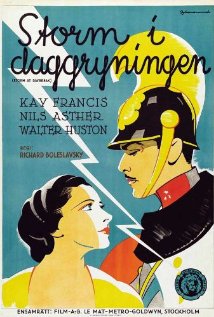
Following the assassination of the Archduke Franz Ferdinand and the Duchess Sophia, a small town in Hungary begins to feel the effects of the war. Kindly mayor Dushan Radovic (Walter Huston) and his friend, Captain Geza Petery (Nils Asther) do what they can to minimize the effects, but, they have problems. The first is that Radovic is a Serbian, while Petery is Hungarian. The second is that Geza and Petery's wife Irina (Kay Francis) have fallen desperately in love. Storm at Daybreak (1933) could have been a good movie. The elements are there. Unfortunately, the film is way too long, and feels as though it were padded for no very good reason. A party scene seems to go on forever, and to no apparent purpose - it attempts to inject humor into a situation where there is precious little. A scene in a railway yard brings Geza momentarily back into the lives of Irina and Dushan, but for no reason; he's gone in an instant, and it doesn't forward the action a jot. One wonders what the writers were trying to accomplish. The script makes Walter Huston's Dushan comes across as a complete moron
who is unable to see that his wife and his supposed best friend are
having real problems. Despite the fact that Irina makes it clear that
she would rather Geza not be around their home, Dushan keeps bringing
him back, making it hard for two people who want to forget their
feelings for one another to function. And Huston, a remarkable actor in so many other roles (watch him in Dodsworth, for example) overacts horribly. Also opting for over-the-top is C. Henry Gordon as the villainous Panto Nikitch. He manages to twirl his mustache without even having one. One can almost hear the director (Richard Boleslawski - this TCM article provides a bit more information about him) shouting "Give me MORE!!" We wanted a lot less.
The New York Times review (the reviewer was Andre D. Senwald), though calling the film "dull entertainment", was far more impressed than we were with Huston (who "blusters picturesquely"), but not very complementary of Ms. Francis (she "hardly seems suited to the enigmatic and mysterious qualities demanded in the rôle of the wife.") Quite honestly, Kay Francis is the best thing in the movie. She doesn't have a whole lot to work with - the part is formulaic at best. But she carefully underplays Irina, making her far more attractive. That being said, a scene in which she runs out into a rainstorm in a huge dress (she could barely get it through the door) to warn her lover of impending doom, was almost ridiculous. Not her fault - she actually GOT the dress through the door - but a true waste of her talents.
We have two favorite character actors present: Eugene Pallette as Janos, Geza's aide-de-camp, and Louise Closser Hale as Militza Brookska, the housekeeper in Dushan's home. Attempts are made to milk their performances for some humor; mostly, it doesn't work (though Pallette does get all the best lines.) By and large they are wasted, as is everyone else in the cast. That the film is formulaic is not really a problem, usually it's a formula we like. But this one is not going down as our favorite Kay Francis movie.
 In the second year of her film career, Kay Francis appeared in 10 films. For the Defense (1930) features her in the third of the 6 films in which she appeared with William Powell. Powell plays attorney William B. Foster, a successful, albeit often unethical attorney who will do almost anything to get his client freed. He loves actress Irene Manners (Ms. Francis), but is unwilling to marry her - he's not the marrying kind, and is perfectly satisfied with their current relationship. She, however, is ready for marriage, and is being wooed by Jack Defoe (Scott Kolk), who is eager to wed her. Irene is ambivalent - she loves Bill, but the relationship is going nowhere; Jack loves her, but she she has no strong feelings about him. Sensing her indecision, Jack drinks too much; Irene insists on driving him home. On their trip, Jack again tries to embrace her; as a result, she inadvertently swerves, hitting and killing a man in the road. Jack insists that she leave the scene; he takes the blame for the accident, and ends up on trial for manslaughter - with Bill as his defense attorney.