Monday, July 25, 2016

Miracle Maker Barbara

The Miracle Woman (1931) is the story of Florence Fallon (Barbara Stanwyck), the daughter of a minister ousted by his ministry in favor of a younger man.  His heart broken by the betrayal of his congregation, the Reverend Fallon dies suddenlyWith his body still in the chair in which he died, his daughter arrives at his pulpit to announce his death, and to harangue the community on their hypocrisy.  Visiting promoter Hornsby (Sam Hardy) is intrigued, and hires Florence  to run a highly profitable "ministry."  But when Florence learns that her sermon stopped blind composer John Carson (David Manners) from committing suicide, Florence must take a long, hard look at her occupation. 

Watching the film right after Ladies They Talk About did lead to a discussion and comparison of the lead actors in the two films. David Manners' chemistry with Stanwyck is quite appealing, and resulted in a much more interesting dynamic that that between Ms. Stanwyck and Preston Foster.  We were particularly taken with the scene in which Stanwyck and Manners begin to sing together.  There is a naturalness in the scene that speaks to improvisation, though it probably was well scripted.  Manners presents us with a gentle, almost fragile man, who grows stronger because of his love for Florence.  But at no point do we find him weak or ineffectual.  His interactions with Stanwyck speak to an equality between them - each has their own demons; their relationship enables them both to face them.
David Manners career in Hollywood was relatively short.  He only appeared in 39 films between 1929 and 1936, and is probably best remembered as Jonathan Harker in the Tod Browning Dracula (1931).  He found life in Hollywood not to his liking, and eventually relocated to Pacific Palisades, with his partner, author William Mercer.  Manners wrote, occasionally returning to the theatre (appearing on Broadway in Truckline Cafe with Marlon Brando in 1946, for example).  Manners died in 1998, age 97.  A detailed obituary is available in The Independent.

The performance of Beryl Mercer as Mrs. Higgins is adorable.  John's landlady is sweet, caring and humorous.  There is no relationship between them other than that he lives in her building, but she seems to regard him as a son.  Both Precode.com and this New York Times review (which is not otherwise all that enthusiastic) mention Ms. Mercer's lovely portrayal.

Because of the portrait painted of a dishonest evangelist, the film was banned in the UK (according to the AFI Catalog).  The AFI also notes the similarities between this film, and the 1960 film Elmer Gantry (even down to the fire at the end of the films), though Elmer Gantry was based on a Sinclair Lewis novel, while this film was based on the play Bless You Sister by Robert Riskin and John Meehan (which, in the 1927 Broadway run, starred Alice Brady in the role that would be played by Ms. Stanwyck).

In this TCM article, it's pointed out that, being this is 1931, there is precious little in the way of special effects in the film.  So, when Stanwyck and Manners are in the cage with the lions, they are IN the cage with the lions - a veil was the only thing separating them from attack.  Convinced that Stanwyck was totally comfortable, Manners would later recall, he became "brave" and went on with the scene, only to discover afterwards that she was actually terrified!  Similarly, in the fire sequence at the end of the film.  Stanwyck had to stand amid the flames, and when Capra went in to get her, he discovered (though was unaware of it while filming), that her heart was pounding from fear.  As always, Ms. Stanwyck's professionalism was the stuff of legend.

We'll end with this scene of Ms. Stanwyck showing off her oratory skills.  We'll return next week with an early Laurence Olivier film. 

Tuesday, July 19, 2016

Barbara's in Prison

When Nan Tayor (Barbara Stanwyck) is arrested as an accessory to a bank robbery, childhood friend David Slade (Preston S. Foster) tries to come to her assistance.  Slade believes her protestations of innocence - her father was once their town's deacon and was good to Slade.  Slade is now a highly regarded attorney and evangelist and uses his influence to have Nan paroled to his charge.  Moved by his trust in her, Nan confesses to him that she was complicit in the robbery, then is disgusted to realize that he will use her confession against her in court.  Nan is sent to prison, after she confesses to the authorities, but she harbors a deep, abiding hatred for the man she considers as her betrayer.  Nan has become one of the Ladies They Talk About (1933)

In a December 2013 article in the New Yorker, Margaret Talbot listed this as one of her 10 favorite Stanwyck films.  We found the film very enjoyable, but without the punch of say, Stella Dallas or Double Indemnity.  Part of the problem is that Stanwyck's portrayal is so powerful, her leading man is unable to stand up to her force of will.  Whenever Stanwyck is on the screen, you watch her - Foster's David Slade is a non-entity next to her, and it's hard to understand what she - or even Susie (Dorothy Burgess) - see in him.  It's not altogether Foster's fault - really, the film's focus is on the prison scenes.  The romance and warfare between Nan and David are secondary to the interaction of the ladies in prison.
Based on a play by Dorothy Mackaye and Carlton Miles entitled Women in Prison, (for more information on the play, visit the  AFI Catalog) the prison scenes are allegedly based on Mackaye's actual experiences in jail.  When her husband was killed in an altercation with Mackaye's lover, Paul Kelly, Mackaye was sentenced to one to three years (she served 10 months) in San Quentin for "attempting to conceal facts" (TCM article) in his death.  [Actor Paul Kelly would serve 25 months for manslaughter; he and Mackaye married after his release from prison, and were together until her death in 1940.  He continued to a successful stage, screen, and television career following his release].   However, any attempt Mackaye may have made in the play to portray living conditions in San Quentin were surely eliminated by the film. The prison is so very nice and homey - it's more like a college dorm room.  Though Warner Brothers had a technical advisor who had served time at San Quentin (San Quentin housed women until 1932, when Tehachapi was opened), they still prettied the prison up substantially.  The women have decorations in their rooms,  record players they can run all hours of the night, and seem to have the run of each other's cells.  Almost everyone seems to get along (except for a woman who is clearly intended to be lesbian - she "likes to wrestle,' Nan is warned.  You can see a picture of her at precode.com).
Lyle Talbot as Nan's partner-in-crime, Don is wasted in the film.  He has so very little screen time - we would have expected him to visit her in prison, but that is given over to Lefty (Harold Huber), as the visits only start when Don also ends up in San Quentin.  A shame, really, as Talbot is an engaging actor who has proved his ability to go toe-to-toe with strong women.

Lillian Roth appears in the film as Nan's prison friend, Linda.  Roth is best remembered today as the subject of the Susan Hayward film I'll Cry Tomorrow.  In our film, Linda gets an opportunity to sing "If I Could Be with You" to a photo of Joe E. Brown (not our idea of a heartthrob, but under contract to Warner Brothers when they released this film.  Then again, so were Jimmy Cagney and Douglas Fairbanks, Jr.  Go figure!). A noted Broadway actress, Roth's addiction to alcohol derailed her career.  Between 1929 and 1939, she appeared in 22 films and shorts, often playing herself.  (Starting in 1955, she began to make sporadic appearances in television and films). She also had a substantial career as a concert and nightclub performer.  Married (and divorced) five times, she ended up broke when her last husband absconded with all of her money.  She died from a stroke in 1980, aged 69.  If you are not familiar with Roth, below is a film of her singing to Mr. Brown!


The reviewer for the New York Times commented on the strength of the prison scene in Ladies They Talk About. He says the film "is effective when it is describing the behavior of the prisoners, the variety of their misdemeanors, their positions in the social whirl outside, their ingenuity in giving an intimate domestic touch to the prison, and their frequently picturesque way of exhibiting pride, jealousy, vanity and other untrammeled feminine emotions."  The romance is less than secondary and is merely a method of giving us a "happily ever after" to the proceedings.  We'll leave you with a trailer to the film.  Next week, we'll take a look at another Stanwyck films from Ms. Talbot's list of 10 that we've not yet discussed.  

Monday, July 11, 2016

Olivia and the Pilots

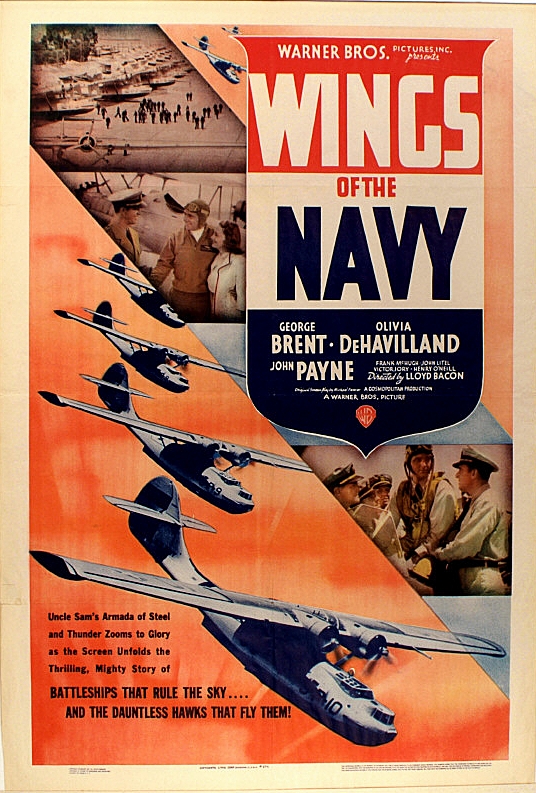
Cass Harrington (George Brent) is a Navy flyer through and through, with a family history in the service.  His father was a highly regarded flyer for the Navy, and his brother Jerry (John Payne), also career Navy, wants to join Cass in the Air Corps, though Cass would rather Jerry stay in the submarine service.  Cass is in love with Irene Dale (Olivia de Havilland), but once Irene meets Jerry, she wonders if she has made the wrong choice - Cass is too wrapped up in his work designing a new fighter plane to pay her much attention.  When the brothers both end up at the Naval Air School in Pensacola, where Cass is an instructor, it's clear that something's got to give.  Wings of the Navy (1939) tells the story of these three individuals and of the making of a Navy airman.

In the July 2016 issue of TCM's Now Playing, Robert Osborne writes that Olivia de Havilland, who had signed a contract with Warner Brothers to star in A Midsummer Night's Dream (1935), "...considered [Wings of the Navy] the absolute nadir of her career.  It was as far afield from Shakespeare as one could get...."  While this isn't the worst film ever made (and probably not her worst either.  There is, after all The Swarm...), it's not all that good.  However, in many ways (according to this TCM article), it was this film that helped Ms. de Havilland appear in her most famous role - she was so irritated that she had been forced to do Wings of the Navy, she redoubled her efforts to land the part of a lifetime - that of Melanie in Gone With the Wind
Really, this film is an advertisement for the Navy, and a means for Warner Brothers to inform the public on the state of the armed services.  It was evident that a war in Europe was in the offing, and the Brothers Warner had already shown their dislike of fascism in 1937's Black Legion.  Shortly after this film was released (February of 1939), Warner Brothers would be the first studio to openly brand Nazi Germany as an enemy in Confessions of a Nazi Spy (released in May, 1939) [PBS History Detectives].  With its emphasis on the flying service, Wings of the Navy is a documentary praising the U.S. Navy Air Corps.  Even the New York Times review felt that "the educational part [of the film] is so interesting that we return to the romantic part... with a feeling almost akin to pain."   The advertising for the release also (discussed on WarnerBrothers.com)  displays the studio's primary interest in creating this film:  "'For all the world to witness that America will not be unprepared!' [it declared] —and backed it up with bravura footage shot at Pensacola Naval Station in Florida and North Island Naval Station at Coronado, California."
 
Because this really is a documentary-type film focusing on the military, the interactions between Brent and Payne, and between Frank McHugh (as Scat Allen) are pretty good, and while we always want to see more of Ms. de Havilland, the love story is pretty pointless - just a way to have the girlfriends agree to come with their dates to see the planes.
There are several surprise appearances in the movie, not the least of which is the appearance of Frank McHugh, who brings both humor and gravitas to the role of Scat, a man who has joined the Air Corps to perfect his flying skills.  He is not planning on a career in the Navy - he plans to return to his profession as a crop duster after his term is over, but Scat ends up being the voice of reason in most situations.  Also appearing are John Litel as Commander Clark, and Victor Jory as Lieutenant Parsons.  Jory's part is so small that if you blink, you might miss him!

Much as Ms. de Havilland disliked the film, she did not immediately escape it.  According to this article from the AFI Catalog, she ended up reprising her role (with George Brent and John Payne) in the Lux Radio Theatre production of October 1940.  While we agree with her, it is not all that wonderful a film, we'll leave you with a clip of Ms. de Havilland and Mr. Payne:

Thursday, June 30, 2016

Olivia's a Farmer

The Civil War is over.  John Chandler (Alan Ladd) and his young son David (David Ladd) arrive at the small Illinois town of Aberdeen.  Once a soldier of the South, the widowed father needs help - his son is mute, the result of witnessing his mother's death in a fire.  John is trying to find a doctor - any doctor - who can help his boy regain his ability to speak.   Doctor Enos Davis (Cecil Kellaway) recommends a colleague at the Mayo Clinic, an expert in dealing with traumatic speech loss.  But before the Chandlers can head out, John is arrested after he crosses paths with the local town bully, Jeb Burleigh (Harry Dean Stanton) and his father Harry (Dean Jagger).  Thus begins The Proud Rebel (1958).

Some films don't seem to have become recognizable classics, and The Proud Rebel is one of them.  Our question is "WHY NOT??"  This is an excellent film that carefully treads a thin line between sympathy and mawkishness - a line it never crosses.  In many ways reminiscent of Shane and The Big Country, this is an outstanding film, which emphasizes the need for family.  The talent of the three leads: Olivia de Havilland (as Linnett Moore), Mr. Ladd, Sr. and Mr. Ladd, Jr.  are important reasons, though the excellent script is a prime factor.

Linnett Moore, as portrayed by Ms. de Havilland is a wonderful woman - she is strong, brave, and stubborn, but also kind, sympathetic and loving.  The film is a love story, but it concentrates on the love that blooms between Linnett and young David more than that of John and Linnett.  Certainly, there is a love story for the adults, but it comes from the desire for family and home more than one of passion.  It is a love story of deep commitment and common beliefs.  Nevertheless, it is a love that will withstand the ravages of time.
Alan Ladd plays John as a man still scarred by the death of his wife.  In Linnett he begins to find the cure for his pain, though his almost obsessive quest for a cure for his equally damaged child is a major barrier.  His obsession initially makes him emotionally unavailable; the image he carries of his wife (a photo he immediately unpacks when he moved into Linnett's ranch) seems to act as an emotional spur, reminding him of the need to find a doctor for David.

The film is full of counterpoints. There are the two family units - the caring relationship of Linnette, David and John, set in contrast to the cruelty of three Burleighs.  The Moore farm, with its simple, cozy atmosphere, can be compared to slovenly home of the Burleigh's. The photo of John and his wife that sits at his bedside will later echo a scene of  John posing with Linnett for a similar photo. 

The performance that really stands out in the film is that of David Ladd, who, at the age of 11 gives a genuine portrayal of this child in crisis.  The chemistry between him and his father is impressive, as is that between him and Ms. de Havilland.  After a notable acting career, David became a producer (like his older brother, Alan Jr).  He and Olivia de Havilland have remained friends since the movie; according to an introduction by Robert Osborne, they regularly speak on the phone. This New York Times review is especially complementary (and deservedly so) of David's work in the film.
Alan Ladd is perfect as the tormented father.  Ladd started in film, in a number of uncredited roles, in 1932, and continued being a face in the crowd and in small roles (including a role as a reporter in Citizen Kane), until his breakthrough performance in This Gun for Hire (1942).  Though he had a wonderful speaking voice (he was much more successful in radio during his early career), his height (he was either 5'6" or 5'7", depending upon the source) was a barrier to leading man roles.  His frequent co-star Veronica Lake was tiny (she was 5'1"), and his costar here, Ms. de Havilland was also not very tall (5'3"), but stories exist of Ladd being perched on a box, so he was taller than costars like Sophia Loren (5'9" Boy on a Dolphin).  But limiting discussion of Ladd's height is to ignore his talent.  In films like Shane, The Glass Key, and The Blue Dahlia he is magnificent - with his subdued demeanor and rumbling voice, he seems made for film noir and westerns.  He was married for 22 years to Sue Carol, who also acted as his agent; the marriage produced three children - David, Alan Jr, and Alana.  Ladd battled depression (his mother, herself a victim of depression, ended her own life), attempted suicide in 1962, and died of an accidental overdose (sleeping pills and alcohol.  Ladd suffered from chronic insomnia) in 1964.  Following his death, his final performance in The Carpetbaggers (he played Nevada Smith, a character later revisited by Steve McQueen) was released, to excellent box office.

Filmed in Utah, the scenery (and cinematography by Ted D. McCord) is fantastic (it should be noted that Utah looks nothing like Illinois!).  According to the AFI catalog, Adolph Menjou was to be in the film (probably in the role of  Harry Burleigh, the role ably enacted by Dean Jagger), but a torn ligament forced Menjou to withdraw from the production.  There was one star of the film who got special treatment - that was King, the border collie that portrayed David's pet, Lance.  According to this  TCM article, "King and his two canine stand-ins were deemed so important by the production team that they were given their own hotel room in one of Utah's finest motels right next to Ladd's and de Havilland's quarters." 

We'll end with the introduction of Linnett Moore. Ms. de Havilland is dynamite in the scene.  And let's take this opportunity to wish this amazing actress a happy 100th birthday (with a link to a recent write-up in Vanity Fair of her 1962 autobiography Every Frenchman Has One):

Wednesday, June 22, 2016

The O'Hara Boys Love Olivia

Ma O'Hara (Mary Gordon) lives with her three sons, Police Officer Pat  (Pat O'Brien), Fireman Mike (Frank McHugh), and Danny (James Cagney),  the black sheep of the family (and Ma's darling) who is trying to forge a career as a fight promoter (much to brother Pat's disgust).  The Irish in Us (1935) looks into the lives of the family as Pat plans for a marriage to Lucille Jackson (Olivia De Havilland) - without telling Lucille.

Sure, this is a rather silly movie, but we enjoyed it.  The interplay among the three O'Hara brothers is spot on, and, not surprising, when James Cagney is on the screen, you really can't take your eyes off of him.  Equally wonderful is the relationship between Cagney and Mary Gordon, who plays his mother.  You can sense the affection within the family group, and Ms. Gordon, especially paints a picture of a woman who is the thread that binds the family unit together.

Though the plotline is so-so, this TCM article points out that director Lloyd Bacon, well aware of the script's limitations, encouraged the actors to ad-lib during the production.  As a result, the dialogue has a bounce and energy to it.  And while boxing match at the end does seem a bit prolonged, it gives the character of Pat time to recover from the circumstances that have alienated him from his youngest brother.  O'Brien and Cagney do a wonderful job of creating a brotherly dynamic that it made us imagine Pat and Danny as children, with Danny always getting into scrapes from which big brother Pat needed to rescue him.
Normally, we love Allen Jenkins, but his Carbarn Hammerschlog is a bit over the top.  One wonders how Danny could possibly see this rather insane man as a successful boxer (but that is Danny - always looking for the underdog!).  It's one of the weaker aspects of the plot, but does serve as a means of getting Cagney into a boxing ring (the AFI Catalog states that Cagney did his own boxing in the picture). 

We're also treated to a picture of bygone era in New York City - a time when you knew all your neighbors, and it was a fact of life that everyone knew what the other person was doing.  One scene in particular - Ma O'Hara passing a bit of butter wrapped in a napkin to her neighbor via the clothes-line between their apartments, brought up memories of my childhood, when my mother would lend a bowl or some eggs to the neighbor through a narrow kitchen shaft window!
The strength of the film is that strong sense of family.  Pat's anger at Danny's haphazard lifestyle centers more on his fear that Danny will not be able to help support the family when Pat marries and moves out than on any jealousy or dislike of his brother.  And the relationship between Ma and Lucille also emphasizes the family as a unit - Ma is immediately welcoming to a potential new member of her family.  Lucille senses that she is now an O'Hara, and seems to find in Ma the mother that she has lost (Lucille has a father, but it seems he may be widowed).

We'll end this discussion with a scene from the film, as Danny and Lucille get to know one another:

Thursday, June 16, 2016

Dorothy's in Hell

Gilda Karlson (Dorothy Mackaill) has hit rock bottom.  In order to survive after losing her job, she sees no other options but to work as a prostitute.  She has basically accepted her fate; but when she arrives at an appointment and finds the client is Piet Van Saal (Ralf Harolde), the man who raped her, fired her from her job in his company, and then prevented her from finding another job, resignation flies out the window.  She informs him that he is the only man on earth to whom she is off-limits; when he tries to again molest her, she hits him with a vase, and runs.  The room catches fire, apparently killing Piet.  With Gilda now on the lam for the murder of Piet, she is taken by her seaman boyfriend, Carl Erickson (Donald Cook) to a Caribbean island where she cannot be extradited.  Though initially devastated by the revelation that Gilda is a hooker, Carl (who has just returned from sea duty to see her) still wants to marry her, but he asks her to promise to remain true to him while he finishes out his service on his current trip - a promise easier said than done on this island where women are at a premium.  Gilda quickly discovers that she is Safe in Hell (1931).

Without giving away the ending, this is not the happiest movie on the planet.  Gilda's life IS hell, and life on this little island doesn't make it any better.  For the most part, the members of my review panel did not enjoy the film, though I myself do like it.  It's a tough movie, but the performance of Dorothy Mackaill makes it a standout for me.  Gilda doesn't always make the best choices, but her strength and determination make her a character worth watching.
The part of the script that my group found most difficult to accept was Carl's decision to bring her to this abysmal environment.  First, she has to endure three days in a box in the hold of a ship, then she ends up on an island full of very nasty men.  Yes, the island has no extradition treaty with the U.S., but since Carl plans on bringing her home once the furor dies down, one would think he could find a safer place to stash her.  This is, after all, not the age of the Internet - drop her in a big city somewhere, give her money to live, change her name and appearance a bit, and she can get lost for a good long time. Is Carl (as suggested by my colleague at Pre-code.com) punishing her for her actions or protecting her?  Given the outcome of the film, it's hard to determine what his motivation could be.  

Perhaps what makes this film a film worth watching (besides Ms. Mackaill's exemplary performance) are the portrayals of Leonie (Nina Mae McKinney) and Newcastle (Clarence Muse), the only really good people in the film.  This is notable because both Mr. Muse and Ms. McKinney are black.  But, we are not treated to servile idiots.  Both Leonie and Newcastle are intelligent and well-spoken.  (This TCM article comments that the original script had the character doing the usual southern black dialect, but it seems director William Wellman changed it).  Leonie and Newcastle work in this horrid environment, but they have not absorbed it.  Their affection for Gilda is evident, as is hers for them. Ms. McKinney, who has a lovely singing voice, gets to do one song, the clip below features just that part of her sensitive performance:
Safe in Hell is reminiscent of  several other precode films:  Suzy, The Unholy Garden, and Mandalay all spring to mind - featuring a woman on the run and some very disreputable men.  In fact, a New York Times review from 1931 (by critic Mordaunt Hall) specifically comments on the similarity to The Unholy Garden, and Mr. Hall was not keen on this film.  But, what is equally interesting is this 2012 New York Times article on Ms.Mackaill, which presents a glowing discussion of Safe in Hell.  Obviously, nearly 80 years makes a big different in attitudes.

It's a shame that Dorothy Mackaill had such a brief career.  She started in silent films (she had two Broadway appearances around the same time - appearing in one of Florenz Ziegfeld shows in 1921).  She was a WAMPAS Baby Star in 1924, and apparently made the transition to sound smoothly - in 1931, she appeared in 6 films. But by 1934, her star was starting to wain.  She made two pictures that year, and then nothing until 1937 (last week's Bulldog Drummond at Bay). With that, she retired to care for her mother.  In 1947, she married Harold Patterson, an orchid grower in Hawaii (they divorced the following year).  She made Hawaii her home, living at the Royal Hawaiian Hotel (sometimes called "The Pink Palace") for the rest of her life.  In the 1970s, she appeared in two episodes of Hawaii Five-O - it was after all, filmed in her home town!  When she died, her ashes were scattered off her beloved Waikiki Beach.  She was 87 (Here is her obituary from the LA Times).
According to this articles from AFI, a number of different people were considered for this film, including Barbara Stanwyck and Lillian Bond as Gilda, David Manners as Carl, and Boris Karloff, with Michael Curtiz originally slated to direct.  This would have been the time period in which Ten Cents a Dance and Night Nurse were released, so perhaps it was better for Stanwyck not to have been given the role of yet another woman with an "image problem."

We'll close with Dorothy's arrival in hell.  I'd also like to recommend reviews from two of my fellow bloggers at Immortal Ephemera and Pre-code.com. Both have spoilers, but are excellent analyses of this difficult film.  Next time, we'll discuss a comedy with another of our favorite actresses, Olivia de Havilland.

Monday, June 6, 2016

Dorothy is Devious

We follow one of our favorite actors with a favorite actress, the lovely Dorothy Mackaill in Bulldog Drummond at Bay (1937).  Ms. Mackaill plays Doris Thompson, a rather shady young lady who seems to be menacing the hero of the piece, Hugh "Bulldog" Drummond, this time played by John Lodge.  When a vacationing Drummond sees two men loading a dead body into a car trunk, he becomes enmeshed in a plot which includes stolen jewels, a mysterious lady, and intrigue.

In a sense, the plot of this Bulldog Drummond adventure seems very reminiscent of the one we watched last week.   However, our reactions to the films were very different.  Where the 1929 film crackled, this one rather drones along.  Part of the problem - in fact, the biggest part - is that John Lodge is no Ronald Colman.  He's quite handsome, and he is an okay actor, but he just doesn't have any spark.  Quite frankly, Dorothy Mackaill steals the film right from under him.  It really should have been entitled Doris Thompson NOT at Bay. (This, by the way, was Ms. Mackaill's final film).  Though the title of this film was reused in 1947 (with Ron Randall in the title role),  the plots seem to be quite different.
John Lodge did not have a long film career.  Discovered by a talent scout while in California visiting his wife (who was dubbing a Greta Garbo film into Italian), between 1933 and 1940, he appeared in 21 films, the most notable being Little Women (1933), as Laurie's tutor, John; The Little Colonel (1935) in which he played Shirley Temple's Confederate officer father; and The Scarlet Empress (1934), as Marlene Dietrich's lover.  He journeyed to France for his last film, Max Ophuls' Sarajevo, then went to New York to appear on Broadway in Night of Love and Watch on the Rhine.  But, by 1943, he was in the Navy, where he achieved the rank of Lieutenant Commander and was decorated with the rank of Chevalier in the French Legion of Honor and with the Croix de Guerre with Palm.  When he returned to civilian life, he and his wife settled in Westport, Connecticut, where Mr. Lodge took up the family business - the grandson of Senator Henry Cabot Lodge, he ran for a seat in the U.S. Congress and won.  He later would serve as governor of Connecticut, and eventually would become ambassador to Spain, Argentina, and Switzerland.  (His wife, Francesca,was a founding member of the American Shakespeare Festival in Stratford, Connecticut.)  He died in 1985, at the age of 82, survived by his two daughters and his wife of 53 year.  The Connecticut Turnpike was named in his honor after his death.
Victor Jory (Gregoroff) is. not surprisingly, the villain of the piece.  Jory spent most of his career playing the baddie - Jonas Wilkerson in Gone with the Wind (1939),  Injun Joe in The Adventures of Tom Sawyer, Yancey in Dodge City, (1939) are just a few of his films, but it was a substantial career.  Mr. Jory began working at the beginning of sound - his first film was in 1930 - and continued working in film, television, radio until 1980, two years before his death.  With a remarkable, unique speaking voice, he was a natural to take up animated films, and in fact his recording of Tubby the Tuba (he served as the narrator to the song, which was designed to introduce children to the parts of an orchestra) was nominated for an Oscar for Best Animated Short Subject in 1947, and was inducted into the National Recording Registry in 2005.  In the 1940s, he moved to New York, where he appeared in 8 Broadway plays. In his later years, he segued easily into television, becoming a staple (usually as the villain) on many television series (including I Spy, Bonanza, and Burke's Law, to touch the tip of the iceberg).  His own series, Manhunt, was on for two years.  Married for 50 years to his wife, Jean,  he was 80 when he died of a heart attack.  This obituary in the Los Angeles Times will give you a fuller picture of his impressive career. 

We'll leave you with this scene of the arrival of Dorothy Mackaill to the Drummond hide-away.  Next week, we'll return with another of her films.

Friday, June 3, 2016

Bulldog Ronald

Former British army Captain Hugh "Bulldog" Drummond (Ronald Colman) is finding civilian life to be a bore, so he puts an advertisement in the Times as a lark - advertising his services in exchange for some adventure.  Though most of the replies are nonsensical, one - from Phyllis Benton (Joan Bennett) is not.  She is in extreme danger and needs his help.  Intrigued, Drummond heads out to meet her - where he finds the adventure he seeks.  So begins Bulldog Drummond (1929), a very early sound film, and the first talkie featuring Ronald Colman.

Films from the beginning of the talking film era can be both a blessing and a curse to the modern audience.  It's fascinating to watch the birth of a new technology, but the birth pangs - the unease with the technology, the problems with its limitation, the insecurities of the performers as they try to adapt to a new style of acting - are equally frustrating in an age where CGI makes special effects hyper-realistic.   But these early films often provide a surprise and in this one, the surprise is Ronald Colman, in his first sound film. 
According to this TCM article, "by late 1928, producer Sam Goldwyn was searching for a suitable property for Ronald Colman to transition from silent films to talkies."  The natural choice seemed to be a romance, but Goldwyn decided instead on a mystery film, and was he ever correct!.  Colman is so natural, and so comfortable with sound that he immediately takes command of the film.  While the rest of the actors (especially Lawrence Grant as one of our villains, Dr. Lakington - he all but twirls his mustache!) appear to have some problems making the transition, Colman is never ill at ease.  One wonders what it was like for the viewers, familiar with Colman in silents, first hearing that glorious voice.  Certainly, Goldwyn must have suspected he had a goldmine on his hands!   Colman gives Drummond a joie de vivre that permeates the film, and keeps you wanting to watch it.

The character of Bulldog Drummond was not unfamiliar to the screen.  While this was the first talking film about his exploits, there had previously been two silent films - Bulldog Drummond (1922, a US production with Carlyle Blackwell in the title role) and The Third Round (from the UK in 1925, with Jack Buchanan as Drummond). Nor would this rendition be the last.  Ronald Colman would return as Drummond in 1934's Bulldog Drummond Strikes Back, but in the meantime, two other films would be released with Kenneth MacKenna (Temple Tower, US, 1930) and Ralph Richardson (The Return of Bulldog Drummond, UK, 1934).  In all, there was a total of 23 films featuring the character of Bulldog Drummond  released between 1922 and 1969.  Among the actors who appeared as the character were Ray Milland, Tom Conway, John Howard, and Walter Pidgeon.   The character also was featured on television and radio adaptations. (TheAFI Catalog also discusses the history of the film series).
The series of films is based on the popular novels of H. C. McNeile (aka "Sapper"), who wrote 10 novels between 1920 and 1937.  Sapper was inspired by Sherlock Holmes, Richard Hannay, and The Scarlet Pimpernel in his creation of the character of the gentleman adventurer.   After McNeile's death, the series continued with 7 novels written by Gerard Fairlie (from 1939-1954).  More novels followed in 1967 and 1969, both authored by Henry Raymond.  Later iterations using the character included short stories and graphic novels.

Our two female leads - Joan Bennett as Phyllis and Lilyan Tashman as Erma display different levels of comfort with sound.  Bennett, at age 19, and also appearing in her first talkie, seems strained, though she gives Phyllis a spunky-ness that is appealing - watching her rescue Drummond was a real treat!  Her unease with the new medium would, of course, quickly pass - she would ultimately appear in 98 film and television appearances.  She began her career as a blonde - it wasn't until her character in Trade Winds (1938) needed a disguise that she went to brunette tresses.  The look was so attractive, and opened up such a range of roles (like that greedy Kitty March in Scarlet Street) that she retained the dark locks til the end of her career.
Lilyan Tashman, on the other hand, seems more relaxed with sound.  An interesting actress, the bulk of her career was in silent films.  She was transitioning nicely, when she was diagnosed with cancer.  She died in the hospital, following surgery.  She was 37 years old.

Bulldog Drummond was extremely well received, as evidenced by these reviews from the New York Times and Variety. The film also received two Oscar nominations: for Art Director James Cameron Menzies and Ronald Colman as best actor (he lost to George Arliss in Disraeli.  Technically, both Arliss and Colman were nominated for two appearances that year.  Colman was also cited for Condemned).  We were lucky enough to see an introduction by author James Curtis.  He credits Menzies and his use of storyboards for the fluidity of the film, as well as the use of sound effects which give the film movement and sound simultaneously, something films of this period generally lack.

We wholeheartedly recommend this film, especially if you are a Colman fan - he is a delight! Next week, we'll look at another Drummond film, with one of our favorite actresses, Dorothy MacKaill.


Monday, May 23, 2016

Kay Tempts Basil

In A Notorious Affair (1930), Patricia Hanley (Billie Dove) defies her father, Sir Thomas Hanley (Montagu Love), and jilts her fiance  Dr. Alan Pomeroy (Kenneth Thompson), when she elopes with struggling violinist Paul Gherardi (Basil Rathbone).  Patricia happily gives up her privileged life to share Paul's poverty, and ultimately his success.  But with that success comes temptation, and Paul becomes involved with the sexually predatory Countess Olga Balakireff (Kay Francis), creating a scandal that involves both Paul and his betrayed wife.

Adapted from the play Fame (written by Audrey and Waverly Carter), the original play may have starred Gerald de Maurier (father of author Daphne.  This AFI Catalog talks briefly of the play's history).  Like many films of the early sound era, this movie suffers from the stagnation of the static camera and microphone.  Scenes that, a year or two later, would be full of movement and energy just sit there because the sound equipment forces the actors to stay stock still.  As a result, the film and the actors seem stiff and un-engaged.

All three of the leads, Francis, Rathbone, and Dove, had theatrical backgrounds.  Basil Rathbone was a veteran of both the London and Broadway stage, but was relatively new to film (he'd done 7 silent films and 3 talking films prior to A Notorious Affair).  Kay Francis had appeared in 4 Broadway plays, as well as 6 films.  Billie Dove, however, had made her career as a Ziegfeld Girl (billed as The American Beauty), not as an actress, though she had already appeared in many silent films and several talkies. (A TCM article about the film discusses the actors' backgrounds).
In spite of Basil Rathbone prior appearances in talkies, he seems rather uncomfortable in this film.  As we are used seeing him in roles in which he dominates the screen (a particular favorite is his turn as the roué in Confession, with his co-star here, Kay Francis), this Basil was a bit off-putting.  We talked about him in some detail in our discussion of his fantastic performance in The Mark of Zorro

But if anyone owns this movie it is Kay Francis.  Olga is quite the seductress, and with a sexual appetite that knows no bounds.  Ms. Francis' ability to telegraph her thoughts with only her eyes serve her in good stead here.  Watch her when she sees a stableboy entering a barn; we know exactly what is about to happen as she quietly enters the barn and shuts the door behind her.    Likewise, the look on her face when she first sees Paul - it's as though she is looking at a steak after a 30 day fast.  But Olga bores just as quickly as she hungers, and her relationship with Paul mirrors her tet-a-tet with the kennel man - once fed, she's done.  The New York Times review had it right when they say that "Kay Francis...as the scheming countess, puts Miss Dove somewhat in the shade."

While we can't wholeheartedly recommend A Notorious Affair as a film, for anyone who is a fan of Kay Francis, this is essential viewing.   Not only are you able to see her before she becomes the Warner Brothers cornerstone, you get to see her playing the kind character that wouldn't come her way for a number of years.

Thursday, May 12, 2016

Stuck on a Desert Island (with a DVD player)

In celebration of National Classic Movie Day, and as part of the Classic Film and TV Cafe's blogathon, I'm going to venture on choosing the five (!!) movies I want with me when I'm stuck on a desert island.  For someone with over 1,000 DVDs in her library, this is no easy task, but I'm going to give it a try with the caveat that the five I pick today may not be the same five I pick tomorrow!

I know that when forced to choose, I'm going to want to mix up the genres a bit, so I'm not watching the same kind of film over and over,.  Let's start with a musical, and my selection here is without equivocation.   Whenever Singin' in the Rain is on, I have to watch the whole thing.  I start out saying "I'll just watch this scene", and the next thing I know, the movie is over and I've re-watched it again.  I actually do that with a lot of movies, which is probably not a surprise to anyone reading this.  Regardless, Singin' in the Rain is special.  With great music, wonderful dancing (Donald O'Connor doing "Make 'em Laugh" is an especial favorite), and terrific actors (Jean Hagen as Lola Lamont - she is perfection!)  it has everything.  It also serves as an introduction to the beginning of talkies.  It's a film to which I frequently refer people, especially when they are puzzled as to why films look like they do in 1929 and 1930.  Plus, it's a film that you will finish with a smile on your face and a song in your heart.
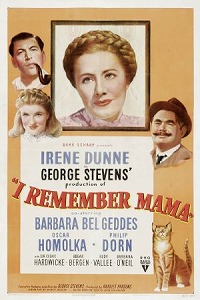
If you've never see I Remember Mama, you are missing a wonderful film.  My pick for drama has several competitors (mainly A Tree Grows in Brooklyn, Johnny Belinda and The Enchanted Cottage), but for this week, I'm going with Irene Dunne in one of her last films.  As the titular Mama, Dunne is perfect as Marta Hansen.  Sure, Mama at time seems without fault, but it's hard to care or even notice as Dunne is so unbelievingly convincing as this warm and loving wife and mother.  Narrated by the family's oldest daughter, Katrin (played beautifully by Barbara Bel Geddes), the story is a series of incidents in the life of the Hansen family over a number of years, which makes it perfect desert island viewing.  Each "story" can be watched as part of the whole progression of the film, or as an independent short story.  Especially poignant is an incident that revolves around the illness of the youngest daughter, Dagmar (June Hedin), and the inability of Mama to see her ailing child after surgery (hospital rules forbid any visitors for 24 hours post surgery.  Wow, have things changed with time!)  Dunne's heartbreak and guilt (she'd promised the child she would be there when she woke) in this segment reaches out from the screen and tears your heart.  Ultimately, it is the strength of the family and the care that the immigrant mother and father show to their children as they try to avoid "go[ing] to the bank" that you will remember.
There are some really great westerns, and I have to admit that I had trouble deciding on just one.  It came down to two:  The Searchers and Westward the Women (add to the mix, a friend suggested Shane and The Big Country.  Yes, my friends make my life harder).  Ultimately, I chose The Searchers since it is again one of those movies I fall into each time I see it.  John Wayne is exceptional as Ethan Edwards, a man driven to almost insanity by his hatred of Native Americans.  When Ethan's niece, Debbie, is captured by a group of Indians who murdered the rest of her family, Ethan and Martin Pawley, a young man of mixed heritage who was raised by Debbie's parents, go on a quest to recover Debbie from her captors.  But as the years pass and Debbie goes from childhood to young adulthood, it becomes clear to Martin that he must continue on the journey, no matter the cost.  For, if he abandons it, Ethan will surely murder the young woman he now sees as a squaw.  The story is intense, with Wayne creating a character that is impossible to like, but with whom the viewer feels a bond.  Also notable are Jeffrey Hunter as Martin and Ward Bond as the Reverend Clayton, both characters that act as counterpoint to Wayne's driven loner.  Finally, there are the magnificent vistas of Monument Valley, which director John Ford uses to tell his tale.  It's a film with so many layers that, with each viewing, you'll see something new. 
There are a number of comedies, especially romantic comedies which come to mind when asked to pick a desert-island selection: Victoria, Victoria, The Major and the Minor, Roman Holiday are just the tip of the iceberg.  But I decided to select Bachelor Mother, starring Ginger Rogers as Polly Parrish, the temporary employee of Merlin and Son Department Store.  When her job is about to come to an end, Polly goes out on her lunch break to find another job.  She sees a woman abandoning a baby at a foundling home.  Fearful the baby will roll from the stoop, Polly rushes in - and is mistaken for the baby's mother by the staff.  As a result, Polly finds herself saddled with a baby, as well as a suitor, in the form of David Merlin, the "and Son" of the department store.  The film is funny and sweet, the baby is adorable, and our romantic couple have a great chemistry.  But what I love about this film are the attitudes of everyone towards this seemingly unwed mother.  Sure, we, the audience, know that Polly is a "good girl", but the other characters don't, and uniformly they treat her with kindness and compassion.  I especially love Polly's landlady Mrs Weiss (played to perfection by Ferike Boros), who, rather than condemn the girl, goes and gets her adult son's baby things and becomes Polly's go-to baby sitter!  In an era where unwed mothers didn't exist, or were punished (usually by death) at movie's end, Bachelor Mother gives us a picture of a society that embraces the mistakes of a young woman, and ends by creating a happy family, all without violating the Code.
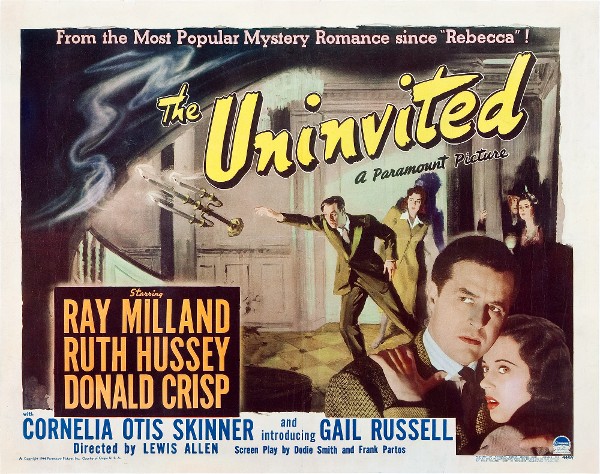
I'm not a huge horror fan, but I love suspenseful films.  The Spiral Staircase is one film that I considered for this category, but really there was no contest in the ultimate winner: The Uninvited.    It really does have everything - a phenomenal story, great cast, two ghosts, a really mysterious house, and a haunting musical score.  (In an earlier blog entry, above, you'll find a link to a You-Tube video of the magnificent theme, Stella By Starlight).  One of the problems with suspense films is that, once you know the answer, you don't always enjoy rewatching the film.  But The Uninvited still is a pleasure even when you know what is coming.  Much like Laura, it's the acting, and the relationships of the characters that keep you returning to this film.  Ray Milland is exceptional as Rick, the new owner of Windwood House, as is Ruth Hussey as his sister Pam.  But the person who steals the film from under everyone else is the ethereal Gail Russell, playing Stella Meredith, the object of Rick's love and the focus of the beings that haunt the house.  The Uninvited is a movie that will make you believe in ghosts.
As I said, this is a list that could change at a moment's notice, and you'll notice that the list lacks a few films that one might expect to see on a desert island list.  So, let's give a nod to To Kill a Mockingbird, Gone with the Wind The Best Years of Our Lives, The Thin Man, Casablanca, just a few in a list of "essentials" that film fans love.  These are wonderful; I own them, I would never give them up. I rewatch them regularly, but you all KNOW about these films.  With my list, I hope I may have brought up a few films that might not have made your own "essentials" queue.