Charles Poncefort "Hopsy" Pike (Henry Fonda) has led a relatively sheltered life. The son of the Pike's Ale magnate (Eugene Pallette), he's been guarded all his life by the inimitable Muggsy (William Demarest). Having finally ventured out on his own, to research snakes in South America, Hopsy is now on his way home to Connecticut. While onboard ship he meets a trio of con artists: "Colonel" Harrington (Charles Coburn), Gerald (Melville Cooper), and Jean Harrington (Barbara Stanwyck). While Jean's initial goal is to fleece this lost lamb, she finds herself falling in love with him, a feeling that is mutual. But, when Hopsy discovers Jean's stock in trade, he dumps her. Determined to get her revenge, Jean invents The Lady Eve (1941). If you have never seen The Lady Eve, please add it to your viewing queue immediately. You're in for a real treat. Besides the inimitable Ms. Stanwyck in one of her finest role, you also get Henry Fonda being totally adorable and a script without compare by director Preston Sturges. It's a win-win scenario! Henry Fonda is in the unenviable position of portraying a character you really want to hate, but can't quite bring yourself to do it. Hopsy is so totally guileless that, even when he is wooing Lady Eve Sidwich with the same lines with which he wooed Jean, you just laugh at his inept lovemaking and forgive him. Of course, you also want Jean to give him is comeuppance. But with two actors who are so equally paired, they are both able to succeed.
Ms. Stanwyck is a sexy delight as the two ladies in Hopsy's life. The scene in which she tries to seduce him by allowing him to put on her shoes is magnificent. It's a wonder they got that and some of the more naughty dialogue past the censors. And her running commentary as she watches the ladies in the dining room lust after Hopsy is a hoot. It's next to impossible to imagine this film without her, but Ms. Stanwyck was not the first (or even the second choice) of the studio. They wanted Claudette Colbert; Madeleine Carroll and Paulette Goddard were also considered. But Mr. Sturges wanted Ms. Stanwyck, and thankfully he won the argument (AFI catalog). Ms. Stanwyck has the unique ability to make the audience (who is in on the joke) believe that Eve and Jean are distinct characters. The studio also considered Brian Aherne, Fred MacMurray, and Joel McCrea for the role of Hopsy (TCM article), but again, Mr. Sturges was victorious and got his choice of Mr. Fonda. There is a lot of slapstick in this film - Hopsy takes a number of pratfalls - not something for which Mr. Fonda was known (sure, he'd done the screwball comedy; for example, The Mad Miss Manton with Ms. Stanwyck, but she's the screwball in that, not him). So, it was perhaps a risk to cast him in the part. But, frankly, he is perfect as the innocent abroad.
The quartet of supporting actors who grace the film are impressive. William Demarest, who must have been in the Preston Sturges stock company (he appeared in 8 of Mr. Sturges' films) is hysterical as the bodyguard/valet, Muggsy, who seethes with suspicion of anyone who approaches his charge. He's cagey though - he knows that Jean's father is not on the level; he's the only one who suspects that Eve is really Jean in disguise. But, his suspicious nature is also his downfall - like Cassandra, Muggsy's warnings go unheeded, to riotous effect. Eric Blore has a small part as Sir Alfred McGlennan Keith, or Pearly
to his mates, one of Colonel Harrington's con artist pals. Mr. Blore is
wonderful at looking exasperated, and does it quite well as he watches Eve get in deeper and deeper. We only
get a few scenes with him - he's a device to get Jean into Hopsy's
house, but he is always enjoyable.
From his entrance singing Come Landlord Fill the Flowing Bowl, Eugene Pallette is also excellent as Charles' father. The only member of the family with any common sense, he plays Mr. Pike as an endearing, if somewhat exasperated individual (witness his frustration as he tries to get breakfast). I look forward to seeing him in films, though my recent discoveries about his private life are dismaying. A supporter of Adolf Hitler, he refused to sit down at a table with actor Clarence Muse (TCM article) while filming In the Meantime, Darling, resulting in his firing by director Otto Preminger. Mr. Pallette eventually retreated to Oregon to hide near his own personal bomb shelter. He would return to Los Angeles in 1948, after a two-year retreat, but he never worked again. He died of throat cancer in 1954, at age 65.
Last, but certainly not least is Charles Coburn. Harry is a rogue, and Mr. Coburn makes no bones about it. He's willing to go against his daughter's wishes, the fleece an easy mark, but it is clear that he loves Jean dearly. One is never quire sure of Harry's motives, but one is sure of his personal integrity among his colleague. As a result, we like him, though we would be very wary of playing cards with him. For more on Mr. Coburn's life, visit our blog post from October 2, 2017.
The Lady Eve was based on a story Two Bad Hats by Monckton Hoffe. A radio version aired on the Lux Radio Theatre on March 1942 with Ray Milland and Barbara Stanwyck (For a discussion of Ms. Stanwyck's participation in this episode, see this article from Film Comment). It was remade as The Birds and the Bees (1956), starring Mizti Gaynor, George Gobel, and David Niven. (Having not seen this film, I won't comment, except to say, George Gobel? Really??) In 1994, The Lady Eve was added to the National Film Registry; since then, it has appeared on two of the AFI Lists: it was #26 on 100 Years, 100 Passions and #55 on 100 Years, 100 Laughs.
We're going to leave you with the trailer from this highly enjoyable film. We'd also like to mention this Vanity Fairarticle on Preston Sturges which you might find interesting. If you've never seen this film, please do give it a try.
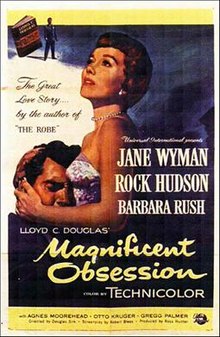
Robert Merrick (Rock Hudson) is afraid of nothing, and is constantly putting himself in jeopardy. When he finally manages to crack up his speedboat, his life is saved with the personal respirator of Dr. Wayne Phillips. But while Bob's life is being saved, Dr. Phillips suffers a heart attack, and there is no way to resuscitate him. Widow Helen (Jane Wyman) and daughter Joyce (Barbara Rush) are left to deal with the aftermath, with Helen forced to fend off the unwelcome attentions of the ever-on-the-prowl Bob. Our film for this week is Magnificent Obsession (1954). If you don't like melodrama, you won't like this film. But, we do enjoy a good weeper and this is an excellent one. In his first major role, Rock Hudson is outstanding as the callow youth who needs a good kick to make him grow up (TCM article). Early in the film, we are told that Bob attended medical school, only to drop out and assume the life of a dilettante in the wake of his father's sudden death. We get no more information than that, but the way Mr. Hudson plays the scene speaks volumes about Bob's bitterness; a bitterness that resulted in his decision to devote his life to pleasure - something it seems his father never got to do. It is important that Mr. Hudson slowly grow his character, and he does so. With subtle allusions to the passing of time by director Douglas Sirk, we watch as Bob Merrick changes from a heel into an admirable human being.
Equally, Jane Wyman is terrific as a woman who loses her husband, only to find her entire life upended by the actions of one irresponsible human being. Like Mr. Hudson, Ms. Wyman's character has to change, but the changes are more subtle. We need to understand why she is attracted to Bob Merrill (sure, she doesn't know who he is at first, but she is recently widowed, and was very much in love with her husband. Any new man should be a hard sell.). More importantly, we need to see her sacrifices as well thought out and not self-pitying. Ms. Wyman does that convincingly. Ms. Wyman was nominated for an Oscar for the part (losing to Grace Kelly in The Country Girl). Agnes Moorehead (Nancy Ashford) is one of the great character actresses of her generation, and she gives a fine performance. Especially notable is her early scene with Rock Hudson, in which she lets him know that he is acting like a complete moron, but does it with professionalism. Ms. Moorehead started her career in radio; her later involvement with Orson Welles Mercury Players led to her casting as Charles Foster Kane's mother in Citizen Kane (1940). She would go on to play nearly every kind of character - Humphrey Bogart's nemesis in Dark Passage (1947), Jane Wyman's rough-hewn Aunt Aggie in Johnny Belinda, Edward G. Robinson's loving wife in Our Vines Have Tender Grapes (1945), and the abused Madame Fosco in The Woman in White (1948). She did Broadway and regional theatre, but it was on television where she would finally make an indelible mark. A generation of viewers can't forget her memorable performance as a farm woman threatened by minature "Invaders" in The Twilight Zone. And then there is Endora on Bewitched. Take a look at
her performance in the fourth episode of the series, "Mother, Meets What's His Name"
When she asks Darrin (the ultimate idiot) "Why do you object to my daughter being herself?" you want to cheer. Her delivery is spot on (and you really want to shake Samantha for submitting to Darrin's domestic tyranny). Ms. Moorehead continued acting until her death of cancer in 1974 at the age of 73.
Also in the cast (and happily still with us) are Barbara Rush (who plays Joyce Phillips). Ms. Rush is 91. She was working until 2007, and since seems to have retired. Judy Nugent, who plays Helen's young friend, Judy, continued acting on film and television until 1978. Around the time she retired, she, husband Buck Taylor, and their three sons moved to Montana. They were divorced in 1983. In an interview for Western Clippings, Ms. Nugent stated this film was her favorite role. Jane Wyman was not the first choice for Helen - Olivia de Havilland, Eleanor Parker, and Joan Crawford were considered for the part. Jeff Chandler was in the running for the role of Bob Merrick, and Charles Bickford was considered for the role of Edgar Randolph (the role would go to Otto Kruger). (AFI catalog)
The film is a remake of a 1935 film with Robert Taylor and Irene Dunne (which was aired on Lux Radio Theatre in April of 1937, starring the film's leads). The New York Times did an excellentDVD review of 1935 and 1954 versions when Criterion released them as a set. The film was such a success that the cast we reunited in All That Heaven Allows the following year. This is a film that becomes richer with each viewing, and we encourage you to give it a try. We'll leave you with a trailer:
The Reverend Samuel Sayer (Robert Morley) and his sister Rose (Katharine Hepburn) work as missionaries in Kungdu in German East Africa. When "jack of all trades, master of none" Charlie Allnut, skipper of The African Queen (1951) arrives with their mail, they discover that Britain is at war with Germany. Blithely believing that no war in Europe can affect them, they are stunned when German soldiers appear, kidnapping their parishioners, and burning down the village, church and all. The Reverend protests their treatment, and is struck on the head by a rifle butt; he becomes disoriented, and dies within a few day. When Charlie returns, he agrees to take Rose to safety. Only she has another idea - journey down the un-navigable river to Lake Tanganyika, and attack the German steamer Louisa. We had the opportunity to see this wonderful film on a big screen as part of the ArcLight Presents series. A restoration of the technicolor film provided a glowing film, rich with the colors of Africa - for indeed The African Queen was filmed in Africa (for more on how the filming dealt with this on-location work, I suggest Katharine Hepburn's humorous account in The Making of the African Queen: Or How I Went to Africa With Bogart, Bacall and Huston and Almost Lost My Mind). But more than that, The African Queen is a pas de deux between Katharine Hepburn and Humphrey Bogart.
Though other actors appear in the film, notably Theodore Bikel as the First Officer on the Louisa and Robert Morley as Rose's pedantic brother, the bulk of the film centers on Rose and Charlie. There relationship starts as one of bare tolerance. Charlie finds the Sayers to be snobs, and Rose is revolted by Charlie's unkempt appearance and rumbling stomach. When circumstances force them together, Charlie is horrified at Rose's plan to attack the Germans (who wouldn't be!), and is convinced that a little bit of stress (like minor rapids) will convince this meek woman that her goals are impossible. But Hepburn's Rose is indomitable. "I never dreamed that any mere physical experience could be so stimulating," she marvels.
Katharine
Hepburn credited the success of her performance to director John Huston.
She first had a problem getting a handle on Rose. When she spoke to
Huston about it, he suggested that she pattern Rose after Eleanor
Roosevelt (TCM article).
One of my favorite lines in the film is delivered by Ms. Hepburn with
pure Mrs. Roosevelt attitude - "Nature, Mr. Allnut, is what we are put
in this world to rise above."
Hepburn was deservedly nominated for an Oscar for her performance (she lost to Vivien Leigh in A Streetcar Named Desire). John Huston and James Agee were also nominated for the screenplay (based on the C.S. Forester novel), and Huston was nominated for directing. Ms. Hepburn relates in her book that she found everything "divine" (that is, until members of the cast and crew started getting sick), much to Mr. Bogart's annoyance. But the big winner of the night was Humphrey Bogart, finally winning his only Oscar (to great applause from the attendees that evening). Leaving toddler Stephen Bogart behind, Lauren Bacall ventured to Africa with her husband, who was allegedly miserable the whole time. (Bogart: In Search of My Father by Stephen Bogart and Gary Provost) However, he found some respite by teasing Ms. Hepburn - she (and her partner, Spencer Tracy) became fast friends with the Bogarts, and were among the last people to visit Mr. Bogart when he was dying of cancer. Mr. Bogart is amazing in the part - then again, he always is. He is able to grow the character and make it believable. The change in Charlie Allnut, from polite disregard of Rose, to abhorrence, to regard, to love, is so swift that, in the hands of a lesser actor, it would not be credible. With Bogart in charge, you buy it wholeheartedly.
Bogart would reprise his role for the Lux Radio Theatre in December 1952, with Greer Garson stepping in for Ms. Hepburn (AFI catalog). The film was added to the National Film Registry in 1994. It's also on multiple of the AFI lists: It was named #65 on AFI's 100 Years, 100 Movies, 10 Anniversary List (and #17 on the original list), #14 on 100 Years, 100 Passions and #48 on 100 Years, 100 Cheers. This is another film that you should run to see. Even on you television screen, it's an amazing film. We'll leave you with a trailer.
Trailer:
Private investigator Bill Reardon (Melvyn Douglas) is trying to find the thief who robbed the jewelry store owned by Francine Nacelle (Margaret Lindsay) and her husband (Pierre Watkin). While he's preoccupied with this case, his wife, Sally (Virginia Bruce) is taking on new clients by pretending she is herself an agent. Highjinks ensue as Sally again complicates Bill's life and career in There's that Woman Again (1938) Some years ago, we saw There's Always a Woman (1938), the precursor to this film. Frankly, we didn't enjoy the first one all that much, and we disliked this one more. The crew seems to think they are making a new Thin Man movie, but they aren't even in the universe, much less the ballpark. The script is plodding, the characters are underdeveloped, and the character of Sally is just plain silly. With Joan Blondell in the part of Sally, you had a slight chance at humor, but Virginia Bruce, who really is quite a good actress in other films, is beyond annoying. It's not Ms. Bruce's fault really. She doesn't have any chemistry with Melvyn Douglas, and the script gives her precious little to do except get in the way of everyone. (Though hats off to her in the very last scene - the only funny one in the film!) Ms. Blondell was pregnant when shooting began (The Women of Warner Brothers: The Lives and Careers of 15 Leading Ladies by Daniel Bubbeo), and thus escaped being embroiled in this fiasco.
Though the film is only 72 minutes long, it feels as though the screenwriters needed to pad it out. And much of the padding makes no sense. The so-called comic bits go on for too long - there is a scene in a gym that has nothing to do with the plot and just goes on forever - and it's not funny. It's clear that they are not sure if they are making a comedy, a mystery, a farce, or pure screwball. Poor Margaret Lindsay has nothing to do in this morass of a movie. She is involved in one of the better scenes - a fairly ingenious murder - but otherwise you want to tell her to run as far away from the film as she can get. Watch The House on 56th Street or B.F.'s Daughter if you want to visit with her.
According to the AFI catalog, this film was supposed to be the second in a trilogy. Thankfully, that idea was mercifully put to sleep after this debacle.Columbia Pictures Movie Series, 1926–1955: The Harry Cohn Years by Gene Blottner says it all: "the comedy is forced and unfunny. The story lets the viewer down when the murderer is revealed long before Douglas comes up with solution. No wonder the series was cancelled after this one." We agree. This is one to pass up.
It's 1862 in southern Indiana. The Birdwell family, Jess (Gary Cooper), Eliza (Dorothy McGuire), Joshua (Anthony Perkins), Martha (Phyllis Love), and Little Jess (Richard Eyer) are getting ready for First Day. Of course, it is not without issues - Little Jess is being plagued by his mother's pet goose, Samantha. Mattie is fantasizing about her love, Gardner Jordan (Mark Richman). Jess is planning his attack for his weekly horse race with neighbor Sam Jordan (Robert Middleton), Eliza is thinking over her sermon for First Day. And Joshua is pondering his potential role in the ongoing Civil War, for the Birdwells are Quaker, and reject violence of any kind. Welcome to Friendly Persuasion (1956) AFI Silver had a special screening of this excellent film, along with a question and answer session featuring Catherine Wyler (daughter of director William Wyler) and Maria Cooper Janis (daughter of star Gary Cooper). Both women discussed their respective parents' affection for the film - for Mr. Cooper, it was his favorite film - and their belief that their fathers' statements about war are very much present in the film's tenets. The film is a deliberation on the ability of mankind to avoid
violence. The Birdwells are peaceful people. It is apparent that Jess is
a convert to the Quaker way of life, whereas Eliza was born to it. Jess
has, by and large, accepts the precepts of his religion, though on
occasion, he finds the life a challenge. For example, he likes music and
dancing. He also can be pushed to violence - when his son is attacked
by some bullies, it takes all his will-power to not simply flatten them.
Jess is contrasted to Mr. Purdy (Richard Hale), a man who's belief in a
peaceable life is valid only til it affects him. With his low-key strength, Mr. Cooper is perfect in the role; it's hard to imagine anyone else being able to do it. We discovered that Bing Crosby was considered for the part when Frank Capra owned the rights to the story (AFI catalog); writer Jessamyn West wanted Mr. Cooper.
Dorothy McGuire provides a quiet dignity that is essential to the character of Eliza. She is the anchor of the family, and of their faith. She's by no means perfect - she too likes music, and is drawn to dancing. She can be moved to anger. But Ms. McGuire shows Eliza's faith, as well as her deep love for her husband and children. Ms. Cooper Janis commented in the q&a how doubly impressive the performance is on a big screen, and it is very true. Ms. McGuire shines in any environment, but in a theatre, she is magical. I'm especially fond of Robert Middleton's portrayal of neighbor Sam Jordan. With his hearty laugh, and good-humored teasing of Jess, he is an engaging character. But more than that, he shows the depth of his goodness when we see him going off to fight at the river. After lambasting the mercurial Purdy (who now espouses a violent confrontation against the enemy), Sam encourages Jess to stay behind, in hope that someone can be true a vision of peace. (It's interesting that the German poster below shows an angry Jess with a gun, totally contrary to the vision of the film.
The interplay between Phyllis Love and Mark Richman is delightful. Phyllis Love's career was primarily spent in television and in theatre (She appeared in 8 Broadway plays). She became a high school drama and English teacher in California. Married twice, she died in 2011, age 85. Mark Richman (he would eventually change his professional name to Peter Mark Richman) still occasionally performs. He was 91 this year, and his last film credit was in 2016. He too did theatre (he appeared in two Broadway plays), and like his co-star, really made his mark in television, appearing in a huge number of shows in the 1960-1990s. He is a painter as well as an actor, and currently is a member of the board of the Motion Picture and Television Fund. Though the part of Enoch is a small one, Joel Fluellen makes his screen time count. An escaped slave, who has lost his whole family, Enoch opts to fight rather than give in to his potential captors. Jess's support of Enoch, as well as Josh's regard for him speak volumes about their views of the rights of men. We'd seen Mr. Fluellen in Lucy Gallant, and liked him there. In this role, he's really given a chance to demonstrate his talent.
Jessamyn West would write a follow-up to Friendly Persuasion, Except for Me and Thee. That would be made into a 1975 television movie (titled Friendly Persuasion), starring Richard Kiley and Shirley Knight (TCM article).
Though Mr. Wyler always wanted Gary Cooper for Jess, other actresses were considered for the part of Eliza - Katharine Hepburn, Vivien Leigh, Ingrid Bergman (who was still in exile with Roberto Rossellini), Margaret Sullavan, Mary Martin, Teresa Wright, Martha Scott, Jane
Russell, Eva Marie Saint, Maureen O'Hara and
Eleanor Parker (the latter two actually screen tested). John Kerr and Susan Strasberg were considered for the roles of Josh and Mattie. If you've never seen this wonderful film, please consider giving it a try. And if you have seen it before, I recommend a revisit. It is a film that always brings something new to each viewing. I'll leave you with a trailer from the film.
Drs. Carol and Niles Nelson are up-and-coming physicians. They have a small private practice together, but are having problems making ends meet - primarily because Niles (John Eldredge) likes to bet on the ponies. But when Niles inadvertently tends to an accomplice of gangster Joe Gurney (Humphrey Bogart), they find themselves in the money. With visions of grandeur dancing in his head, Niles insists on moving their practice uptown. He continues, however, to fritter their earnings away gambling, while secretly working as private physician for Joe and his goons. Niles' death during a raid on Joe's hideout, however, leaves Carol (Kay Francis) in the lurch. Suspected of also being complicit in the gang's activities, Kay has a three months to clear her name with the medical board or lose her license, forcing her to seek out the King of the Underworld (1939). This is a favorite film for me - it features Ms. Francis as a strong woman physician who uses her skill as a doctor to save the day. This was her third outing as a doctor, and perhaps her best. However, her star had declined at Warner Brothers, and only her co-star, the rising star Humphrey Bogart, was giving above-the-title billing. Regardless, Ms. Francis refused to walk out on her hefty salary from Warner Brothers, and just did her usual excellent work. She and Mr. Bogart got along quite well during the shoot, and his snipe at Jack Warner in a trailer may have been partially a response to Jack Warner's treatment of Ms. Francis (TCM article).
Bogart is impressive as the contradictory Joe Gurney. Joe is no brain trust - he thinks being called moronic is a compliment, but reads biographies of Napoleon. Joe was a poor kid, we learn, who became an expert criminal while in the Reformatory. This is a very a-typical gangster film, with no real "good guy," no moll, and a criminal who is truly stupid. Regardless, Bogart makes him a character who you have to watch - he's mesmerizing. Even lying back on a couch, he's scary. Because of the strength of Bogart's performance, however, the other male leads - John Eldredge and James Stephenson (Bill Stevens) are almost invisible. Bill really is the "man in distress." When we first meet him, he faints. He's kidnapped by Joe, and has to be rescued (we won't go into detail here. Spoilers would ensue). Mr. Stephenson began his career on the British stage, and was 48 by the time he made his screen debut. He would work as second leads or as the lead in B pictures (like Calling Philo Vance (1940)). He was only 52, when he died of a heart attack in 1941.
We enjoyed the performance of Jessie Busley (Aunt Josephine). She initially comes across as skittish and weak, encouraging Carol to leave medicine and just lead a quiet life that doesn't involve gangsters. But, she is ultimately willing to move with Carol in her pursuit of the bad guys, and supports her throughout the process. She's even up to doing a little matchmaking on the side!
A loose remake of the Paul Muni film, Dr. Socrates (1935), this film was originally titled Unlawful (AFI Catalog). A script that is different from the one that you will see on screen is also in existence. And in that script, the ending of the film is far more "traditional" than the one that is one the film you can view today.
We'll leave you with the film's trailer, with a brief glimpse of Ms. Francis, but no mention of her at all:
The Cavalry has been ordered to capture Apache chief Nachez (Rudolfo Acosta). Trooper Hook (1957) leads the successful raid. One of the survivors is Cora Sutliff (Barbara Stanwyck), a white woman captured by the Apache many years before, who has born Nachez a son, Quito (Terry Lawrence). Though her "rescuers" suggest leaving the boy with "his people", Cora refuses to give up her child. Sargeant Hook (Joe McCrea) is ordered to return Cora to her husband, Fred (John Dehner). Their journey will take them into a land where both Cora and Quito are despised. If you are not a fan of Westerns, you might have missed this excellent film. In fact, you might have missed it even if you DO like Westerns - it isn't always on the list of the best Westerns, and it should be. With a strong cast, led by two outstanding actors, the film tells a tale of bias in a more-or-less traditional Western format. As always, Barbara Stanwyck is magnificent as a woman whose world has been upturned twice in her lifetime. Her silence as we meet her sets the tone for the film - hearing a language that has become unfamiliar, suspicious of her "rescuers", Cora is first and foremost a mother who wants only to protect her child. We watch fear and suspicion play over her face, we see her tentative movements. She silently bears the verbal abuse of Colonel Adam Weaver (Patrick O'Moore), she hides from his wife, Ann (Jeanne Bates). But when some townspeople assault her son, she is silent no more. Venom spews from her mouth in a torrent, as she attacks them with a shovel. This is no meek victim; this is a survivor. One lovely moment early in the film has a storekeeper, who has witnessed the harassment of Cora and Quito, waving goodbye to her. Ms. Stanwyck's tentative wave and shy smile are a testament to her ability to convey every emotion with the merest flicker of her eyes.
Joel McCrea's prior relationship with Ms. Stanwyck serves them in good stead in the picture (see this TCM article for a brief rundown of some of the earlier work together). Trooper Hook is also a survivor, with a backstory that parallel's Cora's. Mr. McCrea presents a stoic front, but we also quickly realize that he is an unusual man. Though Natchez is his enemy, he admires him for his dedication to his people. He also admires Cora because she survived. He understands the depths to which the survival instinct can bring you. Mr. McCrea's stoicism is not, however, without feeling. Like his co-star, we learn about him from his eyes and from his stance. His affections and integrity radiate from him without discussion.
Earl Holliman (Jeff Bennett) is a delightful surprise in this film. His character is engaging; unlike most of the men Cora meets, he casts no judgement on her and is delighted by little Quito. Mr. Holliman brings a balance to the film - he demonstrates that not everyone is biased against the Native population. It's also intriguing that Jeff falls hard for Consuela Sandoval (Susan Kohner), as a young Mexican woman en route to her arranged marriage. The attraction is mutual, and there is an implication that Consuela may not be adverse to breaking her engagement. Here too, we see that Jeff is not interested in ethnicity. He responds to people as individuals. The only real pointless character in the film is that of Charlie Travers, as played by Edward Andrews. Mr. Andrews always displays a tendency to play broadly, and he certainly does so in this film. As a result, Travers is a disappointing caricature. Though the character is inconsistent, we felt that, in abler hands, the part might have added something to the story.
Terry Lawrence, who played Quito is very appealing in the part. According to the IMDB, this was his only film role, but on his webpage, Mr. Lawrence mentions that he did some television and commercial work. He is now a musician. The AFI catalog mentions that Jody McCrea (Joel's son) and director Charles Marquis Warren's mother, wife, and three children all were listed by The Hollywood Reporter as appearing in the film. Jody appears as Trooper Whitaker, but there is no confirmation of the Warren family's work in the final film.
The paring of Ms. Stanwyck with Mr. McCrea is an inspired one, and both do credit to this timely story. There is a lovely symmetry to it, with the bigotry of characters like Colonel Weaver and Fred Sutliff carefully balanced by the acceptance of Ann Weaver and Jeff Bennett. This is a remarkable film, and one worth your viewing.
Victor Albee Norman (Clark Gable) has just returned to New York City after several years service in the military during World War II. Vic is determined to make up for lost time by getting a job in advertising; but not just any job. He wants a high-paying one. He approaches "Kim" Kimberly (Adolphe Menjou) about employ in his agency, but Kimberly is skeptical. He has a problem client, Evan Llewellyn Evans (Sydney Greenstreet) who takes up much of the firm's time, and the only hiring he might do would be someone that would placate the troublesome Mr. Evans. Vic is quite certain he is that man as he enters the world of The Hucksters (1947) Having served as an officer in the Army Air Corps during World War II, Clark Gable returned to MGM to appear with Greer Garson in the film Adventure (1945). Advertised with the tag line "Gable's back and Garson's got him", the film proved a disappointment to all. Seemingly, there was little chemistry between the pair. It took two years for MGM to pair Mr. Gable with neophyte Deborah Kerr (Kay Dorrance) ("It rhymes with Star!" said MGM's publicity department), and it doesn't hurt that Mr. Gable also had the superb Ava Gardner (Jean Ogilvie) to bounce off of as well! This time, MGM's investment paid off, with the film making double the studio's investment.
The Hucksters is a fascinating examination of the world of advertising. Certainly, there are times when its message seems a bit over-the-top, but by and large it paints a picture of the advertising world that would later be echoed in the film The Man in the Grey Flannel Suit (1956) and in the television show Mad Men. Based on a novel by Frederick Wakeman, the film is a much sanitized version, as Gable was unwilling to play the part as originally written, calling it "filthy and not entertainment." (AFI catalog). For example, Kay in the book was not a widow - she was very much married and Mr. Gable objected to his character having an affair with a married woman. Even cleaned up, The Hucksters can be a strong indictment of the world of Madison Avenue. Take the character of Kim, and his drunken confession concerning his career's start. Or, the way in which Vic, who is by and large a good man, manipulates Dave Lash (Edward Arnold) to get what he wants. There is no question that life in this world results in a compromise of integrity if one is to succeed.
Though Mr. Gable was initially reluctant to star in the film, he was extremely supportive of his two co-stars once production started. He'd ask that Ms. Kerr do a screen test; obviously, once he saw it, he was more than satisfied - he had six dozen roses awaiting her in her dressing room. Ms. Kerr later stated that "He did everything possible to put me at my ease, and was a
man utterly without regard for himself as a film technician, or for his
status in movies." (TCM article) He was similarly supportive of Ms. Gardner, who'd had one major role the year before (she'd done a number of films, often uncredited) in The Killers. When Ms. Gardner had to perform in the night club scene (to an audience of no one - all the extras had left for the day), Mr. Gable arrived, sat down in front of her, providing her with an audience. They became fast friends, and would appear in two other films together (Lone Star (1952) and Mogambo (1953)).
Edward Arnold is excellent in the small role of Dave Lash, an agent who's client, Buddy Hare (Keenan Wynn) has caught the attention of Mr. Evans. Thanks to Gable's demand for changes to the script, the character of Dave Lash was made less charged. Mr. Wakeman's book had made much of Dave's ethnicity - his Jewish heritage was used as a club against him. Instead, the script changes Dave to a man who had had a bit of trouble in his past, but has spent his adult life trying to help children live a better life than he had. Allegedly, Wakeman built the book's character on agent Jules Stein, the founder of MCA (Freddie Callahan as portrayed by George O'Hanlon, was initially a caricature of Lew Wasserman). A tip of the hat as well goes to the delightfully crude Evan Llewellyn Evans, as portrayed by Sydney Greenstreet. Mr. Greenstreet pulls no punches in making Evans totally reprehensible. The audience is both amused and revolted by his antics, making Vic's rebellion against him a delight to watch. Also watch for Keenan Wynn as the atrocious comic Buddy Hare. His awful routine also shows up the horrid taste of Mr. Evans.
The reviews from Variety and Life Magazine were lukewarm at best (Life said: "Opposite the ladylike Deborah, Clark Gable's mannered virility seems embarrassing - something that never happened to him alongside such tough Tessies as Joan Crawford and Jean Harlow..). Regardless, the film made a respectable profit, Ms. Kerr's career was launched, and Mr. Gable was back the following year in the impressive Command Decision. We'll leave you with a scene from the movie: the introduction of Evan Llewellyn Evans and a suggestion that you look this one up.
Jeff Young (or Younger) (Barry Sullivan) is on his way to Rock Creek, when he meets Lucy Lee (Mary Murphy), who's headed there as well to sell her cattle. When Jeff prevents Lucy from being raped by The Sundance Kid (Scott Brady) the two continue to the town together. Once there, Jeff gets a job with Kit Banion (Barbara Stanwyck), at her saloon The Maverick Queen (1956). Kit has been having an affair with Sundance, but is sick of his vulgarity, and finds Jeff to be a much more appealing man. However, Jeff's eagerness to meet the Hole in the Wall Gang arouses her suspicions. We've already ascertained that Barbara Stanwyck can do anything, but Ms. Stanwyck is the perfect Western actress. She looks like she knows how to handle a gun, she looks like a horsewoman, she won't let anyone - man or woman - run her down. So we were really looking forward to this film. Well, we were wrong. The Maverick Queen is a pretty awful movie. And it's not that Ms. Stanwyck is bad in it - she's actually great. But she's got precious little to work with, and the rest of the cast is inferior at best. Ms. Stanwyck performed her own stunts in the film, by the way (TCM article)
I've previously mentioned my antipathy towards Barry Sullivan, and this movie is case in point as to why I don't like him. He plays Jeff totally flat - no emotion, and little reaction. He's got two beautiful women in love with him, and he can't even muster a smile. It's hard to believe that a woman as dynamic as Kit could fall in love with this nonentity, and Mr. Sullivan's performance doesn't help you to believe it. Equally dull is the performance of Mary Murphy as Lucy. She's a pretty woman, but she is banal. She's supposed to be gutsy enough that she's willing to run a herd of cattle to market for sale, but you wouldn't believe it from her performance. Her career was not standout - she's remembered today for her performance in The Wild One (1953) - but does anyone remember any actor but Brando in that film? She did quite a bit of television, retiring in 1975. She died in 2011 at the age of 80.
Scott Brady tries to play his role by not bathing and scowling a lot. Again, why in heavens a woman with the class of Kit would want to sleep with this guy is a mystery. This is not the Sundance Kid as played by Robert Redford thirteen years later; this is a nasty, mean, and crude individual with no class whatsoever. It's always nice to see Jim Davis (Jeff Younger). He's possibly the only
one of the bad guys with any kind of personality, and he's only in a
couple of scene. Now, if Kit had been smitten with him, we might have
believed it, but the casting department flubbed that one.
The script was based on a Zane Grey novel, which was a motivation for Ms. Stanwyck's appearance - she was a fan, and in fact made several appearances on the television series Zane Grey Theatre (hosted by and often starring Dick Powell). But, compare some of her TV scripts to this, and you'll see a big difference in quality. The tight television format was far more entertaining than this muddle.
With fight scenes that are almost laughable, and music by Victor Young (AFI catalog) that is trying to emulate High Noon, this one is a major disappointment. We will leave you with the film's opening, and a suggestion that you try a different Stanwyck western. We'll have a really good one for you shortly.
The life of Lord Robert Clive (Ronald Colman) is recounted in Clive of India (1935), a somewhat fictionalized account of his beginnings as a clerk for the East India company through his rise as a military officer and later diplomatic official. Let's begin by saying that this is a very loose interpretation of the live of Robert Clive. For one thing, Lord Clive, as portrayed by Ronald Colman is a much nicer person than the real Lord Clive, who has been referred to by William Dalrymple as "an unstable sociopath" (The Guardian) because of his treatment of the Indian people. Clive's death is still a bit hazy - it's quite possible that he killed himself; at the very least, his dependence on opium was surely a contributing factor. Nevertheless, this filmed account of Clive makes him far more heroic than the real man ever was. (For more on Robert Clive, visit this Wikipedia article.)
Regardless of its take on history, this film belongs entirely to Ronald Colman. He is in nearly every scene, and dominates the movie. There are a number of fine supporting actors, but most have so little screen time, you are likely to miss some of them. Mr. Colman is not afraid to make Clive annoying at times. He's not really going for totally heroic - his Clive is ambitious, impulsive, violent at times, and a tad greedy. What the film does want to do is to mitigate Clive's attempted destruction of the Indian people in his quest for money (TCM article). It's all for their own good, and Colman is pretty much stuck with that attitude.
Loretta Young as Clive's wife, Margaret Maskelyne, is little more than window dressing. She is included to look supportive and sad, and gets to do very little else. A scene in which she leaves her sick child to accompany Clive back to India is created out of whole cloth - the Clives had nine children (four died in infancy), but their oldest boy, and the child born just before Robert and Margaret returned to India, Edward Clive, 1st Earl of Powis, lived to the age of 85. Why the screenwriters (R.J. Minney and W. P. Lipscomb) felt it necessary to insert this dismaying episode is beyond our ken. (It's also rather irksome that both parents refer to the child as "the boy". Really? Don't his parents know his name?)
Colin Clive, who has two very brief scenes as Clive's adversary Captain Johnstone, was in fact a descendant of Robert Clive. Colin Clive was nearing the end of his career, though his second turn as Dr. Frankenstein in The Bride of Frankenstein, was released in May of 1935 (our film was released in January). Mr. Clive started his film career as a leading man, but by 1935, he was becoming a supporting actor, perhaps due to his increasing dependence on alcohol. He died two years after Clive of India, of tuberculosis exacerbated by his alcoholism.
Even though he was only in a couple of scenes, it's always a pleasure to see Cesar Romero. Cast as Mir Jaffar, an Indian lord, Mr. Romero brought to mind his portrayal of Ram Das in The Little Princess (1939). We wondered if this role led to his being cast as Indians in both the The Little Princess and Wee Willie Winkie (1937). Mr. Romero always played his parts - even when portraying a villain - with a bit of a twinkle in his eyes. Clive of India is no exception; it would have been nice to have seen more of him in the film. Mr. Romero was not the first thought for the role - it was to have been given to George Regas (AFI catalog).
While there are some good scenes in the film - those with the battle elephants were quite impressive - this film is not going to be ranked among Mr. Colman's best. For Colman aficionados, it's worth a look. Otherwise, see Random Harvest or A Double Life.