This week, we visit one movie that was part of a greater series. The Lone Wolf Spy Hunt
(1939) was just one in a series of films about reformed thief Michael
Lanyard. The series started in the silent era, and continued into the
late 1940's. Among the actors to play Lanyard were Melvyn Douglas,
Francis Lederer, and Warren William, who plays Lanyard in our film - his
first in a series of 9 films.
The plot is somewhat convoluted.
Lanyard is being set up by a spy ring, led by Rita Hayworth (as Karen),
who want to force him to steal government plans. The delight here is
less the plot and more the byplay between William and Ida Lupino (as
Lanyard's love interest Val Carson) and between William and Virginia Weidler (as Lanyard's daughter Patricia - the only Lone Wolf
movie in which he HAS a daughter).
The two women are a riot. Val
stalks Michael, trying to get him to make more an emotional commitment
to her. At the same time, he is dealing with his rather precocious
child. A would-be detective herself, she is thrilled to receive a gift
of handcuffs (which she uses to force their butler, Jameson (Leonard
Carey) to actually "die" when she "shoots" him).
You may not remember the actual plot of this film, but you will laugh a lot.
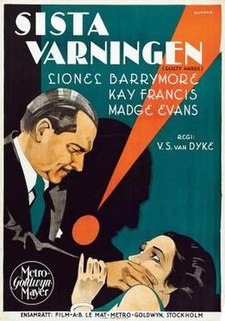
This week, we looked at a very underrated PreCode film from 1931. Guilty Hands stars Lionel Barrymore as Richard Grant, a lawyer who discovers that his beloved daughter is engaged to Gordon
Rich (Alan Mowbray), a client with a horrible reputation as a womanizer
and abuser (Rich probably murdered his last fiance). Grant tells Rich
that if Rich continues with his plan to marry Barbara Grant (Madge
Evans), Grant will kill him AND will get away with it. He will make
sure it is the "perfect murder".
It's not giving
too much away to reveal that Grant DOES kill Rich. But from there, we
will leave you in some amount of suspense. Kay Francis is wonderful
here as Rich's mistress, Marjorie West (this is a pre-code,
after all), who loves him in spite of his engagement to Barbara (and
fully intends to keep on seeing him after his marriage). When Rich
dies, Marjorie begins investigating his death. With some interesting
results.
Lionel Barrymore is fantastic. He is
sympathetic, and at the same time, sinister. You want to root for him,
but he is, after all, a murderer. Yet he did it for a good reason.
leading the audience to feel ambivalent about the conclusion. It is
also a plot that keeps you guessing, right to the very end. Will
Richard be caught? SHOULD he be caught? It's also fun to see Ms.
Francis' Marjorie take command as an amateur detective. Agatha Christie
was just beginning to write Miss Marple in 1926 (but only as a short
story in a magazine. She would not appear in book form til 1932). One
would need to go back, we suspect, to Wilkie Collins (The Lady and the Law, as well as The Woman in White) for an earlier female detective, so Guilty Hands heroine is quite a novel idea.
If you can see this picture, do so. It is worth your time. We think you will be surprised and will LOVE the ending. We'll leave you with a scene from early in the film:
I Loved a Woman from 1933 features Edward G. Robinson as John
Hayden, a would-be artist, living on his father's money in Paris, until
his father's death. He returns to America (Chicago, to be specific),
and at the encouragement of the lovely Martha Lane (Genevieve Tobin), he
assumes the responsibilities of running the company. Once in business,
John is no more a romantic artist, but a hard-headed, in fact cruel and
dishonest, businessman. As his marriage to Martha disintegrates (she pretty much married him for his money and power), he becomes romantically involved with Laura McDonald (Kay Francis), and the two begin a long-term affair. Meanwhile, John continues his ruthless business ways . Edward G. Robinson is quite convincing here. Heis
interesting as the romantic lead, for a change, but he is also, as we
all know from his gangster work during this period, perfectly
comfortable playing a not-very-nice guy. As always, Kay Francis is
great. Her Laura loves John, but this is a Pre-Code movie, so her life
style is, shall we say, rather risque. And again, being that this is a
Pre-Code film, our characters get away with things that, in another
year, would result in their deaths or imprisonment.
Probably
this film is more interesting as a Kay Francis film than as a venue for
Robinson. Not that he is bad, but his character is just not really as
interesting as it could have been. He is so callous in so many ways,
that it is hard to sympathize with him. But there are scenes with
Francis that are fun and interesting, so it is certainly worth a look. And just to get you started, here is the trailer:
Transgression (1931) is a Pre-code wonder from the always
fascinating Kay Francis. Ms. Francis plays the happily married Elsie
Maury, whose husband Robert (Paul Cavanaugh) is called to India on
business. Though Elsie asks to accompany him, Robert refuses, and
instead sends her to Paris. While in Paris, the naive Elsie becomes
enamored of Don Arturo de Borgus, a philanderer of the first water,
played with relish by Ricardo Cortez. Though Elsie tries to remain
loyal to her husband at first, her infatuation, boredom, and Don
Arturo's advances tempt her to stray. And so, she arrives at his
estate. Where, as they say, the plot thickens.
Kay
Francis is just wonderful as the tempted wife. As always, she is
beautifully clothed; she manages to portray the ambivalence of a young
woman who longs for her husband, but is bewildered by the new rules of
the jaded society into which her husband has thrown her. Also fun to
watch is Ricardo Cortez. His Don Arturo is a total cad. And if you
think he is bad at the beginning, wait til you see the end, and realize
just how horrid he truly is! We also very much enjoyed the performance
of Nance O'Neil as Paul's sister, Honoria. What a totally reprehensible
character she is! Nance plays her with relish, and she is a delight to
despise. Here she is spying on our Kay:
The end will show you why this fits so
perfectly into the Pre-Code mystique. And you will really enjoy it! We
will be looking at a few other Kay Francis movies from the Pre-Code era
in the next few weeks, so we hope you will join us again.
This week, we examined another precode movie, notable for being an early effort of Humphrey Bogart. The film is Love Affair (from 1932 - not be be confused with the 1939 film of the same name with Irene Dunne, which inspired An Affair to Remember)
and Bogart plays James Leonard, a brilliant aeronautical engineer who becomes involved with an impoverished heiress. Carol Owen (Dorothy Mackaill) is a party girl, with a love for thrills (and no one else) til she meets Jim at the air field, where she has gone to be wowed in an airplane. He manages to knock the stuffing out of her (by doing loop-d-loops with his plane) and she returns the favor by driving him to the City (at 80 miles per hour!) It doesn't take long before Jim has
spent the night with Carol (this is a precode, after all), and before
Carol discovers that the little money she has is gone, and she will end
up being a detriment to Jim's efforts to develop an airplane motor
company with his revolutionary new motor design.
Dorothy Mackaill was nearing the end of her career when she filmed Love Affair. Within two
years, she left pictures for good (after seeing her rather substantial
career peter out to supporting roles and then none at all). Sad really,
as she was quite talented. We were very impressed by the scene in
which she is flying with Jim - the look on her face is priceless. Also
wonderful was the scene in which we realize she has been intimate with
Jim. Her tears as she brushes her hair before she goes out to join her
lover are very special. We see in her eyes all her emotions - her fears, her anticipation, her deep and abiding love.
This film is also
noteworthy as an early attempt to introduce Bogart as a leading man.
Columbia obviously decided he did not fit the bill (their loss. He is
wonderful in this film) and Bogart would leave to play gangsters and
finally, the ultimate leading man at Warner Brothers. Here is a scene with Bogart looking all ruggedly handsome:
Luckily,
this film is available on DVD (though we caught it on Antenna TV; you
could look for it there as well). It is certainly worth your time.
1937's Camille, with Greta Garbo as the notorious Marguerite
Gautier was the subject of our latest discussion. Garbo, of course, is
wonderful as the opportunistic courtesan who falls in love with the
scion (Robert Taylor as Armand) of a well-to-do family. While
Marguerite resists the attentions of - and her feelings for - Armand,
she finds herself desperately in love with him. A summer alone with him
convinces her that she can change to a simpler lifestyle, but the mores
of the time interfere, and Marguerite is faced with a choice - stay
with Armand, to his ruin, or leave him and break both their hearts.
Garbo
is just remarkable here. Her silent era training is evident as she uses
her face, her eyes and her body - rather than her voice, to show us
Marguerite's physical deterioration. She LOOKS sick - beautiful, but
quite ill. Yet she is not overstated or exaggerated. She is the
epitome of suffering, trying to summon her last ounce of strength to
greet the man she chased away.
Also wonderful is Lionel Barrymore as Armand's father, Monsieur Duval. Barrymore could play his character as a villain, but he does not. Monsieur
Duval is merely a loving father who dreads hurting a woman who seems to
be very sweet, and very much in love with his son, but who will soon
cause his downfall if they continue their relationship. When one
realizes that Barrymore is less than 2 years from being forced into a
wheelchair for the rest of his life (he suffered from severe arthritis
that prevented him from walking), one realizes that he is acting through
his pain.
Robert Taylor, too, is excellent, with
Armand's naivety shining from his youthful face. Armand seems sometimes
like a sex object - a lovely creature for Marguerite to adore. Taylor
fits that bill as well, but also is able to make you understand why
Marguerite would give up everything to be with this lovely, gentle man.
This
is a beautifully designed film as well, with magnificent costumes (by
Adrian). Our group had a bit of discussion on the tendency of some
films to not quite get the hair style right for the period - which is
NOT the case here. The whole atmosphere of the film is perfection. It
is interesting to note that the silent version of the film is also
available (on the DVD of Camille), with Rudolph Valentino as
Armand and Nazimova as Marguerite. It is certainly worth a look if only
as a comparison to its magnificent remake.
This time, our group decided to jump across the pond for what is perhaps the perfect tearjerker: Brief Encounter (1945). Two of us had recently seen the Broadway retelling of the story, and
being fans of the film, were not pleased with the results. We found the
levity in the play too distracting in this story of beautiful sorrow.
The film, directed by David Lean, is a magnificent rendering of a very
simple story line - two married strangers meet casually on the train
platform of a small English town. The following week, they run into one
another again; a friendship is formed, followed quickly by love. Of
course, their love is doomed - both have spouses and children. Neither
can bear to hurt their families. Thus, they must separate, never to see
one another again.
Drawn out as just a few lines of plot, this
film sounds trite. It is not. Aided by the subtle direction of David
Lean, a score that deftly uses Sergei Rachmaninoff's Piano Concerto No. 2
as subtext, and superb acting by Celia Johnson as Laura Jesson and
Trevor Howard as Dr. Alec Harvey, this is a movie (to quote TCM) that is
an Essential. The story is told from Laura's point of view - she is
our narrator - and so we see her reactions to the whirlpool into which
has life has fallen. The original story (a play called Still Life)
only has 4 characters - Laura and Alec, and the "comic" relief of the
train station couple, Albert Godby (Stanley Holloway) and Myrtle Bagot
(Joyce Carey). In fact, the whole play takes place in the refreshment
room of the train station. Lean opens up the action, and allows us to
meet Laura's husband and children, making even more poignant the
decision facing Laura.
The DVD version of Brief Encounter
has some interesting commentary on it. I have to admit that one scene
(in which we see Alec and his friend Stephen argue over Alec's failed
attempt to consummate his affair with Laura), which the commentator said
did not work - since it was not something that Laura could have seen
(she has already run from the room), did, in fact, work for me. I saw
this conversation as LAURA'S imagining of what actually occurred. It
seems unlikely, to this observer, that men would have this discussion.
More, it was the final realization, by Laura, that her relationship with
Alex has become tawdry, and must end.
If you've never seen Brief Encounter, give yourself the pleasure of a visit to post World War II England, and visit with Laura and Alec. Here is the trailer; you can hear some of the music, as well as get a taste of the film itself:
In 1940's Vigil in the Night, Carole Lombard stars as
Anne Lee, a dedicated nurse in a small English town. Anne loves her
work, and has convinced her younger sister Lucy (Anne Shirley) to follow
in her footsteps. Though almost through with nursing school, Lucy
doesn't have Anne's dedication; as a result of her neglect, she allows a
young child to die. Rather than let Lucy be ousted from nursing
school, Anne assumes responsibility for the child's death; she is fired
from her job, and forced to leave town. She ventures to Hepperton,
where she joins the staff of a local hospital, and gradually assumes
positions of greater responsibility. She also finds herself working
with the similarly dedicated Dr. Prescott (Brian Aherne). However, the
appearance of a nurse from her old job, Lucy's involvement with a local
man, and an epidemic in Hepperton all work to create problems for Anne.
Sure,
this is melodrama, but it is melodrama at its best. Ms. Lombard shines
here as a woman whose career is the most important thing in her life.
In the hands of a lesser actress, Anne could have come across as preachy
or shrill. But Lombard's Anne shines when she talks about nursing. Her
Anne is what a nurse SHOULD be - an idealized portrait of a woman who
values human life and the ability to bring comfort to the sick. She is
ably assisted by Anne Shirley (who's Lucy is the poster child for the
person who should NOT enter nursing school, and whose selfishness makes
you want to smack her in the film's early scenes.), and Brian Aherne (an
equally idealized doctor, Aherne also carefully avoids the maudlin).
Vigil in the Night
really is a neglected Lombard masterpiece; a film that is rarely seen
or discussed when talking about her (painfully short) career, but one
that should be looked at more often. We really enjoyed it, and suspect
you will as well. Take a look at this clip, to get an idea of what is in store:
Today, we again visit the pre-code world for Carole Lombard's 1932 film Virtue.
In it, she plays Mae, a young woman with a "career" on the streets,
who is literally run out of New York City on a rail (on what is today
Metro North, to be exact). She has no intention of leaving the City, so
she bails off the train at 125th Street, where she meets Jimmy Doyle
(Pat O' Brien), a smart-mouth cabbie who disdains marriage and women.
Mae runs away without paying her cab fair, much to Jimmy's disgust;
however Mae decides to go straight. Once she has the money, she seeks
Jimmy out to return the fare. After some difficulties, they fall in
love, and decide to marry. Of course, once they marry, Jimmy finds out
about Mae's past. He decides to forgive her, but of course, with
forgiveness does not automatically come trust.
Ms. Lombard is just
wonderful here as Mae. She is sympathetic, but tough. You never
forget her past, but you (as the audience) are far more aware of how far
she has come than the rather dense Jimmy. Pat O'Brien is quite good as
well playing a tough guy. You do want to smack him occasionally for
his stupidity, but I think we ultimately want him with Mae. Perhaps she
deserves better than him, but she loves him, and he is really not a bad
guy. Here, our couple have a conversation:
It is also nice to see Ward Bond (as Jimmy's pal Fran), who
is, as always, wonderful. He makes a small part something to look
forward to. Another treat is seeing Mayo Methot (the one time Mrs.
Humphrey Bogart) as Mae's best friend Lil Blair. Ms. Methot never
actually looked young! And certainly her somewhat hard features
complement the part of a hooker who has tied herself to a rather
disagreeable - and dishonest - lover (said boyfriend is played with a
good deal of slime by Jack LaRue).
Another Lombard movie that
doesn't get enough play, we think. Plus, as a precode film, you get the
extra bonus of something a tiny bit (by later standards) racy.
Lady by Choice from 1934 is an absolute delight. In it,
Carole Lombard plays fan dancer Alabam (Georgia) Lee, who finds herself
in court as the same time as Patsy Patterson (May Robson), a former
entertainer turned homeless drunkard. Patsy has friends, however -
Judge Daly (Walter Connolly) and Johnny Mills (Roger Pryor), a
wealthy young man whose father requested he always look after Patsy.
Patsy, Like Alabam, is a gutsy lady, who speaks her mind. As a result,
when Alabam's agent convinces her to adopt a mother (for the publicity),
it is Patsy she selects. And Patsy, who immediately adores Alabam,
tries to change her new daughter's life for the better, but not always
with the best of results.
May Robson is just
adorable. She gets most of the good lines, and you want to take her
home with you. Lombard's role is also quite rich. Alabam is a
kind, gentle soul; she loves deeply, and is a caring person. Badly used by her agent, she finds herself almost penniless, but still tries to
support Patsy's goals, to make her a legitimate performer, despite her
lack of self-confidence. We have, of course, some romantic
complications. Alabam falls in love with Johnny Mills, but Patsy thinks
that Alabam is after him for his money. It causes some strife, but all
comes right in the end!
This is one that I think most people have not seen. Give it a try. I think you will find it is worth your time. We'll leave you with a scene with Ms. Lombard and Ms. Robson.