Professor Henry Todhunter (Thomas Mitchell) has been diagnosed by his friend, Dr. Lawrence Stevens (James Stephenson) with severe coronary disease; he has, at most, six months to live. University Dean Somers (Thurston Hall) forces Todhunter’s retirement; with nothing better to do, Professor Todhunter spends his days developing new theories. He hypothetically asks his colleagues what they would do if they had only six months to live. Professor Peterson (John Eldredge) has a disturbing idea - murder someone who the law cannot touch but deserves to die. Our film this week is Flight from Destiny (1941). This is a nicely paced mystery story that will keep you guessing through the entire film. The cast is led by Thomas Mitchell, who is wonderful as the dying man. Mr. Mitchell keeps the character just teetering on the edge of sanity - when he proposes his theory that, as he is neither living nor dead, he has the authority to judge the right of another being to live, you wonder if he is sincere. Discovering he is indeed deadly serious (no pun intended), one is chilled to the bone. Without going into too much detail, some of the plot focuses on an art forging racket. This is worth noting, as Thomas Mitchell was himself and art collector, who it is believed, was the victim of a forger. He reportedly purchased a forged Rembrandt, that is currently in the Fogg Museum at Harvard. (Hollywood’s Original Rat Pack: The Bards of Bundy Drive by Stephen C. Jordan)
First billing in the film is given to Geraldine Fitzgerald (Betty Farroway), but don't expect to see her very much. Her character is crucial to the film, setting Professor Todhunter on his mission of "justice," but Ms. Fitzgerald has little to do but look pained. It's a shame really; she's a talented actress and uses what screen time she has well. Jeffrey Lynn (Michael Farroway) is also convincing in the part of the erring husband. Mr. Lynn doesn't often get roles that allow him to do much more than be handsome, but this one gives him a part he can sink his teeth in, and we were impressed with is performance. On the other hand Mona Maris (Ketti Moret) left something to be desired in the part of the thief and seductress. Ms. Marris is a striking woman, but but doesn't have all that much allure. The character was supposed to use her charms to win over her victims; while we only see her briefly with Michael, we do see her with Professor Todhunter at some length. She is just too cold to be convincing as a woman whose primary gift is allegedly her sexual appeal. She does get to show off some remarkable dresses by designer Damon Giffard (who worked in Hollywood for only one year).
Mary Gordon as Professor Todhunter's housekeeper, Martha is worth comment. Though a small part, it's a good character that is well acted by Ms. Gordon. And, if you are a fan of Alexis Smith, she appears in a small role. That same year, she'd appear in Dive Bomber with Errol Flynn (TCM article).
Based on the 1937 novel Trial and Error by Anthony Berkeley Cox, it had two working titles: that of the book and Invitation to a Murder (AFI Catalog). It garnered a very positive review from Thomas M. Pryor in the New York Times, saying that "it was most fortunate that an actor of Mr. Mitchell's ability was selected to interpret [Professor Todhunter]. All in all, this is a little-viewed film that deserves some attention. Do try to find it.
Newly married diplomat David Talbot (William Powell) is celebrating his three-month anniversary with his wife, Lucienne (Hedy Lamarr) when he receives a message, addressing him as Jean, and informing him that he needs to repay a million franc debt by tossing the money over a fence near a deserted farmhouse. Talbot decides to do so, but after advising the police that he is being blackmailed. At the trial, the accused claims that Talbot - who lost his memory after nearly dying in a train accident - is in actuality Jean Pelletier, a thief. Our film is Crossroads (1942), and is posted to celebrate William Powell's day on Summer Under the Stars.
It's always a pleasure to see a William Powell film, and this one is no exception. He brings gravitas to any part he plays, and ably fits the bill of a diplomat. Mr. Powell had played amnesia for laughs in I Love You Again (1940). Here, he brings sympathy to this man who has had to reconstruct his entire life following his near death accident. His relationship with Ms. Lamarr as his stalwart wife is convincing (though, as we'll discuss later, she is severely underutilized). He also is able to make the audience wonder throughout the film how much truth there is in the accusations leveled by his nemesis, Henri Sarrou.
It's a shame Hedy Lamarr has such a small amount of screen time. Her early scenes with Mr. Powell bring some humor to an otherwise serious film, and the conclusion of the film uses her to good effect. She would later work with him in The Heavenly Body (1944). Certainly, she does not have the chemistry with him that he had with actresses like Myrna Loy, but we believe in their romance.
Marlene Dietrich was offered the role of Michele Allaine, but turned it down (TCM article); regardless, Claire Trevor is convincing as David's alleged former lover, and really a better fit for the role. Ms. Trevor keeps the viewer wondering - especially interesting is a scene in which a locket with a surprising photograph is dangled before the eyes of David's wife - just enough out of range that she cannot see it, but close enough to cause David - and the audience - concern. It's Ms. Trevor's adept handling of the scene that makes the audience hold their breath as the action proceeds.
When you have Basil Rathbone (Henri Sarrou) in the cast, you know you are in for a good time. Sure, it's hard to believe in the early scenes that he really is David's rescuer (of course, we are right - he is not), but wow, he is suave and scary as the head of the blackmail ring. It is because of the interplay between Mr. Rathbone and Mr. Powell that you are never quite sure who to believe. They verbally duel, and they make it easy to believe the one or both is hiding more than they are revealing.
Margaret Wycherly (Mme. Pelletier) is excellent as an old lady, allegedly the mother of Jean Pelletier. Ms. Wycherly is a character actor who can turn on a dime - she can go from the sweet little old lady to the she-devil in the blink of an eye. She's probably best noted for her performance as Cody Jarrett's Ma in White Heat (1949). Two other actors of note in the film are Felix Bressart as Dr. Andre Tessier and Sig Ruman as his nemesis in court, Dr. Alex Dubroc. Their scenes together are well done, and Mr. Bressart is enjoyable as David's doctor, friend, and supporter.
Crossroads was based on the screenplay for a 1938 French film, Carrefour, and had several working titles during production: The Man Who Lost His Way , 'Til You Return and The Man from Martinique (AFI catalog). The New York Timesreview by Theodore Strauss (T.S.) was not enthusiastic - except for Mr. Powell, calling him "particularly, flawlessly urbane and crisp...an actor whose talent for
under-statement is perfectly adapted for a melodrama of this genre." The story was reprized with a Lux Radio Theatrebroadcast in March of 1943, with Lana Turner and Jean Pierre Aumont in the lead roles.
We enjoyed the film greatly, and recommend it for your viewing pleasure. In the meantime, here is a trailer:
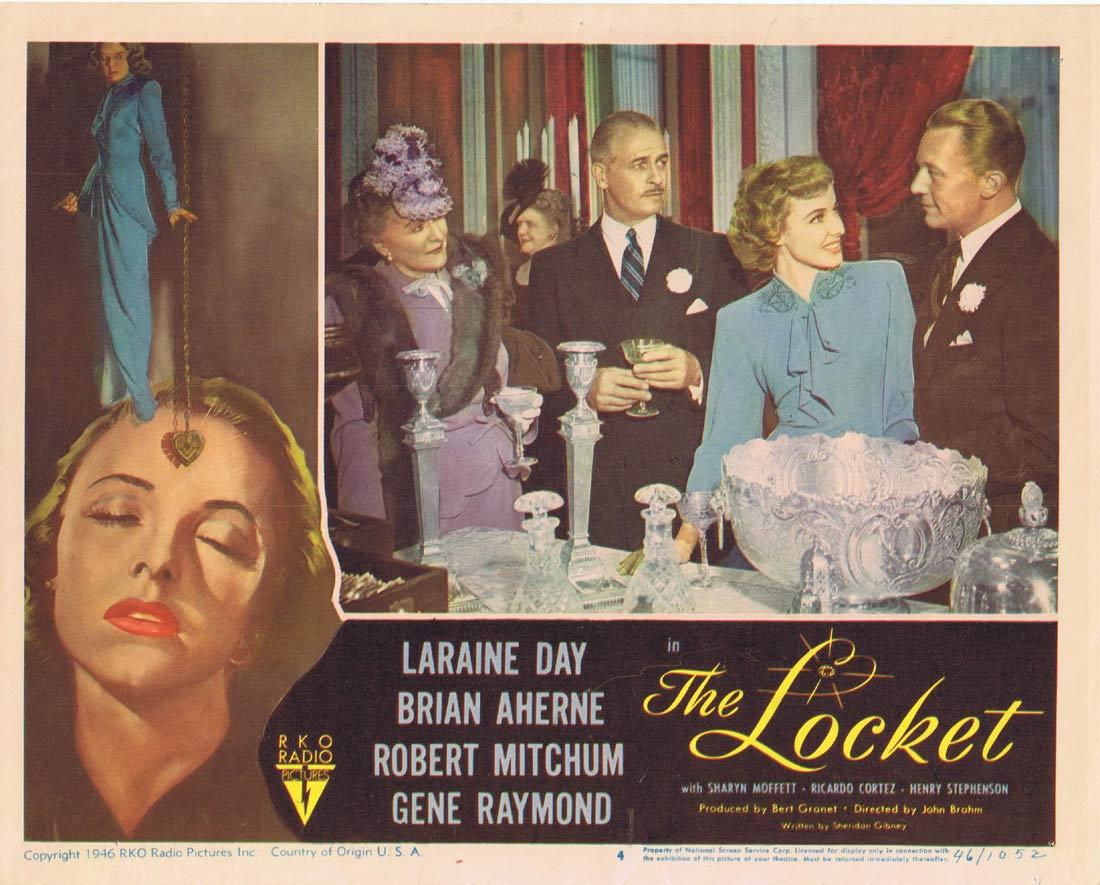
On his wedding day, John Willis (Gene Raymond) is approached by Dr. Harry S. Blair (Brian Aherne). Dr. Blair claims to be the ex-husband of John’s fiancée, Nancy Patton (Laraine Day). Her name was then Nancy Monks, and she was responsible for the deaths of three men, all because of The Locket (1946).
This is by no means a simple movie. It employs the film staple of the flashback, and turns it on its head by taking a single flashback and embedding within it a flashback to a flashback, and another flashback from the second one. Yet, the film is so well written that the audience is always clear as to what is happening - unless, as Eddie Muller noted in his introduction, you arrived after the start of the film (as was so often the case in 1946!). It's a clever device, and keeps the viewer on pins and needles from the beginning to the end of this intriguing film noir.
Laraine Day is excellent in the part of Nancy. You are never really sure how much she knows of her own behavior - does she know about the thefts she committed, or does she forget the kleptomania-induced robberies once they are accomplished. Ms. Day uses her experience as the sweet ingénue to create an intelligent yet enigmatic woman, who is highly attractive to men without be openly seductive. She's a chameleon who adapts herself to the preferences of the men in her life. At one point, Hume Cronyn owned the script, which he intended to feature his wife, Jessica Tandy. When he sold it to RKO, the credited screenwriter (more on that later) wanted Joan Fontaine, but she was not available. Olivia de Havilland campaigned for the part, but producer Bert Granet wanted Ms. Day, and he won the day (TCM article). Interesting, the mother of Joan and Olivia, Lilian Fontaine, appeared as Lady Wyndham.
Robert Mitchum (Norman Clyde) had recently been nominated for an Oscar for his work in The Story of G.I. Joe, and was one year away from what is often cited as his best role - Out of the Past. His appearance as Norman, a moody artist whose life is upended by his relationship with Nancy, is a strong addition to his film credits. He'd known Ms. Day when they worked with the Long Beach Players; she was looking forward to working with him. He however, had formed an idea that she ignored him at one point in their lives, and refused to speak to her during the production (he naturally never told her WHY he was cutting her).
Ricardo Cortez has a small, but pivotal part as Nancy's employer, Andrew Bonner. He manages to put just the right amount of the rake into his performance, making you did wonder exactly what was going on between him and Nancy. Ms. Day was a long-time fan of Mr. Cortez, and asked that he be cast in the film (The Magnificent Heel: The Life and Films of Ricardo Cortez by Dan Van Neste). It is always a pleasure to see him, and he provides a memorable performance. Ms. Day was also a fan of her other leading men - Brian Aherne and Gene Raymond. Mr. Raymond has the smaller part; as the intended groom of the lethal Nancy, he serves as the audience's conduit to her story. Mr. Aherne is our narrator; it is he who tells Nancy's long, involved history. It is also worth noting that all three stories are told to us by him. The question becomes - should we believe him? Is he the victim of Nancy, or is she innocent of the his charges? Laraine Day also had some talent as a dress designer. She helped to create Nancy's wedding dress, and used a spun glass fabric which she discovered. (AFI Catalog) Her discovery is referenced in this lovely Press Kit from the William K Everson Collection at New York University. Before you read it, just know that there are a lot of spoilers included. Originally titled What Nancy Wanted, the screenplay was written by Norma Barzman. She heard the story of a woman who was accused of stealing a necklace as a small girl, which resulted in a life-long history of depression and kleptomania. It was that script which was purchased by Hume Cronyn. When he sold it to RKO, they gave it to Sheridan Gibney, whose major contribution was to set the middle section in England. It took until 2014 for Ms. Barzman to finally was credited with writing the script (Los Angles Times, Eddie Muller extro). It probably didn't help that she was blacklisted for being a member of the Communist Party.
In an interview, the credited screenwriter Sheridan Gibney, called Ms. Day’s performance “weird”. (Film Crazy: Interviews with Hollywood Legends by Patrick McGilligan). Regardless, Ms. Day got good reviews “Laraine Day gives what must be her most fascinating performance” ("Laraine Day Psychopath”. Los Angeles Times, May 27, 1947), and considered this her best role. The ending, which was to have been more oblique, was forced on them by the censors. And the film ended up being under-marketed because of the execution of an innocent man in the story. Some states (Massachusetts in particular) were leery of death-penalty error stories. This is a remarkable film, that is only recently getting the attention that it deserves. We'll leave you with an early scene, and the suggestion that you seek this one out:
A bank robbery results in the murder of a guard and the theft of $92,000. Police detectives Paul Sheridan (Fred MacMurray) and Rick McAllister (Phil Carey) are assigned to watch the girlfriend of the suspect, Lona McLane (Kim Novak). But it’s not long before Paul finds himself a Pushover (1954) for Lona. With a plot as twisty as a pretzel, the intrigue increases in intensity as Paul decides that he can have lots of money AND the girl by trapping robber Harry Wheeler (Paul Richards) and convincing his police colleagues that the money is long gone. It's impossible to view this movie without mentally comparing it to Double Indemnity. While this is a decent film, the similarities to that earlier, brilliant picture, do it no service. As good as Fred MacMurray is - and he is very good - there is a major problem. Kim Novak is no Barbara Stanwyck. This was Ms. Novak's first major role. She'd appeared in two other films (under her birth name, Marilyn Novak) (American Classic Screen Features edited by John C. Tibbetts, James M. Welsh). She's merely adequate as Lona - she has one expression, that of perennially unhappiness. As lovely as she is, it's difficult to understand why Paul falls so hard for her. She's not all that seductive, nor does she seem particularly intelligent or intriguing. Even her relationship with Harry Wheeler is haphazard - when asked why she was with him, her response is that he bought her nice things, but with a lack of enthusiasm that is numbing. Ms. Novak's casting is the film's weak link.
Fred MacMurray is excellent as a good cop gone bad for the love of a woman (and for a lot of money). Mr. MacMurray makes you believe his passion for Lona; to the very end of the film, Paul clearly is infatuated with her. As he spirals into more problematic actions, the audience can see, thanks to his deft performance, the guilt that plagues Paul for the choices he has made. Dorothy Malone (Ann Stewart) has a relatively small part as a nurse living next door to Lona. When we first meet her - seen through the binoculars of Rick McAllister - her presence seems to be merely a romantic interest for the honest cop in the team. That he is watching her constantly without her knowledge is rather creepy for a viewer in 2020, it does begin a theme that will be echoed more fully in Rear Window later that same year (TCM article). Ms. Malone gets her moment to shine towards the end of the movie. Ann is splendid under pressure and the audience is rooting for her because of her strength.
Philip Carey (he's Phil in this movie) is good as Paul's stoic partner. A Marine, who served in both World War II and the Korean Conflict, Mr. Carey started his film career as a military man. At 6'4", he made an impressive soldier and police officer, and much of his film career cast him in those roles. He also made a convincing cowboy, and it is interesting to note that, the film marquee of the theater where Lona meets Paul is showing The Nebraskan - starring Philip Carey (Columbia Noir: A Complete Filmography, 1940-1962 by Gene Blottner). Mr. Carey would segue over to television, working as a guest star in a number of shows (including a highly regarded All in the Family episode as Archie Bunker's pro-football player friend, who turns out to be gay), and starring in the series Laredo and, from 1979 until 2007, the soap opera One Life to Live. Married twice, Mr. Carey died of lung cancer at the age of 83 in 2009.
Two supporting players should be noted - E. G. Marshall (Lt. Carl Eckstrom) as the stern lead on the investigation manages to make a character, who could have been an automaton, sympathetic. Allen Nourse (Paddy Dolan) is especially noteworthy as an alcoholic police officer who is on the edge of losing his job - and his pension - but who has a strict moral compass that will put him in jeopardy.
Based on the novel The Night Watch by Thomas Walsh, Pushover went through several working titles - The Killer Wore a Badge, 322 French Street and The Night Watch (AFI catalog). The reviews for the film were positive; the New York Timesreview by Howard Thompson (HHT) commented on the similarities to Double Indemnity, though acknowledged that the film should be reviewed independently (by the end of his review, Mr. Thompson did find it hard to completely eliminate comparison). Pushover is a good but not great film. But, with the opportunity to see Fred MacMurray in another noir, playing a morally compromised character, it's one to see. We'll leave you with a scene between Mr. MacMurray and Ms. Novak.
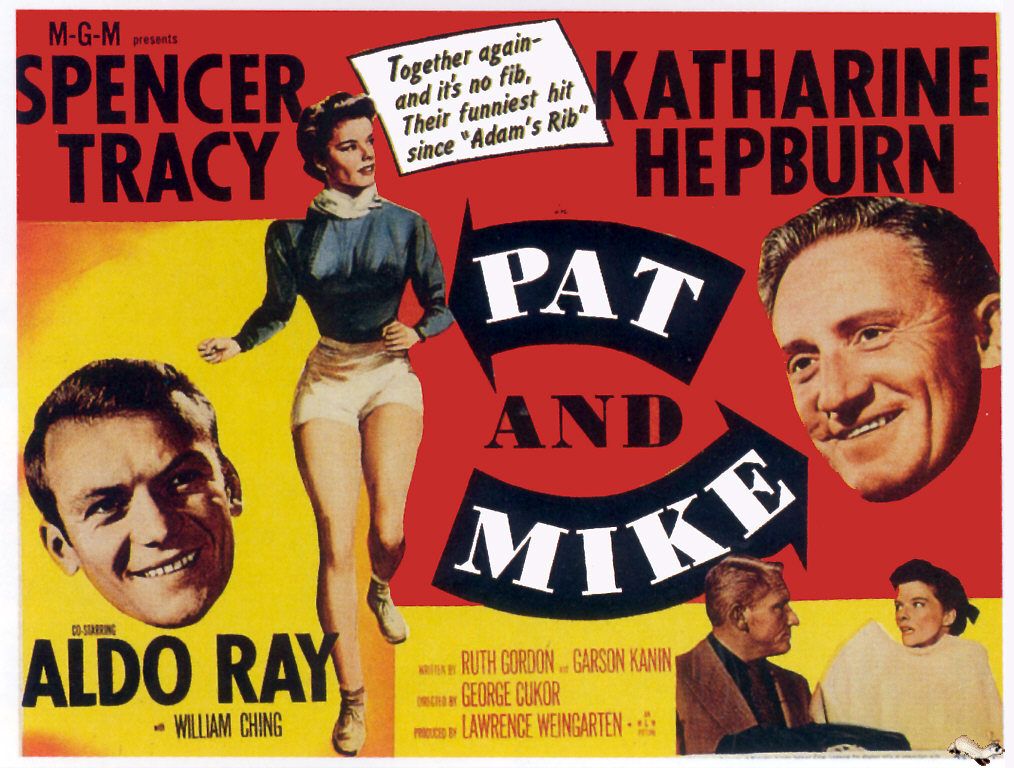
Women's athletic coach at Pacific Tech, Pat Pemberton (Katharine Hepburn) has a problem. A gifted athlete, she freezes when she is around her fiance, Collier Weld (William Ching). She resigns her job when her presence at the college endangers funding from an irate donor (she wasn't respectful enough to his wife when they lost a golf game), and competes in a golf pro-am. There, she attracts the attention of Mike Conovan (Spencer Tracy), a sports promoter. He encourages her to go pro, with him as her manager. Our film this week is Pat and Mike (1952). In their seventh (of nine) film appearances together (TCM article), Spencer Tracy and Katharine Hepburn are at the top of their game in this engaging and humorous film. When the two of them are together on screen, the fireworks are palpable. Their verbal sparring is part of what makes this film a classic. The film was written specifically for Tracy and Hepburn by their friends, Ruth Gordon and Garson Kanin (they'd previously penned Adam's Rib for the couple), with George Cukor in the director's chair. The authors were particularly interested in highlighting Ms. Hepburn's athletic prowess with their screenplay, and Ms. Hepburn did all the sports scenes herself (Sports Cinema 100 Movies: The Best of Hollywood's Athletic Heroes, Losers, Myths and Misfits by Randy Williams). Besides being excellent at golf and tennis, Ms. Hepburn swam on a regular basis, including dips in the ocean near her Fenwick, Connecticut home, even in winter (Women's World).
If there is one problematic aspect to the film, it's why someone as smart, sassy, and gifted as Pat would be involved with a dolt like Collier. William Ching is not all that attractive, and he is a bit of a stiff as an actor, so he brings nothing to the role that explains their relationship. On paper, Collier is a vile bully; he's verbally abusive and downright disgusting. He walks in late to his fiance's tennis match, making tons of distracting noise, openly laughing at her. He'd likely be thrown out of a real tennis match. We'd have like to have seen that happen. It was an absolute joy to see Pat throw her luggage out the window of the train and abandon her obnoxious fiance.
In the capable hands of Spencer Tracy, Mike starts as a conniver and learns the benefits of honest sports from his scrupulous charge. In their first scene together, Mike admires Mrs. Pemberton - "nicely packed, that kid. Not much meat on her, but what's there is cherce," he says. In the original script, the line was to read that Pat was "pretty well stacked." The film's producer Lawrence Weingarten objected - Ms. Hepburn, he said, was not "stacked." So the line was rewritten to "choice." It was Mr. Tracy who put the New York spin of "cherce" into the performances (Spencer Tracy: A Biography by James Curtis).
Chuck Connors (Police Captain) was a minor league baseball player - he'd been in the major leagues for 67 games (1 with the Brooklyn Dodgers; 66 with the Chicago Cubs), and was now working for the Los Angeles Angels (the Cubs minor league affiliate) - when he was approached by casting director (Memories and Dreams, 2018). Realizing his days as a player were coming to a close, he tried his hand at acting - this was his first role, and he is just fine as the bemused policeman. Mr. Connors would continue in films (like Move Over, Darling (1963) and Old Yeller (1957). But it was television that made his career - his five years as Lucas McCain on The Rifleman would bring the actor fame and a career that continued until his death of pneumonia and lung cancer (he was a three-pack a day smoker until the mid-1970s) in 1992.
Aldo Ray (Davie Hucko) had already done a few minor parts in films; the same year that Pat and Mike was released, he starred with Judy Holliday in The Marrying Kind. In his hands, Davie is child-like and trusting. His resentment of Pat blossoms into affection when she begins to look out for his career. He's a versatile actor, who doesn't always get noticed. If you've never seen him, Nightfall (1957), we strongly recommend you add it to your viewing list. Two other performances are worthy of note. Jim Backus (Charles Barry) has two small scenes as a tennis pro who encourages Pat to enter the golf pro-am. Charles Buchinski (Hank Tasling) is a riot as a gangster who gets a pummeling from our lady athlete (she's boxed, by the way). Mr. Buchinski would later gain fame as Charles Bronson.
The New York Timesreview by Bosley Crowther was very positive, and in his introduction to the film, Ben Mankiewicz called it one of Tracy & Hepburn's "best." It did well at the box office, bringing in nearly $2.7 million. Ruth Gordon and Garson Kanin received an Oscar nomination for Original Screenplay (AFI Catalog) - they lost to The Lavender Hill Mob.
We agree wholeheartedly that this is a film well worth viewing - it's not often you get to see a film about a female athlete that makes you want to pick up a tennis racket (or golf club) - and suggest this one for a day when you need a good laugh. We'll leave you with this trailer:
The Amateur Cracksman has struck again, and the police are baffled. Despite his success as a thief, A. J. Raffles (Ronald Colman) is giving up his life of crime for Gwen (Kay Francis), the woman he loves. But that is before he discovers his best friend, Bunny (Bramwell Fletcher) is deeply in debt. To save his friend, Raffles (1930) decides to pull one more job - steal the diamond necklace belonging to Lady Melrose (Alison Skipworth). This was a fun, enjoyable movie. It's very much like the 1939 remake, if a bit more static in places (this is 1930, after all. Sound is still an infant). Regardless, the film's creative team tries to insert some movement and action to the proceedings, which does help to make the film seem less talky. Ronald Colman is the perfect choice for A. J. Raffles. He's charming, debonair, well spoken, and someone you can imagine scaling walls - all the things that are needed to make the audience root for him. His relationship with Bunny is just the icing on the cake - Raffles is a loyal friend. Bunny may not deserve him - he's in debt because of gambling - but this loyalty makes Raffles even more attractive. There was no question as to who would play Raffles in this version. Mr. Colman had proved so successful with Bulldog Drummond the previous year that Sam Goldwyn rushed this film into production (TCM article).
We wanted more Kay Francis. Gwen disappears for much of the film (as Raffles cases the premises to steal Lady Melrose's jewels), then returns towards the end. One thing that her absence accomplishes is to make sure that it takes some time before she realizes that her fiance is actually a robber. Had she been around, we might be shaking our head at how stupid she is for not realizing his hobby (shades of Lois Lane not recognizing Superman when he is wearing glasses!) Once we see her later in the film, Gwen is pretty quick to catch onto Raffles' objective, so it was sadly expedient to not have her around for a bit.
The clever, witty script caused the original director, Harry d'Abbadie D'Arrast, to push for a comedic style. It was deemed to be too fast by producer Goldwyn for Ronald Colman - Mr. Goldwyn saw Mr. Colman as less a comic than a wit, and changed directors; though neither Mr. D'Arrast nor his successor, George Fitzmaurice was listed in the credits (AFI Catalog). By casting actors like Ms. Francis and David Torrence (Inspector McKenzie), both of whom prove to have excellent repartee with Ms. Colman, the film is smart rather than silly. With excellent reviews, like this New York Timesreview which said that Mr. Colman "does well by the part" and Ms. Francis "is also excellent," the film turned a tidy profit (The Women of Warner Brothers: The Lives and Careers of 15 Leading Ladies by Daniel Bubbeo). It isn't surprising that it would be remade in nine years with David Niven in the lead. Both films are enjoyable and well worth a viewing.
Art critic Carol Cabot Hoffman (Joan Bennett) is taking an extended vacation with her husband of eight years, Eric Hoffman (Francis Lederer). Eric's father, Heinrich (Otto Kruger) needs help selling the family business, and the couple and their seven year old son, Ricky (Johnny Russell) are going to Germany to mix business with pleasure. But, when they arrive, Carol begins to wonder if The Man I Married (1940) is the same person with whom she is now living. Joan Bennett is excellent as the wife who gradually realizes that her husband is not only having an affair with his childhood friend, Freda Heinkel (Anna Sten), but is also becoming a fervent Nazi. For the 21st Century viewer, the latter is the most hateful. But like the 1940 audience, Carol is initially less concerned about Eric's political leanings. She serves as the eyes of the audience, slowly learning about the evils of the Nazi party, primarily through her friendship with American newsman Kenneth Delane (Lloyd Nolan). It's a frightening revelation for all concerned, as Carol learns of unjust imprisonments, torture, and murder. As the husband who is seduced into the Nazi party, Francis Lederer is impressive. It would be easy to go over the top with the part, but he doesn't fall into that trap. When Eric and Carol attend a Nazi rally, his fervor becomes apparent. Mr. Lederer does it with a Nazi salute - it's an effective and terrifying moment. George Saunders was originally considered for the role, but he was involved with another film, and was unavailable. (AFI catalog)
Francis Lederer was born in Austria. After stage and silent film work in Germany, he went to London to appear in the play Volpone. Another London production (Autumn Crocus) and a transfer of the play to Broadway (he would appear in four Broadway plays during his career) brought him to America. As he had no desire to return to Germany - Mr. Lederer was Jewish - he stayed and became a U.S. citizen in 1939. He worked in Hollywood (in both films and television) from 1934 until 1971. His third marriage lasted for nearly 60 years, until his death in 2000 at the age of 100. The home that he helped to design is a protected Los Angeles monument (and is now a wine tasting room).
A number of supporting actors add noteworthy performances to the movie. Lloyd Nolan only gets a little screen time, but is excellent as the reporter who tries to help Carol locate a missing academic for his brother, Dr. Hugo Gerhardt (Ludwig Stossel). Mr. Nolan serves as the audience's tour guide to Nazi Germany He has little regard for the Hitler regime; by 1940, it's not likely that the audience knew his time in Germany was about to come to an end. Otto Kruger has a small, but effective part as Eric’s elderly father. He provides the necessary moral compass to the film - a man who lives in Germany, but is not sucked in the the reactionary politics of the Third Reich.
Anna Sten does a decent job with Freda - it's never easy to play a fanatic. If there is any problem with the character, it's that she never seems to be in love with Eric. Her seduction is intended to bring him into the party. Eric is merely another convert for the party. Finally, the always remarkable Maria Ouspenskaya has the small role of Frau Gerhardt, the widow of the academic Carol was asked to seek out. Ms. Ouspenskaya has only one scene in the film, but with her quiet dignity, it is not a moment you are likely to forget.
The
movie was based on a short story, "Swastika" by Oscar Schisgall.
Producer Darryl F. Zanuck changed some names, ostensibly to make them
sound less Jewish, but using "Jude" instead of "Jew" didn't hide a whole
lot. (The Moguls and the Dictators:Hollywood and the Coming of World War II by David Welky). This TCM article cites it as "one of the first aggressively anti-Nazi films made in the wake of the Invasion of Poland in September 1939."
The press for the film was good as is shown in this review from Variety. The New York Timesreview by Bosley Crowther was absolutely glowing: "If we are bound to have a succession of anti-Nazi propaganda
pictures...let's hope that they
all may be as restrained in their emotions, as frank and factual in
their reports and as generally entertaining cinematically as Twentieth
Century-Fox's The Man I Married,...."
Pressure from the German government had resulted in a name change (from I Married a Nazi); the studio underplayed the plot of the film, and didn't distribute it widely. As a result, the film is not as well known as it should be. You may not have heard of this film before, but we suggest you seek it out. It's worth your time.
Her father's sudden death forces Kitty Lane (Barbara Stanwyck) to take a job in a hamburger joint in the city. One of her customers is David Livingston (Regis Toomey), a medical student. He and Kitty gradually fall in love, but David's snooty mother, Helen Livingston (Clara Blandick) has other plans for her son than a Shopworn (1932) girl. This post is part of The Queen of Sass: The Barbara Stanwyck Blogathon hosted by Pale Writer. Shopworn is a mixed bag. On the one hand, you have a dynamic performance by Barbara Stanwyck, but other elements of the film fall into the banal. Perhaps the key culprit is the final film itself. There are huge gaps (probably the result of censorship) (TCM article), that make the movie feel helter skelter. In the latter section of the film, we are told that six years have elapsed - it takes a while to find this out - and in the meantime, we are wondering why the sweet Kitty suddenly seems to be such a notorious woman. With almost no transitions between the major sections of the film, one finds oneself bemused by the changes. Regardless, Ms. Stanwyck makes the change easily to accept, and the audience accepts the change because of her skill. Lila Lee was initially considered for Kitty (AFI Catalog); Ms. Stanwyck evidently was sorry the part was not given to Ms. Lee. It probably didn't help that her marriage to comedian Frank Fay was starting to disintegrate. (A Life of Barbara Stanwyck: Steel-True, 1907-1940 by Victoria Wilson).
The casting of Regis Toomey as Kitty's love interest is another problem. Mr. Toomey is fine as a character actor; he also was a good fit for television. He is a more intimate actor, which makes him ideal for the small screen, but opposite a dynamo like Barbara Stanwyck, he seems insignificant and unworthy of her attention. You spend most of the movie wondering what Kitty could possibly see in this momma's boy. Only when he finally stands up to Judge Forbes (Oscar Apfel) do we finally have any regard for David, but it is perhaps too little too late.
Our villains in the piece are David's nightmare of a mother, and her strongman, Judge Forbes. Given this is a pre-code film, no punishment is meted out. In the long run, we longed for the Judge to get his just deserts. There's no question Helen is a horror, but Forbes is a man of the law, and he misuses his position horribly. He's a despicable man, and the only comeuppance his gets is pitifully inadequate. A lurid trial, and the image of him being disbarred would have been a nice conclusion (but that is probably another movie).
ZaSu Pitts is adorable as Kitty's aunt and best friend, Dot. It's a small, but memorable role, and we looked forward to seeing her reappear on the screen. Her polar opposite is Clara Blandick, who creates the ultimate monster mother in Helen Livingston. It's the women who dominate in this film; but the only woman we really care about is Ms. Stanwyck's Kitty.
While the reviews for the film were not great - Variety called it "the clumsiest kind of literary hoke..." (A Life of Barbara Stanwyck, 1907-1940: Steel-True by Victoria Wilson) and Mordaunt Hall of the New York Times said "It is beyond the powers of such capable players as Barbara Stanwyck,
Regis Toomey, Clara Blandick and Zassu Pitts (sic) to make their actions in
this film convincing or even mildly interesting" - in the long run, the film did well at the box office (Starring Miss Barbara Stanwyckby Ella Smith). If you are a Stanwyck completest, you should watch it for her performance. We'll leave you with a scene in which Kitty shows her strength of character:
Chorus girl Gloria Carroll (Jinx Falkenburg) discovers she's been left one million dollars by Herbert J. Dinwiddie, an older man with whom she had become friends. Not surprisingly, all heck breaks loose. Her boss, Ned McLane (Don Beddoe) wants her to produce a new revue; the criminals from whom Mr. Dinwiddie stole the money want it back, and the gentleman's two sisters, Annabelle (Elizabeth Patterson) and Hettie (Adele Rowland) want a piece of the action. This week, our film is Lucky Legs (1942). A pleasant little B movie with an adequate cast (and one outstanding performance), Lucky Legs is a short (64 minutes) film with a little bit of music, several lovely young ladies, and a plot that has been done before but still manages to be amusing. The lead role is filled by Jinx Falkenburg, an unassuming actress who is reasonably pleasant as the heiress. One rather likes her portrayal of Gloria, a common-sense kind of woman who gets swept up the mania surrounding her surprise inheritance.
Ms. Falkenburg started as a model, and was the first "Miss Rheingold" in New York (Rheingold was a local beer). While her success as an actress was fleeting (she never made it beyond B pictures, though she had a cameo appearance in Cover Girl and spent a good deal of the war doing USO shows), her career after films was impressive. In 1945, she married journalist John "Tex" McCrary. The following year, they launched a radio show Hi Jinx, followed by The Tex and Jinx Show which is credited with being the forerunner of the radio talk show. (You can hear an episode, featuring guest star Nancy Walker here). They branched out into television as well, with At Home and The Tex and Jinx Show. Though the McCrary's never divorced, they did separate in 1980; however they remained close friends. Ms. Falkenburg died in 2003 (one month after her husband's death) in the hospital that she and Tex had helped to found. This opinion piece by William Safire on Jinx's career as a talk radio pioneer was published shortly after her death.
The real star of the film is the delightful Elizabeth Patterson. She sparkles as the mystery loving, Annabelle. She's funny and upbeat, and the viewer looks forward to her scenes. An actress with extensive credits on Broadway (26 plays between 1913 and 1954), Ms. Patterson appeared in over 100 films, including Colonel Effingham's Raid (1946) and Remember the Night (1940). She's also remembered for her role as Mrs. Tumbull on I Love Lucy. Ms. Patterson died at the age of 91, in 1966. It's believed that the story for Lucky Legs was based on a real incident, in which millionaire William Guggenheim willed a million dollars to four showgirls. And though the film was shot between April and October of 1942, it's notable that not one mention of World War II is made. (AFI catalog). Regardless, it's a cute film; it might not be first on your list, but it's good fun for a night in which you want a smile.
Told in flashback, our story begins as seaman Michael O'Hara (Orson Welles) is wandering the streets of New York City and happens upon a mugging. He rescues the victim (Rita Hayworth) from her attackers and returns her safely to her hotel. The next day, he is approached by Arthur Bannister (Everett Sloane), a noted defense attorney, and is asked to accept a position on Bannister's yacht. The Lady from Shanghai (1948), it seems, is his wife, Elsa. Against his better judgement, Michael accepts the job so he can get closer to the tantalizing Elsa. The reaction to the rather odd movie was mixed. One person said, having seen it, she would not choose to view it again. It can be cumbersome viewing it. The film feels like pieces are missing, and the viewer can get lost in the convoluted plot. This is not a surprise, since director Orson Welles planned a much longer movie that was cut drastically by Columbia (TCM article). The sections that were removed were destroyed at some point, so hopes for a director's cut are likely futile. Peter Bogdanovich in his commentary on the film, is eager to shift any blame for the film's defects away from Orson Welles and onto other parties, including Rita Hayworth. Mr. Welles' history as a director and producer demonstrate that he certainly is responsible for much of the film's problems.
Welles' opening narration sets the audience up to wonder at just what exactly Elsa Bannister is up to. Rita Hayworth does not disappoint as a seemingly demure, but somewhat shady character. Her voice, her mannerisms, her eyes all signal the duplicity of Elsa. The notorious hair cut and dye job which so irked Harry Cohn also help her to create this very cunning lady. It's been said that she asked her then-husband Welles for the part - he wanted then unknown actress Barbara Laage, (Orson Welles: The Rise and Fall of an American Genius by Charles Higham) while Ida Lupino was also under consideration at one point (AFI Catalog). Though
their marriage was crumbling when she agreed to take on the part of
Elsa, she may have been trying to patch up the union, or at the very
least assist Welles in providing child support for their daughter,
Rebecca. Sadly, the marriage still ended in November 1947, just around the time filming ended, exacerbated by Mr. Welles
infidelities (Orson Welles: A Biography by Barbara Leaming). (AMC Filmsite). At the same time, a New Yorker DVD of the Week notes that Welles' many close-ups of Mr. Hayworth are loving in their attention to her.
Glenn Anders is appropriately creepy and revolting as George Grisby. He is well matched by Everett Sloane as the sly lawyer and husband. According to Mr. Bogdanovich, Mr. Welles decided to put him on crutches because he didn't like Mr. Sloane's walk. The effect of the crutches and the odd gait that Mr. Sloane affects is disquieting. The film was shot on location in New York, San Francisco, and Acapulco, though one of the early scenes in New York really looks like a poorly designed set (other scenes are clearly of New York). The yacht scenes were filmed aboard Errol Flynn's boat, the Zaca, and it has been said that Mr. Flynn actually appeared in the film, though no one is sure exactly where he appears (Paula's Cinema Club).
Loosely based on the novel If I Die Before I Wake by Sherwood King. Welles offered to direct it if Harry Cohen would give him $50,000 so his musical production of Around the World (with music by Cole Porter) could open (the production had run out of funds just before opening night, and they need to pay for the costumes) The rights to the book were owned by William Castle, who was an associate producer on the movie. It went through a number of titles before release including Black Irish, If I Die Before I Wake, and Take This Woman. The reviews at the time of release were poor, as is evidenced by this New York Timesreview by Bosley Crowther, who said that Mr. Welles "has a strange way of marring his films with sloppiness which he seems to
assume that his dazzling exhibitions of skill will camouflage." As the years progressed, the regard for the film increased, as evidenced by this Irish Timesdiscussion from 2014 and J. Hoberman's discussion of the film in the New York Times on its blu ray release. The Lady from Shanghai was added to the National Film Registry in 2018 This is an essential film - in a recent Noir Alley, Eddie Muller called it "a cinematic bombshell" and "the most daring, sinister, alluring, and combustible... mess ever released by a major studio." You may love it or hate it, but it's one that should be seen. We'll leave you with this trailer: